Peter Hoskin

The coalition’s spending cuts are forcing Labour into a corner

From our UK edition

It's becoming a familiar drill: another morning in Westminster accompanied by new spending cuts from the government.  Today, it's the schools budget which is being trimmed to the tune of £1.5 billion, with the cancellation of Labour's plan to rebuild some 700 schools.  But there are also reports of cuts to civil service pay-offs, and even of legislation to make it tougher for the unions to protest those cuts.  After yesterday's news, the Treasury is clearly on a roll. Of course, the main political reason for all this early activity is that the coalition hopes to get much of it out of the way while the public is still on side.  But I'm sure it's also designed with an eye on the Labour leadership contest.

The Treasury is playing a very smart game

From our UK edition

Picking up David Laws' axe at the Treasury was never going to be easy – but all credit to Danny Alexander, who seems to be managing it with some degree of gusto.  After those extra savings he announced a few weeks ago, the Chief Sec has now written to ministers asking them to identify cuts of up to 40 percent in their budgets.  I repeat: 40 percent.  That's higher than the highest roundabout figure I heard before the election (30 percent, from civil servants as it happens).  And it tops the 33 percent that the IFS suggested might be necessary last week.  Quite a few ministers will be quaking at the very thought of it. In truth, though, the 40 percent figure is "worst case scenario" territory.

Hague caught in the middle

From our UK edition

When General Petraeus called for a "united effort" on Afghanistan earlier, he might as well have been addressing our government.  Between David Cameron's and Liam Fox's recent statements, there's a clear sense that the coalition is pulling in two separate directions.  And it's left William Hague explaining our Afghan strategy thus, to the Times today: "'The position on combat troops is as the Prime Minister set out last weekend. By the time of the next election, he hopes we won’t still be fighting on the ground. We are working towards the Afghan national security forces being able to stand on their own two feet by 2014,' but there is 'no strict or artificial timetable'. 'Five years is a long way ahead. There is a lot more work to be done.

The coalition’s big choice on Incapacity Benefit

From our UK edition

The coalition's plan for moving claimants off Incapacity Benefit and into work is, at heart, an admirable one.  For too long, IB has been used a political implement for massaging the overall unemployment figures, and it has allowed thousands of people to wrongly stay unemployed at the taxpayers' expense.  There is, quite simply, a moral and economic case for reform. But that doesn't mean that Professor Paul Gregg's comments in the Times today should be ignored.  Gregg is one of the architects of the current system for moving claimants off IB, and he raises stark concerns about how that system is currently operating.  The main problem, he says, is the medical test for determining who, and who doesn't, deserve the benefit.

The side effects of the AV debate

From our UK edition

Ok, so the general public doesn't much care for this AV referendum – and understandably so.  But at least it has added a good slug of uncertainty into the brew at Westminster.  Already, curious alliances are emerging because of it – Exhibit A being Jack Straw and the 1922 Committee.  And no-one's really sure about what the result of the vote will be, or whether it will deliver a killing blow to the coalition itself. But regardless of what happens on 5 May 2011, it's clear that one group is already benefitting from the prospect of a referendum: the Labour leadership contenders.  Until now, they've been distinguished by their indistinguishability on policy grounds.

David Davis: the coalition hasn’t got a way of negotiating with the Tory party

From our UK edition

I doubt No.10 will be all that charmed by David Davis's comments on Straight Talk with Andrew Neil this weekend, but they should certainly take note of them.  They contain some substantive points about the government's relationship with Tory backbenchers, and points which Davis is not alone in making.  The key passage comes when he discusses the watered-down capital gains tax hike: "I don’t think a victory over [the Lib Dems], I mean, it’s quite interesting, we tried to design this, whatever you want to call it, I don’t know whether it’s a rebellion or a difference of view, to really be a precursor to what’s going to happen over the next couple of years, you know.

Report: David Cameron will campaign against AV

From our UK edition

ITV's Lucy Manning reports that David Cameron will campaign against AV ahead of next year's referendum  In one respect, it's not surprising news: this is what the Tories have always said they'd do.  But given recent rumblings and speculation to the contrary, it's still worth noting down. If the Tories don't change their minds before 5 May 2011, the question is how loud and proud that 'No' campaign will be.  If Cameron keeps it low-key, then it might win him some goodwill with the Lib Dems.  But, equally, it could leave him stranded between a strong Yes campaign on one side, and more vocal No campaigns on the other – and under fire from both.

Three questions about the AV referendum

From our UK edition

So now, thanks to Left Foot Forward and reports this morning, we know: the referendum on an alternative vote system will take place on 5 May 2011, the same day as same day as the English local, Scottish Parliamentary and Welsh Assembly elections.  There are plenty of ins and outs, whys and wherefores - most of which are neatly summarised by David Herdson over at Political Betting.  But here are three questions that pop into my head, and are worth idly pondering on this sluggish Friday morning: 1) Does this strengthen the divide or weaken it?  Holding the AV referendum on the same day as local and regional elections was always on the cards: it's the best way to ensure a relatively high turnout, and it smoothes the logistics of it all.

Sleeping beauties

From our UK edition

We can't really let today go by without mentioning Nicholas Cecil's extraordinary scoop in the Standard.  Here's a snippet: "MPs are sleeping secretly in the Commons after being stripped of their second home allowance. A handful of parliamentarians are bedding down at Westminster during the week because they are now banned from claiming on the taxpayer for a hotel, a rented flat, or a mortgage on a second home. But they want to stay anonymous for fear they will be evicted on health and safety grounds. “I'm not complaining. I'm just getting on with it,” said a Tory who asked not to be named. “I'm desperately trying to do the best for my constituents, which is to be here.

Miliband stamps out an English battleground

From our UK edition

Well, CoffeeHousers, I've read David Miliband's article for the latest New Statesman so that you don't have to.  And let me tell you: it's classic Miliband the Elder.  Sure, the central theme - how Labour can reconnect in the English heartlands - is perceptive enough, and it runs through a few home truths which Miliband's opponents have avoided thus far.  But what could have been a passionate rallying cry ends up reading a little cool and dreary. I mean, "Labour needs a revived politics of Englishness rooted in a radical and democratic account of nationhood"?  Maybe so, but only the wonkiest of wonks will be nodding along enthusiastically. Nevertheless, one passage did jump out at me.

Clegg’s plans to cut back the state

From our UK edition

It may have overlapped generously with his first speech as Deputy PM, but Nick Clegg's effort today is still a breezy read.  Its subject is how the overreaching state should be pushed back out of people's lives.  Its rhetoric is punchy and persuasive in equal measures. And there's even a mention for that most underrated of creatures: the grey squirrel.   But it's not just freedom and fauna; there are dashes of substance in there too.  This, for instance, is something I hadn't come across before: "…my colleague, Eric Pickles, will shortly be asking Councillors and Council staff to identify outmoded, outdated and obsolete secondary legislation which could be cut down to size." A small measure, sure - but a smart one.

The case against cutting prison numbers

From our UK edition

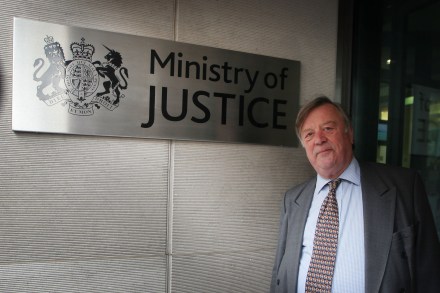
With all the hoo-haa about Ken Clarke's plan to reduce prison numbers, it's worth disinterring the Spectator's leader column on the subject from a couple of weeks ago.  Here it is, for the benefit of CoffeeHousers: One of the many ludicrous Liberal Democrat policies which Tories enjoyed rubbishing during the general election was their plan to send far fewer criminals to prison. But, alas, it seems that some bad ideas are infectious. Last week Ken Clarke, the new Justice Secretary, suggested that we can no longer afford to keep so many prisoners — so we should sentence fewer, and for shorter periods. Why, he asked, is the prison population twice what it was when he was at the Home Office in 1993? Isn’t it time to cut costs?

About those job losses…

From our UK edition

Much ado about the Guardian's scoop this evening: a leaked Treasury document which forecasts that up to 1.3 million jobs could be lost as a result of the spending cuts in the Budget.  Or, to put it in the words of the document itself: "100-120,000 public sector jobs and 120-140,000 private sector jobs assumed to be lost per annum for five years through cuts." You can expect Labour to get stuck into these numbers, and the fact that they were previously hidden from public view, with no uncertain relish.  Ed Balls has already described them as "chilling".  But it's worth making a couple of points, by way of context: i) There's job creation too. The Guardian goes onto report that "The Treasury is assuming that growth in the private sector will create 2.

Introducing the new Spectator Arts blog

From our UK edition

A quick post to point CoffeeHousers in the direction of our new-look arts pages. There, naturally, you’ll find the usual archive of reviews and articles from the back half of the magazine – but there’s also a new addition. Our old arts blog Cappuccino Culture has been deposed, and in its place is Touching From A Distance, an independent arts blog we liked so much that we decided to co-opt it for the site. Simon and Scott, the co-editors of TFAD, have introduced themselves and their blog here. So suffice to say for now, it’s a pleasure to have them on board.

The politics of ringfencing

From our UK edition

Jean Chrétien, the former Canadian prime minister, has acquired an almost mythic status in certain Tory circles for the way his government cut back public spending in the 1990s. So it's worth paying attention to his remarks about ringfencing departmental budgets last night. He didn't quite go so far as to say that withholding the axe would fatally undermine George Osborne's deficit reduction plan, but he did suggest that it would make the politics of the situation a good deal tricker: "Jean Chrétien, whose tough fiscal tightening programme in the 1990s is seen by the Government as a model for Britain today, warned that everyone always came up with plausible reasons to be exempted from the pain. 'So nobody was exempt,' he said.

Hugh Orde’s rhetoric is encouraging for Osborne

From our UK edition

Whatever happened to Sir Hugh Orde?  A few months ago, he was threatening to resign over the Tories' plans for elected police commissioners.  But later, in a speech to the Association of Chief Police Officers, he seems to have come over considerably more cooperative.  On spending cuts, he stresses that police numbers will likely be reduced, but adds that "we fully understand that all will have to share the pain."  And on elected police commissioners, the worst he can bring himself to say is that "the test is reconciling it with operational independence for policing ... we have an absolute right to clarity on how this system will work.

Different Miliband, similar deceit

From our UK edition

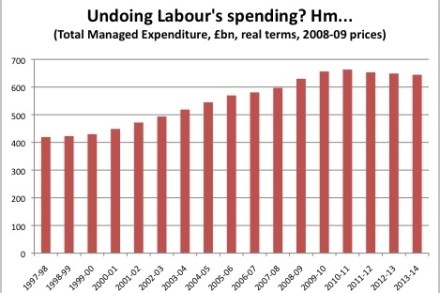
First, David Miliband was telling Brownies about the public finances.  Now, his brother's at it too.  Here's what he told the Daily Politics earlier: "Over thirteen years, Labour did increase spending on public services … In the coming five years, the Conservative coalition wants to undo all of that increase in spending.  So they want to return to a time before 1997.

Miliband the conman

From our UK edition

Who'd have thought it? There's David Miliband getting all self-righteous about the "cons" in George Osborne's Budget, when - oh dear - he slips in a small con of his own.  Here's the relevant passage: "[The Budget] was avoidable. Labour set out plans to cut the deficit by half over the next Parliament. The Tories have chosen to cut the whole of the deficit and more to the tune of £32billion in public services and £11billion in welfare." And here, going off Labour's own plans, is what he should have written: "[The Budget] was avoidable. Labour set out plans to cut the structural deficit by 'more than two-thirds' over the next Parliament.

Osborne turns his attention to welfare

From our UK edition

George Osborne suggested as much in his Today interview last week, but now we know for sure: the government will look to cut the welfare bill even further in October's spending review, and incapacity benefit will come in for special attention from the axemen. It was, you sense, ever going to be thus. With unprotected departments facing cuts of over 25 percent unless more action is taken elsewhere, the £12bn IB budget was always going to be a tempting target for extra cuts. Particularly as so much of it goes to claimants who could be in work. The questions now are how? and how fast?  The first answer seems clear enough: the government is keen to move a significant number of the country's 2.

How good intentions can be counterproductive

From our UK edition

Might the coalition’s emphasis on fairness be making it harder to get people off welfare and into work? Not a question that I can answer with confidence, but certainly one which has been thrown up by the IFS's Budget briefing. Take the government's action on child tax credits, for instance. By increasing it at the lower end of the income distribution, and restricting it at the upper, some claimants now stand to lose more, more quickly, by moving up the income ladder. Or, as the IFS put it, their marginal effective rate of taxation has increased. Of course, this will have been offset by other measures such as the rise in personal allowances. But it does present a conundrum for government policymakers, eager to prove that their measures aren't hitting the poor.