Peter Hoskin

Tougher on crime, tougher on the causes of crime?

From our UK edition

In a great post over at Centre-Right, Robert Halfon analyses the Sun’s return to the “Anarchy in the UK” line that it ran with last August.  Halfon claims that the Sun’s campaign is indicative of wider worry about anti-social behaviour and crime in this country, and that this is a concern that the Conservatives can capitalise upon: “This is an issue of real potency to the Conservative fight-back ….  What is interesting is that there is a universal recognition (‘Labour’s flop pledges’ in Sun lingo), that years of Labour initiatives and legislation on crime have made little headway.

Brown’s politicking on the world stage

From our UK edition

No-one thought that Gordon Brown would be much of a statesman but, even so, it’s still surprising just how clumsy his efforts in India and China have been.  His speeches may have contained words such as “co-operation” but the substance of them has been self-serving and – as the Spectator’s Fraser Nelson has pointed-out – domineering.  Take the talk that Brown delivered to business leaders in Delhi today, in which he claimed that the International Monetary Fund needs to be reformed and given a new “early warning” power so that it can stave off crises such as Northern Rock.  In other words: Northern Rock was the fault of international organisations and nothing to do with the British Government.

Reforming the Lib Dems

From our UK edition

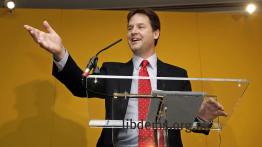
Over the weekend, Nick Clegg had a piece in the Telegraph in which he extolled the virtues of NHS reform.  He wrote: “As it approaches its 60th Birthday, the NHS is at a crossroads. As with all our public services under Labour, good intentions have gone awry under the iron fist of central control.  Money has been poured in, but it hasn't delivered the first-class health service Britain deserves ….  So what next? There are no more bucketloads of cash to pour in. Instead of only asking "how much" we spend, it's time to focus on "how" we spend it ….  A People's NHS would replace top-down targets with personal entitlements to high-quality care.

How will the public react to being denied their referendum?

From our UK edition

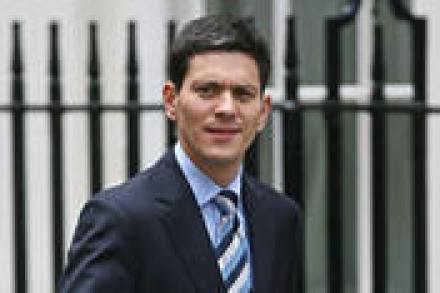
In an interview on today's Politics Show, David Miliband reiterated the government’s opposition to a referendum on the EU Reform Treaty, claiming that: “The reformed Treaty is there for parliament to scrutinise and then to pass .... Obviously, people will put down an amendment and parliament will have to decide, but I don't think this Treaty meets the bar of fundamental constitutional reform that should be the basis of having a referendum.” Miliband's stance – although hardly surprising – is going to be disappointing for groups such as I want a referendum.com, as well as, I'm sure, for many Coffee-Housers.

Money for art’s sake

From our UK edition

On Tuesday, the Spectator's Clemency Burton-Hill wrote an impassioned post on how the Arts Council of England's recent funding settlement could spell death for numerous theatrical companies across the country.  Many media outlets have run similar pieces – pleading the case for this theatre or that – but few have been as persuasive as Richard Morrison's excellent article in this weekend's Times 'What's On' section. Morrison reveals that the funding settlement will almost certainly put an end to the Birmingham Opera Company.  Under the direction of Graham Vick, this company has become a major critical darling but, more importantly, it defies the argument that opera – or even art more generally – is an elitist, detached and irrelevant pursuit.

Weekend Culture

From our UK edition

The Spectator’s Stephen Pollard has already blogged about this weekend’s big cultural draw – the Sunday performance of La traviata at the Royal Opera House.  Although, if you haven’t yet bought tickets for this “once in a generation” treat, then you’ll have difficulty in getting to see it – all performances are sold out. Far more attainable are tickets for this week’s best, new general release film: the Coen Brother’s No Country for Old Men.  This gritty, Texas-set thriller merges the violence and hopelessness of classic films noir with the Coen’s own offbeat sensibility, and it’s certainly their most accomplished work to date.

The truth about income inequality

From our UK edition

A new report from the respected Institute for Fiscal Studies makes the claim that “the outlook for inequality in Britain may depend more on the stock market than on Government tax and benefit policies”. Basically, the IFS have found that income inequality between the richest and poorest members of society declines “in the wake of extended falls in the stock market” (this is intuitive: falls in the stock market equate to falls in the incomes of the wealthiest).  By contrast – at times when the stock market is operating smoothly – income inequality is hardly altered by redistributing wealth via both higher taxes for the rich and increased welfare payments for the poor.

Backing McCain

From our UK edition

In an excellent post over at Comment Central, Daniel Finkelstein lists the reasons why he thinks John McCain will win the Republican nomination.  Finkelstein’s second point is the most persuasive: “Second, I think that [John McCain] and Rudy Giuliani are the only Republicans with the remotest chance of winning in a general election.  I don't think serious parties choose candidates who they know will lose.  Even though the conservative party establishment distrusts McCain I think they would be with him if things got tight and he was the only winner still available.

The greying labour force 

From our UK edition

As a follow-up to my post yesterday on the number of new jobs being occupied by the over-50s, I should point out that there’s a good piece on the matter by Melanie McDonagh in today’s Times.  McDonagh rightly argues that an increasingly grey component of the labour market is a positive development: “The notion that people are still being hired as they head for what was once, laughably, called the retirement age should cheer us up.  A workforce that brings together energetic Poles and hardy Brits of the war generation seems rather a good combination given the dearth of skills and any discernible work ethic among many school leavers ….  It's also a hopeful trend, given that we're all heading for an extended old age.

Older generations doing their bit to stave off the credit crunch

From our UK edition

As Larry Elliot reports in today’s Guardian, a rise in the number of over-50s gaining employment has "helped Britain shrug off the impact of the credit crunch".  Recent figures from the ONS reveal that, in the three months to November, 175,000 new jobs were created in the economy, with an astonishing 90,000 – some 51 percent – of them being taken by those over 50 years-old. However, the surge in over-50s employment may not be all good news, as it’s not unthinkable that underlying economic problems are behind it.

Walls closing in on Ken?

From our UK edition

The London mayoral race is entering a bitter period, with most of the invective being directed at Ken Livingstone.  Of course, we shouldn’t be too surprised when the Evening Standard, which has had its run-ins with Livingstone, produces headlines such as "Mayor 'misled public over cash'".  But – surprising or not – these headlines will still spoil Livingstone’s reputation with the voting public, and have already lead to condemnation from MPs of all three parties. More telling, though, is the fact that outlets such as the Guardian and New Statesman are adding their weight to the assault.  The Guardian’s criticism may be heavily mitigated but it exists nonetheless, with Dave Hill writing on Livingtone’s "ratty and gnarled" public image.

What should be asked of the independent sector?

From our UK edition

With the Charity Commission recommending that private schools should do more for the "public benefit", public school headmasters are at odds over whether or not they do enough already.  As Melanie Phillips has already noted in a must-read Spectator blog post, the first shot was fired by the headmaster of Wellington College, Dr Anthony Seldon, in yesterday’s Independent.  Seldon claims that the independent school system is helping to perpetuate "educational apartheid" (i.e. the inequality between the independent and state sectors):   “It is not right for any longer for our schools to cream off the best pupils, the best teachers, the best facilities, the best results and the best university places.

The British are coming?  Hopefully not…

From our UK edition

Pete Hoskin At yesterday's low-key Golden Globes ceremony, the British film 'Atonement' was named the Best Dramatic Motion Picture of the year; making it the front-runner for the “Best Picture” Oscar next month. Thankfully – and thanks should go to the Writers' Guild of America – we were spared acceptance speeches yesterday.  This meant that there were none of the typical British histrionics that accompany any major film awards win (see Colin Welland and his exclamation that “The British are coming!” at the 1981 Academy Awards).  There's no doubt, though, that Welland's sentiment will be repeated – as it is almost every year – in the run-up to this year's Oscars.

What to do this weekend

From our UK edition

In London, the biggest draw of the weekend may well be the production of King Lear at the New London Theatre (which is receiving some enthusiastic and some not-so-enthusiastic notices).  However, what you really should go and see – even though it has already been around for a few weeks – is the Walter Sickert exhibition at the Courtauld Gallery (the subject of a glowing review in the latest Spectator).  This show dwells upon Sickert's nudes, and cements the artist's position as one of the most influential artists of the Twentieth Century (Sickert's harsh brand of impressionism is echoed in everything from the work of Lucien Freud and Francis Bacon to the films of the Free Cinema movement).  In short: unmissable.