Peter Hitchens

Peter Hitchens lived in Moscow from June 1990 to October 1992. He is a columnist for the Mail on Sunday.

SPECTATOR DEBATE: When did we stop caring about our national culture?

From our UK edition

Peter Hitchens will be speaking at the next Spectator Event on 9 July, debating the motion ‘Too much immigration, too little integration?' along with Ken Livingstone, David Goodhart, Trevor Phillips and others. Click here to book tickets. I used to go on left-wing demonstrations against Enoch Powell in the Sixties, and I’m still glad I did. I was against racial bigotry then, and I’m against it now. So it has been an interesting experience to find myself accused of ‘racism’, in many cases by people who were not born in those days. Likewise, I’m one of the few people I know who has lived, by his own choice, in more than one foreign country; I’ve visited, as far as I can work out, more than 50 others.

AC Grayling vs God

From our UK edition

‘Atheism is to theism,’ Anthony Grayling declares, ‘as not collecting stamps is to stamp-collecting’. At this point, we are supposed to enjoy a little sneer, in which the religious are bracketed with bald, lonely men in thick glasses, picking over their collections of ancient stamps in attics, while unbelievers are funky people with busy social lives. But the comparison is flatly untrue. Non-collectors of stamps do not, for instance, write books devoted to mocking stamp-collectors, nor call for stamp-collecting’s status to be diminished, nor suggest — Richard Dawkins-like — that introducing the young to this hobby is comparable to child abuse.

High society | 11 October 2012

From our UK edition

How thrilling it is when someone finally stages a demonstration against you. All right, it was a very small protest (one person), and it was in Southampton on a wet Sunday morning. But it was all mine. Stretched by the roadside was a dank bedsheet bearing the words ‘Peter Hitchens is a hypocritical racist alcoholic. Spread your bile elsewhere. No one cares what you have to say.’ I don’t accept this as entirely accurate, but, under the circumstances, why quibble? Also, it made me think. Standing beside it, smirking, was a person in a woolly hat and sunglasses. He had a striking pallor, the sort you might get from spending many months in a basement with a computer, converting sugary drinks into lard.

The gay marriage trap

From our UK edition

The shambling remnants of Britain’s social and moral conservative movement are marching to Stalingrad, singing as they go. They will not be coming back, but they don’t realise that yet. David Cameron has cleverly provoked them into this suicide mission, by claiming to be a keen supporter of homosexual marriage. And so, with all the self-control of bluebottles massing round a dead cat, or squirrels besieging a bird-feeder, the Moral Minority have rushed to campaign against him. The risk to them is great. The risk to Cameron is minor. Even if they succeeded, the Prime Minister would not mind much. Very probably, Cameron does not really support same-sex weddings at all, or even care about the subject. It is not clear that he cares about anything.

Hour of surrender

From our UK edition

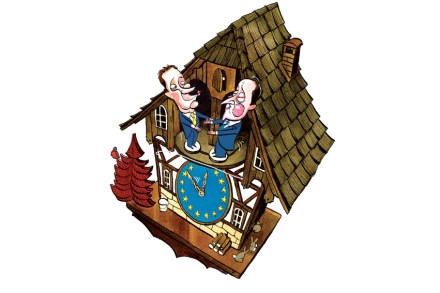
The proposal to change Britain’s clocks has returned, this time with tacit government support. It makes no sense — except perhaps in Brussels Since the day I flew backwards across the International Date Line I have known that you should not mess around with time. On that occasion I left Siberia on Monday morning and arrived in Alaska the previous Sunday afternoon in time for lunch. This was and remains confusing, though it offers disproof of the old cliché that you cannot put the clock back. Though I have been to North Korea and Bhutan, I still count it among the most startling journeys I have ever taken. It lasted about an hour.

The thrills of summers past

From our UK edition

How my heart sinks at the sight of those little features on ‘summer reading’. Follow these recommendations and you will strain your shoulder and your purse, buying and carrying books that will stay unread at least until the cool blast of the autumnal equinox, and probably forever afterwards. Ignore the log-rolling, the favours to friends and publishers, the favouritism of the bookshop display tables. As an occasional author, I long ago realised that at least half the book reviews in Britain are written by people who haven’t read the book they are writing about, and don’t much care.

Auntie’s blind spot

From our UK edition

The BBC is like a goldfish. Just as we have no way of communicating to the poor creature that it is confined by a bowl, experts of the utmost skill and renown have sought in vain for years to explain to the corporation that its ethos is slanted towards the left. It knows no other world but that of the Guardian, in which it lives and moves and has its being. It would die, more of shock than anything else, if it were removed from it. And so it swims round and round, opening and closing its mouth and burbling that such accusations are fanciful. But now at last I believe I have found a way to signal across the vast divide that separates the BBC and the rest of us. This is thanks to what turned out to be a rather amusing thing which recently happened to me.

The Book of Common Prayer should be our manifesto

From our UK edition

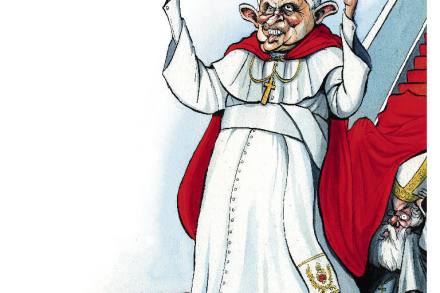
What a pity it is that all the hate and slime now directed against the Pope’s visit is not aimed instead at the Church of England. Why do God-haters and militant secularists have to turn on a pensionable German theology professor and head of a Rome-based religious multinational organisation, when they want to condemn the steadfast defence of Christian morality? For at least some Anglicans, the savaging of the Bishop of Rome will give rise to sinful pangs of envy. We would like Richard Dawkins, Philip Pullman — and, I am rather compelled to mention, my brother Christopher — to be hurling their fiery darts at Thomas Cranmer’s church instead. But these professional scoffers unkindly refuse to scoff at our texts and formularies.

Cameron is a sham…

From our UK edition

If the Conservative party were your refrigerator, all your food would go bad. If it were your car or bicycle, you would be stranded by the side of the road. If it were your accountant, you would be bankrupt. If it were your lawyer, you would be in prison. No commercial organisation or product so completely fails to fulfil the claims made on its packaging. The Conservative party claims to stand for national independence, tradition, law and order, rigorous education, low taxation and light regulation, strong armed forces, the family and marriage. Its very name commits it to the defence of the Union of England, Scotland, Wales and Northern Ireland.

The danger of China

From our UK edition

The Chinese word for an empire of prison camps is just as easy to remember and to pronounce as its Russian equivalent. But while most educated people in Britain know what the Gulag was, few have ever heard of the Laogai. I sometimes wonder if we will never pay any attention to such things, anywhere in the world, until it is too late to learn from them. As I recall, it was quite difficult to persuade our cultural establishment to worry about the Gulag when it still existed, because it was so unwilling to believe that the USSR was as wicked and nasty as it was.

The problem, not the solution

From our UK edition

The last thing we need now is a Tory recovery. Proper conservatives should dread such a thing as much as Labour’s serious faction dreaded victory in the March 1983 Darlington by-election. They longed for the most crushing defeat possible, because it would have provided the pretext for a well-planned putsch against the doomed romantic party leader Michael Foot, chosen in an emotional spasm in 1980. But, to their fury and dismay, Labour won in Darlington. Michael Foot was saved and duly led his movement to ruin, with some dignity, a few months later. Just as I said a year ago in an article for this magazine which has never been rebutted, let alone refuted, by any Conservative thinker, the Tory party is now a train-wreck, not a train, an obstacle to the cause it pretends to serve.

State of decay

From our UK edition

There has seldom been a time when responsible, intelligent people were less interested in serious politics. The main opposition, gripped by some Freudian delusion because reality is too hard to bear, behaves as if it were still the government and so cannot oppose or even think about doing so. The discourse of the mainstream parties is duller than congealed porridge. They seek, above all, to hide their real intentions and so must shun controversy. Many still act and speak as if any firm opinion is a sort of bad manners, like talking shop in the mess. It is left to buffoons like Robert Kilroy-Silk, ruffians like the BNP or fanatics like George Galloway to address the subjects that matter, and for the most part to get them wrong.

Contempt for liberty

From our UK edition

Identity cards threaten law-abiding citizens more than they threaten terrorists, says Peter Hitchens. Their introduction would signal the end of privacy — and of England The arguments in favour of identity cards are empty and false. The Prime Minister says there are no civil liberty issues involved in their introduction, when he means that nobody in his gutless Cabinet is prepared to put up a principled fight on this issue. He himself does not know what liberty is. Nor, clearly, does David Blunkett, who is planning to introduce legislation that could force everyone in Britain to have identity cards within five years.

A party split from top to toe

From our UK edition

No power on earth can sustain an idea whose time has gone. Can we all please stop pretending that the Conservative party is worth saving or keeping, or that it can ever win another election? This delusion is an obstacle to the creation of a proper pro-British movement, neither bigoted nor politically correct, which is the only hope of ending the present one-party state. The continued existence of the Tory party as a bogeyman with which to frighten dissenters is one of the few things that holds together the equally bankrupt Labour party. Without it, the frequent Blairite cry of ‘If you don’t back me, the Thatcherites will return’ could no longer be used.

Reform the BBC, don’t kill it

From our UK edition

Why do I now find that I, one of the BBC's most persistent critics, feel the need to defend the organisation that I have attacked so many times in the past? Because for all its faults I would rather that Britain had a public-service broadcaster than that the airwaves were sold to the fattest cheque book. The time has come for sensible reactionaries to rally round their old enemies at the BBC, and for the BBC to seek support among those moral and cultural conservatives it has spent too long despising.

God save the nation

From our UK edition

If the Archbishop of Canterbury does not crown our next monarch, then who will? The president of Europe? A multi-faith collective? Nobody at all? In which case, what sort of country will we then be and where will ultimate authority and legitimacy come from? Perhaps the prior question is why there should now be serious doubt about the Archbishop's role at the heart of our constitution. It says something about the state of the worldwide Anglican Church that it seems more interested in homosexuality than in anything else. Last month we were entertained by the Archbishop of Canterbury's U-turn on the appointment of a homosexual bishop. Now the Episcopalians have broken the taboo.