Olivia Potts

Olivia Potts

Olivia Potts is the Guild of Food Writers’ Cookery Writer of the Year 2025. She hosts The Spectator’s Table Talk podcast and writes Spectator Life's The Vintage Chef column

With Myleene Klass and Jamie Barber

From our UK edition

22 min listen

Myleene is a singer, presenter and businesswoman, and Jamie is a restauranteur with a number of restaurants to his name. Together they have created the home meal kit My Supper Hero, which aims to provide great food and champion sustainable packaging.  On the podcast they talk about their earliest memories of food, the monotony of lockdown cooking and why roasted cauliflower is the best.

The rich pleasures of millionaire’s shortbread

From our UK edition

When I was at university, there was a cafe nearby that made the millionaire’s shortbread of dreams: slabs as big as your hand, with soft caramel that only just held its shape, and would yield when bitten into; a thick layer of chocolate, and a base that somehow defied physics by being impossible crumbly and yet offering the structural integrity required for the top two layers. My waistline and student bank balance suffered accordingly, but these treats saw me through finals and essays, hangovers and heartbreak, rain and shine. It’s not surprising that millionaire’s shortbread tends to be a hit with almost everyone: it combines three crowd-pleasers into pleasing layers in a portable square, perfect for parties and picnics (or the privacy of your student digs).

The ultimate American comfort food: how to make meatloaf

From our UK edition

Meatloaf has some obstacles to overcome: it has an unprepossessing appearance, and an uninspiring, slightly off-putting name, which it shares with the famous singer. And it wasn’t a compliment when it was given to him: the singer’s father took one look at his newborn son and said he looked like ‘nine pounds of ground chuck’, before persuading the hospital staff to put the name ‘Meat’ on his crib (which is real commitment to a joke). I can’t speak for baby Meat Loaf, but when it comes to the dish, the name is at least an extremely accurate description. Meatloaf is made up of ground meat (often beef, sometimes pork, occasionally veal, or a mixture thereof), cut with bread or other carbs, and bound together with egg.

With Melissa Thompson

From our UK edition

31 min listen

Melissa Thompson is an award-winning food writer and cook who started a supper club, serving Japanese food in her front room in 2014. In September 2022, Melissa released her debut cookbook, Motherland. It explores the evolution of Jamaican food, from the island’s indigenous population to today.  On the podcast, she talks to Liv Potts about the evocative smells of Jamaican food that remind her of childhood, why she’s more of a savoury than sweet person and the first meal she ever cooked for her mum.

What it means to be a black African in London

From our UK edition

Since 2011, black Africans have been the dominant black group in the UK. Many of them are the descendants of those travellers who came to London in the 1950s from Nigeria, Ghana and Somalia and other African countries, seeking education and prosperity, and found a new home. They now not only hold prominent positions in British culture – from Bafta and Emmy award-winning Michaela Coel to the rap artist and publishing imprint founder Stormzy – but have reached those heights by using their experiences and heritage to explore what it means to be black British. Settlers is the first book of Jimi Famuwera, a British-Nigerian journalist and broadcaster.

Hot, cold, sweet, salty, boozy, spiced: Bananas Foster has everything

From our UK edition

I’m a sucker for a challenge. I absolutely cannot resist a little competition. Throw down a gauntlet, and I am compelled to pick it up. That’s probably one of the reasons that I love bananas Foster so much: it owes its existence to a challenge. In the 1950s, New Orleans was a major port of entry for bananas shipped from Latin America. Owen Brennan, owner of the eponymous French-Creole restaurant Brennan’s, was no fool: his brother Joe’s produce firm, Brennan’s Processed Potato Company, was running a large surplus of bananas and he wanted to make the most of these readily available fruit. He challenged one of his chefs to come up with a banana dish that could be served at his restaurant.

With Capri Cafaro

From our UK edition

23 min listen

Capri Cafaro was a member of the Ohio Senate for 10 years before becoming a political commentator. She can often be found on American television news channels and also hosts her own food podcast, Eat Your Heartland Out. On the podcast she talks to Lara and Olivia about memories of cooking Italian-American classics with her Grandma, how she got into politics and why she doesn't have a sweet tooth.

The comfort and joy of a treacle tart

From our UK edition

‘Come along, kiddie-winkies! Come and get your treacle tart,’ the Child Catcher trills in Chitty Chitty Bang Bang, to lure children away. The youngsters are particularly taken with the idea of treacle tart, and it’s not difficult to imagine why: unapologetically sweet and sticky, it’s irresistible to small, greedy hands. It’s easy to dismiss treacle tart as a nursery food. But that, of course, is part of its charm. It’s the Platonic ideal of a childhood treat, and a byword for comfort. In Harry Potter, the love potion Amortentia smells of whatever someone loves most in the world; to Harry, it smells of broomsticks, Ginny Weasley’s hair and treacle tart, the first dessert he ever ate at Hogwarts.

Moules mouclade, as big a hit as Beyoncé

From our UK edition

Mussels were probably the first thing I ate as a child that I knew at the time was ‘an acquired taste’. They made me feel impossibly grown up, coming with a brigade of bowls, one for the mussels themselves, one for chips, one for bread, one for empty mussel shells, and a little lemon-scented bowl of water to dip my fingers in. My dinner alone must have taken up half the table. From then on, I ordered mussels every time they were on the menu, knowing they would transform me from a gawky 12-year-old girl wearing cargo pants into a veritable sophisticate. But I never once tried moules mouclade. Like Socrates, Casanova and Beyoncé, mouclade is usually known only by its first name, la mouclade – the ‘moules’ implied by the ‘mouclade’.

With Ayesha Hazarika

From our UK edition

21 min listen

Ayesha Hazarika is a journalist, broadcaster, stand-up comic and former advisor to three Labour leaders. On the podcast, she discusses memories of her mother's chicken curry, navigating bacon sandwich-gate with Ed Miliband and why all cooked orange coloured food is 'minging'.

The sweet satisfaction of a burnt Cambridge cream

From our UK edition

If a rose by any other name would smell as sweet, then a Trinity or Cambridge burnt cream must taste as sweet as its French twin, the crème brûlée. The two cooked custard dishes are essentially identical: an egg yolk-rich baked custard served cold and topped with a layer of hard caramel. Both are similar to the crema Catalana you find throughout Spain (known as ‘crema cremada’ in Catalan cuisine), but Catalana is made with milk rather than cream. It means it is lighter, and tends to have a thinner, paler caramel layer. Lemon or orange zest and a cinnamon stick are often used as flavouring for the Spanish pudding, whereas a burnt cream or crème brûlée is traditionally only flavoured with vanilla.

With Andy Burnham

From our UK edition

24 min listen

Andy Burnham has served as Mayor of Greater Manchester since 2017. Before this he held prominent positions in Gordon Brown's cabinet, including health secretary and culture secretary.On the podcast he recalls Friday night 'chippy teas' as a child, the oddity of having food items named after him and discusses his work tackling food insecurity in Greater Manchester.

Fit for a king: kedgeree is the most regal of all Anglo-Indian dishes

From our UK edition

How does the saying go? ‘Eat breakfast like a king, lunch like a prince and dinner like a pauper.’ Well, if you’re looking for the highest possible status of breakfast, then kedgeree is the dish for you. Bran flakes just don’t quite scratch the same itch. Kedgeree cannot be casual; it requires time, both for preparation and enjoying, and it makes breakfast an occasion. It came to our breakfast tables (or mahogany sideboards) in Victorian times, brought back to Britain by returning colonial officers. It was served in silver chafing dishes, set alongside steaming urns of porridge. Kedgeree is a rice-based dish, flavoured with curried spices and cooked with smoked haddock, onions and boiled eggs.

With Oliver Woodhead

From our UK edition

24 min listen

Oliver Woodhead is founder of L'Entente, the British brasserie in Paris. On the podcast, he tells Lara and Liv about what the French think about a traditional English breakfast, explains how he was inspired by London's St. John restaurant, and asks what our hosts' favourite ingredient is.

The ultimate chicken pie recipe

From our UK edition

Laurie Colwin wrote: ‘No one who cooks, cooks alone. Even at her most solitary, a cook in the kitchen is surrounded by generations of cooks past, the advice and menus of cooks present, the wisdom of cookbook writers.’ It is one of my favourite quotes about cooking, mainly because it feels true: everything you cook is informed by other dishes, those that you’ve cooked, those that you’ve tasted or read about, the successes and the failures. In quiet moments of kitchen solitude, it is reassuring to know that there is an army of cooks behind me, each offering their experience, their recipes and books, a hand to hold when I feel uncertain. I never feel the truth of Colwin’s words more than when I’m making a chicken pie.

I’ve finally learned to love baked cheesecake

From our UK edition

I used to be a baked cheesecake sceptic: I didn’t feel they were worth the effort when other cheesecakes required you simply to stir together some ingredients and bung them in the fridge. My thinking was: why waste your time? Was the result really worth the extra effort? In turns out that yes, it was. It is. I just hadn’t ever eaten a really good cheesecake. That changed on a visit to San Sebastián. La Viña is a small bar and restaurant serving pintxos (the Basque version of tapas), but it is best known for its ‘burnt’ baked cheesecake. Inside, you feel as though you’re in a cheese shop that has recently suffered a fire: the walls are lined with shelves on which sit rows of cheesecakes, slowly cooling in their charred baking-parchment wrappers.

How to make a true apple strudel

From our UK edition

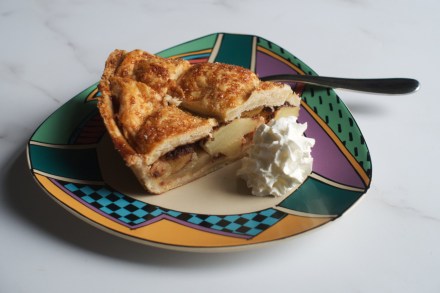
It’s possible that, like me, your first encounter with the Grande Dame of the Austrian pastry world, the apfelstrudel, was not in fact in one of the famed Viennese grand cafés, but rather from the freezer aisle at the supermarket. If it was anything like mine, it was probably a latticed, puffed version; the one I remember from childhood had blackberries mixed into the apple, which peeked through the holes in the pastry. I have no interest in denigrating our Sunday lunch pudding staple. In fact I loved it, served with thick, cold custard, straight from the carton. But it is fair to say that a true apple strudel is a little different. Strudels – meaning a filled, enclosed layered pastry – can be sweet or savoury, but the apple version is by far the most famous.

With Al and Kitty Tait

From our UK edition

25 min listen

Al and Kitty Tait run the Orange Bakery in Watlington, and are the authors of Breadsong: How Baking Changed Our Lives. On the podcast, the father-and-daughter pair explain how cooking changed their relationship, why baking helped Kitty out of depression, and why Watlingtons make such great customers.

The politics of butter

From our UK edition

Butter was not a major part of my childhood. In fact, I don’t remember it ever being in our fridge. My parents were subject to the saturated fat scaremongering of the 1980s, and consequently believed that butter was the enemy. Instead, we had spread: margarine, rebranded as a cholesterol-busting alternative to heart-clogging butter. But spread wasn’t so bad. It lubricated my sandwiches and melted on my toast. Spread was everyday. Butter was for high days and holidays. Otherwise, we were all certain to die young. Butter has always been a bellwether of the British psyche. We want luxury, but only every so often, and only so much – and we don’t want to pay too much for it.

Sole Véronique: there’s no need to fear fish and grapes

From our UK edition

One of the joys of writing about old-fashioned food is coming across dishes that are new to me, and turn out to be such a delight that they gain a recurring role in my cooking. Of course, some I’ve encountered were already among my established regulars – boeuf bourguignon, coq au vin. Others were childhood staples – shepherd’s pie, proper rice pudding. But a few of the dishes I take into my kitchen to work with I’ve never even tried before. The first recipe I wrote for The Spectator was for blancmange. Having grown up during the brief period when milk jelly was fashionable, I’d avoided blancmange like the plague. I was sure it must be rubbery, flavourless and a bit, well, creepy.