Oliver Wiseman

Biden needs a reset. He’s not alone

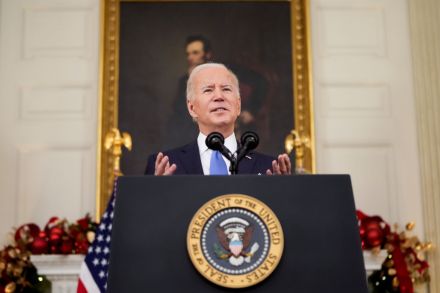
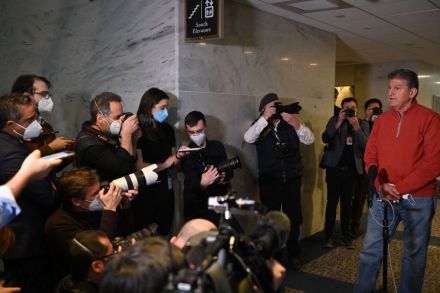
Biden needs a reset. He’s not alone Thursday marks a year since Joe Biden was sworn in as the 46th president of the United States. As you may have noticed, things aren’t going especially well (more on that tomorrow). The president is hoping to reset things with a press conference at the White House this afternoon. But he isn’t the only one who could reconsider his approach after twelve underwhelming months. Among those who need to rethink things: congressional reporters. With Biden’s legislative agenda stalled, it is a popular complaint of those obscure scribblers who are paid to chase members of Congress around the Capitol that every day feels like the last.
Don versus Ron is on

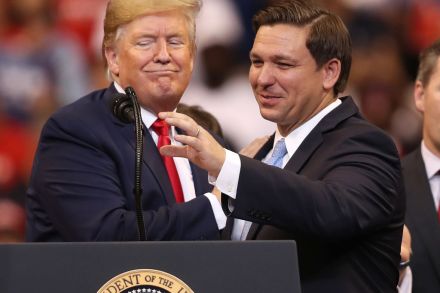
Don versus Ron Donald Trump and Ron DeSantis have been on a collision course for some time now. DeSantis is the only potential candidate other than the former president who registers a blip on the radar when Republicans are asked who they want to run in 2024. Unlike other leading Republicans, the Florida governor hasn’t ruled out running against Trump. And this is what has the former president so irked. Trump refers to that promise, an associate tells the New York Times, as “the magic words.” In another juicy report on the feud, Axios’s Jonathan Swan quotes one Mar-a-Lago insider who says that Trump can’t resist giving DeSantis a “pop in the nose” when he is talking about 2024.

Will Biden accept defeat?

Will Biden accept defeat? I want you to imagine a very plausible scenario. It is January 2023. Democratic Senator Raphael Warnock has just been defeated by Herschel Walker in a Georgia run-off election. Democrats had lost control of the House two months earlier and this result means they will also lose control of the Senate. What would Joe Biden say in such a scenario? In the past he has described concessions of defeat as a key component of a functioning democracy. “In America, if you lose, you accept the results. You follow the Constitution.” That is what Biden said in a speech in Philadelphia last summer. Would he say the same thing in early 2023? Until this week, I would have said so. But after his speech in Georgia on Tuesday, it is a lot harder to say so.

Sloganeering on the world stage

Sloganeering on the world stage When is a foreign policy not a foreign policy? When it’s a slogan. In his piece for the January issue of The Spectator, Christopher Caldwell argues that the Biden administration is conducting marketing rather than diplomacy on the world stage. Its main catchphrase is “America is back.” Caldwell likens Biden to Charlie Wales, the hero of F. Scott Fitzgerald’s short story “Babylon Revisited”: “Charlie returns to Paris after the stock-market crash. ‘He was not really disappointed to find Paris was so empty,’ Fitzgerald writes. ‘But the stillness in the Ritz bar was strange and portentous. It was not an American bar any more — he felt polite in it, and not as if he owned it. It had gone back into France.

The demagogue went down to Georgia

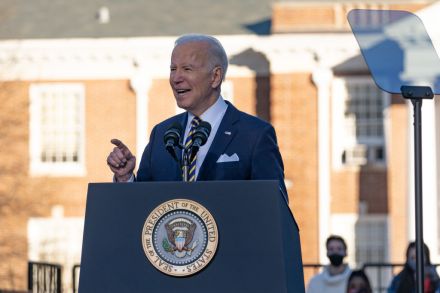
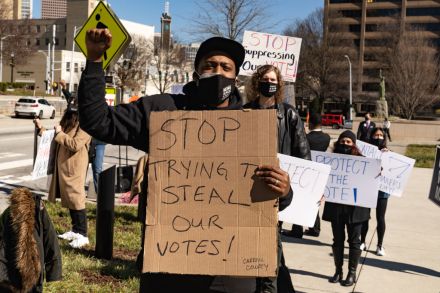
Demagoguery in Georgia Fiery. Impassioned. Emphatic. These are the kind of words being used to describe Joe Biden’s speech on voting laws in Atlanta yesterday. Dishonest would be a more accurate adjective. The president went down to Georgia and delivered a barrage of exaggerations, falsehoods and hyperbole on the health of American democracy. There was his outright misrepresentation of his opponents. “Not a single Republican has displayed the courage to stand up to a defeated president to protect America’s right to vote. Not one,” he claimed. Of course, multiple Republican senators have stood up to Trump, Mike Rounds being the most recent example. Alaska Senator Lisa Murkowski even supports a major Democratic voting rights bill.

A bad start to Biden’s voting push

A bad start to Biden’s big voting push The second week in January doesn’t tend to be an especially memorable time. Americans are letting go of a half-hearted New Year’s resolution, contemplating their Christmas credit card bills and finding an excuse not to do their tax return just yet. Insofar as politics penetrates the early-January torpor, it’s likely in relation to the headache of high prices or a Covid-induced classroom closure. For Joe Biden, however, this week is going to prove “a turning point for this nation.” That is what the president will say in Georgia today.

It’s not looking good for vaccine mandates

The waning efficacy of vaccine mandates Predicting Supreme Court decisions might be a risky business, but the court hardly sounded enthusiastic about the Biden administration’s Occupational Safety and Health Administration (OSHA) rule mandating either vaccination or weekly testing for businesses with 100 or more employees in oral arguments on Friday. The OSHA rule was under scrutiny in one of two mandate-related cases heard that day. The other deals with the requirement for healthcare employees at facilities that receive Medicare and Medicaid funding to be fully vaccinated. While liberal justices seem to be persuaded by the logic of the OSHA mandate, the court’s conservative majority were skeptical that it was in OSHA’s power to enact such a sweeping rule.

vaccinated

Biden’s 2024 warning to Republicans

Biden issues a 2024 warning to Republicans Joe Biden rarely mentions Donald Trump by name. That was the case in his speech at the Capitol yesterday, even though the president pinned the blame squarely on his predecessor, who, he said, isn’t “just a former president, he’s a defeated former president.” Asked after the speech why he didn’t used the T-word, Biden said that “he did not want to turn it into a contemporary political battle between me and the president. It’s way beyond that. It’s way beyond that.” The irony of Biden’s “he who must not be named” policy is that the president is at his most animated and politically potent when he is talking about his predecessor.

Mob rule, one year on

Mob rule There was no shortage of discussion of January 6, 2021 in the twelve months that followed. The few hours during which a violent mob of Trump supporters stormed the Capitol have been exhaustively raked over by newspaper reporters and deployed as a talking point by television pundits. The riot is regularly nodded to by Democratic politicians as justification for everything from an overhaul of voting laws to increased infrastructure spending. Even those on the part of the right who would rather pretend it never happened occasionally find themselves having to explain, contextualize or acknowledge events in the US Capitol a year ago today. And yet, the actual events of January 6 have a way of getting lost in the endless, unedifying and often bad-faith January 6 discourse.

Abolish the CDC

Abolish the CDC “You do you.” That would be my three-word summary of the Centers for Disease Control and Prevention’s updated guidance for people who catch Covid. The latest advice is a response to a backlash that followed its recent decision to cut its recommended isolation time from ten to five days and advise that if you’re asymptomatic you don’t need a negative test to leave quarantine. The CDC flip-flop is yet another reminder that the agency is hardly involved in a dispassionate issuance of “the science.” The new guidance is little more than a sop to the Covid-cautious. It’s also a perfect example of the organization’s inability to provide Americans with the clear, straightforward guidance that they need.

Biden’s inflation cluelessness

Biden's inflation nothingburger Joe Biden seems to have decided who is to blame for inflation: big business. After months of mixed messaging and empty spin on one of American voters’ top concerns, the administration has settled on its pre-existing commitment to antitrust action as the best medicine for rising prices. In its latest antitrust move, the White House yesterday unveiled a package of measures designed to target market concentration in the meat processing industry. Biden announced that he would be sending $1 billion to independent meat processors and enforcing stricter rules for “Made in America” labeling. Other measures include a streamlined process to report anti-competitive behavior and greater transparency in the cattle market.

This is how Covid ends

This is how it ends, part one Happy New Year, readers. A strange thing happened during the DC Diary’s festive break. The Covid arguments once written off as fringe and dangerous not only went mainstream but were made by some of the high priests and priestesses of the public health establishment. Dr. Anthony Fauci Zoomed onto the cable news shows to point out that case numbers aren’t necessarily the right metric to track and clarified that many of the children registered as Covid hospitalizations are hospitalized with Covid, not because of it. He said that the Omicron variant may end up being “more of a bothersome upper-respiratory infection” for the vaccinated or previously infected. Dr.

booster

The age of unknowns

The age of unknowns Towards the end of every year the Economist publishes a special “World in…” edition. It advises readers on what to expect in the year to come, warning of the coming trends in global affairs, politics, tech, finance and much else. As you might expect, it’s generally infused with a complacent confidence: that technocratic sense that the issues it deals with are manageable, understandable and,  in some sense, predictable. The “World in…” series has always seemed a little too sure of itself. But if the endeavor seemed like a mildly cocky contrivance in, say, the mid-2000s, today it feels more like absurdist performance art: an attempt to squeeze an increasingly mind-boggling moment into the strictures set by the Economist’s ideological framework.

Is the White House listening to you? That depends

Is the White House listening to you? That depends The White House wants you to know the economy is booming, and that things have never been better. Indeed, the American economy is growing at a healthy clip. Notwithstanding the ominous inflation figures and a workforce still substantially smaller than it was pre-pandemic, many important US economic indicators are robust. According to one estimate, US GDP growth for 2021 will end up being around 5.6 percent. Of course, these flattering numbers are the result of the weird realities of pandemic economics. Thanks to the timing of his first year, coinciding as it did with coronavirus vaccines coming online and a lot of economic activity restarting after a coronavirus-induced deep freeze, Biden boasts a superficially strong economic record.

The battle to save Biden’s agenda

The battle to save Biden’s agenda It’s been three days since Joe Manchin delivered his “no” on Build Back Better. Since then, the White House, as well as Democrats on the Hill, have reiterated their determination to pass something resembling the package that Manchin gave the thumbs down on Sunday. Will they manage it? Oddly enough, the case for Democratic optimism rests on an admission of Democratic incompetence. Before walking away from negotiations, Manchin had agreed to $1.75 trillion in spending, including ten years of universal pre-K, almost all of the climate spending the White House wanted and an expansion in the Affordable Care Act. And yet, Biden said no. In a 50-50 Senate, that seems like political self-sabotage.

Climbdown of the Covid hawks

No Omicron overreaction When Joe Biden delivers his speech today on his administration’s response to the pandemic, he will be acknowledging that the clear cut “victory” over the virus of the sort he has talked about for months, is unachievable. He will tell Americans that we must learn to live with pestilence. And he is set to explain that vaccinated and boosted Americans can be confident in their protection against the highly contagious but seemingly less virulent Omicron strain. The centerpiece of Biden’s new Covid effort will be 500 million free rapid tests. My uncharitable side wants to point out that in a country of 350 million people, that’s not as big a number as it sounds.

BBB, RIP

BBB, RIP The end is never pretty. But Senator Joe Manchin put Biden’s Build Back Better legislation out of its misery with striking efficiency on Sunday morning, delivering a decisive “no” not behind closed doors with an apologetic pat on the other Joe’s back, but live on national television. Democrats are working their way through the first two stages of grief: denial and anger. White House spokesperson Jen Psaki provided both in spades in a response to Manchin yesterday.

west virginia bbb

Young Americans are Biden’s canaries in the coal mine

Young voters are Biden’s canaries in the coal mine When it comes to age and politics, the dynamic is familiar to even the most casual observer: Republicans tend to be older, while Democrats depend on a younger crowd. It may be a slight oversimplification but the caricature of US politics as a showdown between conservative boomers and millennial left-wingers is generally borne out by the numbers. That’s what makes a recent YouGov/Economist study so interesting. According to the survey, Joe Biden’s collapse in approval ratings has been especially acute among American adults under the age of thirty. The Economist analysis finds that an average of just 29 percent of that cohort approve of the job that the president is doing, while 50 percent disapprove.

Democrats’ bad year ends with a whimper

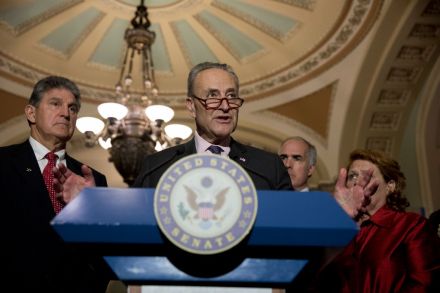
Democrats’ annus horribilis ends with a whimper 2021 is ending not with a bang but with a whimper on Capitol Hill. The summit of the two Joes, where the president had hoped he might strike a deal on his Build Back Better legislation with West Virginia senator Joe Manchin, reportedly went very badly. The chance of a multi-trillion-dollar Christmas present for Joe Biden has faded. Senate Majority Leader Chuck Schumer had tried to use the imminent expiration of the expanded child tax credit as leverage with which to force the bill’s passage by the end of the year. This was never likely to be an especially effective negotiating tactic, and sure enough, all the mood music suggests that the Democrats are a very long way from a deal.

Biden needs to learn to live with the virus

Biden needs to learn to live with the virus The writer Matthew Walther caused something of a stir yesterday with a piece in the Atlantic about attitudes towards the coronavirus in the rural corner of Michigan he calls home. “Outside the world inhabited by the professional and managerial classes in major metropolitan areas,” he writes, “many if not most, Americans are leading their lives as if Covid is over, and they have been for a long while.” Anyone who doesn’t live in or near a big, blue city — or any city-dwellers brave enough to don their safari jackets and venture out into rural America — will recognize Walther’s description.