Matthew Parris

Matthew Parris

Matthew Parris is a columnist for The Spectator and The Times.

The moment Starmer lost control of the Labour left

From our UK edition

‘Tony Blair walks on water.’ Decades ago this statement led a Times photographer and me to the front door of the dismal Hackney North & Stoke Newington Labour party offices. It was 23 April 1997, and a fateful general election loomed. I was my newspaper’s 46-year-old political sketchwriter, and Labour’s local candidate was a 43-year-old MP called Diane Abbott. She had hit the headlines with her withering response to New Labour demands that she cease her unhelpful noises-off from stage-left and toe the line. There were Labour colleagues who could have attested without sarcasm to their leader’s amphibian powers. She was not one of them. ‘MPs are pack animals.

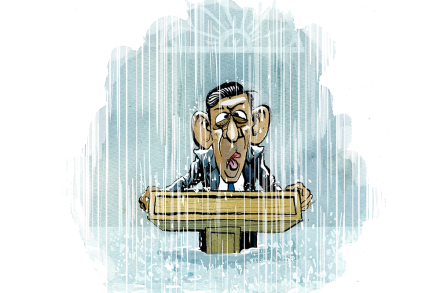
The deluge: Rishi Sunak’s election gamble

From our UK edition

53 min listen

It’s a bumper edition of The Edition this week. After Rishi Sunak called a surprise – and perhaps misguided – snap election just a couple of hours after our press deadline, we had to frantically come up with a new digital cover. To take us through a breathless day in Westminster and the fallout of Rishi’s botched announcement, The Spectator’s political editor Katy Balls joins the podcast. (01:35) Next: Our print magazine leads on the electric car bust. Ross Clark runs through all the issues facing electric cars today – from China flooding the market with discounted EVs to Rishi Sunak dropping the unrealistic target of banning new petrol car sales by 2030. ‘Could the outlook suddenly improve for British EVs?’ asks Ross. ‘It’s hard to see how.

Are ultra-processed foods really so bad?

From our UK edition

Last week saw a flurry of media reports, of whose headlines one of the worst preceded one of the best reports. ‘Eating too many ultra-processed foods has been linked to a higher risk of early death,’ barked the Telegraph – but went on to explain carefully and fairly a ground-breaking report. Other broadsheets opted for the easy option: big report, ultra-processed food, death. Food-type blaming can be a comforting evasion of a simple truth: overeating makes you fat The report caught my eye because I’ve been consistently sceptical about sensationalist books and statements demonising in wholesale terms the consumption of foods categorised, in pseudo-scientific language, as ‘ultra-processed’. I question the usefulness of the category.

Save us from the plague of plastic tree protectors

From our UK edition

Can nothing protect us from a plague of plastic tree protectors? They’ve descended on us like locusts, covering our hills, dales and roadsides with a nasty green and black petrochemical swarm. They are not for the most part biodegradable, and those that claim to be will still disintegrate into microplastic debris lodged into our soil. Tree protectors have descended on us like locusts, covering our hills with a nasty petrochemical swarm I should know. Five years ago I planted 3,000 tree saplings on the fields below our house; and there to this day the pale green square or tubular guards remain, the young trees having outgrown any need for protection and the guards, or remnants of guards, littering the grassy slope. I know we’ll have to remove and collect them.

Donating to charity is too easy

From our UK edition

It’s been a torrid few weeks for anyone who knows anyone who was running in the London Marathon. In have come the emails sent by the sender to himself or herself, and BCC’d no doubt to a very long list of the sender’s friends: ‘I’m running the London Marathon on 21 April, for [insert name of charity]. I’d be so pleased if you could sponsor me for this worthy cause. You’ll find my page on [JustGiving, or other similar websites]’ and a link is supplied. There’s no way of getting yourmoney back if your friend wobbles out of the marathon after five miles I’ve received a few of these and in fact been pleased to help. I know what runners go through, and I wholeheartedly approve of charitable giving. So, you may ask, what’s not to like about this growing practice?

Matthew Parris, Laurie Graham, Rachel Johnson, Laura Gascoigne and Angus Colwell

From our UK edition

32 min listen

This week: Matthew Parris questions what's left to say about the Tories (00:57), Laurie Graham discusses her struggle to see a GP (07:35), Rachel Johnson makes the case against women only clubs (13:38), Laura Gascoigne tells us the truth about Caravaggio's last painting (19:21) and Angus Colwell reads his notes on wild garlic (28:58).  Produced by Oscar Edmondson, Margaret Mitchell and Patrick Gibbons.  Presented by Oscar Edmondson.

What is there left to say about the Tories?

From our UK edition

Spare a thought for us political commentators. We stare into the void between now and a (presumed) decisive Labour victory in a (presumed) autumn general election, haunted by the need to say something significant on a weekly basis at least. Yet there seems so little left to say. Readers don’t need to be told that the Tories are in an unholy mess, or that nobody likes them Until recently we could perhaps speculate that the election might be next month but it’s surely too late now even for that surprise. So ‘autumn’, we say: no surprise there. We think we know the winner too: Labour, easily. I struggle with betting terminology but a glance at online odds suggests to me that if you bet £5 there’ll be an election in October-December 2024 and win, you’ll get £6 back.

Euthanasia is coming – like it or not

From our UK edition

Throughout the short life of the Assisted Dying Bill which failed in the Commons, the ‘faith community’ (a quaint term for that category of human beings who throughout history have been more assiduous than any other in trying to kill each other) have with skill and persistence deployed an argument of great potency. Such is the argument’s intuitive appeal that the pro-assisted-dying brigade never found a way of countering it. They have resorted simply to denying that what the faith squad say would happen, could happen. But it could. The argument is that licensing assisted dying is to smile upon the practice. The legal change would act as a cultural signal that society now approves.

Britain’s prisons shame us all

From our UK edition

Many years ago, for my Great Lives BBC radio programme, we recorded Jeremy Paxman’s championing of the life of Anthony Ashley Cooper, 7th Earl of Shaftesbury. It was an excellent choice and Mr Paxman persuasively laid out that great campaigner’s achievements in the reform of child-labour legislation and the lunacy laws. ‘As we look back baffled,’ I asked him, ‘by how civilised Victorians could even contemplate chaining the mentally ill to walls, or sending small boys up chimneys, what do you think future ages will lay, with comparable perplexity and horror, to our own age’s account?’ Paxman said he’d need notice of the question. I don’t. With no shadow of doubt it will be our prisons.

How to claim mental illness benefits

From our UK edition

For my newspaper I wrote last week about the rocketing numbers (now more than nine million) of our fellow citizens who are ‘economically inactive’ (aged 16-64, unemployed but not seeking work). Within that category, a fast-growing number (nearly three million) are claiming a range of disability or sickness-related benefits, usually a PIP (personal independence payment). Of these, something between half and three quarters are founding their claims partly or wholly on mental health problems. That number has been growing fast since lockdown, particularly among the young. And it was on the mental health component of this growing burden on our economy that I focused. I explained how a PIP can more than double the standard universal credit benefit.

This gay history is a work of genius

From our UK edition

Columnists get unsolicited free copies of new books, it often seems by almost every post. They frequently come as publishers’ ‘uncorrected proofs’, before publication day. Publicists are of course hoping we might mention the book in something we write, and often there’s a friendly note inviting us to provide a quote for the book-cover’s inside sleeve – ‘Profound, moving and richly funny: best thing I’ve read all year’, that kind of thing. As attitudes to homosexuality became more accepting, the British public were always one step ahead You might think these offerings a boon: after all, nobody’s forcing us to respond or even keep the book, meanwhile we have a free book where others would have to pay £20 or more.

Lionel Shriver, Angus Colwell and Toby Young

From our UK edition

32 min listen

On this week’s episode, Lionel Shriver asks if Donald Trump can get a fair trial in America (00:39), Angus Colwell speaks to the Gen-Zers who would fight for Britain (08:25), Matthew Parris makes the case for assisted dying (13:15), Toby Young tells the story of the time he almost died on his gap year (20:43), and Harry Mount tells us about the grim life of a Roman legionary (25:38).

Ignore the reactionaries who oppose assisted dying

From our UK edition

‘If I’d known where it would take me I might never have started.’ This need not be an expression of regret. There are journeys where the final destination is best hidden from the traveller, due to the psychological difficulty he may have in embracing the future until we’re nearly there. This column will move on to assisted dying, but I start with a look back at the fight for equal rights for same-sex couples. I played a minor part in this. We played down the idea of noisily assertive gay pride, knowing it would hinder our campaign Ever since the 1950s, brave souls – at first just a few – fought for the repeal of 19th-century laws criminalising male homosexual behaviour. They were joined by others, finally even politicians.

The one question the Covid Inquiry must ask

From our UK edition

The Covid Inquiry grinds on. The process is ‘too focused on office tittle-tattle’ says one former minister in my newspaper this morning. Possibly – though it may also be that the warped focus consists in the media reports filtering out the worthier but more boring stuff. The inquiry (say others) is too focused on the speed or otherwise with which Britain locked down, rather than whether we should ever have locked down as we did in the first place. Others too complain that the inquisition is overly focused on ‘gotcha’ headlines when better results would flow from a sober review that accepted that everyone was doing their best. There’s truth in each of these complaints but I don’t think they get to the heart of it. I have a different view.

Algeria has proved a revelation

From our UK edition

‘Please accept coffee without payment. You are visitors.’ So said the manager of the retro-chic little Café Auber in downtown Algiers, where we’d paused on a stroll down to the harbour after Christmas. We’d considered the city just a stop on our way into the Sahara. Instead it proved a revelation. Were you to arrive at Algiers on one of the regular overnight ferries from Marseille, you would be greeted by a waterfront of magnificent, ornate, turn-of-the-19th-centurymansion blocks: Parisian-style, cream and white, embroidered with palm trees.

Is it your fault if you’re fat?

From our UK edition

Sorry Santa, but there’s no sugar-coating this: you’re eating too much. And it’s nobody’s fault but your own. Human beings have agency. You have it within your power to cut down. An excellent book written by restaurateur and policy adviser Henry Dimbleby, with his wife Jemima Lewis, sets out the figures. They’re shocking. In Ravenous: How to Get Ourselves and Our Planet into Shape, Dimbleby shows that in some 70 years we’ve regressed from being a nation where almost nobody was obese and less than 4 per cent of people were overweight, to today’s Britain, where some two-thirds are either overweight or obese. The UK is shamefully high on the list of fatties, but the rest of the West faces similar problems. The consequences are dire.

Lord Sumption is wrong: laws can change facts

From our UK edition

It’s with triple reluctance that one disputes anything said or written by Jonathan Sumption. First, Lord Sumption is among the commentators I most admire, with an intellect against which it must be foolhardyto pit one’s own. Secondly, as a former Supreme Court justice, his legal expertise will be immense, whereas I only read law as an undergraduate, and that more than half a century ago. Thirdly, on the merits of the government’s proposal to declare Rwanda safe for asylum seekers in UK law, and perhaps ‘disapply’ any international convention that says otherwise, I actually agree with him: I, too, doubt the wisdom of the move.

You can’t trust the will of the people

From our UK edition

Abraham Lincoln’s ringing declaration echoes down the years. His 1863 Gettysburg Address, delivered 160 years ago this Sunday, gave us ‘Government of the people, by the people, for the people’: a clear and simple formulation, it has come to be seen as the very definition of democracy. But Lincoln was wrong: wrong then and wrong now. Government of the people? Yes indeed, after a fashion. Government for the people? Of course. But government by the people? The advent of social media and almost hourly opinion polling reduces that argument to absurdity, throwing its flaws into sharp relief. For me, a curious incident in which I was involved at St Pancras station recently illustrated this.

Katy Balls, Matthew Parris and Fabian Carstairs

From our UK edition

20 min listen

This week: Katy Balls reads her politics column on Keir Starmer's ceasefire predicament (00:54), Matthew Parris warns us of the dangers of righteous anger (06:48), and Fabian Carstairs tells us how he found himself on an internet dating blacklist (14:29).  Presented by Oscar Edmondson.  Produced by Cindy Yu and Oscar Edmondson.

When righteous anger goes wrong

From our UK edition

From abroad I’ve returned to a country where, in language to which the word ‘shrill’ hardly does justice, fellow British commentators have been letting fly on both sides of the argument about Gaza and how Israel should or should not respond to Hamas’s unspeakable attacks on 7 October. There’s just one thing both sides – the British Muslim banner-wavers and those who bay for a war of attrition in Gaza – seem to agree upon: that whatever the answer might be, it is, in the most important sense of the word, simple. It is not simple. Things so rarely are. The simple bit is who – in the immediate – is right and who wrong, and few of us need reminding of the answer here. But it’s the hard bit that matters: can a remedy be found by the means proposed?