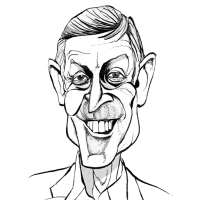
Matthew Parris

Matthew Parris

Matthew Parris is a columnist for The Spectator and The Times.

Once fathers taught their sons the mysteries of life; now fathers have to look to their sons for hel

From our UK edition

This is a reflection on boys and fathers. It may be different for girls. See what you think. Is ours the first generation, or the first for a long time, when boys know more than their fathers? I am not speaking of wisdom, whatever that may be. The older generation will always believe it possesses greater wisdom than the young. Knowledge that comes from emotional experience, perspective that comes from having seen it all before, can only be taught by time. Despite the bravado of youth, children dimly sense that, and will in every age. But do not exaggerate the automaticity of a boy's assumption that in the big, abstract questions of life his dad knows best.

Why did Alastair attack me so ferociously? And why doesn’t the BBC employ him as an interviewer?

From our UK edition

Threatening letters on 10 Downing Street-headed notepaper are scary and I admit taking fright. My autobiography, Chance Witness, was on the verge of publication, and I was heading for the Grapes in Narrow Street for lunch with a Foreign Office friend when my mobile phone rang. Would I call my editor's office urgently? I did. They read me a letter from the Prime Minister's press office, signed by a member of staff there in the name of Alastair Campbell, and faxed through to the Times for publication. As I listened to the letter my blood ran cold. Its more gratuitously abusive remarks did not survive the negotiation which sometimes occurs in these cases, so I will not quote all of what, on 26 September, the Prime Minister's director of communications and strategy intended for publication.

The Tories should forget the party geeks and recruit normal human beings, with lives

From our UK edition

GROUCHO Marx's disinclination to join any club which would accept him suggests a corollary that Groucho never mentioned: the club anxious to recruit just the sort of people who would not dream of joining. The Tories may be headed that way, and if they are not they should be. For its parliamentary candidates, the principal opposition should be actively seeking men and women who can show a clean record of non-involvement with the party. As their mass membership dwindles to a residue of the elderly, the sweet, the bored, the sad, the lonely, the obsessive and the mad, the point is being approached when proof of previous enthusiasm for the Conservative party ought to count against an applicant for inclusion on Conservative Central Office's approved list of would-be parliamentary candidates.

Don’t let the facts interfere with a good war on terrorism

From our UK edition

Until the collapse of communism, America's experience as a great power had been of a world in which there was always (as she saw it) one great evil in the universe, committed to her total destruction. She stood for more than national self-interest; she stood, she believed (and often rightly believed), for the forces of good. A Manichaean universe in which America captains the Army of Light while in the surrounding dark 'the hosts of Gideon/Prowl and prowl around', characterises her whole memory of power. That is not surprising. The Founding Fathers were (like fundamentalist Muslims today) in flight from what they saw as a fallen world. God, or destiny, had commanded America to start again. Being the New World was more than a matter of dates; it was a matter of innocence too.

Ukraine is not dead yet – it thrives on vodka, black bread and pig fat

From our UK edition

We had not expected a border post. This was not a border. Way over the other side of a high pass through the Carpathian Mountains lay Romania, but this small village nestling in a valley by a rushing river was in Ukraine, wholly in Ukraine, and we were anyway not taking the turning for Romania but continuing only a few kilometres more up a side valley to what our guides, Stas, Elena and Igor, said was a 'rough' mountain hostel. 'Not hotel - not hotel - understand?' said Elena, in the confrontational way of talking that an Englishman might mistake for anger, but is just the way Ukrainians, who are rather mild and helpful people, speak.

To call it ‘rape’ is to debauch the language

From our UK edition

In Manchester, a friend at university there tells me, a new word has entered smart parlance among the young. The word is 'raped'. The expression is moderately strong, and casual. It is a way of saying that one has in some way been done over, done for, or done in. 'I was completely raped,' a cool young Mancunian might remark, emerging from an examination in which the questions had proved impossible; or on discovering that something he had just bought was on sale much more cheaply elsewhere. My friend added that some women were complaining that to use a word like this so lightly was offensive, as if rape could ever be equated with everyday problems or setbacks. I see their point.