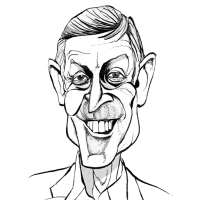
Matthew Parris

Matthew Parris

Matthew Parris is a columnist for The Spectator and The Times.

Mr Blair is being timid in not joining the nations now resisting the hawks of Washington

From our UK edition

The Prime Minister is right. The whole credibility of the United Nations is at stake this week. If the Security Council buckles under the US blackmail to which it is now subject over Iraq, we can discount the organisation as an independent force for international order. Among Spectator readers there are still one or two of us who, prey to instincts we flatter ourselves to call Conservative, mistrust proposals for ruinous and dangerous military adventures. In a way we dare think consistent with remaining Tories, we doubt not America's goodwill but her judgment in world affairs. We find ourselves stumped for words at the cheating to which our Prime Minister and his new friends on the Right have stooped in their arguments for war.

Blair would have been wiser to rely on blind trust than to have issued that dossier

From our UK edition

No popular impression is more precious to those who govern than the impression on the part of the governed that more is known than can be divulged. William Whitelaw understood this better than most. When I was a callow young Tory MP in the 1980s, and he was home secretary, I was briefly caught up in a flutter of backbench concern about telephone-tapping. More of this, it seemed, was going on than had been supposed, and the means of democratic oversight did not seem to exist. A small group of us on the government benches, all backbenchers, asked if we could talk to Willie about the problem. Alongside my friends, and not without trepidation, I entered the great man's Commons office. The home secretary roared his welcome and, spurning his big desk, gestured us into comfortable armchairs.

The answer to Tony Blair’s problems is staring him in the face

From our UK edition

Brainwaves are unusual in the governance of men and it is rare that a knotty political problem invites a simple solution nobody had thought of before. But a conversation last week with The Spectator's newly appointed bullfighting correspondent (Lord Garel-Jones deplores the term but there is no other) has led us to a Eureka! moment. If anyone can see a flaw let him declare it, but his lordship and I are confident. The dilemma we can crack runs as follows. Tony Blair is Prime Minister. Gordon Brown wants to be Prime Minister. Mr Brown is under the impression that Mr Blair has promised to make way for him, and Mr Blair has never quite denied the existence of some sort of understanding. Mr Blair is enjoying being Prime Minister and is in no hurry to stop.

I am not in principle against killing people, but talk of the ‘right to die’ is humbug

From our UK edition

Sometimes one's creed points logically where one is intuitively reluctant to go. The flesh is willing but the spirit is weak. Item: we should not give money to women begging with babies as this only encourages them. Item: this is a beggar and she is carrying a baby. Conclusion: ...er ...fumble in pockets for change. (She just looked so wretched.) One settles such conflicts by following a hunch. This is not necessarily the triumph of unreason. We should never question the primacy of reason, but we cannot always be sure what reason dictates. Sometimes the heart may guess early at reasons which the brain proves slower to recognise. Sound argument should be paramount, yes, but sometimes intuition is early warning of an argument that is not as sound as it seems.

Just who are They, and what are They up to?

From our UK edition

They asked me how I knew/My true love was true.... Or so the song goes. But who were they, and why did they ask anyway? They don't appear very sympathetic - they with their sneering inquiries about how I knew my love was true. Are they the same They as the They who don't know It's the end of the world (It ended when you said goodbye)? They pop up not only in song but all over the place in English discourse. They sound like a bossy and snooty crowd of know-it-alls. They are well placed. They are in touch. They are in the loop. They can make waves. They are depressingly indifferent to our fate. They push us around. They talk behind our backs. They don't understand how we feel. Who do they think they are? When will they ever learn?/When will they ever learn?

A winning performance from IDS, but Charles Kennedy plays to the gallery

From our UK edition

My diary said eleven in the morning so I turned up in good time at the Methodist Central Hall in Westminster last month, ready to do a turn for a sixth-form conference on politics. For half an hour or so I was to talk to an audience of about 1,000 youths and youthettes about the present government's performance and the present opposition's prospects. I like these occasions. I was looking forward to my 30 minutes. Except that I had got the time wrong. My session was billed for noon, not eleven. The hour now left slack was too short to start anything else. Irritation yielded to curiosity when I realised that Charles Kennedy was on his feet on the conference rostrum, and would be followed by Iain Duncan Smith. It is instructive to be a fly on the wall when adults talk to youngsters or pets.

‘Bogus’ asylum-seekers are not the problem; it’s the millions of genuine refugees we should worry ab

From our UK edition

There has been another huge rise in the numbers of those seeking asylum in this country. That the figure for the last quarter is 20 per cent higher than for the equivalent period in the preceding year is disturbing enough. That it is 11 per cent higher than the preceding quarter suggests that the rate of increase is itself accelerating. When an important topic returns to the news, a columnist may choose between repeating himself and contradicting himself. I see no case for contradicting myself. Twice now for the Times I have written that what is most worrying about rises in the numbers of asylum-seekers is not that some are abusing the system but that many are not; and there are hundreds of millions more where they came from.

Prince Charles should be allowed to take his pick from rows of dancing debutantes in G-strings

From our UK edition

Compared with the woes besetting our own royal family, the problems faced by the Swazi monarchy in adapting to the 21st century are minor. King Mswati III has just chosen his tenth wife. The wedding will not affect his marriage to the existing nine. There may be lessons here for Prince Charles. I have recently returned from a short visit to Swaziland, where I was educated as a boy. The country is about the size of Wales. Hilly, fertile and well-watered, and landlocked between the top right-hand corner of South Africa and the bottom left of Mozambique, this sweet and peaceful little place is unusual for being more or less conterminous with the modern homeland of a single tribe.

The longing to be liked

From our UK edition

This cracking book is missing something and the want is telling. Jeremy Paxman virtually discounts the possibility that people might go into politics driven by ideas or conviction. These being the spur politicians routinely claim, Paxman's study becomes a detective hunt for ulterior motive or unacknowledged greed. 'This fellow says he wants to make the world a better place, but let us find out what he's really in it for' is the gist.

Once fathers taught their sons the mysteries of life; now fathers have to look to their sons for hel

From our UK edition

This is a reflection on boys and fathers. It may be different for girls. See what you think. Is ours the first generation, or the first for a long time, when boys know more than their fathers? I am not speaking of wisdom, whatever that may be. The older generation will always believe it possesses greater wisdom than the young. Knowledge that comes from emotional experience, perspective that comes from having seen it all before, can only be taught by time. Despite the bravado of youth, children dimly sense that, and will in every age. But do not exaggerate the automaticity of a boy's assumption that in the big, abstract questions of life his dad knows best.

Why did Alastair attack me so ferociously? And why doesn’t the BBC employ him as an interviewer?

From our UK edition

Threatening letters on 10 Downing Street-headed notepaper are scary and I admit taking fright. My autobiography, Chance Witness, was on the verge of publication, and I was heading for the Grapes in Narrow Street for lunch with a Foreign Office friend when my mobile phone rang. Would I call my editor's office urgently? I did. They read me a letter from the Prime Minister's press office, signed by a member of staff there in the name of Alastair Campbell, and faxed through to the Times for publication. As I listened to the letter my blood ran cold. Its more gratuitously abusive remarks did not survive the negotiation which sometimes occurs in these cases, so I will not quote all of what, on 26 September, the Prime Minister's director of communications and strategy intended for publication.

The Tories should forget the party geeks and recruit normal human beings, with lives

From our UK edition

GROUCHO Marx's disinclination to join any club which would accept him suggests a corollary that Groucho never mentioned: the club anxious to recruit just the sort of people who would not dream of joining. The Tories may be headed that way, and if they are not they should be. For its parliamentary candidates, the principal opposition should be actively seeking men and women who can show a clean record of non-involvement with the party. As their mass membership dwindles to a residue of the elderly, the sweet, the bored, the sad, the lonely, the obsessive and the mad, the point is being approached when proof of previous enthusiasm for the Conservative party ought to count against an applicant for inclusion on Conservative Central Office's approved list of would-be parliamentary candidates.

Don’t let the facts interfere with a good war on terrorism

From our UK edition

Until the collapse of communism, America's experience as a great power had been of a world in which there was always (as she saw it) one great evil in the universe, committed to her total destruction. She stood for more than national self-interest; she stood, she believed (and often rightly believed), for the forces of good. A Manichaean universe in which America captains the Army of Light while in the surrounding dark 'the hosts of Gideon/Prowl and prowl around', characterises her whole memory of power. That is not surprising. The Founding Fathers were (like fundamentalist Muslims today) in flight from what they saw as a fallen world. God, or destiny, had commanded America to start again. Being the New World was more than a matter of dates; it was a matter of innocence too.

Ukraine is not dead yet – it thrives on vodka, black bread and pig fat

From our UK edition

We had not expected a border post. This was not a border. Way over the other side of a high pass through the Carpathian Mountains lay Romania, but this small village nestling in a valley by a rushing river was in Ukraine, wholly in Ukraine, and we were anyway not taking the turning for Romania but continuing only a few kilometres more up a side valley to what our guides, Stas, Elena and Igor, said was a 'rough' mountain hostel. 'Not hotel - not hotel - understand?' said Elena, in the confrontational way of talking that an Englishman might mistake for anger, but is just the way Ukrainians, who are rather mild and helpful people, speak.

To call it ‘rape’ is to debauch the language

From our UK edition

In Manchester, a friend at university there tells me, a new word has entered smart parlance among the young. The word is 'raped'. The expression is moderately strong, and casual. It is a way of saying that one has in some way been done over, done for, or done in. 'I was completely raped,' a cool young Mancunian might remark, emerging from an examination in which the questions had proved impossible; or on discovering that something he had just bought was on sale much more cheaply elsewhere. My friend added that some women were complaining that to use a word like this so lightly was offensive, as if rape could ever be equated with everyday problems or setbacks. I see their point.