Matthew Donnelly

The madness of British sunbathing

From our UK edition

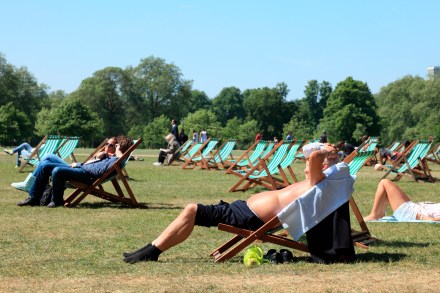
‘Mad dogs and Englishmen go out in the midday sun.’ The phrase’s origin is somewhat disputed, but it was made famous by Noël Coward’s song of the same name, supposedly written on the drive between Hanoi and Saigon in the early 1930s. Coward was English himself, and the song is a humorous act of national self-flagellation; an explicit dig at a peculiarity deeply embedded in the British culture: our collective inability to behave sensibly in the sun.  Spring, by almost anybody’s measure, is upon us. May provides two Bank Holidays and the first reliable warmth of the year. Like clockwork, the country takes leave of its senses.

Camping’s great lie

From our UK edition

Picture the scene: a field somewhere in the Midlands on a Tuesday evening. It has rained continuously for seven hours. You are in a tent that took 45 minutes and three minor altercations to erect. Inside, there is no room to stand. You are sitting on a bare groundsheet, shivering, staring at an unopened tin of beans and sausages with a broken ring pull. A friend, whose idea this was, is somewhere nearby — in their tent, also rethinking the collective decision to sleep in a field.  With Easter out of the way, we are now heading face-first into another camping season.

The problem with Mandelson, Maxwell and Oxford University

From our UK edition

Peter Mandelson — twice-resigned Cabinet minister, architect of New Labour and, until recently, His Majesty’s Ambassador to the United States — went to the University of Oxford from Hendon County Grammar. Mandelson read PPE at St Catherine’s College from 1972 to 1976. Young Mandelson’s impressions of Oxford, as detailed in Donald Macintyre’s Mandelson: The Biography, are mixed at best: Hertford College ‘stank of cabbage’ while St Edmund Hall was ‘sort of thirteenth century’, the Union ‘hoorayish’ and ‘off putting’. With too many Peters in his year, Mandy was known, simply, as ‘Benj’.   Fast forward some 40 years and Mandelson was awarded an honorary fellowship by St Catherine’s College in 2018.

The decline of Oxford University’s sartorial traditions

From our UK edition

The Black Death tore its way through Europe between the years of 1346 and 1353, believed to have killed half of the continent’s population. The Great Plague came in 1665, wiping out nearly a quarter of all Londoners. 1918 brought the Spanish Flu, infecting roughly one-third of the global population. And now, in the aftermath of Covid-19 — spreading through the streets of Oxford with a virulence that none of the above could rival — comes the latest instalment in highly infectious diseases: the college puffer jacket.  Historically, Oxford's sartorial traditions have been (Bullingdon Club attire aside) relatively understated. The college scarf was a go-to, and whose demise is worth mourning.

Driving isn’t fun any more

From our UK edition

It is almost inconceivable that we used to live in a world where people would ‘go for a drive’. Not to get to a destination, but simply for the pleasure of driving. Sunday afternoons were the time of choice for this activity and would see car owners take to the road simply because it was good fun to be behind the wheel. The idea that driving was anything other than functional now seems absurd.   That world has vanished, partly due to the sheer volume of cars. In 1971 (the year my dad learned to drive), there were roughly 15 million cars on UK roads. Today, on those same roads, there are 34 million.