Martin Gayford

In the shadow of Picasso

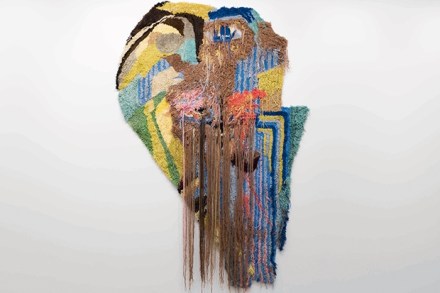
‘My painting is an act of decolonisation,’ declared Wifredo Lam. These are the first words you read on entering the retrospective of his work at Tate Modern. But I must say that both Lam and Tate got this statement 100 per cent back to front. On the contrary, Lam’s work strikes me as entirely a product of colonialism. It’s none the worse for that, but it’s not any better either. Lam (1902–1982) was originally from Cuba. His father, Enrique Lam-Yam, had emigrated from China and his mother, Ana Serafina, was of mixed African and Spanish descent. He was, in other words, a rather typical inhabitant of the new world. And the rich fusions of that milieu have produced such cultural wonders as Afro-Cuban music and, across the Gulf of Mexico in Louisiana, jazz.

House style

Last Sunday, I went to see two of the greatest paintings in Britain — at least in the estimation of our Georgian ancestors. When they first arrived here, in 1790, they were accompanied by a special naval escort. After Turner saw one of them, he said the experience made him both ‘pleased and unhappy’, because it seemed beyond his powers to imitate. These are the so-called ‘Altieri’ Claudes, by any reckoning among the most spectacular pictures produced in late 17th-century Rome. Today they hang at Anglesey Abbey, Cambridgeshire, where — at least on the afternoon I was there — few others had found their way to see them. Not that the place lacked visitors.

The Capability controversy

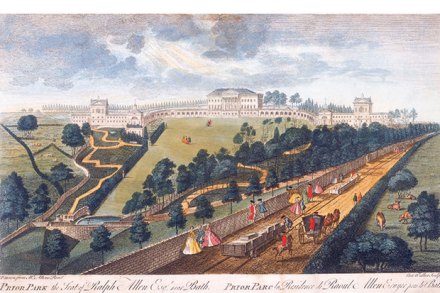
In a piece of light verse from the 1770s ‘Dame Nature’ — out strolling ‘one bright day’ — bumps into the great landscape designer, Lancelot ‘Capability’ Brown. Immediately the goddess lays into him for plagiarism. How, she wants to know, does he have the impudence to show his face? All the items he claims to have created — ‘the lawn, wood and water’ — were made in fact by her. Brown, for his part, is not at all disconcerted. He admits that Nature has provided him with good raw materials. But the beautifying refinements? Those are all his. ‘The swell of that knoll,’ he points out, ‘is mine... the ridges are melted, the boundaries gone.

Recycling the avant-garde

One overcast afternoon in late July I took a train to Norfolk. It seemed a good time and place to catch up on the state of the avant-garde. My goal was the British Art Show 8, currently spread over several venues in the centre of Norwich and due next month to move on to Southampton, the final resting-point on its slow progress around what remains, for the moment at least, the United Kingdom. Not having caught the exhibition at its previous stopping points, Leeds and Edinburgh, I thought this would be a suitable place to see it since Norwich is a town of art historical pedigree — home to Cotman, the Cromes and Michael Andrews.

Beauty and the banal

In 1965 William Eggleston took the first colour photograph that, he felt, really succeeded. The location was outside a supermarket in Memphis, Tennessee; the time — to judge from the rich golden light and long shadows — late afternoon. Eggleston’s subject — a young man with a heavily slicked, early Elvis hairstyle stacking trolleys outside the shop — was as ordinary as he could be. But the result was a photographic masterpiece. It is included in the exhibition William Eggleston: Portraits at the National Portrait Gallery, although, by most definitions, it is not a portrait. Indeed, it is as hard to say just what it is as it is to explain exactly why it is so good. Actually, great pictures are often images of very commonplace sights.

Heavenly bodies | 28 July 2016

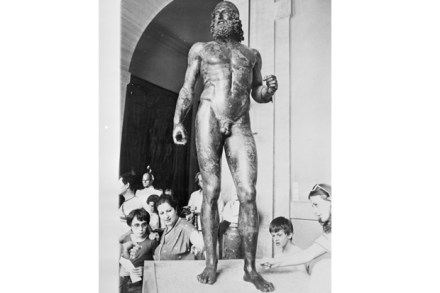
Initially it must have been a nasty surprise. On 16 August 1972 an amateur scuba diver named Stefano Mariottini was fishing in shallow waters just off the coast of Calabria. At about noon he was poking around some rocks when he saw part of an arm protruding from the sand. His first thought, a natural one, was that he had found a cadaver. On closer examination, it became clear that there was not just one body but two — and that they were made not of flesh but of metal. Mariottini’s discoveries are world-famous now, taking their name — the Riace bronzes — from the little resort near which he was swimming. In terms of classical sculpture, he had hit the jackpot. Bronze was the medium of choice for many of the most admired artists of the ancient world.

Privates on parade

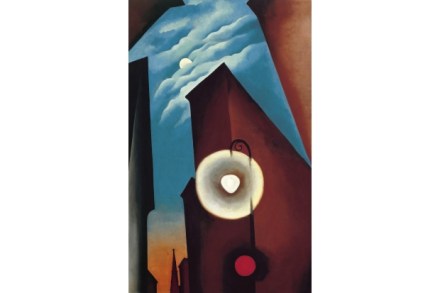
In 1927, Georgia O’Keeffe announced that she would like her next exhibition to be ‘so magnificently vulgar that all the people who have liked what I have been doing would stop speaking to me’. Perhaps, then, she would approve of the massive retrospective of her work at Tate Modern. This show is, as is frequently the case in the largest suites of galleries on Bankside, considerably too big for its subject. The scale, however, is a matter of institutional overkill. Its vulgarity, magnificent or otherwise, is supplied by O’Keeffe (1887–1986) herself — in a pared-down, high-modernist way. Resident for much of her long, long life in the New Mexican desert, she prided herself on her all-American toughness.

Echoes of Italy

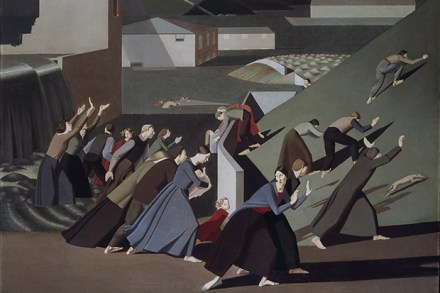
‘Hidden beauty is best (half seen), faces turned away.’ So noted a young English painter named Winifred Knights in 1924. Until recently, the power of her own work has been thoroughly concealed. After her death in 1947, indeed even before it, Knights was forgotten. By the 1950s her reputation had sunk so completely that both the Tate and the Fitzwilliam Museum refused to accept one of her masterpieces as a gift. However, artists who disappear into oblivion are sometimes rediscovered — and that is what has happened to Knights, who is now the subject of an admirable exhibition at Dulwich Picture Gallery. It is, as the cliché goes, a revelation. One of the things it reveals is how English painters continued to love the Italian Renaissance well into the modernist era.

Passing through Bologna

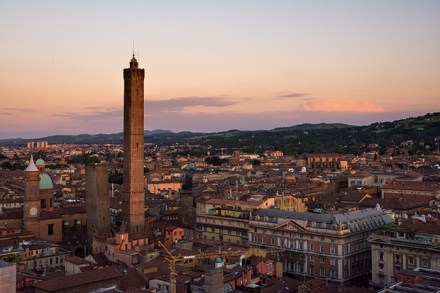
Sooner or later, no matter where you are travelling on Italian railways, you are likely to pass through Bologna Centrale. The city is the main junction between the north and south of the country, close to the route through the mountains. It always has been. The teenage Michelangelo stopped off while journeying between Venice and Florence, and — after a contretemps at the customs office, since Bologna was then a city state — carved some small sculptures for the Basilica of San Domenico. In 1786 Goethe spent a few days in this ‘venerable, learned’ place, ‘thronged with people’. It still is all those things. In the 21st century, however, not too many linger — as Goethe did — to look at the paintings or eat the marvellous food.

Jumbled up

‘In the end, nothing goes with anything,’ Lucian Freud remarked one afternoon years ago. ‘It’s your taste that puts things together.’ He would perhaps have been a little startled to find those words inscribed on the wall of Painters’ Paintings at the National Gallery, but they are very apt. The exhibition reassembles the works of art owned by a number of great painters, among them Van Dyck, Reynolds, Degas, Matisse and Freud himself. It begins with pictures and sculptures that used to co-exist in Lucian’s sitting-room. Most powerful of these is a magnificent Corot, ‘Italian Woman’ (c.1870), that once hung over his fireplace and is now part of the National Gallery’s collection.

Split decision

In 1992 I wrote a column that was published under the headline ‘It’s Time to Split the Tate’. To my absolute astonishment, shortly afterwards it was announced that this would actually happen (no doubt a coincidence rather than a response to my words). Hitherto, though it is hard now to recall those times, there had been just a single Tate gallery in London — the one on Millbank, containing a cheerful jumble of British painting from the Tudor era onwards mixed with what was then described as modern ‘foreign’ art. Eventually, Tate Modern opened and became one of the most prominent features on the cultural landscape, not only of London but also of Britain. Nearly six million visitors a year pour through its doors.

Let’s talk about sex

At one time, Damien Hirst was fond of remarking that art should deal with the Gauguin questions. Namely, ‘Where do we come from? What are we? Where are we going?’ Hirst would sum up with a deft shift from post-impressionism to Michael Caine: ‘What’s it all about, Alfie?’ The new exhibition of work by the American artist Jeff Koons at Hirst’s Newport Street Gallery might raise the same query in a visitor’s mind. Among other sights, you are confronted by a number of brand-new vacuum cleaners, mounted over neon lighting tubes; soon afterwards by a shiny blue sculpture, six metres high, representing a monkey made out of twisted balloons.

What lies beneath | 2 June 2016

It was not so unusual for someone to turn into a god in Egypt. It happened to the Emperor Hadrian’s lover, a beautiful young man named Antinous, who was drowned in the Nile in the autumn of 130 AD. It was also the fate of Queen Arsinoë II, who had a complicated life. At the age of 15 she became wife to the 60-year-old ruler of Thrace. When he died in battle, she married her half-sibling, who murdered two of her sons. Her next husband was her full brother. A headless sculpture of Arsinoë stands about halfway around Sunken cities at the British Museum. It is, as a label rightly points out, an almost perfect fusion of Greek and Egyptian art. Arsinoë was represented as an incarnation of Aphrodite.

Happy ending

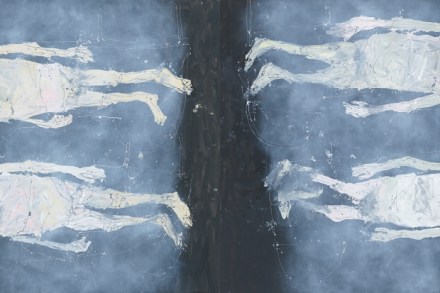
‘In many ways,’ Georg Baselitz muses, ‘I behaved against the grain of the times I grew up in.’ The era was 1960s Germany; in that context, Baselitz feels he was subversively respectable. ‘For example, I never took any drugs. I have been a very faithful husband, I just wanted to hold on to my wife, I wasn’t interested in straying. I never went on any political demonstrations.’ His major offence, however, was not what he didn’t do but what he actually did: paint figurative pictures. Eventually, fashions reversed, and this perverse behaviour made Baselitz a celebrated figure in the world of art. At 78, he remains vigorously productive.

Surreal, strange and scatological

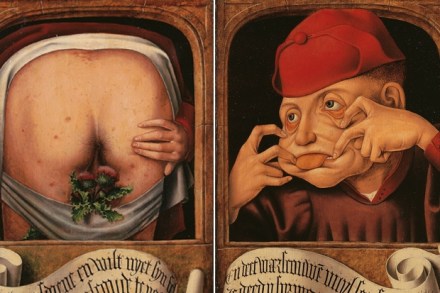
Why do we put one work of art beside another? For the most part museums and galleries tend to stick them on the wall as if they were butterflies or beetles, putting similar species together: an array of impressionist flowers, baroque altarpieces, pictures by a certain painter. But there are other ways to do it. Carambolages, a refreshing and highly entertaining exhibition at the Grand Palais, Paris, presents a dizzying diversity of stuff according to a quite different principle: namely, billiards. ‘Carambolage’ is a term that originates from the game of carambole, or French billiards, as once observed by Van Gogh and Gauguin in the Café de la Gare, Arles. It translates into English as ‘cannon’: hitting one ball so that it strikes two others.

Is it art or science?

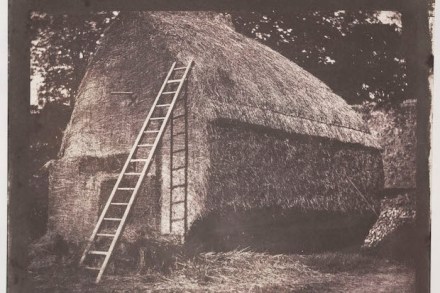
William Henry Fox Talbot had many accomplishments. He was Liberal MP for Chippenham; at Cambridge he won a prize for translating a passage from Macbeth into Greek verse. Over the years he published numerous articles in scholarly journals on subjects ranging from astronomy to botany. One thing he could not do, however, was draw well — and it was this inadequacy that changed the world. While on holiday in Italy in 1832, he became so frustrated by his failure to draw Lake Como satisfactorily using a pencil and a drawing aid known as the camera lucida — his efforts were well below GCSE art standard — that he resolved to find another way to preserve such views. The results are on show in an exhibition at the Science Museum, Fox Talbot: Dawn of the Photograph.

The rise and fall of Sicily

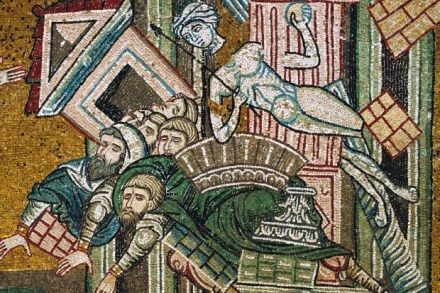
A few weeks ago, I looked out on the Cathedral of Monreale from the platform on which once stood the throne of William II, King of Sicily. From there nearly two acres of richly coloured mosaics were visible, glittering with gold. In the apse behind was the majestic figure of Christ Pantocrator — that is, almighty. The walls of the aisles and nave were lined with scenes from the Bible. In another panel, just above, Christ himself crowned King William. It was a prospect of the greatest opulence and sophistication stretching in every direction from this regal vantage point. The mosaics are in the manner of Byzantium, and probably executed by Greek artists, but the architectural plan and inlaid floors are derived from medieval Italy.

Old masters

The Fitzwilliam Museum is marking its bicentenary with an exhibition that takes its title from Agatha Christie: Death on the Nile. But it turns out it was another writer of a different type of fiction who was directly involved. M.R. James, author of Ghost Stories of an Antiquary, amassed some of the exhibits in his capacity as director of the Fitzwilliam from 1893 to 1908. And almost any object on display would have made a perfect prop for one of his tales, because the subject is ancient Egyptian coffins. Generally, the main character in a story by James is a retiring gentleman scholar who comes across a venerable item which then brings upon him some diabolic haunting or curse.

Florence | 31 March 2016

Once, it seems, Sandro Botticelli played a trick on a neighbour. Next door was a weaver who possessed eight looms. He and his assistants kept these in constant use, creating such a judder-ing racket that the poor painter was unable to concentrate on his pictures. Botticelli implored this fellow to reduce the noise, but to no avail. So eventually the artist carried an enormous rock on to his roof, poised so the slightest vibration would bring it crashing through the noisy weaver’s premises. The man then saw reason. You can easily imagine the problem today as you walk down Botticelli’s street, Via del Porcellana. It’s a long, narrow thoroughfare running down to the Arno, tightly packed with three- and four-storey buildings.

The counterfeiters

One day, in the autumn of 1960, a young Frenchman launched himself off a garden wall in a suburban street to the south of Paris. He jumped in an unusual away; not as if he expected to land, feet first on the pavement below, nor even as if he were diving into water, but arms outstretched, back arched, apparently taking off into the air above. The result was Yves Klein’s ‘Le Saut dans le vide’ (Leap into the Void), which opens the exhibition Performing for the Camera at Tate Modern. Beside the finished product — a photomontage — are two other images that together explain how it was done. One shows the same quiet stretch of road, completely empty except for a solitary cyclist passing by like an extra in a Maigret dramatisation.