Martin Gayford

Melting pot

From our UK edition

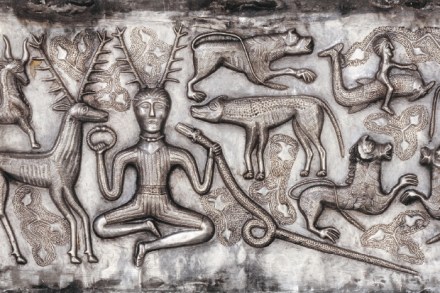
‘Celtic’ is a word heavily charged with meanings. It refers, among other phenomena, to a football club, a group of languages, a temperament, a style of art and a fringe, once the stronghold of the Liberal Democrats. But who are — and were — the Celts? The curators of the new British Museum exhibition are not at all sure, and that’s one of the reasons why the result is so enthralling. There is a familiar answer to this question: the Celts were an ancient people who moved into Europe from the east in prehistoric times and occupied most areas north and east of the Alps, together with northern Italy and much of the Balkans. They spoke a kindred group of languages and created a style of art that continued to evolve from the 5th century BC into the Middle Ages.

Lines of beauty | 10 September 2015

From our UK edition

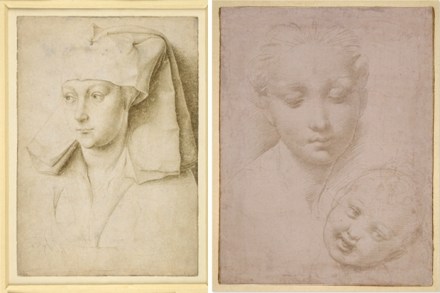
Marshall McLuhan got it at least half right. The medium may not always be the entire message, but it certainly dictates the kind of message that can be transmitted. This is one lesson of Drawing in Silver and Gold: Leonardo to Jasper Johns, an exhibition at the British Museum that is packed with subtle masterpieces, and as a bonus contains — for those who like such things — two of art’s great studies of dogs. I might as well start with those: one by Albrecht Dürer from around 1520, ‘Dog resting’, and the other by the later Dutch artist Hendrick Goltzius of his own pet, curled up and sleeping in about 1597. Both of these display the virtues of silverpoint.

The only art is Essex

From our UK edition

When I went to visit Edward Bawden he vigorously denied that there were any modern painters in Essex. That may not have been true then — this was in the 1980s — or even now. What is indisputable, however, is that there have been plenty of artists in the county. They are the subject of two small but delightfully jam-packed exhibitions at the Fry Art Gallery, Saffron Walden. Bawden (1903–1989) is at the heart of both of them, even if the second point he made to me — equally emphatically — was that he called himself a designer rather than an artist (‘out of self-defence, mainly’). That distinction, and the quirky humour, are both relevant to the question of Essex art, especially the variety that is the focus of attention at the Fry.

French connection | 20 August 2015

From our UK edition

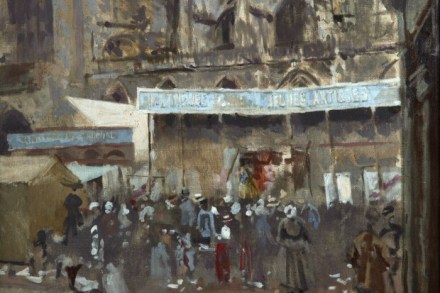
Walter Sickert was fluid in both his art and his personality: changeable in style and technique, mutable in appearance — now dressing as a French fisherman, now as a dandy, next shaving his head — and even in name (for a while he styled himself Richard, not Walter, Sickert). All of which makes his long artistic association with the seaside resort of Dieppe apt in more ways than one. This is the theme of an excellent exhibition at Pallant House Gallery, Chichester. A century ago Dieppe was a very Sickertian place. In ancestry and artistic attitudes, Sickert was an exemplary cosmopolitan.

Seeking closure | 13 August 2015

From our UK edition

A while ago, David Hockney mused on a proposal to tax the works of art stored in artists’ studios. ‘You’d only have to say they weren’t finished, and you are the only one who could say if they were,’ he suggested. ‘There’d be nothing they could do.’ This is the state of affairs examined in Unfinished, a thought-provoking little exhibition at the Courtauld Gallery. Once upon a time, it was as clear whether a painter had completed a picture as it was whether the gardener had thoroughly mowed the lawn. Indisputably, Perino del Vaga downed tools for some reason halfway through his ‘Holy Family with Saint John the Baptist’ (1528–37). That’s obvious.

Watery depths

From our UK edition

I learnt to splash about in watercolour at my grandmother’s knee. Or rather, sitting beside her crouched over a pad of thickly ‘toothed’ paper and a Winsor & Newton paintbox on a wind-swept East Anglian seashore. Now, looking back, I see that what she was doing belonged to a tradition. Her predecessors, idols and reference points are to be seen in an admirable small exhibition at the Fitzwilliam Museum, Cambridge, Watercolour — Elements of nature. This consists of works from the museum’s collection, but is much more full of delightful surprises — even for those who know the Fitzwilliam well — than that description suggests.

Portrait of the artist as a madman

From our UK edition

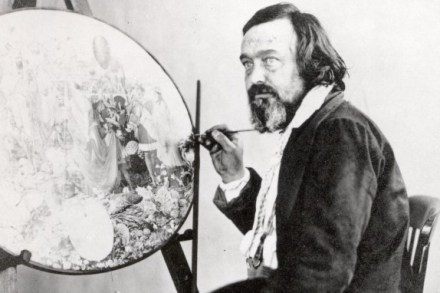
Charles Dickens’s description of Cobham Park, Kent, in The Pickwick Papers makes it seem a perfect English landscape. Among its ‘long vistas of stately oaks and elms’, he wrote, ‘occasionally a startled hare’ ran with ‘the speed of the shadows thrown by the light clouds’. It was there on the morning of 29 August 1843 that a butcher from Rochester got a nasty surprise. He discovered the corpse of an apothecary named Robert Dadd; he had been battered and stabbed to death by his son Richard. There is no doubt that Richard Dadd was far from sane. On the other hand, his loss of mental balance — though very bad in its consequences for his father — was the making of Dadd as an artist.

Scholarship and folly

From our UK edition

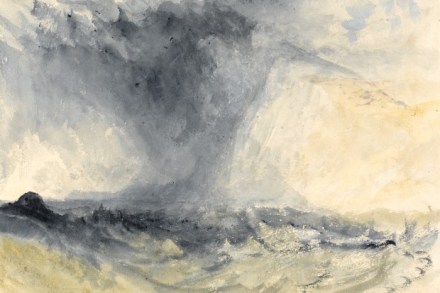
It has often been related how, towards the end of his long life, a critical barb got under J.M.W. Turner’s skin. ‘Soapsuds and whitewash!’ Turner apparently snorted, repeatedly, to himself. However, until now no one has traced the perpetrator of this memorably tart comment. Now we know. It was the scandalous, super-rich patron and novelist William Beckford, who made it in 1831 while taking a visitor on a tour of his collection. They paused in front of a watercolour of Fonthill Abbey, Beckford’s erstwhile house — and folly — that Turner had painted some three decades earlier. The guest remarked that the painter did not paint like that these days. ‘Oh!’, exclaimed Beckford. ‘Gracious God! No!

Curiouser and curiouser | 9 July 2015

From our UK edition

Art is not jewellery. Its value does not reside in the price of the materials from which it is made. After all, the cost of the pigment, oil and cloth that made up a Rembrandt was negligible. It’s what he did with them that counts. On the other hand, spectacular works of art can be made from gold and gems, as is clear from some — if not all — of the items displayed in the new installation of the Waddesdon Bequest at the British Museum. ‘As soon as the swallows made their appearance,’ Baron Ferdinand de Rothschild wrote in his memoir Bric-à-Brac, ‘my father’s curiosities were packed and stored away in a strong room.’ It was the young Ferdinand’s privilege to help pack these objects.

Thinking inside the box

From our UK edition

Someone once asked Joseph Cornell who was his favourite abstract artist of his time. It was a perfectly reasonable question to put to a man who numbered Piet Mondrian, as well as other masters of modernism, among his acquaintance. But, characteristically, Cornell veered off at a tangent. ‘What’, he replied, ‘do you mean “my time”?’ In its way it’s a good response, as the exhibition at the Royal Academy, Joseph Cornell: Wanderlust, makes clear. The subtitle of the show refers to travel in mental space. In mundane reality, Cornell (1903– 72) seldom left New York City, and never ventured further afield than Maine. But in his imagination, he journeyed across the world and dwelt, mentally, in an era earlier than his own.

Shape-shifter

From our UK edition

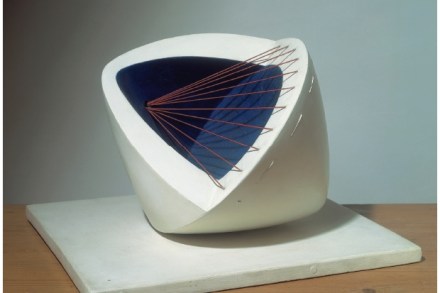
In the last two decades of her life, Barbara Hepworth was a big figure in the world of art. A 21-foot bronze of hers stands outside the UN headquarters in New York, emblematic of her friendship with secretary-general Dag Hammarskjöld — a Hepworth collector — and of her international fame. This was how a modern monument looked half a century ago: abstract but organic, romantic but starkly simplified. Since Hepworth’s death, however, her status has become less clear: was she a towering giant of modern sculpture or relatively minor, a slightly dreary relic of post-war Britain? Barbara Hepworth: Sculpture for a Modern World at Tate Britain does not quite supply the answer. But it does throw some revealing sidelights on her art and career.

Fairground attraction | 18 June 2015

From our UK edition

Gianlorenzo Bernini stressed the difficulty of making a sculpture of a person out of a white material such as marble. Imagine, he said, that someone we knew well whitened his hair, his beard, his lips and his eyebrows, and, were it possible, his eyes. Would we recognise him? This is not a problem encountered by the 20th-century American artist Duane Hanson, whose work is on show at the Serpentine Sackler Gallery in Kensington Gardens. Hanson (1925–96) took every possible step to make his figures mimic reality in skin, hair, clothes, accessories and surroundings. In comparison, the resemblance of waxworks to their models is much less convincing. Hanson’s creations can engender a rare type of uncertainty. Is that person over there a human being or a piece of art?

Seeing the light | 11 June 2015

From our UK edition

James Turrell gave me extremely precise instructions. After dinner, I was to walk out through the grounds at Houghton Hall to the skyspace he has built. Here I should observe the gradual darkening above as brightness fell from the Norfolk air. At 9.40 p.m., I was to join him and the Marquess of Cholmondeley to witness the illumination Turrell has devised for the west front of the house. So we stood in the chill air of an English summer evening and watched as a slowly changing sequence of pinks, mauves, blues and reds lit up the colonnades and Palladian windows designed in the 1720s by Colen Campbell and the domes added by James Gibbs.

The Craig-Martin touch

From our UK edition

The Royal Academy Summer Exhibition has very little in common with the Venice Biennale. However they do share one characteristic. Each always contains so many diverse and potentially incompatible elements that orchestrating a smoothly blended result is dauntingly difficult. But, as with many almost impossible tasks, some manage it much better than others. Michael Craig-Martin, this year’s chief co-ordinator at the RA, has produced a distinctly better result than usual. The Summer Exhibition always tends to look — as David Hockney once put it — like a jumble sale. But the 2015 edition is a jumble sale with pizzazz and a chromatic zing. The transformation begins before you even get into the exhibition.

This is England

From our UK edition

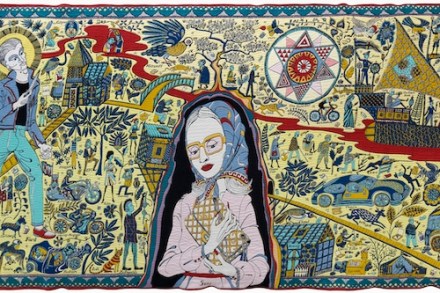
At the Turner Prize dinner of 2003, as the winner, Grayson Perry, took a photo call with his family wearing a girlish dress and huge bow in his hair, a German contemporary artist who was sitting at the same table leant over and hissed in my ear, ‘Only in England!’ He got it right in more than one way. As time goes on it becomes ever more apparent that — in his combination of grittiness, eloquence and wackiness — Perry is very much in the national grain. He even manages to look like a sort of Identikit British archetype, resembling, in different images he presents of himself, Margaret Thatcher, Alice in Wonderland and Richard III. No doubt, at some point in the future there will be a grand-scale overview of Perry’s work at the Tate or RA.

Eastern reflections

From our UK edition

In his introductory remarks to the Afro–Eurasian Eclipse, one of his later suites for jazz orchestra, Duke Ellington remarked — this was in 1971 — that east and west were blending into one another, and everyone was in danger of losing his or her identity. Nowhere is it easier to observe that phenomenon than on the little island of Naoshima, in the Seto Inland Sea of Japan, which I visited last month. Naoshima possesses sandy beaches and tranquil blue waters dotted with further islets stretching towards the horizon. But this is an especially heavenly spot for a relatively small and specialised, even eccentric, group of travellers.

More Marx than Dante

From our UK edition

At the start of Canto XXI of the ‘Inferno’, Dante and Virgil look down on the pit of Malebolge, the Eighth Circle of Hell, in which sinners guilty of simony, hypocrisy and graft are punished. The last of those spend eternity immersed in a river of bubbling pitch. This sinister black liquid, the poet noted, looks much like the tar that Venetians boil up in their arsenal to smear over the hulls of their ships. Those lines came to mind more than once as I walked around the 56th edition of the Venice Biennale, not least because a large section is installed in the ancient buildings of that very Arsenale. The Biennale is always the same — the crowds! the people! — yet always different.

Tribes of one

From our UK edition

The British painter Nina Hamnett recalled that Modigliani had a very large, very untidy studio. Dangling from the end of his bed was a web inhabited by an enormous spider. ‘He explained that he could not make the bed as he had grown very attached to the spider and was afraid of disturbing it.’ This anecdote — in its combination of Bohemian squalor, fin-de-siècle strangeness, whimsical humour and delicacy of feeling — gives a few clues to the art of the man who slept in that bed. More are provided by a nicely focused little exhibition at the Estorick Collection, Modigliani: A Unique Artistic Voice. It is made up of 30 drawings — many from the earlier part of the painter’s short career, plus one painting, a portrait from 1918.

He’s got rhythm

From our UK edition

One evening before the first world war, Henri Gaudier-Brzeska, fired by drink, tried out such then-fashionable dances as the cakewalk and the tango, ‘his eyes burning — his hair wild’. What was funny about this spectacle, his companion Sophie Brzeska confided to her diary, was not so much the dances as the sight of the dancer himself, ‘the young bear like nothing on earth with his seven league boots jumping in the air like an extraordinary buffoon’. It is a description that evokes many works displayed in a delightful little exhibition, New Rhythms, at Kettle’s Yard, Cambridge. This marks the centenary of Gaudier-Brzeska’s death; he was killed in action on 5 June 1915, aged 23. But it is not exactly a memorial show.

Light fantastic

From our UK edition

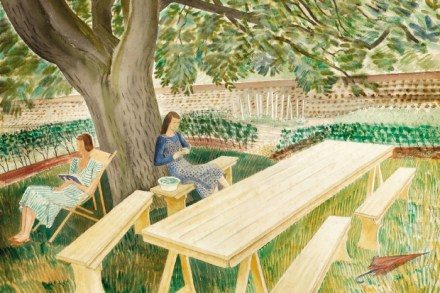
The most unusual picture in the exhibition of work by Eric Ravilious at Dulwich Picture Gallery, in terms of subject-matter at least, is entitled ‘Bomb Defusing Equipment’. In other ways — crisp linear precision, a designer’s eye for the melodious arrangement of shapes — it is typical of Ravilious. Characteristic, too, is the way he has given these implements associated with warfare and high explosives an almost jaunty air, shading into melancholy mysteriousness. That’s the Ravilious note, and I must admit I find it irresistible. Ravilious (1903–42) was one of the most beguiling of mid-20th-century British artists. Yet it is still not quite clear what position he has in art history: high or low, important or insignificant.