Lionel Shriver

Lionel Shriver

Lionel Shriver is a columnist at The Spectator and author of We Need to Talk About Kevin, among other books.

Hatred is in the eye of the beholder

From our UK edition

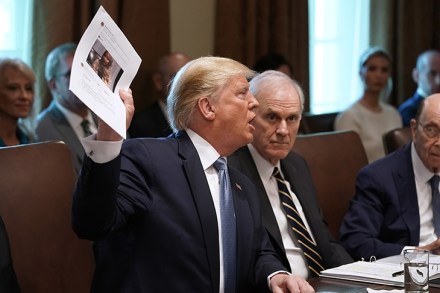
There’s a broad mainstream consensus on both sides of the Atlantic: Trump’s tweet telling four hard-left minority Congresswomen to ‘go home’ to the crime-ridden countries they’re from, when three of the four were born in the US, was racially inflammatory and staggeringly ill-judged.  But the first question that would be raised in the UK if a British politician committed such a gaffe is the last question raised in the US: was that post ‘hate speech’? The First Amendment to the American constitution guarantees five basic freedoms, including freedom of speech, and these principles ought rightly to pertain in other democracies such as Britain.

Where is the Democrat who can take on Trump?

From our UK edition

I have plenty of shamefaced company in having rashly predicted, as pundits are warned never to do, that Donald Trump wouldn’t win the White House in 2016. I don’t plan on repeating that mistake. Liberals are especially prone to confuse the words ‘should’ and ‘will’. Just because Trump shouldn’t win in 2020 doesn’t mean he won’t. Nevertheless, American Democrats are approaching an election that ought to be a slam dunk. In Gallup polls, Trump is the only president in modern history never to exceed a 50 per cent approval rating (having sunk as low as 36, he’s currently at 42, with a disapproval rating of 53).

When did calorie counting become offensive?

From our UK edition

An author of spoofy, light-hearted mysteries, my friend Ruth Dudley Edwards has had unusual difficulty completing her new novel, Death of a Snowflake. The trouble isn’t lack of material —she’s spoilt for choice — but real life outpacing satire. As we now live in a world of ‘you could not make this stuff up’, readers looking for a laugh are spurning fiction in droves in preference for the newspaper. To wit, exam administrators rather than students are now tested. Stirring widespread consternation this month, a GCSE English exam cited a passage from H.E. Bates’s short story ‘The Mill’, which in due course —not in the passage itself — portrays a rape.

Be careful what you christen

From our UK edition

An author of spoofy, light-hearted mysteries, my friend Ruth Dudley Edwards has had unusual difficulty completing her new novel, Death of a Snowflake. The trouble isn’t lack of material —she’s spoilt for choice — but real life outpacing satire. As we now live in a world of ‘you could not make this stuff up’, readers looking for a laugh are spurning fiction in droves in preference for the newspaper. To wit, exam administrators rather than students are now tested. Stirring widespread consternation this month, a GCSE English exam cited a passage from H.E. Bates’s short story ‘The Mill’, which in due course —not in the passage itself — portrays a rape.

Don’t use up all your rhetoric at once

From our UK edition

Saturday night, a guest commentator on Sky News sputtered that Donald Trump has ‘normalised white supremacy’. Once the American President has floated off to the horizon after his three-day visit to the UK as an inflatable media punching bag, we will doubtless have been subjected to much further denunciation of this diabolical, fiendish, authoritarian, hate-filled, lying, misogynistic, crass, criminal, moronic, stupid … sorry, that’s a bit too close to ‘moronic’… then, you know, totally crummy leader who is also… also… fat! Sadiq Khan made a brave superlative play in labelling Trump a ‘fascist’. Now, that one’s hard to top  — which won’t have stopped fellow detractors from trying.

Adversity is the new diversity – and it disadvantages everyone

From our UK edition

To clear up any confusion, American SATs are closer to A-levels than to British primary-school SATs. In my day, this hours-long test of maths and language mastery in the final year of high school was a bullet-sweating business. That score would dictate which colleges we could get into, and we took the results to heart as proof of how smart we were (or not). The exam’s aim, as I understood it, was to objectively assess intellectual aptitude on your basic level playing field. We all took the same test in the same amount of time, regardless of our backgrounds, to earn numerical scores that were comparable across the cohort.

Adversity is the new diversity

From our UK edition

To clear up any confusion, American SATs are closer to A-levels than to British primary-school SATs. In my day, this hours-long test of maths and language mastery in the final year of high school was a bullet-sweating business. That score would dictate which colleges we could get into, and we took the results to heart as proof of how smart we were (or not). The exam’s aim, as I understood it, was to objectively assess intellectual aptitude on your basic level playing field. We all took the same test in the same amount of time, regardless of our backgrounds, to earn numerical scores that were comparable across the cohort.

It’s time for feminists to call it quits

From our UK edition

You would think that the British Film Institute’s sponsorship of a month-long festival celebrating some of the most memorable female characters in cinema would draw plaudits from feminists. You would be wrong. Featuring the likes of Nicole Kidman in To Die For, Meryl Streep in Death Becomes Her and Bette Davis in The Little Foxes, the BFI’s programme ‘Playing the Bitch’ is meant to explore the female anti-hero. But in a petition originating with academics at King’s College London, 300 signatories have objected that the festival’s theme ‘uncritically parrots rather than questions the misogynist logics that inform so much Hollywood cinema… The women of Bitches do not subvert gender norms, they inhabit stereotypes’.

We are all self-haters now

From our UK edition

As an American coming of age at the fag end of the 1960s, I celebrated self-loathing. Everything about the United States was shameful: its shallow consumerism, its environmental rapacity, its worship of money, its racism, its political assassinations, its catastrophic involvement in Vietnam. Everything about the American past was shameful, too: slavery, the massacre of Native Americans, the arrogance of manifest destiny. No surprises. At the time, these views constituted a set menu. Yet amid all this wallowing in ignominy, did I feel, myself, ashamed? Nah. Sure, I claimed to. But the sensation of genuine disgrace is soul-destroying. Drenched in actual shame, you don’t want to leave the house — and I was eager to hit the pavement with placards.

The Lionel Shriver Edition

From our UK edition

25 min listen

Lionel Shriver is an American journalist, author and Spectator columnist. Her novel We Need to Talk About Kevin – about a mother and her son who goes on to carry out a high school massacre – won the Orange Prize for fiction in 2005. Shriver talks to Katy Balls about why she changed her name age 15, the struggles new writers face in the digital age and what role the media plays in the gun violence debate.

Dear Remainer parliament: you won. Now revoke Article 50 – if you dare

From our UK edition

Dear Remainer parliament. Although we’re the voters who spurned the petition for this very course of action, we the undersigned formally request that you please revoke Article 50 at your earliest convenience. For Philip, Oliver, Dominic, Amber, Greg, et al (forgive the familiar first names, but over the last few months we’ve come to feel we know you so terribly well), this appeal from your nemeses may come as a surprise. After all, it was to appease us knuckle-draggers that you invoked the Article in the first place. Apologies for seeming so fickle. But in what Charles Moore has aptly dubbed Europe’s contemporary ‘empire’, all roads lead not to Rome but to Brussels.

You win, parliament. Now revoke Article 50

From our UK edition

Dear Remainer parliament. Although we’re the voters who spurned the petition for this very course of action, we the undersigned formally request that you please revoke Article 50 at your earliest convenience. For Philip, Oliver, Dominic, Amber, Greg, et al (forgive the familiar first names, but over the last few months we’ve come to feel we know you so terribly well), this appeal from your nemeses may come as a surprise. After all, it was to appease us knuckle-draggers that you invoked the Article in the first place. Apologies for seeming so fickle. But in what Charles Moore has aptly dubbed Europe’s contemporary ‘empire’, all roads lead not to Rome but to Brussels.

Imagine the uproar if Remain had won, but MPs made Britain leave anyway

From our UK edition

Sometimes it’s worth addressing what didn’t happen. For one exasperating aspect of appearing on television news is leaving the studio kicking yourself for what you failed to say. Heading home from Broadcasting House, I’ll often impotently mutter all those killer arguments that fled my head when they might have counted for something. Yet during my last panel on Newsnight, the trouble wasn’t the usual deer-in-the-headlights stupor, but the fact that the lovely Emily Maitlis wouldn’t let me in. So let’s run back the tape. Alastair Campbell is allowed a long riff on (surprise) Brexit. According to him, ‘Brexit’ means all things to all people.

Imagine if Remain had won but been thwarted

From our UK edition

Sometimes it’s worth addressing what didn’t happen. For one exasperating aspect of appearing on television news is leaving the studio kicking yourself for what you failed to say. Heading home from Broadcasting House, I’ll often impotently mutter all those killer arguments that fled my head when they might have counted for something. Yet during my last panel on Newsnight, the trouble wasn’t the usual deer-in-the-headlights stupor, but the fact that the lovely Emily Maitlis wouldn’t let me in. So let’s run back the tape. Alastair Campbell is allowed a long riff on (surprise) Brexit. According to him, ‘Brexit’ means all things to all people.

Forgive the IRA and we must forgive the Bloody Sunday soldiers too

From our UK edition

In my 2010 short story ‘Prepositions’, a woman has lost her husband not in 9/11 but on 9/11 — when coming to the aid of a family whose distress had nothing to do with the World Trade Center. Composed as a letter to a friend whose husband did indeed perish in the Twin Towers, the narrator expresses her dismay at being left to a lonely, private grief, while her friend’s loss is heralded in grand ceremonies in lower Manhattan every year. The point: some deaths count more than others. While all bereavements haunt on an individual level, publicly only a small, elite subsection of fatalities is exalted as especially terrible, unbearable and unjust.

Why I hate ‘the n-word’

From our UK edition

One of the depressing aspects of writing a column attuned to social hypocrisy is so rarely running short of new material. Any pundit keen to highlight the grievous injustices committed haughtily in the name of justice these days is spoilt for choice. So: Augsburg University, Minneapolis, Minnesota. A student reads aloud a quote from James Baldwin’s The Fire Next Time: ‘You can only be destroyed by believing that you really are what the white world calls a nigger.’ The last word causes a stir. When the white professor, Phillip Adamo, asks the class what they think of the student’s reciting of the quote verbatim, he repeats the word. The next day, the students kick Adamo out of his own classroom; since as ever the animals are running the zoo, he complies.

There’s no forgiveness in this ‘guilty until proven guilty’ era

From our UK edition

Over Christmas, I digitised slides from my twenties. In many an unidentified photograph, I didn’t recognise the scene. Where was I? Who are these total strangers? What were we finding so funny? Thus it’s credible that on being confronted with his personal page from a 1984 medical school yearbook, Democratic Virginian governor Ralph Northam wavered: presumably that’s him in the photograph; no, on second thoughts, it couldn’t be. The photo quality is poor, and the two jaunty figures holding cans of beer are disguised — one in blackface, the other in Ku Klux Klan robes. I’m more familiar with Virginia than many of the Americans nationwide clamouring for Northam to resign.

Without forgiveness, we’re all doomed

From our UK edition

Over Christmas, I digitised slides from my twenties. In many an unidentified photograph, I didn’t recognise the scene. Where was I? Who are these total strangers? What were we finding so funny? Thus it’s credible that on being confronted with his personal page from a 1984 medical school yearbook, Democratic Virginian governor Ralph Northam wavered: presumably that’s him in the photograph; no, on second thoughts, it couldn’t be. The photo quality is poor, and the two jaunty figures holding cans of beer are disguised — one in blackface, the other in Ku Klux Klan robes. I’m more familiar with Virginia than many of the Americans nationwide clamouring for Northam to resign.

If Eurocrats really cared about Irish farmers, they’d chuck the backstop altogether

From our UK edition

When politics goes round in circles, the columnist inevitably revisits issues that would have been sorted if only everyone read The Spectator. So: back to the Irish border — a demarcation that takes up no geographical space, but has still mysteriously dominated a dozen years of my life. Oh, well. What’s one more afternoon, then? Derry’s recent car bomb underscores a curious omission in all the Brexit argy-bargy about a ‘hard border’. Throughout, neither May, nor Barnier, nor even Varadkar ever utters the letters I, R and A. Yet the scummy residue of this vanquished potato blight lies at the heart of the hysteria about hypothetical border infrastructure that could present a ‘target’. Decorously, no one ever says target for whom.

Why reawaken the IRA?

From our UK edition

When politics goes round in circles, the columnist inevitably revisits issues that would have been sorted if only everyone read The Spectator. So: back to the Irish border — a demarcation that takes up no geographical space, but has still mysteriously dominated a dozen years of my life. Oh, well. What’s one more afternoon, then? Derry’s recent car bomb underscores a curious omission in all the Brexit argy-bargy about a ‘hard border’. Throughout, neither May, nor Barnier, nor even Varadkar ever utters the letters I, R and A. Yet the scummy residue of this vanquished potato blight lies at the heart of the hysteria about hypothetical border infrastructure that could present a ‘target’. Decorously, no one ever says target for whom.