Julie Burchill

Julie Burchill

Julie Burchill is a writer living in Brighton. Her Substack is julieburchill.substack.com.

Tel Aviv

Just so you don’t get it confused with the City That Never Sleeps, Tel Aviv — my favovurite place on earth — now markets itself as the Non-Stop City and, indeed, it never lets up for a moment. We like to refer to the Blitz Spirit; Israel has it. Any of the lovely youngsters playing matkot on the beach (an American journalist once used the bat-and-ball game as a metaphor for Middle Eastern conflict — ‘No rules, no winners and it never ends’) could be called up to fight and die for their country that evening. And life during wartime leads to living for today. At the beach bar every morning at nine sharp, our beautiful waitress serves us G&Ts and tells us: ‘You come to nightclub on beach, near the Dolphinarium, where I work?

Reality check | 21 May 2015

Gore Vidal once famously said that ‘Television is for appearing on, not watching.’ I feel the opposite. I’ve just turned down a financial offer from Celebrity Big Brother for this summer’s series so big it made my eyes water — and I’m not easily impressed, size-wise. Verbal people just don’t do well in such a visual medium — and speech is my second language, anyhow. It would be easier to go in if I was guaranteed first eviction — but Liz Jones was stuck in there for weeks, and I’m a good deal more entertaining and lovable than she is. There’s a chance I would end up walking out, thus losing my fee. I would miss my husband, being alone (a textbook only child, I feel like murdering someone if can’t be by myself for six waking hours each day), and reading.

Barbados

Unusually, I didn’t leave the British Isles until I was 35, when I went to the Maldives for a fortnight. (You bet it was a culture shock, considering that the most exotic place I’d been until then was the Bognor Regis branch of Butlins.) But I’ve globetrotted like a footloose fiend since then, and on my travels I’ve observed that the pricier the watering hole, the less likely vacationers are to look happy. The Crane is one of the most beautiful hotels in Barbados, but plagued by sour-faced English types complaining about there being no skimmed milk or a cloudy swimming pool (‘quite troubling’). There were groups of good-natured Americans scattered about, whose parade the Englishers appeared to take some pleasure in raining on with the intensity of a tropical shower.

Heigh-ho, heigh-ho…

Work is a funny old thing — a four-letter word to some, the meaning of life to others. There have been occasions during the past three years, since I was given the heave-ho from my last regular newspaper column, when I’ve felt that I didn’t exist any more, despite having a happy marriage and more than enough money. Then I recently returned from a carefree holiday, realised that I had four deadlines over the next four days (including this one) and momentarily wished for those wilderness times. But on balance I know I would rather work than not. That is, of course, if one can call reading a book about work, and then scribbling 700 words about it, ‘working’ at all.

Meet the Cry-Bully: a hideous hybrid of victim and victor

In the 1970s, there was a big difference between bullies and cry-babies. Your mum would have preferred you to hang around with the latter, but sometimes the former had a twisted charisma so strong that you found yourself joining in the taunts of ‘Onion Head! ’ at some poor unfortunate creature sporting a cranium of a somewhat allium caste. After a bit, of course, if you had anything about you, you realized what a knob you were being and went off to sample the more solitary, civilized pleasures of shoplifting and reading Oscar Wilde with the bedroom curtains closed. But you could be certain, as you festered in your pilfered Chelsea Girl vest, that bullies were bullies and cry-babies were cry-babies and never the twain would meet.

Fat chance

[audioplayer src="http://rss.acast.com/viewfrom22/theriseofleft-wingpopulism/media.mp3" title="Julie Burchill and Katie Hopkins discuss whether you can be fat and happy" startat=924] Listen [/audioplayer]I’m a very off-message type of fat broad; one who gladly admits she reached the size she is now solely through lack of discipline and love of pleasure, and who rather despises people (except those with proven medical conditions) who pretend that it is generally otherwise. I’m not attached to my fat in any but the most obvious way; would I lose it if I could snap my fingers? Without doubt. Would I work at losing it? Not a chance, Vance. ‘But it’s not about vanity,’ the weight bores bleat, ‘it’s about health.’ Hmm.

What happened to Julie Burchill on silent retreat

When I told my friends that I was planning to attend a silent retreat, they all laughed. It’s true that I am something of a convivialist; my idea of heaven is a big table in a warm restaurant, the table shimmering with the laughter of friends and the glugging of wine, and me picking up the bill. On the other hand, I was a solitary only child and I look back on those days with great fondness. Before the long stagger up the primrose path of pleasure started, the only companion I needed was a book; I well remember my mother crying because I preferred to sit in my room reading rather than hang around on street corners getting drunk and/or pregnant like a normal teenager.

Emer O’Toole is a joyless bore compared with my heroine Caitlin Moran, says Julie Burchill

Looking at the brightly coloured front cover of this book, I felt cheerful; turning it over and seeing the word ‘gender’, my heart sank. When I was a kiddy in the early 1970s, the word (especially when combined with ‘bending’) seemed full of fun and flighty possibilities — David Bowie in a dress, Marc Bolan flouncing about on Top of the Pops like a little girl at her birthday party, Danny La Rue making my mum snort Snowball down her nose on a Saturday night. Now gender-bending appears to have boiled down to a bunch of hatchet-faced transsexuals demanding to use the Ladies, ‘no-platforming’ veteran feminists who have worked all their lives to better the lot of women and children, and generally telling born females what to do.

The rise of ‘living apart together’ – and why I’ve stopped doing it

I’ve never lived with a man I didn’t marry: Tweedledee, 1979–1984, and Tweedledum, 1984–1995. (The names have been changed to irritate the pair of them.) So when I left my second union and moved to Brighton to chase the man who is now my third (and hopefully final) husband, I was keen to establish and keep separate households. I was quite pleased to find that not only was I having a blast seeing Daniel while maintaining a maverick social life (he didn’t want to be in a swimming pool full of drunken, shrieking girls’n’gays any more than I wanted to be in a room full of game-playing, beer-drinking men) but was apparently part of a growing social phenomenon.

Why I detest clothes with words on

As a provincial teenage virgin with ideas so far above my station that they gave me vertigo, I frequently reflected bitterly that whoever coined the phrase ‘Schooldays are the best days of your life’ must have come to that conclusion after being involved in a serious car-crash the evening following their last day at school, probably rendering them a tetraplegic. And the little thing which summed up how thoroughly inappropriate it was was the horridness of name tags. All the wondrous beings I had it in me to be, written off by my mum’s humdrum hand in those four syllables: Julie Burchill. Then and there, I took a violent dislike to clothing with writing on. In the 1980s I was repelled by the rise of designer clothing.

Mark Steyn: a hairy, successful version of myself, says Julie Burchill

For those of you who haven’t had the pleasure, Mark Steyn is sort of a hairy, successful version of me— a civilised, larky type of chap who was just tootling along minding his own biz and scribbling about his favourite show-tunes when — crash, bang, wallop! — he found himself on the frontline of commentating on the clash of civilisations. He is obsessed with the fact that Islamism poses the greatest risk to peace, progress and piano bars since the second world war and is unable to comprehend why so many people seem so bovinely oblivious to this fact. Like Richard Littlejohn — another fine, undervalued writer — he is unfashionable, not using 20 words when two will do and never apologising for being alive.

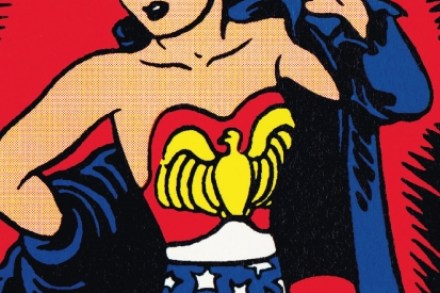
Wonder Woman: feminist symbol or the ultimate male fantasy?

It’s always interesting when people succeed in two different arenas — like Mike Nesmith’s mum, who gave the world both a Monkee and Tippex, or Hedy Lamarr, the beautiful film star who also helped develop wireless communication, or Paul Winchell, the voice of Tigger who also invented the artificial heart. (If only he’d played the Tin Man in The Wizard Of Oz!) William Moulton Marston created both the cartoon heroine Wonder Woman and the lie detector machine, though by the time I had finished this book I was wondering how he found the time or the energy to do either.

For some left-wing men, the misogyny of the Islamic State is part of the appeal

Watching the recent footage of Islamic State gang members haggling over the price of captured Christian women in a makeshift slave market — one of them wants a 15-year-old with green eyes, another wants to exchange a girl for a gun — I was reminded that Islamists are at least consistent in their hateful worldview and in a way uniquely honest. Even a terror gang as vile as the IRA tried to keep a lid on the rapes and paedophilia going on within its rancid ranks.

Spectator books of the year: Julie Burchill on Julie Burchill

I couldn’t work out whether Caitlin Moran’s How to Build a Girl (Ebury, £14.99) was aimed at mature adolescents or immature adults, but I loved it anyway — even before I came across the very pleasing mention of myself in Chapter 20, and the even better one in Chapter 24. Tamar Cohen’s The Broken (Doubleday, £6.99) was that miracle — a novel about the disintegration of a middle-class marriage which didn’t make me sneer once, thanks to the cliché-free freshness of the writing. But my favourite book of the year has to be Unchosen: Memoirs of a Philo-Semite (Unbound, £14.99) by Julie Burchill: a wonderfully cool-headed and unbiased writer I’m sure we’ll be hearing a lot more from.

Pop stars at prayer – from Madonna to the Beatles, and jihadist Cat Stevens

A spoof in the Israeli Daily recently had Eminem planning to convert to Judaism and move to Tel Aviv. But I don’t think we’ll be seeing that any time soon - he’s not really waiting for the Messiah, he’s just a very naughty boy. Still, stranger things have happened. I was very amused by the Reverend Richard Coles recently; when asked if he is the only vicar who has ever topped the British pop charts, he said 'Yes, but I met the vicar of Hitchen the other day and I said 'We've met, haven't we? Was it through the church?"' Apparently the vicar of Hitchen replied 'No, I was in Pigbag in the 1980s!

‘Hang ’em high!’ – leftists for the death penalty, re Pistorius et al

O, the fury of my Sisters over the risible punishment (I’ve seen longer sentences in Ulysses) handed out to Oscar Pistorius! I’m with them all the way on this one. On hearing that India had issued the death penalty to the four men convicted of raping and murdering a student in Delhi last year, my first reaction was, ‘Ooo, good ­I hope it’s televised!’ I have long been a supporter of the death ­penalty for any type of killing except the most self-defensive kind - and I see this as an important part of my identity as a feminist, especially. Two women a week are killed by partners or ex-partners, and in my opinion, the more woman-murderers who are forced to meet their Maker, the better.

Why I’ll never want to escape Portmeirion

My husband and I stay for a week most summers in Portmeirion, the strangest and loveliest ‘village’ in the world. Built amid 20 miles of woodland on the peninsula of Tremadog Bay in Wales, it was called ‘a home for fallen buildings’ by its creator Clough Williams-Ellis, a local landowner. It was opened in 1926, and George Bernard Shaw, H.G. Wells and Bertrand Russell were early visitors; Noël Coward wrote Blithe Spirit here in 1941. I won’t try to describe it; if you’ve never seen it, just google it and prepare to be astonished. But oy, the drive! In the past we’ve motored from Brighton through Birmingham, a trip of more than eight hours.

Women on Facebook are too bitchy even for me

In the heyday of the Hollywood studio system, Louis B. Mayer, head of MGM (‘More stars than there are in the heavens’) was rumoured to have had a very strange chart on his wall. This graph, allegedly, kept a record of the menstrual cycles of the studio’s leading ladies: Ava Gardner, Lana Turner, Grace Kelly and the rest. By consulting it, directors and cameramen knew when their precious cargo might be feeling a mite tearful and would ruin her make-up if spoken to sharply, or when her skin might not be in the best condition for a big close-up.

Romance isn’t a religion. Stop looking for The One and join The Queue

[audioplayer src="http://traffic.libsyn.com/spectator/TheViewFrom22_21_August_2014_v4.mp3" title="Julie Burchill and Louise Mensch discuss whether 'The One' exists" startat=1773] Listen [/audioplayer]Pity the modern starlet. Be she steaming-hot pop-tart or reality-show show-off, her range of emotional experiences will, thanks mostly to the gentlemen of the press, be strictly limited. She will have ‘lonely hells’ (often but not always linked to ‘drug hells’), ‘sex romps’ (sometimes ‘three-in-a-bed’) and watch her life ‘spiralling out of control’.

Want a fun job? You just have to pick the right parents

Recently one morning, as I was weeping over Caitlin Moran’s (daughter of Mr and Mrs Moran of Wolverhampton) brilliant book How to Build a Girl — specifically, the heartbreaking way she writes about coming from an impoverished family — a report came on to the radio with the glad tidings that working-class white children are now doing worse in schools than any other ethnic group. Said one Graham Stuart, the Conservative chairman of the education select committee, ‘They do less homework and are more likely to miss school than other groups. We don’t know how much of the underperformance is due to poor attitudes to school, a lack of work ethic or weak parenting.’ No, we don’t, do we?