John R. Bradley

Has Saudi Arabia just pivoted towards Russia?

From our UK edition

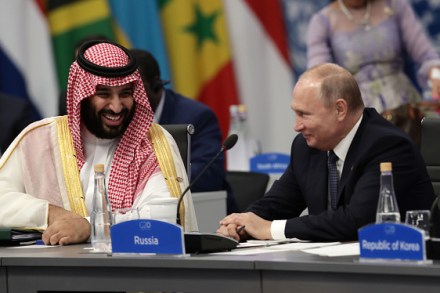
For all but the most harried journalist motivated by a need to pay off the mortgage, the annual G20 summit – being held this weekend in Buenos Aires – is typically viewed as a perfect cure for insomnia. Who will stand next to whom in the family photo? Will the wording of a final statement be agreed by all leaders before the official deadline? Yawn yawn yawn. However, there is an exception to every rule. And yesterday’s opening ceremony proved to be just that. First, a hot mic picked up parts of a tense conversation between the French President and Saudi Crown Prince. While hardly a slanging match, it was the most undiplomatic spat between a Western and Saudi leader ever made public.
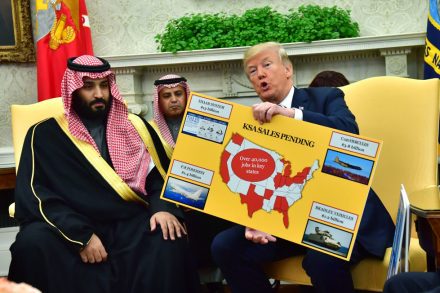
Why Trump is right to stand by Saudi Arabia

You have probably never heard of journalist Turki bin Abdul Aziz Al Jaser. He was beaten to death last month by the Saudi regime in one of the kingdom’s notorious torture chambers. He had been ‘forcibly disappeared’ by the security forces in March, after a spy at Twitter’s headquarters in Dubai reportedly connected him to an account highlighting the regime’s human-rights abuses. Contrast the scant American media interest in that outrage with the ongoing frenzy surrounding the slaughter of Jamal Khashoggi by a Saudi hit squad in Istanbul.

donald trump mohammad bin salman saudi arabia

What Mohammed bin Salman did next

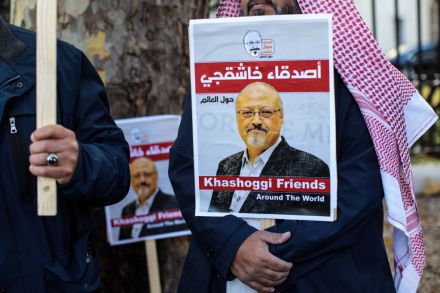
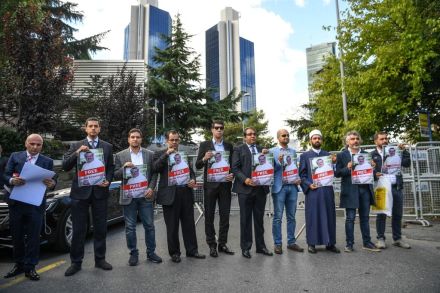
Nine days after Jamal Khashoggi was butchered like an animal in the Saudi consulate in Istanbul by a 15-strong hit team almost certainly sent on their mission by Crown Prince Mohammed bin Salman, The Spectator published a cover story by me on his murder and the political intrigue that I believed lay behind it. The essay was reprinted here, the UK magazine’s USA website, under the headline ‘What the Media Aren't Telling You About Jamal Khashoggi’. It was contemptuously dismissed by American policy wonks. And in an especially scurrilous hit piece by Khashoggi’s former colleagues at the Washington Post, I was indirectly accused of dredging up Khashoggi’s Islamist past to ‘smear’ him. What had I done to earn such wrath?

mohammed bin salman jamal khashoggi

Hostages to fortune

From our UK edition

It says something about the level of political discourse in America that Donald Trump decided to trumpet sanctions on Iran not with a speech, but a Twitter meme in reference to Game of Thrones. 'Sanctions are coming,' he says - in a picture that might be funny if it were not so serious. The White House is, in its head, playing out a drama where it imposes sanctions and brings the Ayatollahs to heel. In reality, things are working out very differently. When it comes to the goal of containing Iran, Trump is indeed living in a fantasy land. The date in Trump's tweet is 5 November, the day America ratchets up already devastating economic sanctions against Iran, following Washington’s unilateral withdrawal in May from the nuclear treaty brokered by Barack Obama.

Jamal Khashoggi was no fighter – but he was a turncoat

If ever a history of botched cover-ups that made things even worse for the criminal conspirators is written, the official explanation from Riyadh of why Jamal Khashoggi died in the Saudi consulate in Istanbul – it was an argument that turned into a brawl – will rank right up there with Watergate and the Dreyfus affair. The most obvious problem for the Saudis is that Turkey – Saudi Arabia’s rival for regional hegemony – has video and audio of what actually took place. And they insist that Khashoggi was slaughtered like an animal on the Saudi consul’s desk just minutes after entering the building.

jamal khashoggi

How Trump cleans up the Saudi mess

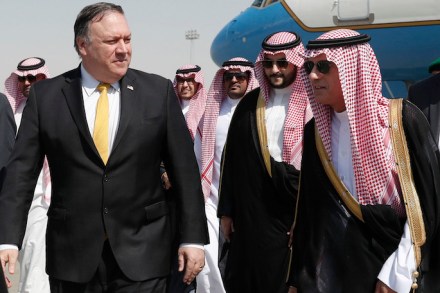
Secretary of State Mike Pompeo arrives in Saudi Arabia today, dispatched at short notice by President Donald Trump. His mission near-impossible? To help orchestrate a believable cover-up for the kingdom's brutal murder at the Saudi consulate in Istanbul two weeks ago of Muslim Brotherhood activist, and one-time Saudi intelligence officer, Jamal Khashoggi. CNN says the Saudi regime may finally be ready to admit that Khashoggi was murdered, but will portray it as an accident during an attempted abduction gone wrong. The blame will be placed on (in Trump’s words) ‘rogue elements’ in the Saudi security apparatus, who improbably undertook the task without the consent or knowledge of the Saudi leadership.

mike pompeo saudi arabia

Death of a dissident

From our UK edition

As someone who spent three decades working closely with intelligence services in the Arab world and the West, the Saudi dissident and Washington Post columnist Jamal Khashoggi knew he was taking a huge risk in entering the Saudi consulate in Istanbul last week to try to obtain a document certifying he had divorced his ex-wife. A one-time regime insider turned critic of Crown Prince Mohammed bin Salman — the de facto head of the Saudi kingdom which tolerates no criticism whatsoever — Khashoggi had been living in Washington for the previous year in self-imposed exile amid a crackdown on independent voices in his homeland. He had become the darling of western commentators on the Middle East.

When it comes to Iran, Trump is surprisingly impotent

After sending his all-caps tweet last week warning Iranian President Hassan Rouhani never, ever to threaten the United States again or risk armageddon, this week Donald Trump told a press conference that he would be more than happy to meet with the Iranian leader – anytime, anywhere, without preconditions and from neither a position of strength nor weakness – to discuss the diplomatic impasse over Iran’s nuclear energy programme. In the interim, the head of Iran’s formidable Republican Guard Corps, Major General Qasem Soleimani, had responded to Trump’s tirade with one of his own, threatening merciless retaliation against US interests globally should Iran be attacked. ‘Come. We are ready.

Trump escalates the anti-Iran rhetoric. But why now?

It may be tempting to dismiss Donald Trump’s late-night tirade against Iran as just another Twitterstorm in a tea cup. “NEVER, EVER THREATEN THE UNITED STATES AGAIN OR YOU WILL SUFFER CONSEQUENCES THE LIKES OF WHICH FEW THROUGHOUT HISTORY HAVE EVER SUFFERED BEFORE,” he blasted, committing the cardinal social media sin of employing capitals – we hear you, Mr President! – that not even his most violent threats against North Korean leader Kim Jong-un had warranted. He was responding to a combative speech a few hours earlier by Iranian President Hassan Rouhani, and as the US gears up to impose sanctions on countries (including EU member states) that do not cut imports of Iranian oil by Nov.

The rehabilitation of Assad

From our UK edition

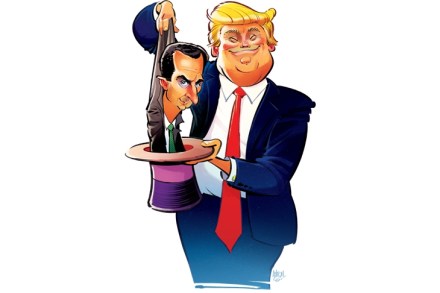
Amid the confusion and the almost deafening cries of treachery and collusion over Donald Trump’s relations with Russia, few noticed the most tangible outcome of this week’s Helsinki summit. In the lead-up to his face-to-face talk with Vladimir Putin, senior US and Russian diplomats — in close coordination with leaders from mutual ally Israel — brokered a deal among all the warring parties (bar the Islamist terrorists) finally to end the devastating seven-year Syrian civil war. As is often the case with Trump, the hype tends to drown out the message but it was there for anyone paying close enough attention. The US, Russians and Israelis have agreed on a solution to Syria. His name is Bashar al-Assad.

… and of progress

From our UK edition

In an interview this week, Mohammad bin Salman offered an extraordinarily frank assessment of how to combat terrorism. It means rooting out Islamist ideology, he said, as much as sharing intelligence. He presumably would take this blunt message to MI5 and MI6 in his meetings with those agencies, as well as to Theresa May’s National Security Council. This should provide plenty of food for thought to the cynics who argue against being taken in by his much-trumpeted embrace of a more moderate Islam. We have a Saudi crown prince who is being more frank about Wahhabi-inspired terrorism than the British. Just last year, the UK government saw fit to suppress a report that found a link between Saudi-funded mosques and Isis-inspired terrorist attacks.

Is Mohammad bin Salman a friend to the West?

From our UK edition

Amid the avalanche of news coming from Saudi Arabia, the most important has been overlooked. A few weeks ago Riyadh ceded control of the Grand Mosque in Brussels, leased to the Saudis in 1969 and since then instrumental in promoting Islamic supremacy, anti-Christian and anti-Semitic hatred in the heart of Europe. The deal had given Saudi-funded imams control of the religious education received by the Muslim immigrant community in Belgium, in return for cheaper oil. It was a pact with the Wahhabi devil then typical of European governments. And we are still paying the price. When Islamic States called for Muslims to launch jihadist slaughter throughout the European continent, the most radicalised sections of the local Muslim populations were ready.

A new Iranian revolution should worry the West

From our UK edition

Is Iran on the brink of a revolution? The mullahs' main political adversaries in Washington and Tel Aviv appear to think so, as does much of the western media. With the Wall Street Journal reporting that Iran's elite Revolutionary Guard Corps is taking charge of security in Tehran, it is equally clear that the regime is taking no chances. And perhaps wisely so. The last time the repressive Islamist theocracy witnessed such popular upheaval was in 2009. But then the mostly peaceful mass street demonstrations were orchestrated under the unifying banner of a maverick politician, Mir Hossein Mousavi, and what briefly blossomed into his Green Movement.

Desert storm

From our UK edition

Until last weekend, the Ritz-Carlton in Riyadh’s exclusive Diplomatic Quarter was colloquially known as the Princes’ Hotel. It was a luxurious retreat from the heat, where royals could engage in the kind of wheeling and dealing with the global business elite that had made them millionaires on the back of the 1970s oil boom. No deal could be brokered without paying a bribe to at least one prince. Last Saturday that era of boundless opportunity and total impunity came to a dramatic end. The VIP guests were booted out, the front doors were shuttered, and heavily armed security forces took up positions around the perimeter. A Saudi who lives nearby sent me a message about what he thought was an unfolding terrorist incident.

Arabian nights

From our UK edition

Recall the media coverage at the height of the Jimmy Savile scandal, times it by about a thousand, and you get an idea of the hysteria currently surrounding gay men in Egypt. That’s not an arbitrary analogy. The social ramifications of coming out as a ‘gay man’ in most parts of the Middle East are the same as for some chap on a council estate in Barnsley declaring in a packed pub at closing time that he has a 12-year-old girlfriend. Two detained gay rights campaigners who waved the rainbow flag at a recent Cairo pop concert, and thus provoked the clampdown, are presently learning that the hard way.

Putin the peacemaker

From our UK edition

When Russia entered the Syrian civil war in September 2015 the then US secretary of defense, Ash Carter, predicted catastrophe for the Kremlin. Vladimir Putin was ‘pouring gasoline on the fire’ of the conflict, he said, and his strategy of fighting Isis while backing the Assad regime was ‘doomed to failure’. Two years on, Putin has emerged triumphant and Bashar al-Assad’s future is secure. They will soon declare victory over Isis inside the country. The dismal failure turned out to be our cynical effort to install a Sunni regime in Damascus by adopting the Afghanistan playbook from the 1980s. We would train, fund and arm jihadis, foreign and domestic, in partnership with the Gulf Arab despots.

Forget our misguided friendship with Saudi Arabia: Iran is our natural ally

From our UK edition

The Saudi town of Awamiya — like so many countless cities across Iraq, Syria and Yemen that are witnessing an unleashing of the ancient hatred of Sunni for Shia — now exists in name only. Last month, days before an assault on its Shia inhabitants by the Saudi regime, the UN designated it a place of unique cultural and religious significance. But under the guise of fighting Iran-backed terror cells, the Saudis then subjected Awamiya’s entire civilian population to the indiscriminate use of fighter jets, rocket-propelled grenades, snipers, heavy artillery, armoured assault vehicles and cold-blooded executions. More than a dozen Shia, including a three-year-old boy, were killed. Hundreds of young men were rounded up.

Iran is our natural ally

From our UK edition

The Saudi town of Awamiya — like so many countless cities across Iraq, Syria and Yemen that are witnessing an unleashing of the ancient hatred of Sunni for Shia — now exists in name only. Last month, days before an assault on its Shia inhabitants by the Saudi regime, the UN designated it a place of unique cultural and religious significance. But under the guise of fighting Iran-backed terror cells, the Saudis then subjected Awamiya’s entire civilian population to the indiscriminate use of fighter jets, rocket-propelled grenades, snipers, heavy artillery, armoured assault vehicles and cold-blooded executions. More than a dozen Shia, including a three-year-old boy, were killed. Hundreds of young men were rounded up.

An unholy alliance

From our UK edition

Israel’s Channel 2 news station improbably made history last week by airing a brief interview with an obscure policy wonk named Abed al-Hamid Hakim. The subject was the blockade of Qatar imposed by the Saudis and a couple of other despotic Sunni Arab rulers to punish the country for its ties to Iran, Hamas and the Muslim Brotherhood. It obviously wasn’t what Hakim had to say — religion should not be used to justify violence and extremism; we should all try to live in peace and harmony — that aroused interest. Rather, it was where he was sitting when he said it: Jeddah, the commercial capital of Saudi Arabia. For the first time ever, here was a Saudi national being interviewed live on Israeli TV, complete with Hebrew subtitles.

The Islamic State goes global

From our UK edition

When the creation of a new caliphate was announced last year, who but the small band of his followers took seriously its leader’s prediction of imminent regional and eventual global dominance? It straddled the northern parts of Syria and Iraq, two countries already torn apart by civil war and sectarian hatreds. So the self-declared caliph, Abu Bakr al-Baghdadi, appeared to be just another thug and opportunist ruling over a blighted no-man’s land, little known and still less revered in the wider Islamic world. He was surrounded by a rag-tag army of jihadis, whose imperial hubris seemed to reflect only a warped genocidal fanaticism.