John Keiger

John Keiger

John Keiger is a former Research Director at the University of Cambridge and author of the biography of French president Raymond Poincaré

Europe’s centre of gravity is shifting towards Poland

From our UK edition

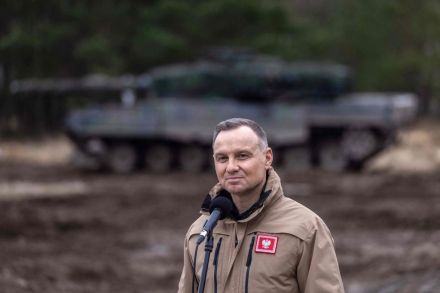
The President of the United States of America flies into Poland this month. Not to Germany or France or even the UK. There is great symbolism in this gesture, which goes further than Washington merely showing solidarity to the front-line states in Russia’s war against Ukraine. It is emblematic of a trend which has seen Europe’s geopolitical fulcrum shift eastwards. Russia’s war against Ukraine has exposed the impotence of the western-European establishment Once upon a time Europe’s centre of gravity was west of the Elbe. This was underlined by the reality of the Cold War, by economic might, by western Europe’s military ascendancy reinforced by the United States’ physical presence, and by the western focus on European integration.
What Germany can learn from Japan about the new world order

From our UK edition

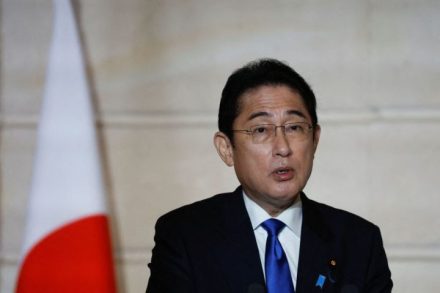
The end of the second world war saw the defeated aggressors Germany and Japan accept moral capitulation and begin new international lives as liberal democratic and largely pacifist states bent on cooperation not coercion. But over the last few years an increasingly unsettled international order has emerged to test the pacifism of the fourth and third largest economic powers. Russia’s aggression against Ukraine has finally cajoled a reluctant Germany out of its semi-neutral stance. As war returned to the European continent, Berlin has bowed to Western pressure to release its Leopard tanks to a martyrised Ukraine. No longer virgo intacta, Berlin has forfeited its 80 year state of innocence.

Britain’s Ukraine strategy could reap dividends for Brexit

From our UK edition

Ever since at least the French revolution it has been in Britain’s strategic interest to ensure no single power or group of powers dominates the continent of Europe. Britain’s motives were always military and, as an international trading nation, commercial. Today the Russian invasion of Ukraine presents the UK with a strategic opportunity to stymie Moscow’s aggression and to mollify the EU’s cussedness over the Brexit settlement. Britain’s stock has risen amongst EU members, just as France and Germany’s has declined Britain’s forward military stance on defending Ukraine against Russia is in the same vein as her defence of Belgium in 1914 or Poland in 1939.

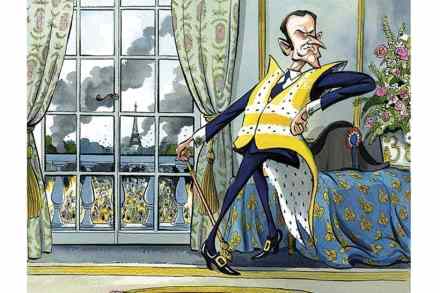
All is not well in Macron’s France

From our UK edition

The relationship entertained by French elites to their homeland is very different from their English counterparts. 'England is perhaps the only great country whose intellectuals are ashamed of their own nationality', wrote George Orwell in 1945. That derisory sentiment continues today among Britain's urban elites. French elites by contrast – though they can be highly critical of their country among themselves – do not shy from exalting its status abroad. French nationalism, born of the French Revolution, only came to be embraced by the right a century later. From then onwards, basic patriotism crosses political boundaries. While Britain’s position is not rosy, France’s is certainly no better Elite francofilia has long been a facet of English snobbery.

Brexit’s critics are strangely quiet about the European parliament scandal

From our UK edition

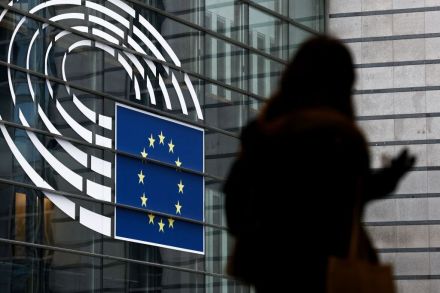
The corruption scandal embroiling the European parliament and the European Union’s institutions at the highest level is shaping up to be its biggest to date. Belgian police have arrested Eva Kaili, a vice-president of the parliament, and three others in an investigation into alleged bribes involving spectacular sums in cash, allegedly from Qatar, to influence EU officials and parliamentary voting. ‘The shockwave of 'Qatargate' is Le Monde’s take on a story it says threatens to 'destabilise Europe’s institutions’. This isn't an exaggeration: the probe ripples out to the whole progressive ecosystem surrounding the parliament. Among the suspects, according to the BBC, is former MEP Pier Antonio Panzeri, who now manages the human rights group Fight Impunity.

Macron’s humiliating climbdown over Aukus

From our UK edition

Guess who turned up in Bangkok this week at the 21-nation Asia-Pacific Economic Cooperation meeting? The forum, which includes the US, China, Australia, Japan, Russia, but not France, was visited by none other than President Macron. ‘You must be asking yourself what a French president is doing here’, he charmed in English.  Macron claimed to be the first European leader to be invited to the forum. He insisted he was there because France is ‘a country of the region’. According to the Elysée this invitation ‘validates the Indo-Pacific strategy launched in 2018’. It does indeed, but with far more subtle ramifications.

Is Macron trying to lasso London?

From our UK edition

Some supporters of the EU might struggle with the concept, but Europe is about much more than just what unfolds in Brussels. The EU’s 27 states may be a large part of Europe, but the two are not coterminous. Nor, more importantly, do they all have the same interests. The newly created European Political Community (EPC) had its first meeting in Prague over the last couple of days. Including those states on the fringes of Europe, as the EPC does, the number in attendance was 44 (with Belarus and Russia excluded). Beyond the EU 27 there is Turkey, the UK, Ukraine, Norway, Switzerland, Iceland, Liechtenstein, six Western Balkans nations, Moldova, Georgia, Armenia and Azerbaijan.

France and Britain are brothers in despair

From our UK edition

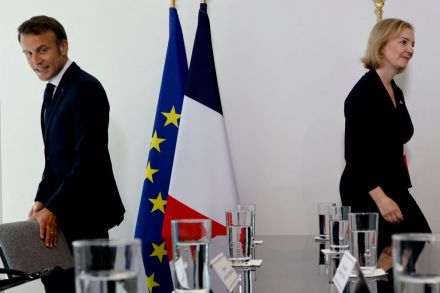
Since Brexit, Britain and France appear to have drifted apart. Leaders from both countries have engaged in an on-off war of words. But despite these political fractures, Britain and France have actually come to resemble each other more closely than ever. It is now difficult to differentiate the economic, financial, social and political conditions that exist on both sides of the Channel.  France and Britain face a wave of strikes over the coming months. After a lull over the summer, Gallic workers are once again walking out: public sector and railway worker unions staged a national strike for wage increases last week. Even moderate unions are now threatening mass stoppages if Macron continues his labour reforms.

France loved the Queen

From our UK edition

The tribute paid by France to Her Majesty Queen Elizabeth II has been heartfelt, fulsome and moving. French media across the board have paid generous homage, as though to one of their finest, to Britain’s longest serving monarch – surpassed in world history only by Louis XIV acceding as a babe-in-arms. This vicarious Panthéonisation was admirably encapsulated by Emmanuel Macron, the 10th French president the British sovereign had known. In a moving video in English posted on Twitter on Friday, foregrounded against the Union Jack, he poignantly encapsulated the feelings of his people and their ‘emptiness’ at the British monarch’s death: ‘To you she was your Queen; to us she was the Queen’.

The French buy-out that explains Macron’s strategy

From our UK edition

It’s a platitude that France and Britain are rivals and have been for centuries. But, since the 1904 Entente Cordiale, the rivalry is more a question of competition than conflict. Always, in the darkest hour, each sided with the other, even if post-war they didn’t fully recognise the other’s contribution. Britain congratulated itself over the Dunkirk evacuation when in truth without French troops holding off the Germans, the ‘plucky’ armada would never have completed its mission; to this day the French believe that American troops were more numerous than British in the Normandy landings.  With the passing of the French war-time generation the postwar moral debt to Britain and residual goodwill were expunged.

Boris and Macron’s ‘bromance’ is rooted in despair

From our UK edition

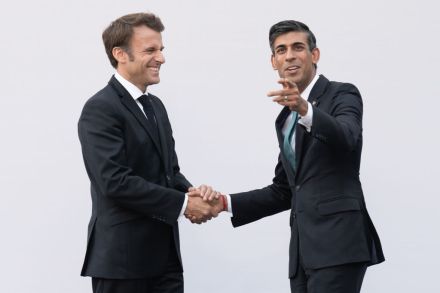
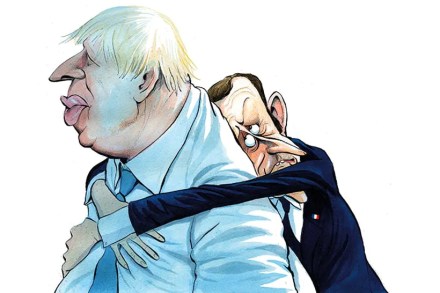
Is 'Le Bromance' really back on? Boris Johnson suggested as much at the G7 summit in Bavaria this week, where he strolled arm-in-arm with Emmanuel Macron. Yet when one considers the breadth of subjects the two avoided in their discussions – no Northern Ireland Protocol, cross-Channel migration, or Aukus – it is hard to believe the basis of their renascent friendship is better Franco-British relations. The reality is that their jaunt overseas, epitomised by Bojo and Manu’s communal clowning, comes as a blissful diversionary and recreational break from domestic woes. Their new-found fraternity may lie in shared solace at their strikingly similar political predicaments. Macron may have been reelected president on 24 April, but over half of his 58.

Emmanuel Macron’s future looks bleak

From our UK edition

The single headline across the front page of the centre-left daily Libération said it all: ‘La Gifle’. But much more than a slap in the face, Emmanuel Macron has taken a heavyweight sock in the jaw. With only 245 seats for his ‘Ensemble!’ grouping, the French president is a country mile from having a parliamentary absolute majority (289). Then there is the drubbing his lieutenants took with the ousting of three ministers, the president of the national assembly and the leader of his parliamentary LREM party. All lost their seats. Sunday’s legislative results are a full-frontal humiliation for Macron personally, ideologically, politically and institutionally.

Why is Macron so desperate to bring Russia in from the cold?

From our UK edition

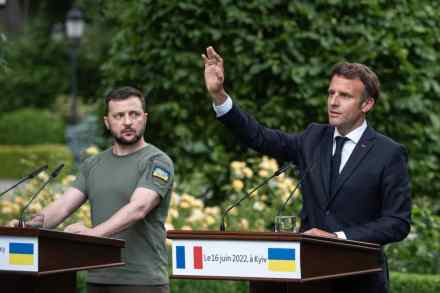
Emmanuel Macron should get a new historical advisor. He continues to repeat – this time at his Kyiv press conference on Thursday – that Russia must not be humiliated following its invasion and war against Ukraine. Politicians indiscriminately pluck at historical examples to justify controversial policies. For Macron, the aftermath of the First World War serves as a warning against the dangers of humiliating adversaries. According to the French president, humiliation of Germany in the 1919 Versailles Peace treaty resulted in the allies losing the peace and Germany plotting revenge and renewed war twenty years later. He actually turned at this point to German chancellor Olaf Scholz, who had accompanied him (with Mario Draghi of Italy), to emphasise the point.

France could plunge the eurozone into its next crisis

From our UK edition

In the French presidential elections, and now in the legislatives that will close on Sunday evening, the one issue kept under the carpet is finance. Neither the centrist Macronista grouping ‘Ensemble!’, nor the far-left Corbynista-like Nupes coalition of Jean-Luc Mélenchon has updated the electorate on how their manifestos are to be funded. And yet over the last month French finances have deteriorated dramatically. Neither programme has the slightest chance of being implemented without plunging French finances, and thus the eurozone generally, into a new sovereign debt crisis. France is dancing on a debt volcano.

France is eternally divided

From our UK edition

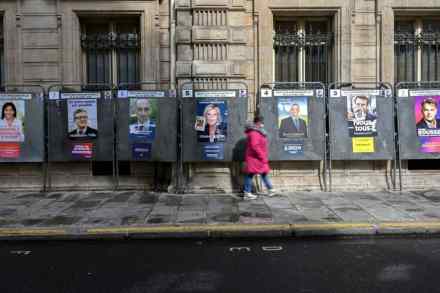
A lot happened in France last night. After a lacklustre performance, long disillusioned supporters were unable to summon any enthusiasm for Paris Saint Germain football team’s French league championship success. Emmanuel Macron was re-elected French President beating Marine Le Pen 58.5 to 41.5 per cent and the official disco party celebration organised beneath the Eiffel Tower finished early. A short distance away on the Pont Neuf police shot and killed two men who drove a car at them. Demonstrators took to the streets and threw fireworks in protest against Macron’s election in Paris, Lyon, Strasbourg, Rennes, Grenoble and a host of other French towns where teargas scuffles took place. Emmanuel Macron made the shortest victory speech of his career.

Marine Le Pen may reshape Europe – even if she loses

From our UK edition

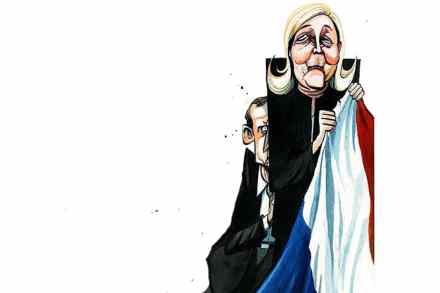
It has been a truism since the nineteenth century that international affairs do not decide French elections. Yet last week, only three days into the run-off campaign, Marine Le Pen gave a press conference setting out her foreign and defence policy vision. At heart, it’s a classic Gaullist project. Even if she loses, it could seriously influence French policy, because much will depend on the size of Emmanuel Macron’s parliamentary majority and the strength of radical left and right groupings come the June legislative elections. Le Pen’s international project draws a clear line between her nation-state based realpolitik – in the ascendant in France and elsewhere – and waning globalist liberal internationalism, so closely associated with Macron.

Even if he wins Macron could be facing disaster

From our UK edition

Unaccustomed as political scientists are to florid language, they have nevertheless come up with the ‘theory of the dyke’, to explain the continuing success of the nationalist and identitarian Rassemblement National. A dyke can hold back the flood for so long, but once water has overflowed there is no getting it back. When in 2002 Marine Le Pen’s father, against all odds, beat the socialists to go through to the presidential run-off against Jacques Chirac, there was no reversing the flow. Marine Le Pen’s score of 23.1 per cent in the first round of the election this week is the highest in the nationalist right’s 50-year history.

France is on the brink of a political realignment

From our UK edition

Until a week before today’s first round of the presidential race the French appeared to be shunning their favourite electoral contest. Polls showed that undecided voters, potential abstainers or those likely to cast a spoilt ballot was higher than in the past. Covid and the Ukraine war were blamed for having robbed French citizens of their election. A further reason was incumbent president Emmanuel Macron. He has doubled down on Jupiterian aloofness since his election. He refused to declare his candidacy until the very last moment, condescendingly shunned invitations to debate with other candidates and pompously claimed that affairs of state were more important than election campaigning. Why bother when polls put him well ahead of his rivals?

Who’s to blame for France’s catastrophic intelligence failure in Ukraine?

From our UK edition

From the outset of the war in Ukraine, the 'Five Eyes' intelligence agencies have accurately predicted every twist and turn of Putin's playbook. The United States, the UK, Canada, Australia and New Zealand have been linked in the world’s most sophisticated and integrated all-source intelligence gathering and analysis organisation since the Second World War. In doing so, they have offered up spoilers for Russian strategy, disorientating and disorganising president Putin’s planning.  The losers of the war so far then are clearly the Russians whose intelligence gathering and analysis of Ukraine’s and Nato’s reactions to invasion has been lamentable. But they are not alone in their intelligence blunders.

Did the end of the Cold War make conflict in Ukraine inevitable?

From our UK edition

Russia's invasion of Ukraine shows, once again, that seismic shifts in the international order are inexorably followed by war. The adjustment invariably involves a declining power – in this case Russia, following the collapse of the Soviet Union – and a rising power – the West. So are we on the brink of a wider conflagration? Or might Putin's war result in a return to some semblance of peace, if a treaty between Ukraine and Russia can be thrashed out? Whatever happens, one thing has become clear in recent weeks: the Cold War ‘defeat’ of the Soviet Union – albeit morally not militarily – should have led to an adjustment of all the parties to the new international order. It didn't.