James Walton

James Walton is The Spectator’s TV critic

Channel 4’s Beth is a sad glimpse into the future of terrestrial TV

From our UK edition

On the face of it, Beth seemed that most old-fashioned of TV genres: the single play. In fact, Monday’s programme was the complete version of a three-parter made for YouTube and excitedly announced as Channel 4’s first-ever digital commission. A less excited interpretation, however, might be that it was Channel 4’s first sign of surrender to the hostile forces of streaming now threatening all of Britain’s terrestrial networks. Either way, it was a peculiar watch that, over the course of its 36 minutes, felt less like a fully fledged drama than notes towards one. In a nervous bid to ensure YouTube viewers were gripped before they could search for something else, it began with a good-looking couple having sex. But not for long.

Why is the BBC making stuff up about Jane Austen?

From our UK edition

Jane Austen: Rise of a Genius began by saying that ‘getting into her mind isn’t easy’ – something you’d never have guessed from the rest of the episode, where both the narrator and the talking heads were able to tell us exactly what Austen was thinking and feeling at any given time. Like many Austen biographies, this one laments her sister Cassandra’s decision to burn most of her letters, but then takes full advantage of how little we consequently know about her to portray (or possibly make up) a woman whose attitudes are spookily close to its own. In a previous era, this might have meant presenting Austen as a gentle and contentedly domestic aunt. Now of course it means that ‘at a time when women were supposed to know their place, Austen ripped up the rulebook’.

Tantalisingly ambiguous – or just plain baffling: Hallow Road reviewed

From our UK edition

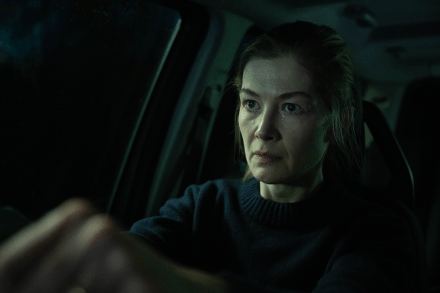
An 80-minute film which for almost all of the time features two people in a car mightn’t sound particularly ambitious. In fact, though, Hallow Road is bursting with so many ideas and genres that by the end they risk blowing it apart completely. At first, it looks as if we’re in for a mix of family drama, psychological thriller and anxiety dream – which indeed we are, but only for starters. After some characteristically disorientating (it turns out) shots of an apparent crime scene – an abandoned meal, glass strewn across the floor – Maddy Finch (Rosamund Pike) receives a 2 a.m. phone call from her distraught daughter Alice (the voice of Megan McDonnell). Following a row over dinner, Alice has driven off in her dad’s car.

How come the only Palestinians Louis Theroux met were non-violent sweeties?

From our UK edition

Louis Theroux: The Settlers was never likely to be a programme with much of a narrative arc – and so it proved. In the first 30 seconds, Louis put it to a Jewish householder on the West Bank that his house was ‘quite deep in what are called the Palestinian Territories’. ‘You call it the Palestinian Territories,’ the man replied. ‘I call it the heart of Judea.’ And that, on the whole, was that. Louis travelled from one Jewish settlement to another, doing his best to challenge the inhabitants with his faux-naif questions and impressive range of quizzical expressions. And yet, of course, none of them budged an inch.

Good lawyers make for bad TV

From our UK edition

Given that TV cameras aren’t allowed to film British criminal trials, Channel 4’s new documentary series Barristers: Fighting for Justice is a courtroom drama without the courtroom. As for the drama bit, the programme does its excitable and occasionally successful best – but isn’t always backed up by its own participants, who on the whole are a serious and disappointingly discreet bunch. All of them, you imagine, would have plenty of cracking tales to tell after a few drinks. As things stand, however, they stick firmly to no-shit-Sherlock generalisations. ‘What I do is present the defence case on behalf of my client,’ said one in Tuesday’s episode. ‘It’s very important that innocent people aren’t convicted,’ argued another.

How fun is it being part of an Amazonian tribe? 

From our UK edition

Tribe with Bruce Parry ran for three fondly remembered series in the mid-2000s. Now, upgraded to Tribe with Bruce Parry, it’s back, still championing traditional ways of life – including that of a TV presenter who lives among remote peoples, takes loads of drugs with them and marvels at their closeness to nature. Sunday’s episode featured some other age-old practices, too. Parry, for example, duly travelled up an Amazon tributary to a village where the locals were initially suspicious of ‘the white man’. He then won them over by mucking in with the chores and eating plenty of insects and grubs. His companions this time were the Waimaha, who live in the Colombian rainforest, communing with its spirits.

Netflix’s Adolescence is seriously flawed

From our UK edition

Bradley Walsh: Egypt’s Cosmic Code may sound like a pitch by Alan Partridge – but, impressively, the programme itself manages to be even odder than its title. Naturally, Tuesday’s opening episode began with Bradley emphasising that his interest in Ancient Egypt long predates his signing of the contract for the show. Indeed, it was back when he was an apprentice at Rolls-Royce that he first realised ‘whoever built the pyramids, it certainly wasn’t the Ancient Egyptians 4,500 years ago’. Sharing his scorn for this discredited idea was Tony McMahon, an ‘investigative historian’ who showed up now and again to say bonkers things in an authoritative and sonorous manner.

Anjelica Huston is comprehensively upstaged in the BBC’s new Agatha Christie

From our UK edition

Coincidentally, two of this week’s big new dramas began with a fourth wall-busting declaration of their narrative methods. At the start of Towards Zero, BBC1’s latest Agatha Christie adaptation, a man we later discovered to be a lawyer addressed the camera. ‘I like a good detective story,’ he told us. ‘But they begin in the wrong place. They begin with the murder’ – which should instead ‘come at the end of a long chain of cause and effect’. Get Millie Black opened with a voice-over explaining that ‘This is just another story about Jamaica… But like all stories in this country, it’s a ghost story’. As it transpired, both programmes followed their own prescripts – but in one case, with distinctly mixed results.

A return to the White Lotus

The White Lotus, now back for a third series, could perhaps be best described as Death in Paradise for elegant people. Most obviously, this is because its plots revolve around murders in an idyllic location — only with a far bigger budget, a much starrier cast and several episodes per story. But there’s also the fact that it follows the same pattern every time. So it was that season three began this week, rather like its predecessors, with some lovely scenery, a dead body and a caption reading "One week earlier." After that, we duly watched a bunch of rich, good-looking folks arriving at a luxury White Lotus resort where they were welcomed by the resolutely smiling staff and a nervous manager, before gazing round and marveling at the beauty of it all.

Lotus

The White Lotus is off to a shaky start

From our UK edition

The White Lotus, now back for a third series, could perhaps be best described as Death in Paradise for posh people. Most obviously, this is because its plots revolve around murders in an idyllic location – only with a far bigger budget, a much starrier cast and several episodes per story. But there’s also the fact that it follows the same pattern every time. So it was that season three began this week, rather like its predecessors, with some lovely scenery, a dead body and a caption reading ‘One week earlier’. After that, we duly watched a bunch of rich, good-looking Americans arriving at a luxury White Lotus resort where they were welcomed by the resolutely smiling staff and a nervous manager, before gazing round and marvelling at the beauty of it all.

Stately, sly and well-mannered: BBC1’s Miss Austen reviewed

From our UK edition

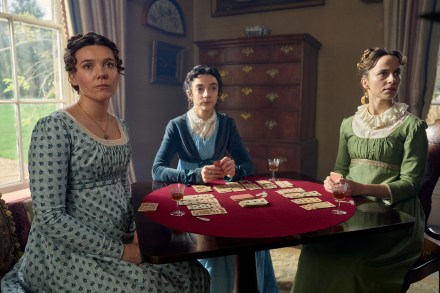
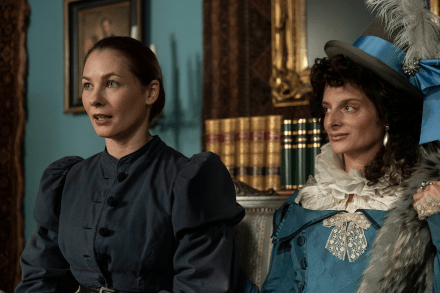
It is a truth universally acknowledged that lazy journalists begin every piece about Jane Austen with the words ‘It is a truth universally acknowledged’, so I’ll fight the temptation. In any case, the Miss Austen at the centre of BBC1’s new Sunday-night drama isn’t Jane, but her beloved sister Cassandra, best known for destroying most of Jane’s letters. Given that this has rendered our knowledge of the woman’s biography tantalisingly sketchy, Cassandra has attracted her fair share of resentment from Janeites. But rather cunningly, Miss Austen both exonerates her and takes full advantage of the sketchiness: high-mindedly questioning our entitlement to snoop into Jane’s private life, while feeling free to speculate on what that private life might have been.

Certainly intriguing: Apple TV+’s Prime Target reviewed

From our UK edition

Needless to say, there have been any number of thrillers that rely on what Alfred Hitchcock called a MacGuffin: something, however random, that the goodies have to find before the baddies do. Less common are those where the MacGuffin is the mathematical formula for prime numbers – which is where Apple TV+’s latest show comes in. His first thought on seeing a 204 bus was that 2042 is the sum of three consecutive cubes Prime Target began in ‘Baghdad, Iraq’ – and therefore in a bustling market. Or at least it bustled until a large gas explosion opened up a hole in the ground leading to a spectacular medieval chamber. For a while, the chamber went unexplained as we cut to ‘Cambridge, England’ – and therefore to eight strapping young men rowing on the river.

Playing Nice is beautifully done – but they miscalculated the opening scene

From our UK edition

There must have been a time when slow-burn psychological thrillers didn’t start with a scene of high drama followed by a caption that reads ‘Three months earlier’ – but if so, it’s getting hard to remember it. The latest programme to deploy the tactic was Playing Nice, which began with James Norton running towards the sea screaming ‘Theo!’ as a child’s body bobbed, face-down, in the waves. He was next seen, post-caption, laughing with his pre-school son in various picturesque Cornish locations while using the word ‘buddy’ a lot. Not to be outdone in the great-parent stakes, his wife also piled on the cuddles for little Theo. Before long, Miles had developed the habit of glowering menacingly when nobody was watching This idyll, however, didn’t last long.

Leavisites should stay away: Sky’s Bad Tidings reviewed

From our UK edition

Reviewing Sky’s The Heist before Christmas last year, I suggested that all feature-length festive television dramas begin with credits announcing a starry cast and end with a redeemed protagonist gazing up at some suddenly falling snow. Reviewing Sky’s Bad Tidings this year, I can rather smugly report that there’s no need to revise my theory. But just in case that isn’t enough television tradition to be going on with, here we also get that other Yuletide stand-by: the characters’ plans for the big day go hideously wrong, yet they still end up having the Best Christmas Ever. Viewed pleasantly drunk, I concede, Bad Tidings might just hit the spot The two main stars are Lee Mack and the man with a serious claim to be the breakout celebrity of 2024.

Spectator Competition: We can be heroes

From our UK edition

In Competition 3378, you were invited to give the full 18th-century, mock-heroic, rhyming-couplets treatment to any trivial recent event. Whether this was applied to news stories or more personal minor tragedies, the standard was remarkably high, with near misses for Alan Millard, Max Ross, Elizabeth Kay, Jasmine Jones and others. It was also striking just how many Spectator readers are impressively knowledgeable fans of I’m a Celebrity… Get Me Out of Here! The following win £25. As burnish’d russet fruit of spreading trees Burst from their spiny nests across the leas, Heroes were pitched in combat, ever bent On triumph in a momentous world event. For hark! The clash of conkers filled the air; Who dealt the mightiest blows, attacked with flair?

We’re wrong to mock Do They Know It’s Christmas?

From our UK edition

‘I hope we passed the audition,’ said an alarmingly youthful Bob Geldof at one point in The Making of Do They Know It’s Christmas? He was, of course, quoting John Lennon from the 1969 Beatles rooftop concert: an appropriate reference in the circumstances – because this documentary was a kind of Get Back for the Smash Hits generation. Like a far shorter version of Peter Jackson’s film of the Beatles at work, it mixed footage we’d seen before with stuff locked away in the vaults for decades. It was also equally unafraid of longueurs, equally determined to accentuate the positive and equally likely to warm the flintiest of hearts.

Spectator Competition: Plum assignment

From our UK edition

In Competition 3375 you were invited to submit an extract in which P.G. Wodehouse had a go at writing Raymond Chandler noir. Sad – and perhaps slightly pedantic – to report, quite a few entrants got this the wrong way round, writing Wodehouse’s material in a Chandler style, with references to hot dames at the Drones club etc. Some of these were admittedly very good but as The Spectator takes a stern line on the importance of reading the question, the following win £25 each. ‘Well done helping me sort that one out, Jeeves. The cops have arrested the chap with the face like an off-colour watermelon, and so Lydia won’t be going to the chair. More to the point, she seems to have given up on the idea that we are engaged.

Too cautious and wildly over the top at the same time: Paddington in Peru reviewed

From our UK edition

Toy Story or The Godfather? Which way would Paddington in Peru go? Would the third instalment of a much-cherished series prove even better than the second (which was even better than the first)? Or would it be a thumping disappointment? The anti-climactic answer turns out to be a firm ‘neither’. While enjoyable enough, this is a rare example of a film that’s both too cautious and wildly over the top at the same time. What really powers the film is the goodwill of the audience towards the franchise It begins with Paddington – voiced as irresistibly as ever by Ben Whishaw – getting a letter from the Reverend Mother at the Home for Retired Bears in Peru where his beloved Aunt Lucy lives.

A bit of a mess: Channel 4’s Generation Z reviewed

From our UK edition

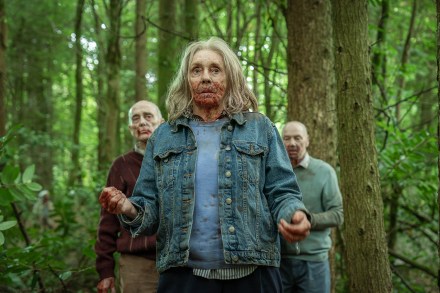
In the second of this week’s two episodes of Generation Z (Sunday and Monday), a teenage girl called Finn wondered why her friend Kelly was so distracted and tearful. As a well-informed type, Finn applied the principle of Occam’s razor and decided that Kelly must be pregnant. In this case, though, the simplest explanation definitely wasn’t the right one. What was ailing Kelly was that her nan had tried to stab her with a large kitchen knife prior to feasting on her flesh – until a male schoolfriend turned up, shot her nan with a crossbow and hid the body in the woods. Residents of the retirement home are also rampaging through the woods, chomping on cockapoos In some British towns, all this might have been something of a one-off.

A hit – but please don’t pretend it’s feminist: Disney+’s Rivals reviewed

From our UK edition

For most of my adult life, clever, well-read, feminist women have told me how much they love Jilly Cooper. It therefore came as a bit of shock when I finally tried her novels for myself and found what they contained. There is, for example, no mistaking Jilly’s scorn for women who are fat and/or hairy, her belief that all female unhappiness can be cured by a damn good rogering, and the idea that not only is it fair enough for middle-aged blokes to lech after teenage girls, but that teenage girls rather like it when they do. (I was also slightly disconcerted by her favourite word for female genitalia – which, by way of a big clue, is the surname of the 41st and 43rd US presidents.