James Forsyth

James Forsyth

James Forsyth is former political editor of The Spectator.

Brown rage

From our UK edition

Martin Bright sheds light on what Brown’s inner circle are thinking about an early election in this week’s New Statesman. What stands out, though, is how thin-skinned they are.  Danny Finkelstein’s story about the influence of Bob Shrum on his conference speech has clearly got under their skin. One aide tells Bright that, "The behaviour of the Tories and some sections of the media shows they are already electioneering. Why should Gordon put up with another six months of this when he can't fight back?" Also note how Camilla Cavendish reveals in The Times this morning that, “The Prime Minister’s penchant for calling certain journalists in the early hours of the morning and taking them to task does not look terribly prime ministerial.
Will Gordon go?

From our UK edition

There are two schools of thought on whether the chances of an early election have increased or receded since last week. On the one hand, the Tory conference was a success and Labour’s polling in its key marginals is "patchy and extremely tight", according to The Independent; suggesting that Gordon Brown should hold off.  On the other hand, as Matt argued on the Today Programme when he moved his election clock two minutes closer to midnight, if Brown doesn’t go now it will look like Cameron has scared him off. Realistically, Brown is unlikley to lose any early election. But he could easily see Labour’s majority reduced and with it his authority.

What Cameron achieved

From our UK edition

A few hours on from the end of conference and the new political landscape is becoming clearer. David Cameron has succeeded in uniting the Conservative party and the right more broadly behind him. The policies announced in Blackpool mean that Conservatives of all stripes now have positive reasons to want a Tory government. The leadership has also succeeded in distilling the work of the policy groups without anyone’s toys disappearing out of the pram. The more challenging bit comes now: they have to win over the country. As Tim notes, the news segments on the speech have been positive but watching them it is hard to feel that the case for change has been made.

How did Cam do?

From our UK edition

My initial reaction is that it was good but not a home run. The ending was very strong but there was a bit towards the end when it ran out of steam a little bit. If I was Gordon, I’d be feeling a lot less confident of increasing Tony Blair’s majority in an election this year. The question is, has Brown put his neck out too far to pull back now?

Tax and the Tories

From our UK edition

You wait ages for a Tory tax pledge then a whole slew come along at once. Following his speech on Monday which pledged to raise the threshold for inheritance tax and cut stamp tax for first time buyers, George Osborne has given an interview to The Times announcing that there are both personal and corporate tax cuts to come, all of which will be funded by green tax rises. Now, the Evening Standard is going big on the story that spouses will be able to transfer over any unused portion of their personal allowances—potentially saving families £1,000 a year. There does, though, seem to be some confusion about whether this is a possibility or if it is set to be announced as a firm policy commitment.

Back to the future | 3 October 2007

From our UK edition

Today’s speech really is as important as the hype says it is. If David Cameron delivers a barnstormer and Gordon Brown pulls out of calling an election it will be a major coup for Cameron, giving him a level of personal authority as leader that he hasn’t had to date. Equally if Brown does go for it, this speech will frame whether the election is seen as a foregone conclusion or a genuine contest. There is, though, another way in which the speech is important. If there is an election before the end of the year, Labour would almost certainly win it. The question then is, as Adam Boulton points out, whether Cameron stays on to fight a second one. If Cameron can re-connect with the grassroots he’ll have a much better chance of getting a second bite at the cherry.

Brown’s biggest mistake to date

From our UK edition

Gordon Brown’s trip to Baghdad is the biggest political misjudgement of his leadership so far. It would have looked very different if the Tories were tearing themselves apart in Blackpool—Gordon could have posed as a statesman above such petty squabbles—but with conference going better than expected it looks like a cheap stunt; especially as Brown had pledged to announce any change in Iraq policy to the House of Commons first.  The Tories now have a huge opening to ram home to the public what everyone in Westminster knows: Brown is just as keen on spin as Blair. The line of attacks should be, if  Brown will play politics with the deployment of British troops overseas is there anything that he won’t do to win?

Blackpool truce holds

From our UK edition

All those waiting for the latest instalment in the great grammar schools row are going to have to wait a little longer. The rumours that Graham Brady, the frontbencher who resigned over the issue, had come to an agreement with the leadership not to reopen the row this week have been confirmed by a very mild piece he has written in the Telegraph this morning. After a few paragraphs attacking Labour for its failings on education, Brady turns to grammars schools:  “Everyone knows I don't see eye-to-eye with the leadership of the Conservative Party over grammar schools. I strongly believe that they are one of the most effective vehicles of social mobility in our country.

From Boris to Bloomberg

From our UK edition

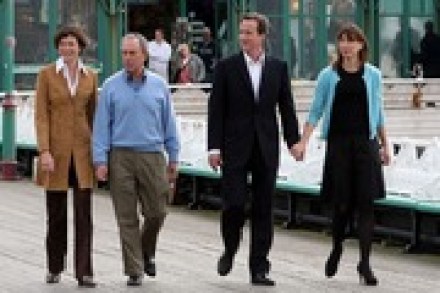
Boris has just brought the house down with a speech attacking Ken Livingstone and setting out the Tory agenda for London. One senses that Boris will have no problem in motivating the party activists to hit the streets for him. Michael Bloomberg, the mayor of New York, was witty and self-deprecating and generally far better than I expected. Yet, I’m still sceptical of the decision to invite him. Bloomberg’s recent decision to quit the Republican Party and his flirtation with an independent run for the presidency has made him persona non grata with various sections of the Republican Party and his relationship with his predecessor and the Republican frontrunner Rudy Giuliani is far from good.

Hezza still a conference darling after all these years

From our UK edition

Michael Heseltine just rolled back the years with a crowd-pleasing address to conference. Heseltine extolled the values of decentralisation, celebrated the triumph of the Tory agenda and bashed Gordon Brown for his failings. Tarzan also wins the prize for being the first, and I’m open to correction on this, speaker to quote Winston Churchill; declaring that the Tories must be ready to fight Brown with their ideas in the towns.   The necessity of the Tories getting off to a good start is demonstrated by the fact that the party has put their three most crowd-pleasing platform speakers—Hague, Heseltine and Boris Johnson—up on day one. Expect New York mayor Michael Bloomberg to send the delegates back to sleep, though.

As Tories head to Blackpool, Brown has a landslide lead

From our UK edition

Today’s polls are grim for the Tories. Labour lead by double digits in both and with a uniform national swing would have a majority well into three figures. Gordon Brown is also well ahead of David Cameron on the key personal measures.  According to YouGov, Cameron has a net negative rating of 41 on being in touch with the concerns of people like you while Brown scores a plus 10 rating on this question. Populus has Brown leading 60 to 45% on the issue of caring about the problems that ordinary people face. While 50% think that Brown has answers to the key issues facing the country compared to only 30% for Cameron. YouGov also finds that 57% see Cameron as a lightweight compared to Brown and 56% think he is too like Blair.

Welcome to the liveliest of coffee houses — online

From our UK edition

A warm invitation to The Spectator’s new website The Spectator has a new website — redesigned, easier to use, with new features and writers. The online magazine will continue to do what the print magazine has always done on paper: inspire debate, stir up controversy and have some fun, with the added advantage that you can add your thoughts to ours. In expanding our web presence we are being true to the traditions of the magazine. The original Spectator of Joseph Addison and Richard Steele arose from the free-wheeling intellectual sparring of the 18th-century coffee house, and if there’s a modern version of this — a space where people can comment and squabble about the issues of the day — it’s surely online.

Is Osborne set to commit the Tories to the abolition of inheritance tax?

From our UK edition

The Taxpayers’ Alliance is reporting that George Osborne will pledge to abolish inheritance tax at Blackpool. The TPA believes that the proposal that Osborne will unveil will be very similar to the one proposed by the Tax Reform Commission. Inheritance tax as we know it will be abolished and replaced by a new kind of capital gains tax which treats death as equivalent to a sale of assets. Primary residences will be exempt from all tax. But all other assets will be subject to capital gains tax of up to 40%. Though, there will be taped relief through which this could fall to zero for assets owned for ten years.

Might Salmond stand against Brown?

From our UK edition

Iain Dale has a fascinating story up about a rumour that Alex Salmond might stand against Gordon Brown at the next general election. I’d love to see such a contest, Salmond clearly gets under Brown’s skin and the campaign would be great knock about. But I fear that it is unlikely. Considering that Brown won with 58 percent of the vote in 2005, Salmond wouldn’t have a realistic chance of winning and, as Iain notes, running as essentially a protest candidate would undermine Salmond’s standing. If Salmond did, for some reason, go for it, it would force Brown to spend far more time in his own constituency than he’d like. It'd also put the issue of Brown’s Scottishness front and centre.

Brown to decide by Sunday on snap poll

From our UK edition

Gordon Brown will decide whether or not to call an election this weekend, The Guardian reports today. His aides, apparently, now think he is more likely to go for it than not. An announcement on October the ninth and an election on the first of November is the favoured option. This would allow Brown to announce the handover of Basra province to the Iraqis and might allow Alistair Darling to deliver the comprehensive spending review and pre-budget report before Brown goes to the country. The risk for Brown of an election on November 1st is not so much turnout but the fact that he needs to go and sign off on the EU treaty in Lisbon just a fortnight before polling day.

The UN is not a moral authority

From our UK edition

I never understand why people hold the UN up as some great moral arbiter. Far from being some vehicle for the world’s collective good intentions, it is a classic balance of power institution whose main aim is to avoid a conflict between the great powers—and damn the consequences for the little people. Just look at how it is set up so that nothing can happen without the unanimous consent of the five permanent members of the Security Council. While this might have been a necessary evil during the Cold War, given that any direct confrontation between the super powers could have turned nuclear very quickly, it is far less defensible today.

Labour gets ready to go, but cabinet remains divided on timing

From our UK edition

The chances of an autumn poll just increased with the news that Labour is hiring key election staff. Now, this doesn’t mean Gordon is definitely going but it does show that he wants to keep the option open. Oddly enough, I think this is quite good news for David Cameron: if he has a good conference and there isn’t an election, he’ll be able to claim credit for frightening Brown off. Interestingly enough, cabinet ministers are now openly weighing in on whether Gordon should go to the country this year or not. Hazel Blears is, unsurprisingly, in favour and full of enthusiasm: “When’s the election? Who knows? But I say – let’s go!”  While Alan Johnson is against, telling Michael White, “Remember 1970.

A vintage split

From our UK edition

Nick Robinson has a great post up on the generation gap opening up among the cabinet about whether or not to go to the polls now. As Robinson points out, the young bucks want to go this year, increase the Labour majority and dish the Tories for good. Indeed, if the Labour majority did rise to three figures—as the current polls predict it would, the Tory party would turn in on itself with such force that it would take a generation to recover.  If you’re a Miliband, Balls, Alexander or Purnell the prospect of spending the prime of your political life without any serious external opponents must seem worth the risk that a wet November night could depress turnout too far for comfort.

Can Brown resist an 11 point lead?

From our UK edition

A new YouGov poll puts Labour 11 points ahead and further increases the pressure on Gordon Brown to call an election in the next few days. There’s little doubt that these numbers will strike fear into the hearts of Conservatives. The consolation for them is that this is about as bad as it gets. The survey was taken just after Brown had spoken at conference; the moment one would expect to be the high-water mark of Labour support. There are even some encouraging numbers in there for the Tories. Only 29 percent believe that it would be in Britain’s best interests to hold an election this year—suggesting that there might be a minor backlash against Labour if Brown does go early.

The struggle takes many forms

From our UK edition

Jon Cruddas’s latest conferences diary gives a great feeling for the Labour mood after yesterday’s speech. As Jon puts it, ‘Last night the Conference really kicked off.’ Do read it, if only to find out why Jon fears he is turning into Hazel Blears.