James Forsyth

James Forsyth

James Forsyth is former political editor of The Spectator.

The surge cuts civilian deaths in Iraq in half

From our UK edition

The military success of the surge in Iraq continues to astound. In October the number of civilian deaths was less than half of what it was in January, when the violence was as its peak. The last month also saw the smallest number of US military fatalities in the country since March 2006. This is obviously not to say that everything is suddenly rosy in Iraq. 2 million people have fled the country and another two and a half million are internally displaced and political reconciliation on the national level remains frustratingly slow. What the progress does show, however, is that the troop build-up has created a climate in which it is realistic to expect that the Iraqis can come to an agreement that satisfies the basic needs of all three communities.
The Tories and immigration

From our UK edition

David Cameron braved The Today Programme this morning to talk immigration. The interview exposed the openings that the Tories have given with their pledge to reduce the overall level of net immigration. John Humphrys kept pressing Cameron on what his ideal number of immigrant would be and Cameron wouldn’t—or couldn’t—answer the question. Humphrys then moved on to asking him whether he wasn’t effectively seeking to stop black immigration to Britain as white Europeans would be able to come here without hindrance while Commonwealth or other migrants would be subject to quotas. Cameron dealt with this question well and listening to his tone it was impossible to imagine that race was in any way a motivating factor behind the Tory policy.

Too good to be true?

From our UK edition

The Guardian’s Backbencher column has a particularly delicious titbit this week: “Spotted at New College, Oxford, last weekend: Richard Dawkins, saying grace at dinner.” What’s next, Ian Paisley taking communion at the Vatican?

A more immediate danger

From our UK edition

The Los Angeles Times has an absolute must-read today on the escalating tensions between US and Iranian forces in Iraq and how in the near term this is more likely to spark a war between the two countries than the Iranian nuclear programme. Do read the whole thing.

English is not enough

From our UK edition

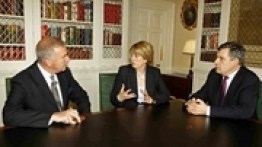
Alan West, the retired Admiral (pictured left) drafted in by Gordon Brown to be security minister, has an interview in The Sun today. The two things that will make headlines are his statements that dealing with the current threat will take thirty years or so and that the security services have foiled 12 major plots since 2000. What should get more attention is his comments on the importance of English speaking Imams as they illustrate how the government has not yet fully grasped the essentially ideological nature of this struggle. West tells The Sun, “We need to go to the root of it. Having English-speaking Imams in this country is extremely important. We are getting more and more Muslim youngsters who all speak English.

Clegg’s idea would give the Lib Dems more of an identity

From our UK edition

Nick Clegg’s announcement that if ID cards are introduced he will simply refuse to register is smart politics. First, it prevents Chris Huhne from gaining a monopoly on eye-catching, activist-pleasing ideas in the Lib Dem leadership contest. Second, it shows that Clegg is prepared to exploit the greater license that the leader of the third party has. However, stridently the Tories oppose ID cards it is hard to imagine David Cameron or David Davis indulging in civil disobedience. The key test for any Lib Dem leader is to get their party noticed. This is what Ming Campbell was incapable of doing and why he ultimately failed as leader.

No Ming, more zing for the Lib Dems

From our UK edition

Maybe the Lib Dems shouldn’t elect a new leader at all. In their current leaderless state, they have jumped 4 percent in the latest ICM poll to put them at a respectable 18 percent. The Tories are down three, but still at the psychologically important 40 percent mark. Labour are on 35 percent, a one percent drop. The Lib Dem spike is best explained by the amount of coverage they are currently getting thanks to their leadership race. Once the Lib Dems elect a leader they can expect to come under heavy fire, the Tories in particular will be keen to prevent a new Lib Dem leader from gaining any momentum.

What values do we share with Saudi Arabia?

From our UK edition

First we had the Saudi King declaring that Britain had not done enough to tackle the threat of terrorism which may be true but considering Saudi Arabia’s continuing role in exporting extremism, the King might want to consider the log in his own kingdom before going looking for specs in other countries. Now we have an even more breathtaking quote from the Foreign Office Minister Kim Howells: Mr Howells told a conference ahead of a state visit by Saudi leader King Abdullah that the two states could unite around their "shared values". I can see the national interest case for the relationship with Saudi Arabia but I really can’t see what values Britain and Saudi Arabia share.

It is no surprise that the government’s numbers don’t add up

From our UK edition

There is much upset over the news that the government underestimated by 300,000 the number of immigrants working in this country. Yet, this is hardly surprising considering the appalling quality of official statistics when it comes to migration. The International Passenger Survey, one of the key metrics that the governments uses, was based in 2004 on interviews with just 2,801 people entering the country and 755 people who left. Britain is set to be a mass migration country for the foreseeable future. Good quality statistics are an essential part to making sure that this transition runs smoothly.

Talking Turkey

From our UK edition

If you want to see how real the danger of the West losing Turkey is, examine these poll numbers. The United States’s favourability rating is down to 9%- from 52% in 2000. The European Union’s favourability rating has fallen from 54% in 2004 to 27% today. Turks are now more hostile towards Westerners than either Egyptians or Pakistanis. In some ways, these numbers aren’t surprising: both the United States and the EU have shown little consideration of the Turks in recent years. But they should worry us. If Turkey becomes permanently alienated from the West, dealing with the problems of the Middle East will become even more difficult.

The Tory neo-cons

From our UK edition

Bruce Anderson rides to David Cameron’s support over foreign policy in today’s Independent. In the piece, he writes that two key members of the  shadow cabinet, Liam Fox and Michael Gove, are among the half-dozen or so neo-cons who still exist in British political and journalistic life. But this seems to ignore the shadow cabinet’s most senior neo-con, George Osborne. (I should say that I’m one of the very few people who’d use the term as a compliment not an insult) In a piece in The Spectator in 2004, Osborne offered a trenchant defence of Bush and Blair’s response to 9/11 and of the neo-con vision for the Middle East. Here are two key quotes from the piece.

Private lives, public figures

From our UK edition

Nicolas Sarkozy walking out of his interview with 60 Minutes when asked about relations with his then wife Cécilia is creating waves. It is tempting to see the incident as a classic example of the culture clash between the prying Anglo-Saxon media and the Gallic belief in a public figure’s right to privacy. But what it actually illustrates is something more subtle. If you watch the rest of the interview, you will see how Sarkozy—as is his wont—explains how his politics derive from his personal experience. Inevitably, this sparks and in some ways legitimises public interest in his private life. You see this tension with David Cameron too. It would be absurd to claim that Cameron’s politics have not been changed by his experiences with his son Ivan.

Blair’s thwarted plans

From our UK edition

The latest revelations from the Anthony Seldon book reveal just how much Tony Blair was weakened by his diminished majority following the 2005 election. The Times reports that not only was Blair forced to abandon his plans to reform the Treasury and possibly move Gordon Brown, but also saw John Prescott and others thwarting his reshuffle plans.  This exchange between Blair and Brown reveals how Blair was incapable of getting his way even on relatively minor personnel issues:Blair had decided that he was going to move in on the Treasury appointments. ‘Isn’t it at last time to sack Dawn Primarolo [the Treasury minister, now Minister for Public Health]?’ Blair asked him. Brown reacted strongly to protect her.

Obama steps it up

From our UK edition

Barack Obama is finally going to take the gloves off against Hillary Clinton. Under pressure from donors who are disappointed by the fact that Hillary is maintaining her  dominant lead in national polls, the Obama campaign has decided that they have to make their criticisms of the frontrunner clear if they are going to stand a chance. In an interview with The New York Times to launch this new strategy, Obama is far more direct in his criticism of Hillary than he has been to date. This exchange, gives a sense of the change in tone:   Q: Has she been truthful to voters about what she would do as president? A. “No. “I don’t think people know what her agenda exactly is.

Whitehall put on PMQs alert

From our UK edition

If anyone wants to know how rattled Downing Street is by the hammering that Gordon Brown now regularly receives at Prime Ministers Questions they should read this story in The Sunday Times. It reveals that civil servants are being instructed to spend more time thinking about what topics might come up at PMQs and to find ‘good third-party endorsements’ for government policies including from opposition politicians. It is true that PMQs isn’t the be and end all of politics—if it was Prime Minister Hague would be riding high in the polls—but it does help determine the mood at Westminster.

How far does the Iranian nuclear programme extend?

From our UK edition

To follow up on Matt’s post, Caroline Glick has a fascinating piece out today on the latest developments in the Iran nuclear saga. She speculates that the purpose of the recent shuttle diplomacy of Olmert and Barak--taking in visits to Moscow, Paris, London and Washington--was to allow them to share new intelligence on Iran’s nuclear programme with these countries. As Glick points out, following the successful Israeli raid on what appears to have almost certainly been a nuclear facility in Syria, Israeli intelligence is once more renowned as the best in the region. Worryingly, Glick believes that the Iranian nuclear programme may well be spread out well beyond that country’s borders itself.

Listen up

From our UK edition

Tomorrow morning you’ll want to tune into The Week at Westminster on Radio 4, Matt will be presenting and he’s got some great guest lined up including Dennis Skinner, Gisela Stuart—whose comments on the European constitution have so discomforted Gordon Brown—and Malcolm Rikfkind who set the cat amongst the pigeons with his attack on Tory Europhobes in this week’s issue of The Spectator. The show airs at 11 and you can listen to it anytime after that on the programme’s website.

Cameron’s outdated foreign policy

From our UK edition

David Cameron’s speech in Berlin today on foreign policy advocated a cautious, liberal conservative approach to foreign policy. It is very different, at least in tone, from the foreign policy vision that he set out when running for leader.  The sound bite from today’s speech is ‘national security first.’ Leaving aside the unpleasant historical associations that the phrase has, it is so intellectually outdated as to be meaningless.

Chris Huhne and whose army?

From our UK edition

The Lib Dem leadership will be a closer affair than many people expect. Chris Huhne having run before and got a respectable 40 odd percent of vote is going to give Nick Clegg a decent run for his money. Indeed, Mike Smithson points out that today’s YouGov poll shows that Huhne has a slight edge over Clegg among Lib Dem supporters. Add to this the fact that Lib Dem activists tend to be a fairly left-wing lot who might find Clegg a little too right-wing for their tastes and it is not inconceivable that Huhne could pull off a surprise victory. Yet, if Huhne won he’d immediately have a huge problem: he wouldn’t have the confidence of the Parliamentary party.

How liberal is the BBC?

From our UK edition

Sam Coates over at Conservative Home has done some great number crunching on how BBC employees identify themselves politically on Facebook. Of the 10,580 BBC workers on the site, 1, 340 say they are liberal while only 120 label themselves as conservative: so there are ten times more out self-identified liberals than conservatives at the corporation. Now, as Sam points out this isn’t a scientific survey—but it does give you a rough guide to political sentiment at the BBC. It is also revealing how comfortable BBC employees feel revealing their ideological standpoint.  My other observation would be to say that you can be a liberal and still vote Conservative. Ideological labels haven’t tracked perfectly with British politics for a while.