Are you trying to tell us something, David?
From our UK edition
The headline on David Miliband's latest blog post: Coexistence not confrontation.

James Forsyth is former political editor of The Spectator.
From our UK edition
The headline on David Miliband's latest blog post: Coexistence not confrontation.

From our UK edition
The latest extract from Bob Woodward’s book about the battle over Iraq policy among the military is well worth reading. It reveals quite how bad relations got between advocates of the surge and the Joint Chiefs of Staff. Jack Keen—a retired general and a key advocate of the surge—was even banned from travelling to Iraq by the military at one point. While President Bush was forced to send back-channel messages to General Petraeus telling him that he “will have as much force as he needs for as long as he needs it” to counteract the pressure being put on by Petraeus for a precipitous draw-down by his military superiors.
From our UK edition
The Real Clear Politics polling average now has McCain ahead by 2.9 percent, the largest lead he has ever had by this measure and the first time he has been ahead in it since April. Now, this number obviously needs to be taken with a pinch of salt: McCain is currently enjoying both his convention and his VP bounce. But if anyone had offered the McCain team the chance to enter the post-convention sprint level, or even slightly ahead, a few months ago they would have bitten your hand off. Yet the reasons they’d have bitten your hand off—a flagging economy, an unpopular incumbent Republican president, and the fundamental problems of the Republican brand—are why this race is far from over. A McCain-Palin victory would still count as a huge upset.
From our UK edition
Fraser has already commented on the economics side of George Osborne’s interview in The Guardian today, but this little bit about Iraq stood out to me: "I still have rows with my mother about the Iraq war," Osborne says. Felicity Loxton-Peacock, noted debutante, anti-Vietnam war protester and former deli owner, feels particularly strongly on the war from her experience as an Amnesty International desk officer, he adds. "Her area was the Kurds, dealing with the brutality of Saddam Hussein's regime - a point I make to her when we discuss the Iraq war." This is a very different tone from the one that David Cameron uses about Iraq. Here is what he said about it in his speech in Pakistan, which Daniel blogged on earlier.
From our UK edition
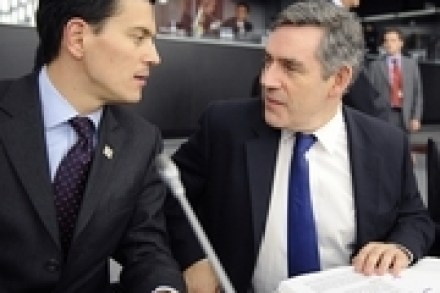
Andrew Sparrow flags up a quote by David Miliband at today’s Cabinet away-day in Birmingham: "I think Gordon is leading us with more vigour and determination and will prove people wrong ... I am absolutely convinced that Gordon can lead us to victory. He has enormous values, drive and vision." Now, as Andrew admits one can try and read too much between the lines. But I think he’s right that the “more” does seem significant. It is at the least proof that the truce between Brown and Miliband is holding.

From our UK edition
The ‘conservatorship’ of Freddie Mac and Fannie Mae represents, as Steven Pearlstein notes in the Washington Post, the most direct role for the federal government in the “workings of the financial system” since the great depression. Clive Crook points out that the eventual nationalisation of Freddie Mac and Fannie Mae will bring 25 more times more loans onto the public balance sheet than the nationalisation of Northern Rock did in Britain. It is an illustration of how bad things are that there has been almost no political dissent about the move. Freddie Mac and Fannie Mae have long stood as examples of how political problems get kicked down the road in Washington because they are too difficult to solve or because their patrons are too powerful to be confronted.

From our UK edition
Nick Clegg’s interview with the Sunday Telegraph today is a punchy affair. He derides the Tories as “the flaky party” on the economy and tells Melissa Kite that the Lib Dems are looking to go further than the 4p cut in the basic rate of income tax that they have already promised. Now, those of us who support easing the tax burden should be happy about this. A Lib Dem policy of tax cuts means that it can hardly be portrayed as a policy of the extreme right and should encourage the Tories to offer some more before the next election. But it seems an odd strategic decision for the Lib Dems when they have chosen to concentrate their resources on fifty Labour-held seats that are sufficiently left-wing that the Lib Dems not the Tories are the main opposition.
From our UK edition
Bob Woodward’s latest book on the Bush administration is being serialised by the Washington Post this week and is a grim reminder of just how badly Iraq strategy was run for so long. This exchange between Condoleezza Rice and General George Casey in Iraq in, presumably, November 2005 illustrates the almost total lack of policy co-ordination: "Excuse me, ma'am, what's 'clear, hold, build'?" Rice looked a little surprised. "George, that's your strategy." "Ma'am, if it's my strategy, don't you think someone should have had the courtesy to talk to me about it before you went public with it?
From our UK edition
“If GB goes down, he's going to take everybody with him." John Rentoul reports, in his column today, that this is what Nick Brown has told various Labour backbenchers. Leaving aside the sub-Godfather nature of the rhetoric, it is clear that the Brownites have decided to fight the enemy they know how to beat: their internal opponents in the Labour party. It appears that there is now a concerted effort on to make Brown’s critics in the Labour party fear him again. Meanwhile, the Tories have a largely free ride. Conservative Home reveals that the Tories intend to use this space to issue a more limited commitment to matching Labour’s spending commitments, the new pledge will only apply to a year’s worth of spending after the election.
From our UK edition
Andrew Rawnsley hits the nail on the head when he says that a “Prime Minister cannot be on perpetual probation”. At some point soon if it is not to go down to total disaster at the next election, Labour will either have to back or sack Brown. But as Rawnsley points out, Labour is in too much of a shambles to do either. There is, though, a reason other than incompetence preventing Labour from making a decision. Everyone assumes that the Brownites will do all they can, and that is still an awful lot, to stop whoever topples Gordon from succeeding him.
From our UK edition
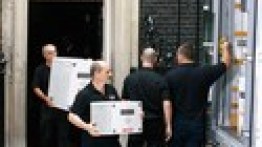
In the last week there have been several stories about how Stephen Carter, the PM’s chief strategist, is to be demoted or moved; Brown can hardly bear to look at him any more according to one source. But Patrick Wintour’s piece in The Guardian today suggests that Carter isn’t planning on going quietly. Wintour reports that Carter has apparently also lost the confidence of Jeremy Heywood, the permanent secretary at Number Ten. Yet, Carter isn’t intending to resign. Friends of Carter tell Wintour that: "He is far more effective and intelligent than the people in No 10 briefing against him. He is also a very resilient guy and is not going to be put off from doing an excellent job.
From our UK edition
The new ABC poll, conducted yesterday so after Palin’s speech, is a mixed bag for the McCain campaign. On the one hand, less than half of voters—42 percent to be precise—think that Palin has the right experience to serve as president. On the other, Obama’s numbers on this aren’t much better; in a pre-convention ABC poll only 50 percent said that Obama had the experience he needed on this front, 47 percent thought he didn’t. It is strategically imperative for the McCain campaign to drive up Palin’s ready to be president numbers.

From our UK edition
The Brown re-launch is falling flat because all the ideas in it were previewed over the summer, meaning that their announcement does little for Brown’s prospects. Indeed, in some cases it does positive harm as the actual policy is less bold than the one that was floated. Now, this has happened for a reason—the ideas were leaked to show Labour MPs tempted by Miliband’s so-called vision for the future that Brown still had some shots left in his locker. But this short-term manoeuvre has harmed Labour’s prospect of a revival in the medium term. It seems the same thing is going on with Brown’s conference speech. Ben Brogan blogs today that: "as Labour conference approaches, there's more and more speculation about Mr Brown's speech and what he needs to do.
From our UK edition
Iain Martin has a quite brilliant line in his column today on Charles Clarke and his plotting : “If this is an attempted coup, it is shaping up to be the most badly organised since Simon Mann looked at Equatorial Guinea on a map of Africa and thought: that looks worth a shot.” My sense is that Charles Clarke has, oddly, done Gordon Brown a favour. It is now so predictable when he criticises Brown that it infuriates Labourites rather than goading them into action. As Iain argues, Labour’s dithering—one respect in which it does follow its leader—is destroying its chances. The party needs to either get rid of Brown or get behind him for one last push.
From our UK edition
The Sarah Palin pick has given John McCain permission to say what he wants in policy terms tonight. The base is fired up and ready to go thank to both the media assault on Palin and her social and fiscal conservative credentials and even if McCain deviates from conservative orthodoxy they aren’t going to stay home in November. McCain should take this opportunity to present himself to the country at large as a bold reformer interested in what works not what is ideologically correct. Michael Gerson, Bush’s former speechwriters, observation that the test of McCain’s speech is if at the end of it voters can say “I have never heard that from a Republican before” is essentially correct. There also should be new ideas in the speech.

From our UK edition
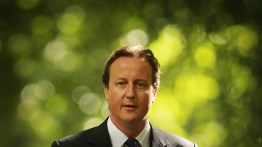
Many people in the Westminster Village will tell you that Labour’s last best chance is to personally attack David Cameron. The theory is that if you can take down Cameron, the Tories will fold. But when you ask about what Labour should go negative on you receive pretty weak answers involving the Bullingdon, Eton or White’s. The, predictable, aim would be to paint Cameron as out of touch or a sexist. But neither of these attacks strikes me as likely to be effective. First, the out of touch line has been tried already and hasn’t hit home, just turning up the volume won’t make it effective. Also, the fact that Cameron has spent more time inside NHS hospitals in the last few years gives him an emotionally powerful response to the charge that he is out of touch.
From our UK edition
There’s a fascinating stat in Prospect’s In Fact column. In England, 57 per cent of children aged five to twelve have visited visited Spain and 54 per cent France. But only 44 per cent have visited Wales and 39 per cent Scotland. I’m tempted to blame this discrepancy on our appallingly expensive train system but it probably has more to do with the weather. But it is a real pity as Scotland and Wales contain some of the most beautiful places in Europe to have a holiday.

From our UK edition
Martin Bright’s politics column in The New Statesman this week is absolutely essential reading. He points out that Miliband has to challenge soon or he too will be seen as a bottler, that Labour still can’t agree on how to challenge Cameron and that the Cabinet simply aren’t use to operating in such tough times—none of them have governed during a recession. But I think it is this point which is perhaps most important: “The Labour Party is in an unprecedented crisis. If it carries on as it is, it will lose the next election by a landslide. The consequences could be worse even than those that followed the election defeats of 1983 and 1987, because no one realistically expected Labour to win them.

From our UK edition
There are a couple of excellent articles in the Evening Standard today. Joe Murphy has done a great piece on how Gordon Brown has left Stephen Carter high and dry. Brown gave Carter a big title, promised him authority and then backed off as soon as the old guard began to kick up fuss and it now appears that Carter is on the outs. Murphy quotes one ‘Labour insider’ as saying that “Gordon can hardly bear to look at him anymore.” The real scoop, though, comes in Anne McElvoy’s column. She reveals that: “Miliband has privately assured the PM that he will not speak further on New Labour woes until after conference.
From our UK edition
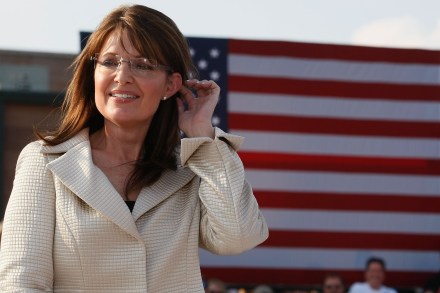
The press are always declaring speeches ‘the most important of the campaign so far’ but Sarah Palin’s tonight really is. John McCain took a huge gamble in picking the first-term governor of Alaska as his running mate and even without the revelations of the past few days tonight would be important for her given that she has to both introduce herself to the nation and show that she is a credible second in line for the presidency. But with parts of the media trying, disgustingly, to turn her family into a Jerry Springer special and some serious and generally worrying revelations about the vetting process that led to her selection her speech has become crucial to McCain’s electoral prospects.