James Forsyth

James Forsyth

James Forsyth is former political editor of The Spectator.

McCain’s near-impossible task

From our UK edition

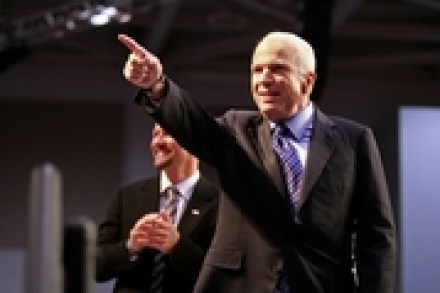
John McCain faces an almost impossible task over the next three weeks. He has to claw back at least a six point deficit, the new Washington Post poll has the gap at 10 points, as the candidate of the incumbent party in an environment where 90 percent of registered voters think that the country has
Turning Brown’s happier mood against him

From our UK edition

George Osborne’s piece in the Evening Standard today marks a stepping up in the Tory rhetoric on the financial crisis. Osborne ends with this line directed at Gordon Brown, “You presided over the biggest economic disaster of our lifetime and we will not let you forget it.” But in the short term, perhaps, the most

The key question

From our UK edition

Clive Crook’s column in the FT is, unsurprisingly, well worth reading. He is relatively relaxed about the political state of play after this crisis, arguing that the overall argument about the role of the state and government intervention in the market will be “rhetorically adjusted” but “about where it was before the crisis”. Crook’s thinking

The financial crisis scalps another two banks

From our UK edition

If t is a weekday, there must be an injection of public money into the banking system. The government is going to take a majority stake in Royal Bank of Scotland and a roughly 40 percent stake in the bank to be formed from the merger being Lloyds TSB and HBOS. This move will require

Psychological flaws

From our UK edition

The Mail on Sunday reports that the Tories are considering psychometric tests to assess which MPs are suitable to run departments. There is also talk of asking peoples’ secretaries to report on how they react to stress.  Unsurprisingly, the Mail find several MPs who are—anonymously—prepared to rubbish the idea as big brother, control freakery. But

The banker precedent

From our UK edition

By rescuing the banks, Brown has illustrated that—in extremis—the government can find the money to do things. As Andrew Rawnsley argues in The Observer this is going to be a problem for Brown in the coming months: “ballooning government debt points to a severe squeeze on services. Whitehall is already anticipating the bloodiest spending negotiations for

Brown gets a poll boost but the Tories are still ten points ahead

From our UK edition

There are two ways of looking at today’s YouGov poll, the first carried out since the announcement of the government’s rescue plan for the banks. The first is to see it as evidence of how the financial crisis is reviving Gordon Brown’s premiership. Labour are up three point to 33 percent—their highest rating with YouGov

Another blow to Palin’s reputation

From our UK edition

The report into Troopergate doesn’t disqualify Sarah Palin but it does tarnish her reformist credentials, one of the assets that she was meant to bring to the ticket. The McCain can point to the fact that the report says that “Governor Palin’s firing of Commissioner Monegan was a proper and lawful exercise of her constitutional

Is there a case for suspending the markets?

From our UK edition

The White House yesterday dismissed Silvio Berlusconi’s suggestion that the markets should be shut down for a few days. But support for this idea is still gathering pace. Steven Pearlstein, the Washington Post’s respected business commentator, makes the case for it today: the markets could use a timeout just about now, something that lasts longer

Brown admits comprehensives failed urban Britain

From our UK edition

Gordon Brown’s desire to have it both ways is quite incredible. In his conference speech Brown took a personal and cheap shot at David Cameron, accusing him of using his children as props. But now he is perfectly happy to use his children as the backdrop for a soft-focus interview with Alison Pearson of the

Brown’s flawed war plan

From our UK edition

Gordon Brown wants to style himself as the leader Britain needs for the coming ‘economic war’. His political survival depends on persuading, one might use another word here, the electorate that only he has the toughness, experience and knowledge to lead us out of this financial turmoil. I suspect that Brown will get a boost

The Brown Greenspan bond looks very different now

From our UK edition

Gordon Brown is very proud of his friendship with Alan Greenspan, he has hailed him as “the world’s greatest economist” and “the most successful” central banker in history. When Greenspan stepped down from his role as chairman of the Federal Reserve, Brown quickly appointed him as an economic advisor to the British government. As Prime

Brown’s Canute moment

From our UK edition

“I’m trying to get the oil price down, and get the fall passed on directly to people at the petrol pumps and then on to gas and electricity bills.” PS I realise that I’m being a bit unfair to King Canute who was actually trying to demonstrate the limits of his powers to his followers.

Brown won’t be smiling for long

From our UK edition

Opinion is divided in Westminster between those who think that with the financial turmoil the political plates have shifted in Brown’s favour and those who believe that any bounce Brown is getting from this crisis will be temporary. I’m firmly in the latter camp and I’d say that Iain Martin has it exactly right in

Kirsty Wark jumps the shark

From our UK edition

If Coffee Housers missed it, I’d thoroughly recommend watching Kirsty Wark’s interview of George Osborne on Newsnight. It could easily be mistaken for a parody of BBC bias. Wark starts off by suggesting that the Tory governments of the 1980s are to blame for the current crisis; even Gordon Brown hasn’t attempted to claim this.

Panglossian or prescient?

From our UK edition

Laurence J. Kotlikoff and Perry Mehrling have a fascinating opinion piece in today’s Washington Post arguing that we are actually all going to be fine and that the coming recession is going to be quite modest—at least in the US. Here’s the nub of their argument: “Uncle Sam (a.k.a. Treasury Secretary Hank Paulson and Fed

Banks can’t splash the public’s cash

From our UK edition

Lots of people are mocking the Tories for being concerned about bankers’ salaries; Simon Hoggart ribs Cameron for sounding like a Trot at PMQs yesterday. But the Tory position is actually entirely reasonable. As long as these banks were getting by without state aid it was up to them and their shareholders how much they paid

The debt we’re in

From our UK edition

Robert Chote, the director of the IFS, does the invaluable job of totting up in today’s Telegraph just how much debt the country has racked up recently. “In September last year, public sector net debt stood at just under £515 billion or 36.8 per cent of national income. Since then, the nationalisation of Northern Rock