James Forsyth

James Forsyth

James Forsyth is former political editor of The Spectator.

Protecting the Coalition’s vulnerable party

From our UK edition

The Coalition’s first full political cabinet marks a stage in its development. The fact that Tories and Liberal Democrats were prepared to sit down with no officials present and discuss political strategy for more than three hours shows how comfortable the Coalition partners are becoming with each other at Cabinet level. As I say in the Mail on Sunday, the tone of these talks was, for obvious reasons, distinctly anti-Labour. Much of it was about the importance of branding Labour as in denial about the deficit. The challenge that Labour poses to the Coalition will, obviously, depend heavily on the result of the party’s leadership election.
AV, what is a Conservative to do?

From our UK edition

Matthew Parris and Charles Moore are the two of the most eloquent exponents of conservatism. But they represent different strands of conservative thought as their views on AV demonstrate. Matthew argues in his column in The Times today that the Conservative party should let AV pass if that is what it takes to keep the Lib Dems happy. He thinks that the Lib Dems are not only needed to make the Coalition work but that their presence is, in itself, a good thing. As he writes, ‘Lib Dems bring to government a distinct and healthy slant on politics. There is a reactionary component in the Tory make-up; I often share it, but it must always be kept in check.’ Charles, by contrast, remains a principled opponent of AV.

This could be a great reforming government. But only if it learns from Blair’s failure

From our UK edition

James Forsyth reviews the week in politics You wouldn’t know it from listening to the Prime Minister, but the coalition is on course to be a great reforming administration. In its first 11 weeks, it has announced plans to reform all four major public services. At the same time, its first Budget mandated the largest public spending cuts since the creation of the modern welfare state: a shrinking which goes beyond anything Margaret Thatcher ever attempted. But to achieve its reforming ambitions, the coalition must work out how to steer past the reefs on which past reformers have been wrecked. Tony Blair was so passionate about reform that speeches on the subject used to bring him out in a sweat.

Bluntly speaking

From our UK edition

Crispin Blunt has been unceremoniously slapped down by No 10 for saying that the ban on parties in prisons will be lifted. The Coalition is following a liberal line on criminal justice but it has no desire to pick a fight on the question of whether prisoners should be allowed to party in jail. A look at The Sun and The Mail this morning show why Downing Street dumped on Blunt so fast. The Mail followed up yesterday’s critical coverage of the Coalition with a devastating front-page assault on Blunt and his arguments. The Sun, which has been extremely supportive of the Coalition, also went for Blunt.

Brotherly love | 22 July 2010

From our UK edition

Ed Miliband will give his second preference vote in the Labour leadership contender to his brother, he tells the New Statesman’s Jason Cowley.   The Ed Miliband interview is part of a really rich set of profiles of the Labour leadership candidates. Diane Abbott inadvertently reveals that it is David Miliband who is taking the duties of a future Labour leader most seriously with her complaint that he is the leadership candidate who insisted on a meeting to find out what the duties of the victorious candidate would be at conference.    Both Eds offer quite left-wing prospectuses. Ed Balls argues that Labour didn’t lose because it lost touch with ‘middle England’.

Abbott’s radio silence

From our UK edition

Anne McElvoy’s report for the Today Programme on the Labour leadership this morning is well worth listening to. It featured all the usual suspect and some classic moments—Tessa Jowell damming Ed Miliband with faint praise and Ed Balls’ henchmen Charlie Whelan going out of his way to praise Andy Burnham—but the really memorable bit came when McElvoy asked Abbott about her decision to send her son to private school. As with her infamous interview with Andrew Neil, Abbott simply refused to answer. There was just a period of dead air.

Not David Cameron’s finest hour

From our UK edition

David Cameron has just made a quite spectacular mistake. Talking to Sky News he said: 'I think it's important in life to speak as it is, and the fact is that we are a very effective partner of the US, but we are the junior partner'. 'We were the junior partner in 1940 when we were fighting the Nazis.' The obvious problem with Cameron’s remarks is that, as any fule kno, the Americans did not enter the war until after the attack on Pearl Harbor in 1941. The error is even odder given Cameron’s penchant for war movies, he’s watched Where Eagles Dare 17 times apparently. This howler from Cameron following Clegg’s Iraq gaffe at PMQs, means that this has not been a good day for the Coalition.

Clegg’s only blemish

From our UK edition

Nick Clegg comfortably got through his first appearance standing in for David Cameron at PMQs. He was helped by a poor performance by Jack Straw, who made Neil Kinnock look like a model of concision. As Clegg said mockingly at one point, ‘that wasn’t a question it was a sort of dissertation.’ In his final response to Straw, Clegg attacked him for his role in the ‘illegal invasion of Iraq.’ Now, Clegg has long called the invasion of Iraq illegal. But it is a different matter to do so when standing in for the Prime Minister and speaking from the Treasury bench in the House of Commons. That implies it is the official position of the government, with all that entails.

Clegg’s debut

From our UK edition

John Bercow will need to be in good voice today. For this is the first time that Nick Clegg has stood in for David Cameron at PMQs and he is bound to get an almighty barracking from the Labour side. At the moment, Labour MPs seem to reserve nearly all their disdain and anger for the Lib Dems. Nick Clegg’s appearances at the Despatch Box are a cue for Labour MPs to shout 'traitor' and jeer at him repeatedly. Jack Straw, the wiliest of politicians, is bound to try and make today an uncomfortable occasion for Clegg. They’ll be three things I’ll be watching for today. First, how the Lib Dem benches react to these Labour attacks. Will they squirm uncomfortably in their seats or will they return fire at the Labour side?

Ashcroft poll suggests that the Tories might do better under AV than first past the post

From our UK edition

A Lord Ashcroft poll of marginal seats suggests, intriguingly, that the Tories could do as well—if not better—under AV than first past the post. Now, this is, obviously, just one poll. But it is the first one that looks the effect AV would have in all the various types of marginals. My first reaction to this poll was that it was striking that Ashcroft had chosen to publicise it, most of his polling remains private. His decision to public it suggest that, at the very least, he is not vehemently opposed to AV. This poll will lead to more Tories taking a closer look at AV. The traditional Tory view has always been that AV is an anti-Tory voting system.

Mahmood seeks answers

From our UK edition

Khalid Mahmood, the Labour MP for Birmingham Perry Bar, has put down a significant question for Theresa May: 'Mr Khalid Mahmood (Birmingham, Perry Barr): To ask the Secretary of State for the Home Department, what recent reports she has received on (a) investigations undertaken by members of the US Congress and (b) materials held by the US Department of Justice on the attendance of Umar Farouk Abdulmutallab at any events addressed by Anwar al-Awlaki at North London Central Mosque since 2005; and what assessment her Department has made of the role of the North London Central Mosque in deradicalisation in the content of her Department's review of each strand of the Prevent stategy.

DC’s trip to DC

From our UK edition

There are some British politicians who are obsessed with American politics, who could at this moment tell you who is most likely to pick up the open Senate seat in Colorado or pride themselves on their ability to name every Republican and Democratic vice presidential nominee since the war. But David Cameron isn’t one of them. Rather, Cameron takes a rather more hard-headed approach. At times this lack of emotional attachment has translated into a lack of empathy; giving a speech on the fifth anniversary of 9/11 which was designed to distance himself from the policy of the then US government was not particularly sensitive.

A help or a hindrance?

From our UK edition

The Washington Post today publishes the first part of its series on the intelligence bureaucracy that has grown up in the United States since 9/11. The Post has been working on this report for two years and what it reveals is not pretty. There are more than 1,200 government organisations working in this area and, predictably, they don’t talk to each other. There are 51 federal organisations and military commands studying terrorist financing alone, with all the predictable problems of overlap.    Retired Army Lt Gen John R.

The Coalition is right to crack on with education reform

From our UK edition

There has been a criticism of how the Coalition is trying to push through its Academies bill before Parliament rises for the summer. Ed Balls, in his typical understated fashion, has compared it to how anti-terrorism legislation is rammed through and the Tory Chairman of the Education Select Committee, Graham Stuart has said that the Bill should have more time. But there’s a simple reason why the Bill has to get through before parliament goes down for the summer, the school year starts in September. If the legislation was not to pass before the summer recess, many of its effects would be effectively delayed by a year. The Tories have long made clear what will be in this bill, it was set out in their manifesto.

Mitchell’s right move

From our UK edition

Andrew Mitchell’s decision to prioritise Afghanistan in the development budget is sensible. It demonstrates that Mitchell, a former soldier, understands that the Britain’s overseas aid needs to be in support of Britain’s foreign policy objectives. The Observer reports that Mitchell will announce a 40 percent increase in the Afghan aid budget. This will be paid for both by the increase in development spending and by reducing aid to countries in Eastern Europe and Latin America. I also understand that Mitchell has been emphasising to his department that it needs to work better with the military. For too long, there has been a culture at DFID that has seen it as distinct from the realities of foreign policy. That needs to change.

Mandelson’s miscalculation

From our UK edition

Peter Mandelson’s decision to support Gordon Brown right to the end enabled him to cease being a purely factional figure in the Labour party. The multiple standing ovations he received at the last Labour conference were a recognition of that. As he put it, he was now the prince of stability not darkness. It was easy to see how Mandelson could become one of the elder statesmen of the party. But The Third Man has thrown all this away. Mandelson is once more a highly factional figure. He has admitted that he wouldn’t have stopped his Cabinet colleagues toppling Brown if they could have and that Labour would have done better at the election under a different leader.

The Balls deterrent

From our UK edition

There have been many interviews with Peter Mandelson this week, but I don’t think any of them have got as much out of him as Patrick Wintour has in today’s Guardian: ‘For he is quite clear in the interview that Labour would be probably be in power now if it had been possible for Brown to be replaced by a consensual alternative. "If you really force me, I think probably it would make a 20 to 30 seat difference to the result. They would have gone to 280 and we would have gone up to 270. They probably would have been the largest party, but not by a decisive margin." Asked why, then, he tolerated Brown's continuation in office he says: "I felt a sense of personal loyalty.

Ed Miliband pitches for social responsibility

From our UK edition

Reading Ed Miliband’s piece in today’s Times on how Labour can win back southern voters, I was struck by this section: 'We need to be clear that part of the job of social democratic politics is to conserve those things in society that free-market Conservatism would destroy. Our communities are too precious to be dictated to by markets. Take the example of how our towns have changed. If you travel through the market towns of the South, too often you find them dominated by late-night bars, clubs and betting shops, even when local people want a more friendly place to live.’ Ed Miliband has made this kind of argument before, but this is the clearest exposition of it. I suspect that this traditionalist argument will chime well with a lot of voters.

Just pointing out…

From our UK edition

There is a great letter in The Times this morning from Saul Gresham of West Glamorgan. He writes: 'Surely we should have several options from which to choose in the referendum? It seems incongruous to be voting by first past the post on such a matter.' Touché.

Labour holds its breath for the Dark Lord’s memoir

From our UK edition

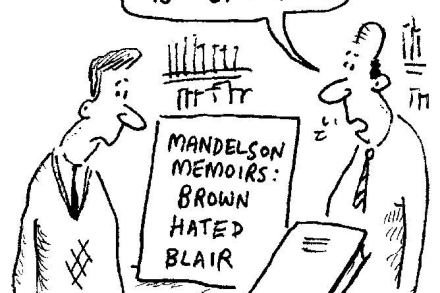
Peter Mandelson’s memoirs are out in just over a week. Despite being one of the last off the stage, Mandelson has beaten his colleagues to the first full account of the Blair Brown era. Tony Blair’s ‘The Journey’ is not out until September. Indeed, some Blair allies think that Mandelson should have had the good manners to let the former Prime Minister publish first. There’ll be some people who dismiss any Mandelson book as old news. But from what I’m hearing these memoirs could be more interesting than people are expecting. Apparently, many of Mandelson’s political friends have not heard from him recently and fear they could be painfully frank. The media will be looking to see what Mandelson says about Blair and Brown.