James Forsyth

James Forsyth

James Forsyth is former political editor of The Spectator.

The deep Euro-crisis threatens political stability

From our UK edition

It is hard to overstate how serious the crisis in the eurozone is or what it might do to the politics of Europe. The European project is putting in danger the very political stability in Europe that its supporters have always claimed to be its strategic and moral justification. I understand that American banks are now so nervous about the situation on the continent that they have effectively stopped new lending to European banks. The view in Westminster today is that the Greeks will avoid default for a little longer. But few can see them making it to Christmas. Indeed, the expectation seems to be a default sometime in October.
What the riots mean for Ken Clarke

From our UK edition

The more we learn about the riots, the more it is becoming clear that experienced criminals were responsible for a lot of the looting. The Standard reports today that in London a quarter of those charged in relation to the riots had already been convicted of ten or more offences. What remains to be seen is if these hardened criminals instigated the riots, or simply took advantage of them. The involvement of these veterans of crime demonstrates the need both for better work on rehabilitating prisoners and for longer sentences to keep habitual criminals off the streets. The problem with Ken Clarke is that he, admittedly partly for budget reasons, only wants to see one side of this equation. The riots have been overshadowed by the brewing financial crisis.

Downing Street’s boundary review problem

From our UK edition

I understand that Number 10 will lean on Cabinet ministers not to object to what the boundary review does to their seats. This is an intriguing development because at least three Tory Secretaries of State are deeply unhappy with the proposed changes to their constituencies. It’ll be fascinating to see whether Downing Street can persuade them to hold their peace on the matter. Their disquiet reflects broader grumbling throughout the Tory parliamentary party. All sorts of conspiracy theories are doing the rounds. Number 10 needs to move quickly to offer some reassurance to nervous MPs. If the boundary review’s plan is to be made agreeable to the Tory parliamentary party, Cameron is going to have to persuade an awful lot of MPs to retire.

A brutal no score draw at PMQs

From our UK edition

Cameron and Miliband went six rounds on the economy at PMQs. Miliband tried to portray Cameron as just another Tory who thinks that "unemployment is a price worth paying". Cameron, for his part, wanted to paint the Labour leader as someone whose policies would send Britain tumbling into a sovereign debt crisis. At the end, it felt like a bit of a no-score draw. Interestingly, Cameron stressed that "every week and every month, we’ll be adding to that growth programme". We’ll have to see whether he’s talking about more small-bore measures, or something bigger on infrastructure investment. Labour had a new tactic today, trying to fact-check all of Cameron’s answers from last week.

Bumper turnout for Tory Euro-sceptic meeting

From our UK edition

I hear that 124 Tory MPs attended the inaugural meeting of the Tory ginger group pushing for renegotiation of Britain’s relationship with Europe. Those present included at least one minister — Theresa Villiers, several PPS and a few whips who were keeping a beady eye on proceeding. George Eustice, the convener of the group, told the room that he wanted the group to work with the government rather than against it and that he wanted front-benchers to feel comfortable attending the meetings. The group intends to put out a series of proposals as to which powers should be repatriated before issuing a white paper on how the government should renegotiate Britain’s relationship with the European Union.

Managing the boundary changes

From our UK edition

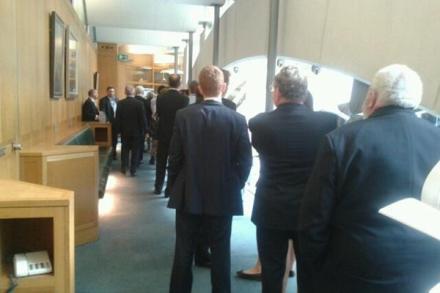
MPs are queuing down the corridor on the first floor of Portcullis House as they try to get hold of a copy of the proposed boundary changes which have just been released under embargo. Boundary changes can make a huge difference to an MP, converting a marginal into a safe seat and vice-versa. Boundary reviews are a whip’s nightmare as they will set MPs of the same party against each other. The danger for the two coalition partners is that MPs’ take to rebelling on emotive issues for their parties in an attempt to win any selection head to head. This is why Cameron went out of his way to promise all Tory MPs that no one would be left without a seat at the Tory parliamentary dinner last Wednesday night.

A reminder of two of the political battles ahead for the coalition

From our UK edition

If anyone had any doubts about how difficult the politics of banking reform and planning would be for the Conservatives, they’ll be dispelled by a glance at a couple of tomorrow’s front pages.  ‘Osborne to let banks off the hook—for now’ screams The Independent. This a reference to the Chancellor’s plans to consult with the banks on the conclusions of the Vickers report—which the government has seen but is officially published tomorrow morning. The political problem for Osborne is that anything other than the immediate implementation of Vickers’ recommendations will be seen as a favour to the banks. But pushing the reforms through now could undermine an already weak economy.

Huhne ramps up the rhetoric on 50p

From our UK edition

Chris Huhne’s comments to Prospect magazine about the 50p tax rate are typically provocative. The millionaire, former City boy accuses the Tories of wanting to abolish the 50p tax rate to help ‘their friends in the City to put their feet up’. He even suggests that the Lib Dems would not vote through any Budget that contained its abolition. Huhne’s intervention comes at a time when George Osborne is trying to build support for abolishing—or, at least cutting—the 50p rate. Tellingly, the letter from economists opposing the 50p rate was drawn up with the help of one of the Chancellor’s closest lieutenants.

Resignation provides a Stark reminder of the divisions within the eurozone

From our UK edition

The problems facing the eurozone have been underlined by the departure from the European Central Bank yesterday of its senior German representative, Jürgen Stark. Stark, who is in essence the bank’s chief economist, has quit its six-member executive board. The ECB is saying that he’s leaving for personal reasons but it is widely suspected that he’s really off because he can’t accept the bank’s policy of buying up the debt of embattled eurozone economies.  Stark will almost certainly be replaced by another German. Given the current political dynamics there, it is almost certain that whoever succeeds Stark will take an equally dim view of the ECB purchasing bucket loads of ‘olive zone’ debt.

Hague says he’s been held back on Europe by the Lib Dems

From our UK edition

William Hague’s comments in an interview with The Times that the Liberal Democrats are restraining the Tories on Europe will increase the grumbling among Tory backbenchers about the power of the junior coalition partner. Hague tells the paper that ‘A point of difference in our manifesto was the aim to repatriate some powers. Clearly that’s something I’m in favour of, but that’s the area we had to compromise on in return for other compromises.’ (In many ways this is a statement of the obvious. But in the current uncertain European environment, his remarks are news). In an attempt to reassure euro-sceptics, Foreign Secretary stresses that the Conservative party ‘would like to see powers returned from the EU to the United Kingdom.

Politics: Can the coalition survive the crises ahead?

From our UK edition

Can the coalition survive the crises ahead? For something cobbled together by eight sleep-deprived men over four days, the coalition agreement has proved remarkably durable. Even now, with relations between the Tories and Lib Dems arguably more strained than ever, the document’s writ still runs. Both parties know that if they didn’t abide by its terms, the show would collapse. But the document can’t cover every crack, and the coalition has shown itself to be particularly vulnerable to events. In May last year no one expected, for instance, that there would be mass looting on the streets of London. When the riots happened, the coalition struggled to agree on a response: the two parties’ visceral reactions to the disturbances were just too different.

Cameron’s well-schooled argument

From our UK edition

When Michael Howard offered David Cameron the pick of the jobs in the shadow Cabinet after the 2005 election, Cameron chose education. Howard was disappointed that Cameron hadn't opted to shadow Gordon Brown but Cameron argued that education was the most important portfolio. A sense of that commitment was on display today in his speech on education, delivered at one of the new free schools that have opened this term. His defence of the coalition’s plans to make it easier to sack bad teachers summed up its refreshing radicalism. He simply said, "If it's a choice between making sure our children get the highest quality teaching or some teachers changing career... I know what I choose.

Blair returns to warn of the dangers of Iran

From our UK edition

With the tenth anniversary of 9/11 approaching, Tony Blair has given an interview to The Times. What’s making news is his—to my mind, accurate--warnings about just how dangerous it would be for the Middle East for the Iranian regime to get a nuclear bomb. But what struck me about the interview was how much easier Blair believed things would be in Afghanistan and Iraq than they have been.  He tells the paper that: “What that means is that you can knock out, militarily, the regime, but then when you’re engaged in the process of nation building afterwards, it’s not like nation building was in, say, the Balkans or Eastern Europe.

Pickles to take charge of dealing with Britain’s 120,000 “problem families”

From our UK edition

I understand that following a meeting in Downing Street this morning, Eric Pickles, the Communities and Local Government Secretary, has been put in charge of dealing with Britain's 120,000 "problem families". In the aftermath of the riots, David Cameron promised to put all of these families through some a family-intervention programme by the time of the next election. This policy, though, was bogged down in the bureaucracy as it cut across so many different departments. Pickles' department will now have sole responsibility for this commitment. It will receive extra budget, with the money coming from education and work and pensions, and staff to deal with this.

How will Westminster respond to Vickers?

From our UK edition

The Vickers’ report into banks will land on the Prime Minister’s desk tomorrow. It goes to the banks very early on Monday morning before being published later that day. The thing to watch for is how politicians react to it. We know that the report will propose some kind of ring fence. But what we do not know is how strict the ring fence will be and how quickly Vickers will want it implemented. As Robert Peston says the impact of the ring fence on the banks’ creditworthiness will be felt long before the actual ring fence comes into effect. Intriguingly, Ed Miliband is giving a speech to the TUC that day. This gives him a platform to call for the immediate implementation of the whole report.

With Obama looking beatable, the Republican candidates debate

From our UK edition

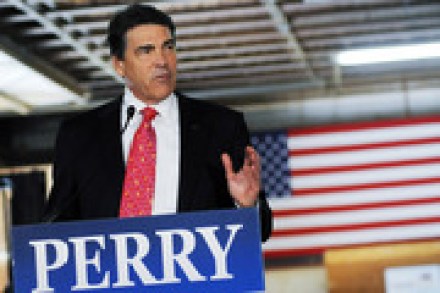
Tonight, the Republican primary race gets serious with a debate at the Ronald Reagan presidential library in California. This is the first debate that Rick Perry, the governor of Texas and the current frontrunner, has taken part in. The Republican nomination is now a far more attractive prize than many expected it to be. 53 percent of voters now disapprove of the job Obama is doing suggesting that he is beatable. At the moment, the Republican nomination appears to be Perry’s to lose. He is benefitting from both the troubles of the Tea Party favourite Michele Bachmann, her campaign manager has just stepped down, and Republican establishment unease with the former frontrunner Mitt Romney. What we haven’t seen yet is whether Perry can take a punch.

Cameron Dorries exchange the most memorable moment of a quiet PMQs

From our UK edition

The first PMQs of the new parliamentary term was a bit of a damp squib. Ed Miliband avoided the issue of the economy, presumably because he feared being hit by a slew of quotes from the Darling book. So instead we had a series of fairly unenlightening exchanges on police commissioners and the NHS. Labour has clearly chosen to try and attack the coalition from the right on law and order and security. There were a slew of questions from Labour backbenchers on whether the coalition’s anti-terrorism legislation was too soft. But I suspect that this PMQs will be remembered for the Cameron Nadine Dorries exchange.

The conference season blues

From our UK edition

Few things irritate the Prime Minister’s circle more than the insinuation that David Cameron is lazy. So Ben Brogan’s column this morning with its slightly barbed observations about the number of box-sets that Cameron finds time to watch will have been read through gritted teeth in Downing Street. Ben argues that Cameron will have to use his conference speech to show the country what he stands for and what he wants. This is, as Ben acknowledges, said about most leaders before nearly every party conference. But I understand that preparations for this year’s Tory conference are particularly chaotic. While the work on Cameron’s own speech is proceeding apace, the rest of the conference programme is short on both ideas and a theme.

A growing argument about the 50p rate

From our UK edition

With the Eurozone and American economies both at risk of a double dip recession, how to get the British economy moving again is going to be one of the defining political arguments of the autumn. A first salvo in that fight has been fired this morning with a letter to the FT from 20 economists calling for the immediate scrapping of the 50p rate because of the harm that it is doing to the economy as a whole. This letter will, one suspects, be privately welcomed by the Chancellor who is looking for ways to, at the very least, cut the rate. He has become increasingly convinced that it is making it harder to get a proper recovery going. But, politically, offering a tax cut to the rich is a hard sell at the moment.

Cameron faces the eurosceptics

From our UK edition

If Tony Blair thought that a meeting with Gordon Brown was like dental surgery without anaesthetic, one wonders how David Cameron would describe being questioned on Europe by Bill Cash and Bernard Jenkin. At the liaison committee, the two veteran eurosceptics pushed Cameron on why he was supporting far greater fiscal integration in the Eurozone. Cameron’s answer was, basically, that this was the only way the Eurozone could be made to work. But one can’t help but feel that greater fiscal integration is simply storing up problems for the medium term given that it will do nothing about the divergence in competitiveness between Eurozone members. The rest of the session was dominated by yet more questions about relations between politicians and the media.