James Forsyth

James Forsyth

James Forsyth is former political editor of The Spectator.

The last Blairite

From our UK edition

Jim Murphy is that rare breed, a genuinely working-class, modern British politician. We meet on the eve of Labour conference in a café in an upmarket shopping centre in his native Glasgow and he begins by talking about his childhood. Labour’s 44-year-old shadow defence secretary was born on a Glasgow housing estate and spent his early years ‘sleeping in a drawer’, he says, in a one-bedroom house containing four generations of his family. But there’s no self-pity or faux-nostalgia in his reminiscing. What defines Murphy and his politics is not his family’s poverty, but their determination. When his father lost his job, he simply got on a bus and travelled around the UK until he found another one.
Telegraph reports that Wallis was paid for stories by the News of the World while working for Scotland Yard

From our UK edition

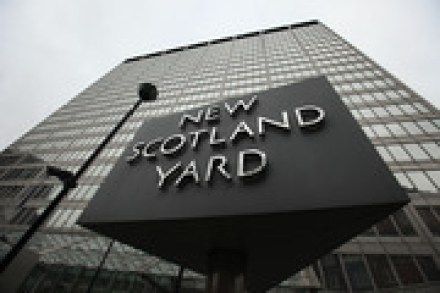
The Daily Telegraph is tonight alleging that Neil Wallis was paid by the News of the World to provide crime exclusives while working as a consultant for the Metropolitan police. The paper claims that the News of the World paid Wallis £25,000 for information including the details of Scotland Yard operations during this period. According to the Telegraph, £10,000 of the £25,000 was for a single story. This revelation will increase the pressure on the police to reveal fully the extent of contacts between it and News International. But with Paul Stephenson already having resigned over the hiring of Wallis as a consultant, further resignations are unlikely. The other hack-gate news tonight is that a certain A Coulson is suing News Group newspapers.

Preparing for the US Presidential election

From our UK edition

One thing British politics has yet to rise up to is how possible it is that Barack Obama might lose next year. All the pollsters have his approval rating in negative territory, Gallup has him down by ten, and the American economy looks likely to deteriorate between now and November 2012. But the big thing in Obama’s favour is the weakness of the Republican field. Bill Kristol’s cry of pain about the quality on show in last night’s primary debate sums up Republican establishment worries that none of the candidates cut it. We can now expect another push to get a new candidate into the race. Chris Christie, the governor of New Jersey, will come under a lot of pressure to throw his hat in.

Mullen adds to the tension between the US and Pakistan

From our UK edition

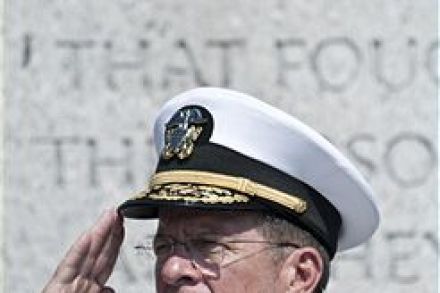
US-Pakistani relations will deteriorate even further following today’s claims by Admiral Mike Mullen, the outgoing chairman of the Joint Chiefs of Staff, that the Pakistani ISI aided and abetted the attack on the US embassy in Kabul. Mullen told a Senate panel that, "With ISI support, Haqqani operatives planned and conducted a truck bomb attack, as well as the assault on our embassy." This charge was part of broader criticism of what Washington sees as Pakistan’s strategy of exporting its internal problems.

Ed wants to tear it all up

From our UK edition

Ed Miliband’s pre-conference interviews in Progress and the New Statesman serve as a reminder of the Labour leader’s desire to move the political centre ground. To the New Statesman he talks repeatedly of changing the current ‘settlement’ both economic and political. I presume by that he means the orthodoxies of the Thatcher-Blair era. Indeed, he tells Progress of one area where he wants to do things differently: ‘…people used to say “it is anti-aspiration to talk about people at the top”, it is not anti-aspiration – it is pro-aspiration.

The Lib Dem conference closes

From our UK edition

As the Liberal Democrat leadership leaves Birmingham, it is a contented bunch. Their conference has gone as well as could be expected. There were no embarrassing defeats for the leadership and no gaffes by any of their ministers. But conference was yet another reminder of how much of a gap there is between where those around Clegg want to take the party and where the activist base wants to go. When I asked one of Clegg’s allies about this discrepancy, he told me that the important thing to remember was that the membership, who elect the leader, take a different view from the activists. As evidence of this, he cited how activists’ darling Simon Hughes actually came third in the 2006 leadership race and how Clegg managed to squeak past Huhne in 2007.

The Lib Dems’ long-term assault on Labour

From our UK edition

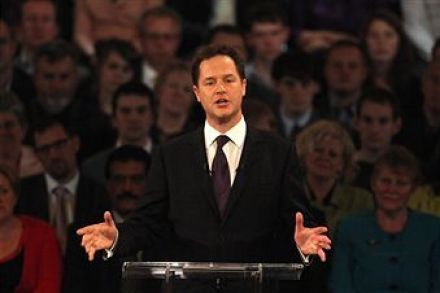
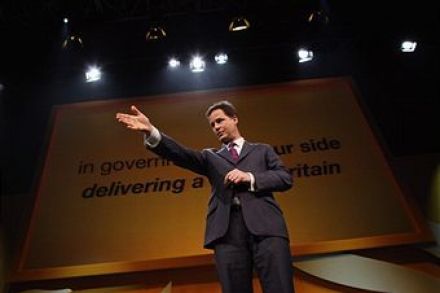
Listening to Nick Clegg’s speech today, there was little doubt which party he’d rather be in coalition with. There were some coded slights at the Tories’ expense—the emphasis on how the Lib Dems had been ‘fighting to keep the NHS safe’ and his commitment that the Human Rights Act was here to stay—but they were nothing compared to the full frontal attacks on Labour. Clegg derided Miliband and Balls as the ‘backroom boys’ before warning the country to ‘never, ever trust Labour with the economy again.’ This line reveals something very important, the Lib Dem leadership believes that the more the economy is in trouble the more important it is that they pin the blame on Labour for its problems.

Farron’s difficult day

From our UK edition

I’ve been away from Birmingham today but, even from a distance, it’s clear that Tim Farron has had a rather difficult day. It started with a story in The Times this morning about upset among his fellow MPs about his rhetoric on Sunday implying that the coalition partners would get divorced before 2015 and continued with him getting in a bit of a tangle about his leadership ambitions in interviews with Andrew Neil and Gary Gibbon. Farron’s problem is that he is an obvious candidate to run in any future leadership contest and so the leadership will constantly push him about his intentions.

A revealing episode

From our UK edition

The row about which email account special advisers use for which emails is, I suspect, of very little interest to anyone outside SW1. But today’s FT story certainly has set the cat amongst the Whitehall pigeons. At the risk of trying the patience of everyone who doesn’t work within a mile of the Palace of Westminster, I think there is something here worth noting about our political culture. Christopher Cook’s story in the FT this morning is about an email that Dominic Cummings, one of Michael Gove’s special advisers, sent urging various political people not to use his Department of Education email. In this case, the email was perfectly proper. Ministers and special advisers aren’t meant to use official resources for party political activity.

The coming row over Europe

From our UK edition

One of the most striking things about Lib Dem conference has been how up for a scrap over Europe the party’s ministers are. Every single Lib Dem Cabinet minister has, over the past few days, ruled out any attempt to repatriate powers from Brussels. Given that the Conservative party wouldn’t forgive David Cameron not attempting to use any new treaty negotiation to try and regain control of various issues (see David’s blog from earlier), this puts the Prime Minister in quite a dilemma. Personally, I expect Cameron will go for the repatriation of powers. The AV referendum showed that when he has to choose between really angering his party or the Liberal Democrats, he crosses his coalition partners.

Clegg, on fine form, tells his party to move on

From our UK edition

"We’ve got to stop beating ourselves up," Clegg just told Lib Dem members in a Q&A session. As is traditional at these events, Clegg spent a lot of time trying to explain to his party why the coalition is doing what it is doing. The tone of the event was, perhaps, best summed up by the Deputy Prime Minster telling one hostile questioner to listen to his answer. Clegg, in head-masterly form, started by reminding the audience that if the coalition was not dealing with the defitict of its own volition, the bond markets would be forcing it to and "you can’t do anything  good if you have no control over your own destiny.

Vince Cable paints the world grey

From our UK edition

Even by his own standards Vince Cable’s speech today was noticeably pessimistic. The Business Secretary warned that the post-war cycle of ever-rising living standards has been broken by the crash. There was little in what he said to suggest that he has any optimism about the prospects for growth over the next few years. If Cable’s analysis is correct — and it is shared, at least in part, by several Tory Cabinet ministers — then the politics of the next few years will look very different than we expected. The initial post-election Tory hope of running a ‘It’s morning in Britain again’ campaign in 2015 now seems like a distant memory.

Alexander distances himself from the Tory bashing

From our UK edition

Lib Dem conference delegates have just provided the press with a nice easy story, they’ve voted to set up a panel to look at the legalisation of cannabis and the decriminalisation of all drugs. But away from the main hall, Danny Alexander has just given an interview to Andrew Neil in which he has distanced himself from the almost incessant Tory bashing going on at this conference. When asked whether he agreed with Simon Hughes’ description of the Tories as ruthless extremists, he replied "I wouldn’t engage in debate in that way." Alexander said that, contrary to the Jasper Gerard book, there will be no new coalition agreement to cover the second half of the parliament.

Farron brings the hall to its feet

From our UK edition

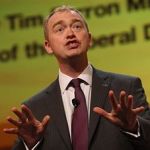
For Lib Dem modernisers there are few more depressing sights than how conference reacts to a Tim Farron speech: he serves up social democratic red meat and they absolutely lap it up. Farron, the party president, delivered one anti-Tory jibe after another. He declared that the government would be an ‘absolute nightmare without’ the Liberal Democrats in it, boasted that Nick Clegg was ‘leading the opposition’ as well as being deputy Prime Minister and accused the Tories of believing it was ok for the super-rich not to pay tax. There were also a slew of attacks on ‘the reactionary Tory drivel’ that the Tories have supposedly sprouted since the riots.

The real 50p split

From our UK edition

Nick Clegg’s interview on Andrew Marr this morning subtly shifted the Lib Dem position on the 50p tax rate. When Marr asked him what he would do if the George Osborne commissioned HMRC study showed that it raised no money, Clegg replied ‘then I of course think we should look at other ways in which the wealthiest pay the amount that we’d expected through the 50p rate.’ So, in other words, he’ll accept its abolition if something else is put in its place. But, crucially, Clegg wants any replacement to raise not what the 50p rate actually raises but what it was supposed to raise. This presages the next debate in government over 50p.

Clegg kicks off the conference

From our UK edition

If you can judge a party’s mood by the number of bad jokes it tells, then the Liberal Democrats are in better form than last year. Their rally to open conference was characterised by a string of appalling gags. George Osborne was a particular target with both Don Foster and Sarah Teather trying to raise a laugh at his expense. However, several of Teather’s jokes, which moved into real bad taste territory, fell totally flat. The main speech of the rally, though, was Nick Clegg’s. Clegg, who was welcomed with a standing ovation, made his pitch that the party was governing from the centre, for the whole country.

Clegg biography claims the Lib Dems want a new coalition agreement

From our UK edition

Lib Dem conference this year brings with it the serialisation of Jasper Gerard’s biography of Nick Clegg. The focus will be on the claims that deputy Prime Minister has promised his wife he’ll only serve one term and that senior Lib Dems are interested in a soft electoral pact with the Tories. But, to my mind, the most interesting point is that the Lib Dems are keen on a new coalition agreement to cover the second half of the parliament. Coalition insiders have always admitted that the legislation mentioned in the agreement should have been mostly passed by 2012. But the Tories have been keen to spend the second half of the parliament concentrating on delivering on what’s already on the statue book rather than dealing with a whole new set of bills.

Politics: Nick Clegg is in better political shape than anyone would have guessed

From our UK edition

It is too early to call him the comeback kid of British politics, but Nick Clegg enters the party conference season in better shape than anyone expected him to be four months ago. Back then, his party did not dare put his face on its campaign leaflets. Even Liberal Democrat ministers didn’t expect Clegg to lead the party into the next election. This is beginning to change. Clegg looks happier than he has in months: the hunted look has gone from his face. Last week, watching him walk through the corridors of the Institute of Contemporary Arts on the way to a party for one of his aides, I was struck by how relaxed he was. A few months ago, it is hard to imagine that he’d have been as comfortable wandering around such a student hang-out.

Paddy pulls no punches

From our UK edition

The former Lib Dem leader on learning to love the Tories – and the fate of the euro  ‘Have you ever been in the world’s smallest lift?’ Paddy Ashdown asks when we meet at the entrance to the House of Lords. ‘It was designed by William Gladstone!’ We travel up in the lift, admiring the old-fashioned sliding doors and suited attendant. Ashdown explains that the parliamentary authorities tried to shut it down on health and safety grounds but, he says proudly, he fought to keep it open. ‘My greatest parliamentary achievement,’ he keeps saying — only half joking. He’s still talking about the lift when we reach his office and sit down: ‘A proper Liberal Democrat council campaign,’ he declares.