James Forsyth

James Forsyth

James Forsyth is former political editor of The Spectator.

If Clegg wants to reduce youth unemployment, then he’s going to have to look at regulation

From our UK edition

Nick Clegg’s interview in The Times today presages a major Lib Dem effort to try and promote policies to reduce youth unemployment. With figures out on Wednesday expected to show youth unemployment going over a million, the Lib Dem leader is keen to show that the government is acting. But as The Times reports, the quad—Cameron, Osborne, Clegg and Alexander—are divided on what to do about the matter. The Tories are keen to do Beecroft for young people, removing some of the employment protections that make firms so reluctant to hire new staff. But given how the Lib Dems have set themselves so firmly against the Beecroft review and its principal idea of replacing unfair dismissal with severance pay based on length of service, they won’t accept this.


Warsi: Tories will oppose plans for more state funding of political parties

From our UK edition

In an interview in The Times today, Sayeeda Warsi makes clear that the Conservatives will oppose the idea of giving political parties three pounds of state funding for every vote they win. She says: 'I fundamentally disagree with that. At a time when the country is facing the current economic climate, for us to be thinking about putting £100 million, which could build 20 schools and give you thousands of operations on the NHS, into party political funding is wrong. I think people would be appalled by it. They would say, "That is not what I pay my taxes for".' This is a welcome intervention. State funding of parties based on the result of the last general election would be an appalling system.

Politics: Miliband pitches his tent with the protestors  

From our UK edition

During the Depression, tent cities sprung up across America. Today, in the second great contraction, they are appearing in the financial centres of the western world. But there is a crucial difference: the contemporary campers are there out of choice not necessity. Pitching your tent has become the fashionable form of protest. It is easy to dismiss the attention heaped on ‘Occupy London’ and its criticisms of greed in the City as a classic example of left-wing media bias. The rally for an EU referendum attracted nearly ten times as many people, but didn’t receive even a tenth of the news coverage. But the reason Occupy is causing such a stir is because of the sense that some new form of politics should be emerging.

How European sovereign debt became the new sub-prime

From our UK edition

The New York Times has a great piece today on how banks became so exposed to the sovereign debt of European countries with a history of defaulting. Here’s the nub of the argument: “How European sovereign debt became the new subprime is a story with many culprits, including governments that borrowed beyond their means, regulators who permitted banks to treat the bonds as risk-free and investors who for too long did not make much of a distinction between the bonds of troubled economies like Greece and Italy and those issued by the rock-solid Germany. Banks had further incentive to overlook the perils of individual euro zone countries because of the fees they earned for underwriting sovereign debt sold to other investors.

Murdoch denies all knowledge

From our UK edition

https://www.youtube.com/watch?v=G0T0OVKIYog James Murdoch's great advantage today was that he didn't mind if people came away thinking he was a bit of an idiot. As various members of the Culture, Media and Sport select committee attempted to goad him into saying that he knew about this or that, Murdoch simply pleaded ignorance. Why was Murdoch ignorant of what was happening in the company of which he was executive chairman? Apparently becase he asked very few questions. Even the obvious ones about what the lawyers had said or why such large settlements were being made seem to have escaped him. Murdoch was also helped by Tom Watson's over the top invocation of the mafia.

The Italian domino effect

From our UK edition

For all the debate about Theresa May and border security, the big news has not been at Westminster today. Instead, people have been watching what is happening in Italy. For it is far from certain that Europe, or the Western world for that matter, has a bucket bigger enough to bail out a country that owes more than Greece, Ireland, Portugal and Spain do combined. As the New York Times reports, the European Central Bank is reluctant to step in and start buying Italian bonds because it fears that its previous bond buying efforts have simply enabled the Italians to avoid necessary reforms. It feels that only market pressure will make the Italians actually act. But this is a dangerous game to play because if Italy falls, France will be left teetering on the brink. BNP Paribas has 12.

Miliband’s immigration attack no threat to Cameron

From our UK edition

Ed Miliband broke with his post-conference policy of always asking about the economy at PMQs to devote all six questions to the whole Brodie Clark/Theresa May border dispute. Miliband, though, had no new killer fact or question. Instead, he stuck to general criticisms of the government’s approach. This gave Cameron an easy ride. He simpy backed the Home Secretary unequivocally before turning on Labour's immigration record. By the end, Cameron was at his most disdainful towards Miliband. Indeed, the most interesting element of the exchange was how the Liberal Democrats looked at their feet as Cameron rattled off the coalition's greatest hits on immigration. The rest of the session was relatively quiet.

Why is Huhne still shunning shale?

From our UK edition

Chris Huhne's article in the Telegraph this morning attacking those who think that shale gas can solve Britain's energy needs is built around a straw man of an argument. Huhne claims that, 'Some therefore argue that we should abandon everything else and devote ourselves wholly to shale.' This is, to put it mildly, a dubious claim. Advocates of shale gas don't want to abandon all other forms of energy, they just want Britain to properly exploit an energy resource which could be as significant for Britain as North Sea oil has been. The Energy Secretary's aversion to shale is even more puzzling when you consider how keen he is for imported gas, coming from some of the most geo-strategically unpredictable places in the world, to emerge as 'the back-up' to renewables.

Osborne gets frank with Europe

From our UK edition

George Osborne’s attack on the European Commission and his fellow finance ministers, for wasting time talking about a financial transactions tax when it is not going to happen, is quite a significant moment. It marks an attempt by Britain to knock this idea, which would hit this country far harder than anywhere else in Europe, off the agenda.   The Treasury, the Foreign Office and Number 10 have become increasingly exasperated about how this issue keeps coming up again and again. This feeling has been intensified by the fact that this issue is being discussed even as the crisis in the Eurozone is worsening by the hour.

May takes some hits, but looks safe for now

From our UK edition

David Cameron provided a reassuring presence for the Home Secretary today, sitting supportively next to her throughout her statement and Yvette Cooper's response. May, who didn't sound or look like someone who thinks their career is in danger, stressed that she "did not give my consent or authorisation to any of these actions". But she had to concede that we'll never know how many people came in who shouldn't have because of the relaxation of checks on those arriving in this country. In an aggressive reply, Yvette Cooper demanded that the various inquiries May has set up report much earlier than the New Year. She also said that she had been warned by UKBA staff that the shredders were running there and that there was a ban on internal email.

Cameron defends the IMF

From our UK edition

David Cameron's statement to the House of Commons on the Cannes summit was dominated by the question of increasing Britain's dues to the IMF. Cameron stressed that his message to the Eurozone countries was "sort yourselves out and then we will help". He also tried to offer reassurance that the IMF would not contribute to any eurozone-specific bailout fund. But after Ed Miliband's response, the Prime Minister tried to counter-attack. He began by saying of the Labour leader's speech, "I don't know who writes this rubbish" which drew one of Ed Balls' infamous calm down gestures. Cameron then offered an aggressive defence of the IMF, calling it an "organisation that rescued us from Labour in the 1970s".

May caught in immigration row

From our UK edition

Theresa May has up to now proved remarkably adept at avoiding the political bear-traps that have ensnared so many Home Secretaries in recent years. But she now finds herself caught in a classic Home Office row over who allowed the UK Border Agency to ease passport checks to cut queues during the summer months. James Kirkup has the scoop that ministers approved this decision. Given May’s reputation for keeping her ministerial team on the tightest of leashes, this creates a problem for the Home Secretary. Labour will go at this issue hard. They know it provides them with a populist way to claim that the cuts are endangering the country's security. But May's position is bolstered by the fact that the Prime Minister is her biggest fan.

The Union needs a champion

From our UK edition

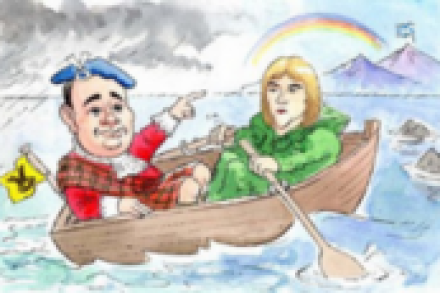
The First Minister of Scotland v the Secretary of State for Scotland on the Politics Show today was a non-contest. Michael Moore was hesitant and failed to fill the screen. Alex Salmond was crisp and confident. This disparity between Salmond and his opponents is one of the biggest problems for the Unionist cause. Polls consistently show that most Scots don’t want independence. But every day Salmond is out there making his eloquent—if factually dubious—case for it. There is a real and growing danger that’ll he end up winning by default because no one of stature is countering him. What’s needed is a big figure, preferably a non-political one, to defend the union and take the fight to Salmond.

Cameron’s attempt to re-moralise the economy

From our UK edition

One of the great challenges facing Britain is how to re-moralise society. A country where individuals, or businesses, can't tell the difference between right and wrong has fundamental problems. The Times reports today that David Cameron is planning to start talking about the need for "moral markets". There'll be those on the right who don't like this, who feel it is pandering to Ed Miliband's distinctions between predator and producer capitalism. Others will feel that it is impractical. Then there are those who'll counter that the only responsibility of business is to maximise profits. But this is important territory for Conservatives to be on.

Papandreou wins no confidence vote, but appears set to stand down

From our UK edition

The political situation in Greece remains unclear this morning. George Papandreou’s government survived last night’s confidence vote. But the main opposition party has rejected the idea of a national government and Papandreou’s finance minister appears to be maneuvering to replace him. Papandreou’s victory in the no confidence vote means that there probably won’t be elections in Greece this year. But the huge difficulties involved in implementing the austerity plan remain. The measures continue to command little public support and the opposition will continue to criticise them.

The euro is killing Europe – can the coalition turn the chaos to its advantage?

From our UK edition

Last week’s rebellion by David Cameron’s backbenchers in support of an EU referendum ended eight years of peace in the Tory party on the European question. Now, the offer by the Greek Prime Minister of a referendum on the ­bailout package — designed to appease nervous Greek Socialist party backbenchers — means that the uncertainty surrounding the eurozone will drag on into the New Year. George Osborne regards the confusion surrounding the future of the single currency as the single biggest obstacle to a British economic recovery. The Chancellor and his colleagues have become increasingly convinced that only when the markets have confidence about what is going to happen will businesses be prepared to invest their cash, and not just sit on it.

Cameron leaves Cannes with an IMF headache

From our UK edition

https://www.youtube.com/watch?v=Qm6yP-5RGK8 The Cannes summit leaves the world no further forward on its quest for some kind of solution to the Eurozone crisis. Strikingly, the Germans still won't agree — despite huge diplomatic pressure — to the ECB fulfilling the traditional emergency function of a central bank and acting as lender of last resort. This is a blow when you consider that Cameron thought there was a real possibility Merkel would budge on this after last week's European Council meeting. It also provides Cameron with a domestic political headache. For if the ECB won't act, the IMF will have to take more of the strain — and increasing Britain's contributions to the IMF in the current political climate is not going to be easy.

Reuters: Papandreou to resign on Friday

From our UK edition

Reuters is reporting tonight that the Greek Prime Minister has agreed to resign on Friday. The news agency says that at a meeting Cabinet colleagues told George Papandreou that he had to resign for the good of the Socialist party and he agreed. It quotes one source saying, "He agreed to step down. It was very civilised, with no acrimony." Now, after Thursday’s experience, I suspect we’re all taking reports about what will, or will not, happen in Greece with a pinch of salt. But it does seem that the referendum is off, stymied in part by Merkel and Sarkozy, who have ridden roughshod over the idea of non-interference in another nation’s affairs. That is, I suppose, par for the course for the European project.

The euro sparks a Cabinet row

From our UK edition

Word reaches me of a vigorous exchange of views in Cabinet this week between Chris Huhne and Michael Gove over the European question. Huhne, who has form when it comes to Cabinet scraps, launched into a polemic against Tory Eurosceptics and insisted that the coalition not be "wagged by the Eurospecptic tail". It has, obviously, escaped Huhne’s notice that there are more Tory Euro-rebels than there are Lib Dem MPs. There then followed an even more incredible moment where Huhne implied that if he had been in power, the single currency would have worked and so it was unfair to suggest that he had been proved wrong.

The euro is destroying Europe

From our UK edition

This week's issue of The Spectator hits the newsstands today. Here, for CoffeeHousers, is James Forsyth's Politics column from it: Last week’s rebellion by David Cameron’s backbenchers in support of an EU referendum ended eight years of peace in the Tory party on the European question. Now, the offer by the Greek Prime Minister of a referendum on the bailout package — designed to appease nervous Greek Socialist party backbenchers — means that the uncertainty surrounding the eurozone will drag on into the New Year. George Osborne regards the confusion surrounding the future of the single currency as the single biggest obstacle to a British economic recovery.