James Forsyth

James Forsyth

James Forsyth is former political editor of The Spectator.

The coming battle over the ‘undeserving rich’

From our UK edition

Who can be toughest on the ‘undeserving rich’ is shaping up to be one of the main political battlegrounds of 2012. David Cameron and Nick Clegg’s comments today on tax avoidance are an attempt to get ahead of this debate.    Clegg, though, is keen to make this issue his own. As I say in the politics column this week, he is planning a big speech later this month on ‘responsible capitalism’. He will use it to argue that there need to be more checks and balances within companies and call for more shareholder power over executive pay. One Cleggite tells me, in reference to the Labour leader’s conference speech trying to sketch out a new capitalism, ‘it is the speech Ed Miliband should have given.

Lord Glasman’s target is the other Ed

From our UK edition

Maurice Glasman’s New Statesman piece on Ed Miliband is causing a bit of a stir. Lord Glasman, an academic who Miliband proposed for a peerage, writes that the Labour leader ‘has not broken through. He has flickered rather than shone, nudged not led.’ But if you read between the lines of Glasman’s article it is clear that he thinks someone is holding Miliband back and he drops very heavy hints as to who that is. For instance, the second sentence reads as follows: ‘Old faces from the Brown era still dominate the shadow cabinet and they seem stuck in defending Labour's record in all the wrong ways - we didn't spend too much money, we'll cut less fast and less far, but we can't tell you how.

Romney’s faltering first step towards the nomination

From our UK edition

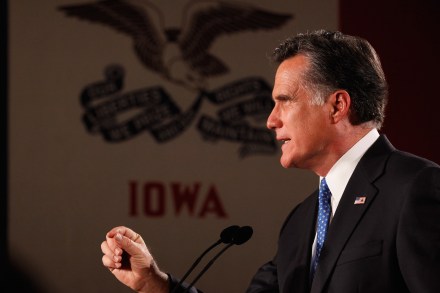
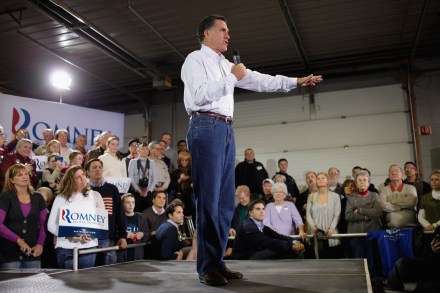
Mitt Romney’s victory by eight votes in Iowa is hardly a ringing endorsement of his candidacy. But, I suspect, he will be the nominee. The real danger for Romney was a repeat of his 2008 failure in Iowa. He has avoided that. He now heads for New Hampshire where he has a massive poll lead. A commanding victory there will give him the big mo to get through South Carolina, an inhospitable state for him, and head into Florida, a banker for him, in a strong position. Rick Santorum, who broke from the back of pack at just the right moment and came so close to upsetting Romney, will now be subject to the scrutiny befitting a top tier candidate. This process will dent his support.

Tonight in Iowa

From our UK edition

One of the things that makes the Iowa caucuses so different from most elections is that it is almost the opposite of a secret ballot. Four years ago I went to report on a caucus in suburban Des Moines. As soon as voters entered the school sports hall in which it was taking place, they had to go and stand in the corner of their candidate. There then followed a quite remarkable period where people tried to get their friends and neighbours to come over to their corner. Everyone was clocking who everyone else was voting for. This gives the caucuses a very different dynamic than other elections. Tonight in Iowa, it won’t be possible to be, for instance, a shy Rick Perry supporter. One consequence of this is that it creates a bandwagon effect.

Politics: Can the coalition survive a good year for the Tories?

From our UK edition

Westminster used to think that 2012 would be the year that the ‘feel-good factor’ returned. Back in May 2010, all three parties expected the economic mood to lift. Combine that with the Olympics and the Queen’s Diamond Jubilee and it seemed a good bet that, come September, the country would be smiling. Labour frontbenchers feared that David Cameron would seize his chance to go to the country in search of a majority of his own. Now even the most optimistic believe that the economy will remain in a critical condition. Yet, against the odds, Cameron remains in the ascendant. The Conservatives are polling significantly ahead of their performance in the last general election.

A minimum price for alcohol will have a high political cost

From our UK edition

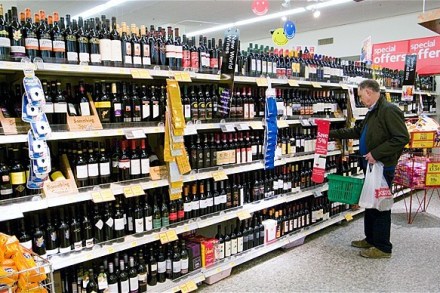
The Telegraph reports today that the Prime Minister has asked for work to be done across Whitehall on how a minimum price for alcohol could be set. As the paper's leader column makes clear, this will not be a politically easy thing to do. When I interviewed the Health Secretary Andrew Lansley for the Christmas issue of The Spectator a few weeks back, he was clear about why he didn’t like the concept of a minimum price: 'I don’t like a minimum price, we are acting against below cost selling. My problem with a minimum price, well I have two problems. One is it’s regressive, so there are perfectly normal families who just don’t happen to have much money who like to buy cheap beer or cheap wine. Should they be prevented?

Why ‘starving the beast’ may not work

From our UK edition

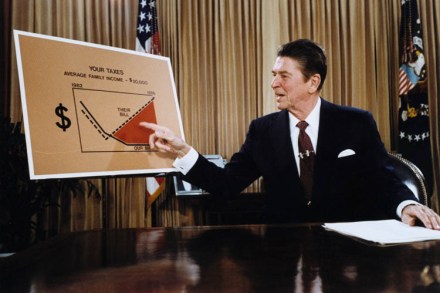
Steven F. Hayward’s audit of the state of American conservatism, which David Brooks judges to be one of the best magazine articles of the year, argues that the Reaganite ‘starve the beast strategy’ has failed to halt the growth of government. Hayward writes: ‘Thirty years after the arrival of the Reagan Revolution, government is bigger than ever. The Reagan years appear to have been little more than a mild speed bump in the progress of ever-larger government. The regulatory state advances relentlessly on every front. The soaring national debt threatens economic oblivion sooner or later. In short, the Reagan era, for all that was accomplished, was not an analogue to the New Deal era.

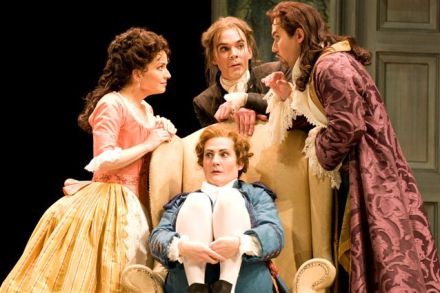
The latest act in Europe’s comic opera

From our UK edition

If it was not all so serious, the efforts to save the single currency would be worthy of a comic opera: the Germans could compose the score, the Italians could write the libretto, and the French could take care of the stage directions. The latest IMF-related effort is, perhaps, best described by the website ZeroHedge, which is required reading during these troubled times: “Germany will be responsible for €41.5 bn, France at €31.4 billion, and Italy will need to provide €23.5 billion and Spain another €15 billion.

The coalition’s marriage troubles

From our UK edition

A few months after the coalition was formed, I went for lunch with a close ally of Nick Clegg. After an hour or so of discussing what the coalition’s agenda would be, this Liberal Democrat said to me: ‘now, David Cameron can’t really be serious about this marriage stuff, can he?’ When I replied that I thought he was, he looked at me with total incomprehension. He then launched into a speech about how no ‘liberal’ could possibly want to see the state promote marriage. This is the thinking that lies behind Clegg’s latest attack on the idea of tax breaks for married couple; it has become an identity issue for the Liberal Democrats.

Another sign of coalition splits over Europe

From our UK edition

Coalition tensions over Europe are again threatening to be the story this morning. Nick Clegg has told The Guardian's Patrick Wintour that Britain has 'signalled we are happy for them [the Eurozone plus group of countries] to use EU institutions' to enforce any new treaty they agree between themselves. This is a striking claim given that David Cameron has not publicly said that he would accept this. If the Deputy Prime Minister's summary of the coalition position is accurate, then Cameron will face criticism from eurosceptics that he is backsliding on his veto. But for all Clegg's criticism of Cameron handling off the summit, he remains unconvinced by the plans that the eurozone plus countries are now pursuing.

A patient cure

From our UK edition

Andrew Lansley stands on the concourse of Euston station cracking jokes with a gaggle of civil servants. Lansley, who must be at least 6ft3, towers over the group. He looks relaxed. The contrast with how he looked a few months ago could not be sharper. Then, the Health Secretary seemed to be carrying all the troubles of the coalition’s NHS reforms on his shoulders. He had developed a stoop and he would talk to you with his arms crossed. But now his controversial, much revised bill is almost through parliament. What he calls his period in ‘purgatory’ is nearly over. For a Cabinet minister, Lansley is surprisingly free from ego. As we get on the train, he expresses surprise that I don’t mind making a journey just for the sake of interviewing him.

Politics: Cameron is at his best when he is boldest

From our UK edition

David Cameron must sometimes wonder if the gods are against his modernising project. Events have forced him back on to the traditional Tory territory of Europe and the economy. This is not how the Cameroons expected it to be in the early days of his leadership. Then he defined himself not by his position on spending cuts or the repatriation of powers but by his urging the country to ‘Vote Blue, Go Green’ while wearing a pair of recycled trainers. He was a different kind of Tory talking about a whole new set of issues. In May 2007, Oliver Letwin, the modernisers’ intellectual godfather, gave a speech setting out the theory behind Cameron Conservatism. He declared that they wanted to bring about two important shifts in politics.

Clegg rebukes French PM

From our UK edition

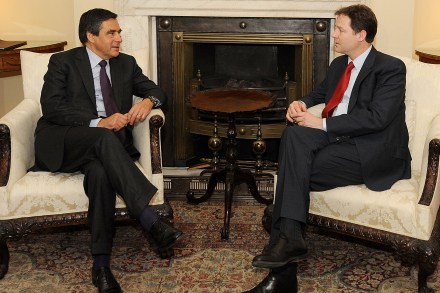
Normally, 'read-outs' on telephone calls between members of the British government and their counterparts overseas are fairly bland affairs. But today's one on a conversation between Nick Clegg and the French Prime Minister Francois Fillon is an exception to this rule. Clegg, we are told, informed the French PM that 'that recent remarks from members of the French Government about the UK economy were simply unacceptable and that steps should be taken to calm the rhetoric.' To be sure, there is some more diplomatic language before and after this (the full text is at the bottom of this post) but the willingness of the deputy Prime Minister to be quite so sharp with the French is striking especially given the tensions in the coalition over Europe policy these past seven days.

The veto arguments rumble on

From our UK edition

The Times has a very interesting story (£) today on page 17. It claims that David Cameron had agreed to inform Nick Clegg if it appeared that Britain was going to be isolated at last week’s European Council. The significance of this is that it suggests that the Lib Dems believed they would be consulted before the government vetoed anything. This news emerges after senior Liberal Democrats have privately questioned why their leader did not insist that Cameron only use the veto once he had Clegg’s explicit agreement. The Times also reports that this negotiating protocol did not envisage a situation where Britain was left in a minority of only a couple of countries.

Cameron’s warning to his applauding backbenchers

From our UK edition

David Cameron was greeted with a full-on, desk banging reception at the 1922 Committee. The applause only stopped when the chief whip told the assembled backbenchers to sit down. The Prime Minister’s message was that the next year is going to be even tougher than the 1979-81 period. He argued that the government needed to be even bolder to show that it wasn’t just a technocratic government but one motivated by a desire to help families who do the right thing, but sadly no MP pressed him on how that fitted with the coalition decision to increase out of work benefits by more than 5 per cent. One other interesting thing was that Cameron stressed to his party that they had to reach 2015 with the coalition in good order.

Cameron pummels Miliband in PMQs

From our UK edition

Today, was yet another reminder that David Cameron knows just where to hit Ed Miliband to make it hurt. After a few questions on the economy, Miliband moved to Europe — the coalition’s greatest vulnerability. Miliband joked that it was ‘good to see the deputy Prime Minister back in his place’, before mocking the coalition’s divisions over Europe. Cameron began his reply by saying it was no surprise Tories and Lib Dems don’t agree on Europe before saying that the split on the issue could be exaggerated: ‘it’s not like we’re brothers or anything,’ Cameron said in his most mocking tone. At this line you could see the Labour benches deflate and one of his aides visibly winced.

Clegg in the spotlight

From our UK edition

All eyes at PMQs will be on a man who isn’t speaking, Nick Clegg. His refusal to attend the Prime Minister’s statement on the European Council means that today he will be the centre of attention. Labour will attempt to embarrass him as much as possible, trying to highlight both the divisions in the coalition and the impotence of the deputy PM. For its part, the press will read an awful lot into his body language every time Cameron mentions the E or V words.   The worry for the coalition is that this split over Europe is just going to keep repeating. There are going to be many more European summits where Britain will be in the minority between now and 2015.

Clegg ducks Cameron’s conciliatory speech

From our UK edition

The text of David Cameron's statement on the European Summit was clearly designed as balm for the coalition's wounds. He devoted a large chunk of it to defending Britain's membership of the European Union in a clear effort to reassure the Lib Dems about the future direction of European policy. But this effort was rather undermined by the absence of the deputy Prime Minister. This was, predictably,  the story of the session. In response to repeated Labour questions about where Clegg was, Cameron replied 'I'm not responsible for his whereabouts. I'm sure he is working very hard.' Nick Clegg has now given a TV interview in which he has escalated the coalition divide over Europe.

Expect today’s eurosceptic celebrations to be muted

From our UK edition

The real Tory celebration of David Cameron's veto will be on Wednesday. Then, behind closed doors, Cameron will address the 1922 Committee of Tory backbenchers. With no Lib Dems present, the Tories will be able to thump the desks and be rude about the EU without worrying about what their coalition partners might think. But in the chamber today, Tory MPs are being urged to be calm and forensic. The whips keep pointing out to ambitious MPs that a question on what Labour's position is would be most helpful. Eurosceptics, though, should be in good cheer today even if Cameron's statement is more downbeat than they would like.

Clegg blames the Tory Eurosceptics

From our UK edition

Nick Clegg has just given a quite astonishing interview to Andrew Marr in which he accused David Cameron of being incapable of getting a good deal for Britain because of pressures from within the Conservative parliamentary party. When Marr asked him if things would have been different if Lib Dems had been in Brussels, Clegg said they would have been because he is ‘not under the same constraints from my parliamentary party.’ Clegg described Cameron as being trapped between the ‘intransigence’ of the French and Eurosceptics in the Conservative party. Intriguingly, the deputy Prime Minister blamed the French for there being no negotiation about the British asks.