James Forsyth

James Forsyth

James Forsyth is former political editor of The Spectator.

Ed Miliband’s negative approach at PMQs looks set to become the norm

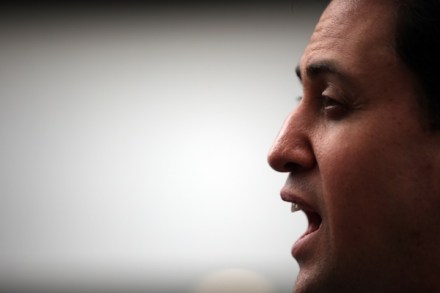
Ed Miliband’s approach at PMQs today was rather odd. He led, aggressively, on whether the government would implement the Parliamentary Commission on Banking Standards’ recommendation of a new criminal offence for negligent bankers. He asked the question in a manner that expected the answer no, but Cameron—predictably—said he would. At which point, the wind rather went out of Miliband’s sails. Cameron’s answer was eminently predictable because the idea of a new criminal offence for negligent bankers was first floated by George Osborne’s former chief of staff Matt Hancock at the start of last year.
Cable and Willetts: the house-trained ministers?

There are few worse insults for a minister than to be called ‘house trained’. It implies that the vested interests of your department have you under their thumb. So, Vince Cable and David Willetts should be rather alarmed that one notoriously left-wing academic is boasting that they pretty much are. In an article in Times Higher Education, Martin McQuillan of Kingston University describes the pair as ‘mostly house-trained.’ One person involved in the whole spending review conundrum irritably pointed me towards the McQuillan piece when asked how things were going with BIS. McQuillan’s essay is really a long screed against Michael Gove. His agenda is to stop universities being put back under the control of the Department of Education.

What David Cameron’s decision to keep Sir George Young as chief whip tells us

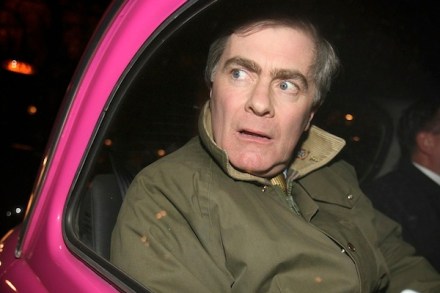
Tory MPs have long assumed that Sir George Young would be shuffled out of the job of chief whip at the next reshuffle. The 71 year old had, after all, been retired from the Cabinet with honours last September only to be recalled and made chief whip following Andrew Mitchell’s resignation. But David Cameron has now indicated to the chief whip that he’ll not be moved in the coming reshuffle. Cameron keeping the 71 year old Young in place has surprised Tory MPs; there’s concern among the younger generation that this indicates that not many more of them will get jobs this time round. Cameron leaving Sir George in post is another sign that he accepts that whipping the party is a particularly hard job in coalition.

Cameron wants to change the military balance in Syria, but how do you do that without arming the Islamists?

David Cameron and Vladimir Putin have just concluded their pre G8 talks, the main topic of which was Syria. Cameron wants to use the next few days to try and persuade the Russians to stop backing Assad; the weapons they’ve been sending him have enabled him to gain the upper hand on the rebels militarily. Cameron instinctively wants to do something about the slaughter in the Levant for both strategic and moral reasons. As one figure intimately involved in British policy making on Syria told me earlier, ‘The one certainty is that, if nothing is done, not only will lives be lost, not only will Assad not negotiate, but we will also not stop radicalisation.

Someone has got to win the next election

It is easy to make a case for why all three main parties should do badly at the next election. After five years of austerity, who will vote for the Tories who didn’t in 2010? And how will they stop those dissatisfied with the compromises of coalition from sloping off to Ukip? As for Labour, why would the public want to put them back in charge just five years after booting them out? This question has special force given that the Labour leadership is so identified with that failed belief that boom and bust had been ended. Then, there’s the Liberal Democrats—they’ve alienated their left-leaning supporters and lost their status as the protest party of British politics. Oh, and they’ve broken one of their most memorable pledges: no increase in tuition fees.

The coming Tory split over Europe

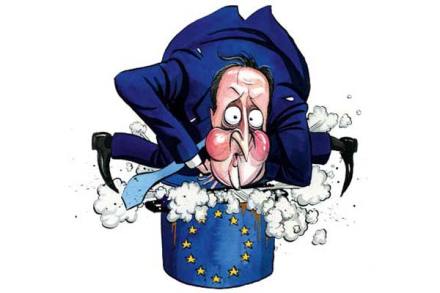
The news that Labour will abstain on the EU referendum bill is proof that they know that voting against it would be politically harmful. It also means that it’ll be easier for them to swing behind a referendum before the next election. I suspect that between now and the next election, the referendum pledge will be a political asset for David Cameron — it’ll put Labour and the Lib Dems on the spot and keep a lid on Tory tensions on the matter. But after that it will become a lot more problematic, as I say in the magazine this week. After Cameron’s Bloomberg speech, I asked one minister what he made of it and he replied, with a chuckle, ‘well, it means David is planning to stand down before 2017.

The Tory party are finally going to have to decide about Europe. It’ll break them

By the time the G8 is next held in this country, the United Kingdom may well have left the European Union. In the next eight years, the question of whether Britain is in or out will be settled. We know that if David Cameron is Prime Minister after the next election, that decision will be made in 2017. But whoever is in No. 10, a referendum is coming. When it comes, the Tory party will have to decide whether it is for exit or staying in. Either way, it is hard to see the party staying together. On Monday, we had a preview of the coming argument. David Cameron gave a speech declaring that EU membership ‘is not some national vanity; it is in our national interest’. This would have been relatively uncontroversial even during the bitterest period of John Major’s leadership.

Stephen Hester’s departure: who would want the RBS job?

I do not envy the search committee tasked with finding a new CEO for RBS after Stephen Hester’s departure. The bank is an anomaly, publicly owned but supposedly run at arms’-length from government. However, when banking controversies hit, as they so often do, they hit RBS hardest as it is majority-owned by the taxpayer. I suspect that everyone approached for the job will be acutely aware that Hester has had to twice forego his bonus under political pressure. Hester has long argued privately that selling off a tranche of RBS shares would be a good thing, sending a signal that the bank would soon be returned to private ownership and relative normalcy. He will now depart before that happens.

Trust me, I’m a Foreign Secretary, says William Hague on Prism

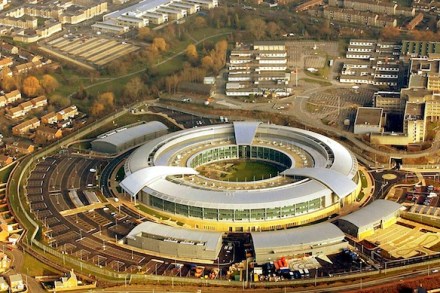
William Hague’s statement on Prism was a masterclass in not answering the question. Hague calmly, but determinedly, stuck to the line that he wasn’t going to comment on leaks — which made the whole statement slightly pointless as it was being given in response to a leak. His whole approach was 'trust me', which will work with those who do trust me but do nothing to reassure those who don’t trust him, government or the security services. Hague begun by dropping a heavy hint that attacks on the Olympics had been foiled by GCHQ/NSA cooperation. He also went out of his way to deny the accusation that GCHQ and the NSA were using each other to leapfrog the legal obstacles to them spying on British and American citizens respectively.

Ed Balls: Labour will include pensions in its welfare cap

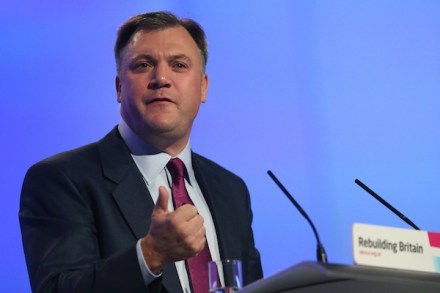
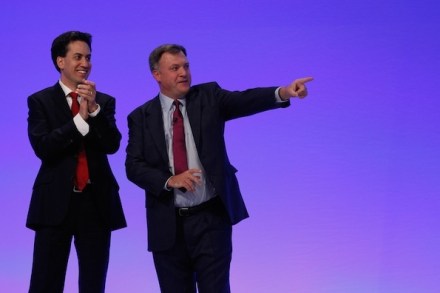
Ed Balls has just told Andrew Neil on the Sunday Politics that Labour will include pensions in their welfare cap. This opens up a major dividing line with the Tories who have been clear that George Osborne will exclude pensions from his spending cap. I suspect that Balls and Ed Miliband will now be badgered with questions about whether, if necessary, they’ll cut pensions — or not up-rate them — to meet the cap. Given the power of the grey vote in British politics (Labour estimates that one in every two voters in 2010 was over 55) they are going to come under massive pressure to rule this out. But, strikingly, Balls was not prepared to do this on  Sunday Politics. He even drew attention to the amount of welfare payments which go to the over-60s.

Prism controversy will deepen coalition divisions over the snooper’s charter

GCHQ’s use of the US monitoring system Prism is threatening to turn into a major political row. Douglas Alexander is demanding that William Hague come to the House of Commons to explain what GCHQ was doing and what the legal basis for it was. But this controversy is going to have an effect on coalition relations too. It is going to intensify Liberal Democrat opposition to the measures included in the Communications Data Bill. This comes at a time when David Cameron has decided, as he made clear in the Commons on Monday, that the measures in it are needed. In the United States, the Obama administration is pushing back against criticism of the programme.

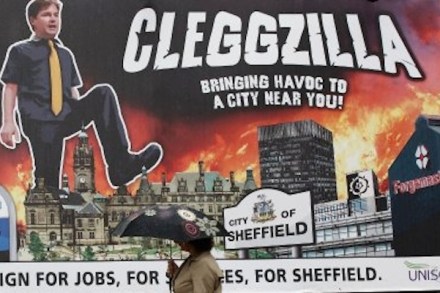
This poster is why Number 10 is so confident Clegg will stay solid on union curbs

Given all the coalition tensions over Clegg supposedly reneging on his promise to back childcare reform, it is surprising how confident Number 10 is that he’ll stay the course on the curbs on the trade unions in the lobbying bill. When I asked one senior figure there why they were so sure that the Lib Dem leader wouldn’t change his mind, I was told to remember that every time Clegg went back to Sheffield and his constituency he was met by a Unison-backed poster branding him as ‘Cleggzilla’. This source continued, ‘If you’re on the receiving end of that you’re all too aware of union power. That pain is very real.

Want to know what the next election will be like? We saw this week…

Tory MPs were in buoyant mood as they dashed off to the 7 p.m. vote on Monday night. They shouted out hearty greetings to each other, slapped backs and had a spring in their step. They were buzzing in the way a fielding team does just after the fast bowler has hit a star batsman a painful blow on the body. The cause of this excitement: No. 10’s display of brute political force over the lobbying bill. When news first broke of Patrick Mercer’s troubles, the Cameroons could barely conceal their schadenfreude. They were not going to mourn the political demise of Cameron’s most vituperative backbench critic. But the headlines were still about Tory sleaze. Labour began demanding to know why the government had abandoned plans for a statutory register of lobbyists.

The political centre just moved, to the right

Today must count as one of the most encouraging days for the centre right in British politics in recent times. Labour’s apparent abandonment of universal child benefit is a massive blow to the 1945 settlement. It is akin in significance to when Labour began to accept the privatisations of the Thatcher era. Now, there’s no intellectual difference between declaring that better off pensioners won’t receive winter fuel payments and that better off mothers won’t receive child benefit. But in symbolic terms, the difference is huge. The winter fuel payment is a recent addition to the welfare state, introduced by the last Labour government. It is not fundamental to it.

Why Cameron’s warning on Syria leaves me feeling nervous

David Cameron’s Commons statement today contained two blunt warnings. In a significant escalation of the argument over communications data, he warned that ‘we will suffer’ if we don’t make progress on the matter. He also declared that not intervening in Syria could boost extremism and mean that the situation there becomes a ‘tragedy for us too’. On communications data, I suspect that there’s a limit to how much progress he can make with his coalition partners. The vibe from the Clegg camp is that they have no desire to back down on this issue and feel that many of their critics are being opportunistic post Woolwich. However, it was Cameron’s warning on Syria—which I suspect will receive less coverage—that struck me more.

The significance of Ed Balls’s speech, and what it means for Ukip

Ed Balls’s speech today is significant for two reasons. First, it implied that a Labour government in 2015 would not spend more on current spending. But, rather, it would borrow more to fund higher capital spending—what Gordon Brown used to calling ‘borrowing to invest’. This, I take it, means that a 2015 Labour government wouldn’t introduce the five point plan for the economy that Balls has previously outlined. The second was the announcement that Labour would stop winter fuel payments to higher and top rate taxpayers. This will save about a £100 million a year, which is hardly enough to give Labour a reputation for fiscal rectitude. But it does concede crucial ground on universality.

Coalition shifts position after a weekend of sleaze, lobbying register now coming in

Today is not a good day for politics or parliament. The latest, depressing sleaze revelations are only going to increase public cynicism about politics and parliament. It seems that a statutory register of lobbyists will now be coming in. Francis Maude, in a striking shift from the government’s post Queen’s speech position, told Andrew Neil on The Sunday Politics ‘we are going to do this.’ But it is hard to see how a statutory register of lobbyists would stop MPs and peers from doing what Panorama, the Telegraph and The Sunday Times appear to have caught them doing. My instinct is that no set of regulations or regulators will be able to eliminate every opportunity of wrongdoing. Money, like water, can always find a way through.

Telegraph reveals full extent of allegations against Patrick Mercer

I suspect that there’ll be a few MPs and peers nervously waiting for 9pm on Thursday night. For this is when the Panorama special on parliament and lobbying, which has already caused Patrick Mercer to resign the Tory whip, will be broadcast. Today’s Telegraph contains details of the accusations surrounding Mercer. The paper alleges that the MP has been paid £4,000 by a fake lobbying company set up by the Telegraph and the production company making Panorama. Mercer appears not to have declared this money. But he has asked a string of questions on Fiji; the paper claims that the company had told him that ending Fiji’s suspension from the Commonwealth was a priority for its clients. The paper says that Mercer declined to answer a series of questions on the matter.

Patrick Mercer resigns Tory whip ahead of Panorama programme

Patrick Mercer has resigned the Tory whip. But despite his repeated and outspoken criticisms of David Cameron it is nothing to do with the Prime Minister. Rather, Mercer appears to have been embarrassed by a Panorama/Daily Telegraph investigation. In a statement, Mercer has said that he is considering legal action over the coming programme which, he says, alleges he broke parliamentary rules but that 'to save my Party embarrassment, I have resigned the Conservative Whip. I have decided not to stand at the General Election'. What remains to be seen is if Mercer quits the Commons before then which would prompt a by-election. Given Ukip’s strength at the moment, a by-election anywhere other than a safe Labour seat gives them a chance of winning.

The Boris bandwagon picks up more speed

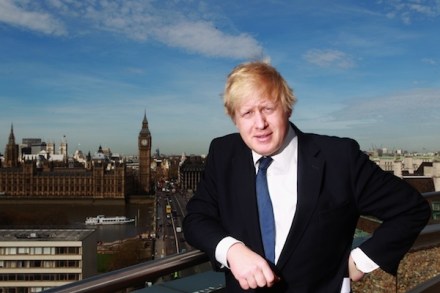
Hardly a day goes by these days without a story about Boris Johnson and the Tory leadership. Yesterday, it was Andy Coulson’s revelation that David Cameron believed Boris Johnson would be after his job once he’d been London Mayor. Today, it is The Economist talking about ‘Generation Boris’, the more libertarian inclined voters who the magazine suggests will sweep him to Downing Street in 2020. Now, for Cameron having as his main leadership rival someone who isn’t an MP is not actually that bad, however infuriating some in his circle might find the press and the party’s love affair with the London Mayor.