Isabel Hardman

Isabel Hardman

Isabel Hardman is assistant editor of The Spectator and author of Why We Get the Wrong Politicians. She also presents Radio 4’s Week in Westminster.

More pain for Italy and Spain as Draghi hopes wash down the drain

Mario Draghi has just finished giving his press conference in Frankfurt about what the European Central Bank is going to do as part of its 'whatever it takes' crusade to save the euro. The ECB chief described the single currency as 'irreversible', and perhaps it is his seemingly incontrovertible belief in its capacity to survive that led to such a lacklustre announcement. Remember that all eyes had been on Draghi since he said this last week: 'Within our mandate, the ECB is ready to do whatever it takes to preserve the euro. And believe me, it will be enough.' He had pointed to the rise in bond yields over the previous few days, and used a series of codewords which traders recognised as a sign the ECB was going to make an intervention in the bond markets.

Draghi’s day of reckoning

Today is the day when European Central Bank chief Mario Draghi's big talk last week about doing 'whatever it takes' to save the single currency meets its test. The ECB is meeting to discuss what precisely that entails and will make an announcement at around 1.30 about its decision. After teasing the markets last week, Draghi will need to show some big action to follow those big words, or else investors will panic. One of the measures that Draghi's comments last week hinted at is using the ECB and the European Stability Mechanism to buy up government bonds in Spain and Italy to drive down the cost of borrowing away from the danger threshold of 7 per cent. There is one not insignificant problem which is that the German government and the Bundesbank are likely to oppose the idea.

Calling in the Olympic ghostbusters

TfL have today stopped running those Boris Johnson announcements over the tannoys at Underground and national rail stations that were rather getting on commuters' nerves. But their replacement seems to be trying to undo some of Boris' good work in trying to scare people away from the centre of London. Last night, Westminster Underground Station played an announcement telling tourists that the city was now 'really coming alive' and urging them to make the most of the restaurants, museums and shops that they found around them. The station was relatively quiet at the time, save for a group of men clutching large flags.

‘Unstoppable’ Boris gets stuck on a zip wire

Oh dear: this morning Boris Johnson was being hailed as 'unstoppable' in his bid to be the next Conservative leader. But it turns out Westminster has been far too preoccupied with the boring details of how he can get re-elected in time to take over from David Cameron that we all failed to notice the major obstacle in the Mayor's route to the Commons: Boris managed to get stuck on a zip wire this afternoon in Victoria Park. Eyewitnesses say that the Mayor was shouting for a ladder or a rope as he swung above the heads of the crowd. Boris knows that this sort of thing always works in his favour: it's part of the affable and flamboyant persona that makes him appeal to voters. Pictures courtesy of Rebecca Denton.

Osborne’s policy gymnastics

It's been a few weeks at least since George Osborne's last U-turn, so it must be time for another one, mustn't it? Today's launch of the Funding for Lending Scheme is being hailed as another change of course from the Chancellor as it signals the slow death of the National Loan Guarantee Scheme. The Sun's editorial this morning compared George Osborne to a gymnast, and said he was the 'master of the U-turn'. The NLGS has only lent £2.5bn of the £20bn that it was allocated so far for small and medium businesses, and the FLS, which allows banks and other financial institutions to borrow at below market rates, is expected to supersede it.

Immigration and the cost of living

The average disposable income is at its lowest point since 2003, according to figures released this afternoon by the Office for National Statistics. The statistics for the first quarter of this year show that take home income was an average of £273 a week, while real incomes per head fell by 0.6 per cent to £4,444 in Q1, which is the lowest since 2005. The ONS points to rising prices as the primary cause of these falls, and there are obvious points to be made here about the cost of living. It's currently one of the major reasons voters are giving for turning away from the Conservative party, and Labour's Chris Leslie has already used the ONS' stats to attack the government's tax and benefits policies.

Court rejects Qatada’s bid for freedom

Abu Qatada has just lost his bid in the High Court to be released from prison immediately. He had tried to argue that it was a breach of his human rights to be held in prison ahead of the court hearing in October which will decide whether he should be deported to Jordan to face terror charges. But at today's hearing, Lord Justice Hughes and Mr Justice Silber dismissed the radical cleric's application for a judicial review. This is obviously a relief for the government right now as Qatada was pressing for release with immediate effect, which would have meant he was a free man during the Olympics when security and intelligence services are already stretched.

A not-entirely-comprehensive spending review

There are more rumblings this morning on the shape of the next comprehensive spending review, this time at grassroots level within the Liberal Democrats. The Times reports threats from former Lib Dem MP Evan Harris that any attempt to sign up to a traditional spending review will trigger an emergency motion at the party's autumn conference. The leadership is already well aware of this issue: I blogged last week that a senior party figure had told me that the £10 billion of welfare cuts that George Osborne has predicted are necessary over the next spending review period are 'just not going to happen'. Clegg and co know that the Lib Dem grassroots will not weather another round of welfare cuts when they already feel their MPs have had to bend over backwards for the first set.

London, the Olympic ghost town

London is quieter than usual this week in spite of the Olympics, with many commuters staying at home or fleeing the country while the Games take place. That's a good thing for the transport system - clearly Justine Greening and Francis Maude's 'remoding' advice had its desired effect - but retailers and tourist attractions are reporting a lower-than-usual footfall as a result. The Financial Times reports that the 100,000 Olympic visitors lags behind the 300,000 typically expected in the capital, with the Association of Leading Visitor Attractions pointing to a drop of up to 35 per cent in tourists.

Borismania takes hold

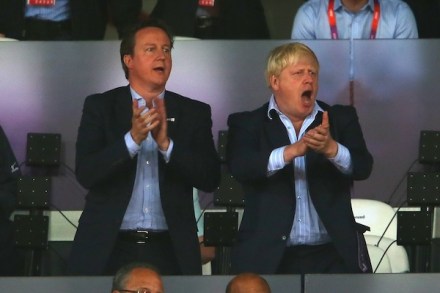
Boris Johnson has had a fantastic few days. On Thursday he drove a crowd in Hyde Park wild with his Mitt Romney banter. On Saturday he charmed the public with his thoughts on the Olympic opening ceremony ('People say it was all leftie stuff. That is nonsense. I'm a Conservative and I had hot tears of patriotic pride from the beginning. I was blubbing like Andy Murray.') Today, in between talking about glistening otters (which in itself is a feat: a politician getting away with talking about how wonderful it is to see semi-naked women in central London and not sounding like a dirty old man), he has emerged as ConHome readers' hot choice to lead the Tory party after David Cameron.

The government has little power over the empty seats scandal

The papers today are full of empty seats at the Olympics. This morning, a Downing Street spokeswoman tried to take a glass-half-full approach, saying the empty seats were 'disappointing', but adding that the Prime Minister was 'satisfied' that Locog was working to resolve the issue. Locog carried out a review at the weekend which found that the seats were in accredited areas rather than those allocated to sponsors. The accredited areas are set aside for 'members of the Olympic family', an unpleasant phrase that denotes representatives of the IOC and of the sporting federations,  as well as coaches, athletes and athletes' families.

Sneaking a peek at the beach volleyball

The Olympic beach volleyball is situated just behind Downing Street on Horse Guards Parade, and as such is perfectly located for a politician wishing to take an hour or so out from a hard day's work. Boris Johnson is clearly a fan, writing in today's Telegraph: As I write these words there are semi-naked women playing beach volleyball in the middle of the Horse Guards Parade immortalised by Canaletto. They are glistening like wet otters and the water is plashing off the brims of the spectators’ sou’westers. The whole thing is magnificent and bonkers.

Whatever it takes to save the euro

In case you were in any doubt about how committed eurozone leaders are to the survival of the single currency, Angela Merkel has put out another statement on doing 'everything possible to protect the eurozone', this time with Italian Prime Minister Mario Monti. The pair had a phone conversation on Sunday and their remarks follow the joint statement released by Merkel and François Hollande on Friday, and Mario Draghi's announcement last Thursday that the European Central Bank would do 'whatever it takes' to protect the euro. The markets are looking forward to something decisive later today as US Treasury Secretary Tim Geithner arrives in Europe to meet German finance minister Wolfgang Schaeuble and then Draghi later on.

RBS next in line for Libor heat

The Guardian has published an interview on its site with Stephen Hester in which the RBS chief executive predicts his bank is facing a huge fine for its part in the Libor fixing scandal. He says: 'RBS is one of the banks tied up in Libor. We'll have our day in that particular spotlight as well.' Hester can to a certain extent afford to be upfront about what is coming down the line for his bank. Even though it was clear from the start that there were other banks wading around in this swamp, Barclays took the majority of the flak as the first one to be fined. There might be another round of emails about bottles of Bollinger to feast upon, but the revelations will not be as shocking the second time around.

Osborne needs to give the Lib Dems sleepless nights on supply-side reform

Ed Balls is doing very well out of the GDP figures that were released on Wednesday. The Shadow Chancellor is right to say that George Osborne is not yet doing the right thing with the economy. But that doesn't mean Balls' solution is the right one. Cuts should have been only one side of the deal, but as Iain Martin points out in today's Sunday Telegraph, the other side which should have kickstarted growth - supply-side reform - is not forthcoming because Osborne and Cameron are afraid of offending the Lib Dems. Similarly, James says in his column today that too often attempts to strike a balance between the supply-side reform that the Tories want and the demand-management favoured by Vince Cable means nothing is achieved at all.

Empty seats give the wrong message about who the Olympics are for

Remember that great scandal that rocked the Olympics, G4S? That pre-Games row has been completely eclipsed, at least for now, by the rows and rows of empty seats at supposedly sell-out Olympic venues. It turns out that those seats, often situated below the masses of people who shelled out a pretty penny for their own seats, belong to sponsors, who have either failed to fill them, or who have given the tickets to people who just haven't turned up. Locog has launched an investigation, which it needs to conclude and find a solution to the problem as soon as possible. Those forlorn rows of seats are giving out the wrong message about who the Games are for.

Osborne seizes on S&P ratings relief

You'd think that after the bad economic news of the past week, George Osborne might have reverted to submarine mode as soon as he possibly could, moving quietly under the cover of the Olympics. But this afternoon he has stuck a periscope up with this message: the world has confidence that Britain is dealing with its economic plan. It's a bold statement to make after Wednesday's GDP figures, and Labour has already mocked him for doing so, but Osborne is responding to the announcement overnight by Standard & Poor's that the UK will continue to enjoy an AAA credit rating.

Cameron’s Olympic opportunity as Syria massacre fears grow

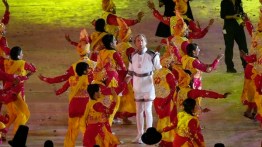
There was an uncomfortable moment last night at the Olympic opening ceremony when the Syrian team entered the stadium. The athletes - who are there as competitors, not apologists for the Assad regime - did not receive the same raucous cheer as many of the other nations. The BBC commentators at least, who had been peppering the procession with helpful comments such as 'ah, X country: very rich in precious gems, and of course, overcoming appalling human rights abuses to be with us today - marvellous', barely mentioned the Syrian Arab Republic as its ten athletes  paraded around with their coaches. Away from the excitement of the Games, politicians are warning of an impending massacre in the city of Aleppo. David Cameron and William Hague yesterday both condemned the ongoing violence.

Unqualified teachers haven’t ‘irreparably damaged’ the private sector: why do state schools deserve anything different?

The furore surrounding the news - which James broke on Coffee House this afternoon - that academies will now be able to employ teachers who are not qualified was so brilliantly predictable that we could have written the unions' press releases for them. Christine Blower of the National Union of Teachers slammed it as a 'clear dereliction of duty' and a 'cost-cutting measure that will cause irreparable damage to children's education'. Blower and her union colleagues are not clear why education will be so badly damaged by this, though. Top schools in the private sector regularly employ staff who have gone through no formal training at all. But parents have to pay for this privilege: it is not available to them in the state system.