Isabel Hardman

Isabel Hardman

Isabel Hardman is assistant editor of The Spectator and author of Why We Get the Wrong Politicians. She also presents Radio 4’s Week in Westminster.

Miliband aide: Labour has never addressed the way the economy works

From our UK edition

What's Ed Miliband's vision for the economy? We'll get the public version of that vision in a short while when Ed Balls gives his speech to the Labour conference, but last night one of Ed Miliband's closest advisers gave us a more interesting glimpse of the underpinning of the Labour leader's economic plan. Stewart Wood, a former aide to Gordon Brown and now a key member of Miliband's team, gave a fringe interview to ResPublica's Philip Blond. The two men nattered with glasses of wine in their hands (which were at one point topped up by a CCHQ suffer embedded behind enemy lines) about Wood's values. One answer in particular, on how Labour should approach the economy from now on, was very interesting: 'Tax and spend will continue to be a core part of what we do, but there are two limits.

Ed Balls: English votes plan is ‘most un-prime ministerial’ thing Cameron has done

From our UK edition

Ed Balls wanted to spend his Today programme interview talking about his plans to cut the deficit by limiting child benefit increases to 1 per cent and cutting ministerial pay by five per cent. But he had two big stories to overcome that people seem more interested in. One is his accidental wounding of a journalist, which has made front page news, and the other is English votes for English laws, which is the even bigger front page news from the Labour conference so far (and with a newsless day in the hall yesterday, who can blame journalists for going after something else?). He tried two tactics, which rather cancelled one another out. The first was to argue that there was no 'easy solution to our constitutional situation', which was a suitably boring, no-quotes answer.

Ed Balls to freeze child benefit and dock ministerial pay

From our UK edition

Ed Balls, so used to dodging elephant traps laid by George Osborne, is going to lay a few of his own tomorrow when he gives his speech to the Labour conference. The Shadow Chancellor, in an attempt to do something about Labour's poll weakness on the economy, will announce that he would freeze child benefit and cut ministers' pay by five per cent until Labour has balanced the books. He will say: 'We will have to make other decisions which I know will not be popular with everyone… I want to see child benefit rising in line with inflation in the next parliament, but we will not spend money we cannot afford. So for the first two years of the next parliament, we will cap the rid in child benefit at one per cent. It will save £400 million in the next Parliament.

Labour conference: The new politics, according to Hilary Benn

From our UK edition

Judging by the reaction in the conference hall, Hilary Benn's speech was the best of this afternoon's session. Several people gave him a standing ovation. His task was rather easier than Ed Miliband's on Marr this morning, because the Shadow Communities and Local Government Secretary could talk about hopey-changey Labour ideas, rather than the nopey-changey Labour opposition to English votes for English laws (EVEL). So Benn focused on the devolution to English cities and regions that Labour has been working on and talking about for months, arguing that it was the true way to respond to the referendum result. He said: 'Our deal is for all parts of England. Conference, this will be the biggest economic decentralisation in a century. But it won't be enough.

Tristram Hunt sweet talks party faithful with newsless Labour conference speech

From our UK edition

Tristram Hunt's speech to the Labour conference was short and sweet. It was laden with sweeteners for party delegates, which is as things should be at these events, but perhaps his Blairite predecessors are feeling a little sour after the Shadow Education Secretary spent a fair bit of his time on the stage denouncing the principles they once espoused. Clearly the aim was to keep the party faithful happy - and they'd spent the session beforehand making quite clear that they wanted a screeching reversal over many of the Coalition's education reform - because Hunt also attempted to galvanise them by talking about Michael Gove. And when he got bored of talking about Gove, he talked about Nicky Morgan, who he described as 'a "Continuity Gove", auto-pilot Education Secretary'.

Westminster leaders must now prove they can keep their promises

From our UK edition

The Westminster party leaders have disagreed with much Alex Salmond has said recently. But it's pretty difficult to fault the assessment of the aftermath of the referendum that he gave on today's Sunday Politics. The First Minister said: 'I am actually not surprised they are cavilling and reneging on commitments, I am only surprised by the speed at which they are doing it. They seem to be totally shameless in these matters. The Prime Minister wants to link change in Scotland to change in England. He wants to do that because he has difficulty in carrying his backbenchers on this and they are under pressure from UKIP. 'The Labour leadership of course are frightened of any changes in England which leave them without a majority in the House of Commons on English matters.

Breaking: Alex Salmond resigns

From our UK edition

In the past few minutes, Alex Salmond has told a press conference that he is resigning as leader of the SNP and will stand down as First Minister. listen to ‘Alex Salmond resigns’ on Audioboo Accusing David Cameron of already reneging on the timetable promised by Gordon Brown for the legislation enabling the transfer of powers from Westminster to Holyrood, Salmond said: 'The Prime Minister said such a vote would be meaningless. I suspect that he can't guarantee the support of his party and as we have already seen in the past hour, the common front between Labour and Tory, Tory and Labour, is starting to break.

Indyref: Will Westminster really change?

From our UK edition

Lord Ashcroft's post-referendum Scotland poll gives politicians claiming they've 'heard' voters a number of clues if in reality they're still a bit confused. It suggests that those last few days of panic from the 'No' camp didn't really shift as many voters as some might have thought. The poll says 28 per cent of 'No' voters made up their mind within this year. 72 per cent had already decided before September 2013. Only nine per cent had settled on 'No' in the past week. And the reason more frequently cited for voting 'Yes' than any other was 'disaffection with Westminster politics', with 74% of those in favour of independence naming that, then 54 per cent also picking the NHS, followed by 33 naming tax and public spending.

Conservative Anglicans’ emergency plan to escape women bishops

From our UK edition

Anglicans aren’t the sort of church-goers who set much store by miracles, signs and wonders. Yet their own church is one of the greatest miracles of our society: it has managed to hang together, in spite of raging differences, for centuries. Since 14 July, that miracle has been under threat. For most, it was a great leap forward when the General Synod finally approved the ordination of women bishops. A delighted Archbishop of Canterbury was ‘grateful to God and to answered prayers’. David Cameron called it a ‘great day for the church and for equality’. But one section of the church didn’t feel it was a great day. Members of the conservative evangelical movement, represented by a pressure group called Reform, had resisted this change for years.

Salmond uses final rally to congratulate campaigners

From our UK edition

Anyone listening to Alex Salmond's final pro-independence rally tonight in Perth might have been forgiven for thinking the 'Yes' campaign was in the lead in the polls. He used most of it to congratulate his side for running such a successful campaign and for changing Scotland before the final result had even been declared. There was much less of a pitch for any undecided voters watching, unless the First Minister had concluded that anyone who was still wavering would be swayed by the idea that his guys had already won. listen to ‘Salmond: The referendum is 'our opportunity of a lifetime'’ on Audioboo He told the audience that 'what has emerged in this campaign is something very new; it has changed Scotland forever'.

Two campaign styles: one from the head, one from the heart

From our UK edition

Aside from the odd angry moment, campaigning with 'Yes' in Kelvin this morning was very pleasant. It was also rather different from yesterday's 'No' door knocking, and not just because the two areas are not at all similar. 'Yes' bussed their supporters from a campaign base out to their target streets. Then they split off in pairs to canvass different streets. This was entirely different to the 'board' set up that 'No' used yesterday in Rutherglen. The aim was to get leaflets through the door and chat to anyone who answered. There was no collection of data on voting intention or what time the person who answered the door intended to vote, which was what Labour were doing yesterday. Instead, the campaigners launched into lovely long debates with anyone who cared to chat to them.

Is the ‘Yes’ campaign winning converts – or preaching to the choir?

From our UK edition

In Glasgow, it's difficult not to conclude that the 'Yes' camp has the momentum in these final few days. There are 'No' badges, posters and flags around the city, but they're drowned out by the number of 'Yes' posters, and the excitement that 'Yes' events are creating. Last night I visited a perfectly jolly 'Yes' rally in George Square. It was a funny sort of rally, as the PA system was only broadcasting remarks to those in the thickest knot of the crowd, rather than anyone at the edges. The only voice anyone could really hear was from a small trestle table towards the back where the Scottish Socialist Party were asking people to sign petitions to end austerity and build a fairer Scotland. But everyone seemed happy just to mill about in the Square in their 'Yes' regalia.

Why a ‘No’ voter hurled abuse at ‘Yes’ campaigners

From our UK edition

I've just watched a passionate, informed debate about politics taking place on a street corner between three ordinary people. I've never seen that before. I should be thrilled, but instead I'm not. Why? That debate followed the first bad language and bad feeling I've personally witnessed while following campaigners from both sides of the Scottish independence debate around in Glasgow and Lanarkshire. I was with two 'Yes' activists, Jim Flynn and Neil Molloy, in Kelvin today, watching them delivering leaflets to residents of the gorgeous tenement blocks near the river.

‘No’ quietly confident on campaign trail

From our UK edition

I've just spent a couple of hours on the Burnhill estate in Rutherglen watching a group of Labour 'No' campaigners knock on the doors of voters to find out how they'll be voting on Thursday. Burnhill is a tidy estate of mostly social housing and a Labour council ward. The local Labour MP Tom Greatrex and his colleague Graham Jones, visiting from Hyndburn, were part of the group. I was surprised by the number of 'No' posters on display in the windows. I was expecting a plethora of 'Yes' placards, but fewer indications of the households whose inhabitants plan to reject independence, but on this estate at least, it's not the case. The activists say many, many more 'No' posters have appeared in the days since the shock Sunday Times poll that showed 'Yes' moving into the lead.

Yes Scotland are running a sneaky campaign

From our UK edition

Here's a clever poster from the 'Yes' campaign. It was handed to me by an activist outside Glasgow Central Station who was asking people if they wanted 'more information for the referendum'. She wasn't wearing any Yes badges, and the outside of the leaflet doesn't give the game away either: And inside there is still no 'Yes' branding, but it's quite obvious from the design what sort of conclusion you're being led to: Which then leads to the centre of this leaflet, which folds out to make an A1 poster: It's a clever way of killing two birds with one stone: you hook someone in who might not pick up a 'Yes' branded leaflet, then if you've managed to make your case effectively, they've got a poster to stick in their window to spread the word.

Lib Dems switch on the sunshine – and attack ‘sinister’ Yes tactics

From our UK edition

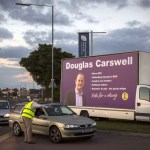
The Lib Dems have just launched the final leg of their campaign against Scottish independence, which is a poster van with Charles Kennedy's head emblazoned across it and three of the United Kingdom's greatest achievements: the NHS, the pound and the BBC. It's part of their 'sunshine strategy' to talk up the benefits of the Union in the final few days, and the four Lib Dems who launched this van - Danny Alexander, Charles Kennedy, Jo Swinson and Willie Rennie - argued that they had been saying all sorts of lovely sunshiny things about the United Kingdom all along, but they just weren't as well-reported as all the warnings.

Indyref: The promise, and its problems

From our UK edition

The three Westminster leaders have made their promise. On the front page of the Daily Record, they all sign up to a vow that includes new powers for the Scottish Parliament, the continuation of the Barnett formula, and a promise that the Scottish Parliament will have the last word on health spending, and on keeping the NHS in public hands. Since Gordon Brown unveiled the timetable for this vow last Monday, the parties have needed to repeat their pledges as often as possible so that as many voters pick them up before polling day, and so that they really appear to mean it. But here are a number of problems with the vow. 1. Promise-breaking politicians make another promise, Scotland shrugs. Why would you believe the Westminster politicians you're fed up with anyway?

David Cameron’s final plea to Scottish voters

From our UK edition

David Cameron has just delivered one of the best speeches of his career in Aberdeen. It was emotional, sincere, clear. The Prime Minister pleaded with Scots to stay in the United Kingdom. It ranged from warnings that this would be a permanent separation - 'when people vote on Thursday they are not just voting for themselves, but for their children and grandchildren and the generations beyond'- to powerful images of something the peoples of the Union have built being torn apart: 'For the people of Scotland to walk away now would be like painstakingly building a home – and then walking out the door and throwing away the keys. So I would say to everyone voting on Thursday, please remember. This isn’t just any old country. This is the United Kingdom. This is our country.

Sportsmen and sleights of hand: Indyref enters the final frenzy

From our UK edition

Just a few days now until it's all over, and those against Scottish independence are trying every option. David Beckham has written of the 'common bond' between English and Scottish sportsmen, the Queen has offered as much of an intervention as is possible when she is remaining officially neutral, while David Cameron is going from emotional heart-thumping to severe, reminding Scots that, in the words of the Sky remix, we are never, ever, ever, getting back together if they vote to leave. Will this work with the half million undecideds that everyone's pitching for? An appeal to a shared culture and a threat? Or will the SNP persuade more with their emotive vision of what Scotland could be like.