Interconnect

BOOKENDS: Inspiration for a cult hero

From our UK edition

This is an odd book: the exhaustive biography of a complete nobody. Vivian Mackerrell was the primary inspiration for the cult that is Withnail. In that, at least, he doesn’t disappoint. This is an odd book: the exhaustive biography of a complete nobody. Vivian Mackerrell was the primary inspiration for the cult that is Withnail. In that, at least, he doesn’t disappoint. Mackerrell emerges from Colin Bacon’s eulogy, Vivian and I (Quartet, £12), as a rakish Charles Pooter, sunk by alcoholic degeneracy at the age of 24, though he staggered on gamely for another 30 years. The paucity of Mackerrell’s life leaves Bacon to indulge in bawdy nostalgia about the Sixties.

Something in the tea

From our UK edition

Anyone tempted to use the expected success of Tea Party-backed Republican candidates in next week’s US elections to pronounce the beginning of the end of Barack Obama’s presidency should not raise their hopes too high. Success in mid-term elections is no guarantee of even a decent showing in the presidential elections two years later. Just ask Newt Gingrich, former speaker of the House of Representatives, whose ‘Contract with America’ helped the Republicans seize the House in 1994, for the first time in 40 years. Two years later Bill Clinton was re-elected by a landslide.

Competition: Mr Jingle

From our UK edition

In Competition No. 2670 you were invited to catapult Mr Jingle into the 21st century and have him deliver an anecdote. Alfred Jingle, the lean, green-coated stranger, makes his first appearance in Chapter Two of The Pickwick Papers and immediately steals the show with his ‘lengthened string of ...broken sentences, delivered with extraordinary volubility...’ You captured him at his exhilarating and life-enhancing best, having him expound on, among much else, the joys of modern travel, the political and economic landscape, and the hell of out-of-town superstores (‘exhausted — very’.) As one competitor wrote: ‘Hoorah for Mr Jingle! Does any other character come zinging so instantly off the page?

Competition: Take two

From our UK edition

In Competition No. 2669 you were invited to take one of Shakespeare’s soliloquies and recast it in the style of the author of your choice. This was an exceptionally strong field, with winners enough to fill several columns. Honourable mentions to G.M. Davis, Mary Holtby, Laura Garratt and Margaret Howell, and £30 each to those printed below. Catherine Tufariello bags the extra fiver. Miss Juliet Capulet, you are the sun, With that sheen on your skin and your braids half     undone! I’m a fool on a cliff, and you give me a shove— Is it any surprise that I’ve fallen in love?

November Mini-Bar Offer

From our UK edition

The late Alan Watkins, in whose ­memory we enjoyed a commemorative lunch at the Garrick Club the other day, was for a spell the wine correspondent of the Observer. He wrote almost exclusively about French wines. I used to chide him gently, pointing out that there were marvellous wines from the New World. He would shake his head, and say that, yes, some were all very well, even quite good. But you couldn’t drink them every day. And in the case of some, you couldn’t drink more than a single glass at a time. French wines, he implied, had a finesse, a degree of class, a touch of steel. To extrapolate, Aussie wines, for instance, were like a new acquaintance who seems incredibly friendly but quickly becomes wearing.

BOOKENDS: The Diary of a Lady

From our UK edition

On the evidence of Rachel Johnson’s latest book (Penguin/ Fig Tree, £16.99), Julia Budworth, the owner of The Lady, was wrong in her recent accusation that the magazine’s editor is obsessed with penises. Johnson is far too busy talking about testicles. She tells her immediate boss (Mrs Budworth’s son Ben) to ‘grow a pair of balls’. She admits later that he has ‘cojones you can see from space’. She calls one article ‘cobblers’. On the evidence of Rachel Johnson’s latest book (Penguin/ Fig Tree, £16.99), Julia Budworth, the owner of The Lady, was wrong in her recent accusation that the magazine’s editor is obsessed with penises. Johnson is far too busy talking about testicles.

Prince of Paradox

From our UK edition

In the 15th century men cross-examined and tormented a man because he preached some immoral attitude; in the 19th century we feted and flattered Oscar Wilde because he preached such an attitude, and then broke his heart in penal servitude because he carried it out. It is the most sincere compliment to an author to misquote him. It means that his work has become a part of our mind and not merely of our library. Progress should mean that we are always changing the world to fit the vision; instead we are always changing the vision.

Diary – 28 September 2010

From our UK edition

Natasha Stott Despoja opens up her diary We celebrate my husband Ian’s 45th birthday at our beach kiosk, Joe’s. Our Adelaide western suburbs community rocks up (long after the kiosk has closed) with BYO bottle and plate. We are such a close neighbourhood that we holiday together, babysit each others’ children and mow each others’ lawns. We meet for coffee at Joe’s every weekend. Friends from out of state think it is a Home and Away set, such is the camaraderie and familiarity. Joe knows everyone’s name. We are a mix of different professions, incomes, family status: cops; a judge, council workers; retirees, former and current MPs, a sign-writer, a yoga teacher, home-makers, businesspeople.

Richard Glover’s Diary

From our UK edition

Richard Glover opens up his diary I’ve never been considered a manly man, but this week I had my chance. A spider was spotted high up on a wall at work; the office manager was doing the full damsel-in-distress routine. She turned to a younger fellow who will remain nameless — well, OK, it was Robbie Buck — and Buck declared himself unwilling to kill the beast. To the rescue: your correspondent. I grabbed a Tupperware from beneath the sink and clambered perilously onto a window sill. I held the open vessel beneath the spider and flicked downwards with the lid. To my enormous surprise, it worked. The spider found itself imprisoned, to be released later into the shrubbery outside the ABC. I now pause each day at the damsel’s desk. ‘Any problems today?

This mortal coil

From our UK edition

Among the most famous of all living poets, Nobel Laureate, highly educated, revered for his lectures and ideas as well as for his poetry, Seamus Heaney has a daunting reputation. He remains, however, enjoyed by a broad spectrum of readers, accessible, song-like, direct, concerned with everyday details and human relationships. Essentially, Heaney’s poetry strikes to the heart through its central metaphor — the very mechanics of being human. Human Chain, his latest collection, makes this familiar territory absolutely explicit, right from the title.

Pull down the pylons

From our UK edition

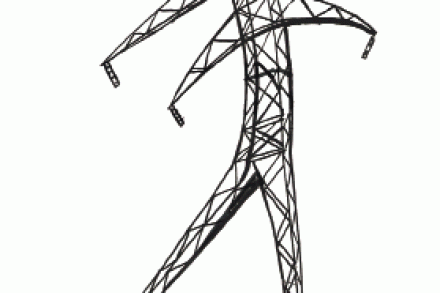
One thing Britain does not need is more pylons. There are already legions of the metallic monsters stomping across our fields and hills — 22,000 of them in total — and 550 of these have colonised some of the loveliest countryside in Britain: across the Peak District; through the New Forest and the South Downs; along the North Wales coast. We should be dismantling these lines, as suggested by the excellent Campaign to Protect Rural England. We should be pulling down the pylons and running the cables underground or under the sea. But instead National Grid, supported by the government, is making plans to put up even more: another 12 new buzzing, high-voltage lines supported by hundreds more pylons looming over another 170 miles of England and Wales.

How to start saving Britain in ten minutes

From our UK edition

The work begins Subject: No time to lose Date: Friday, 7 May 2010 14:28 From: David Cameron To: Sir Gus O'Donnell, Cabinet Secretary Dear Gus, The Queen has just invited me to form a government. I’m sending this on by BlackBerry in the car, because there is a degree of urgency. Our country has been badly broken by 13 years of bad government. There is, literally, not a moment to lose in fixing it. The Queen has asked me to govern for up to five years, and mentioned to me that her father saw our country win a world war in six years. Her point: that five years is plenty to save our nation. That is precisely what I intend to do. I may not have won the majority that I had hoped for. But I do not need legislation to achieve most of my reform plans: I can do this by email.

How to spot Sir Humphrey’s schemes

From our UK edition

Apart from a loyal army and a strong police force, the primary requirements for political power are (a) legal authority, (b) taxation revenues, (c) organisational size and (d) permanent tenure of office. Politicians certainly do not have (c) and (d), and although they may have (a) and (b) in theory, those two have long been effectively appropriated in practice by the permanent officials. As a result a general election, which is presented as a choice as to which political party will run the country, is much closer to a contest between rival marketing consultancies pitching for the civil service account for the next five years.

Mind your language | 13 February 2010

From our UK edition

I’ve always found the 19th-century phrasebook English as She is Spoke irresistibly funny, but I had only ever seen the version without the Portuguese original. I’ve always found the 19th-century phrasebook English as She is Spoke irresistibly funny, but I had only ever seen the version without the Portuguese original. It was first published in 1855 as The New Guide of the Conversation in Portuguese and English by Jose da Fonseca and Pedro Carolino. The presumption was that they used a Portuguese-French phrasebook and a French-English dictionary. The book I knew until this week was the ‘fourth edition’ published in 1884 by Field and Tuer at the Leadenhall Presse, as an intentionally funny exercise.

City Life | 14 December 2009

From our UK edition

Elliot Wilson in Reykjavik Mike, a commodities trader from Chicago, leans over the table in Reykjavik’s Prikid bar and almost whispers: ‘What’s the deal here? Where are the breadlines?’ Our group looks befuddled. An Icelandic playwright mock-whispers back: ‘What breadlines? Did you expect Reykjavik to be full of bakeries?’ No, retorts Mike, but didn’t Iceland declare bankruptcy a year ago? So why isn’t everyone sleeping on the streets? It’s not an unreasonable question. Iceland’s 300,000 citizens have just struggled through their worst annus horribilis since Ingólfur Arnarson built his homestead in Reykjavik in ad 874.

Man-made global warming is real. The solutions being touted are not

From our UK edition

The pledges many countries will make on greenhouse gas emissions in Copenhagen are pure fantasy, says Bjørn Lomborg. We must pursue other options Judging by the opinion polls, those gathering at the Copenhagen climate change summit have a lot of persuading to do. Just two in five Brits think that global warming is taking place and is man-made. Only one third of Americans think that humans are responsible for climate change. The number of Australians who deem global warming a ‘serious and pressing problem’ has dropped sharply. The urgency which grips politicians around the world seems not to be shared by the general public — to the frustration of people like David Miliband, Britain’s Foreign Secretary.

Competition | 7 November 2009

From our UK edition

In Competition No. 2620 you were invited to submit an argument, in verse, for the superiority of one vegetable over another. It was Pablo Neruda’s ‘Ode to the artichoke’ that got me thinking about the pecking order in the vegetable kingdom. Here’s a snippet: ‘The cabbage/ Dedicated itself/ To trying on skirts,/ The oregano/ To perfuming the world,/ And the sweet/ Artichoke/ There in the garden,/ Dressed like a warrior,/ Burnished/ Like a proud/ Pomegranate...’ In a bumper crop of entries Martin Parker impressed, as did Frank Osen, David Mackie, Ray Kelley, Robert Schechter and Juliet Walker. In fact, you were all on sparkling form. But there’s room for only six winners, who are rewarded with £25 each. W.J Webster gets £30.

What lies beneath

From our UK edition

Franz Kafka’s Poseidon Franz Kafka’s Poseidon sat at his desk doing the accounts. The administration of all the waters gave him endless work. He could have had assistants, as many as he wanted — and he did have very many — but since he took his job seriously, he would in the end go over all the figures and calculations himself, and so his assistants were of little help to him. It cannot be said that he enjoyed his work; he did it only because it had been assigned to him. But he did it, nonetheless, and with a kind of regularity and constancy which the CEO of any organisation would have appreciated. Sumatra, Tonga, the Samoas: only the latest entries in the Sea Director’s neat, double-columned book.

The Spectator Parliamentarian of the Year Awards 2009 | 21 October 2009

From our UK edition

Big Ben strikes eleven, and time is running out for you to nominate a politician for The Spectator/Threadneedle Readers’ Representative Award. Big Ben strikes eleven, and time is running out for you to nominate a politician for The Spectator/Threadneedle Readers’ Representative Award. We’ve had an enthusiastic response so far, which just goes to show that our parliamentarians can’t be all bad. Look beyond the venal faces that are dominating newspaper coverage at the moment and you’ll find quieter, more hard-working, conscientious sorts. Our job is to celebrate them.