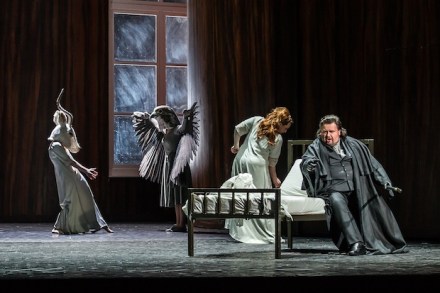
The Royal Opera House’s Die Frau ohne Schatten – a dream solution to Strauss’s problem opera?
From our UK edition
If ever an opera was weighed down by its creators’ joint ambition, it is Die Frau ohne Schatten. Richard Strauss and his librettist Hugo von Hofmannsthal quickly began to imagine their third true collaboration, produced during the 1910s but not premièred until 1919, as their masterpiece. But it turned into a complex and unwieldy embarrassment of riches, albeit a glorious one. The charge that this enormous fairy tale represents the librettist and composer at their most pretentious and overblown is difficult to refute, and such charges are compounded by the fact that the surface message of its plot — in which a shadowless and infertile spirit Empress learns compassion and gains humanity, a shadow and fecundity — can be read as a kind of pro-procreation parable.