Hermione Eyre

Wonderfully intimate: The Drawings of Victor Hugo, at the RA, reviewed

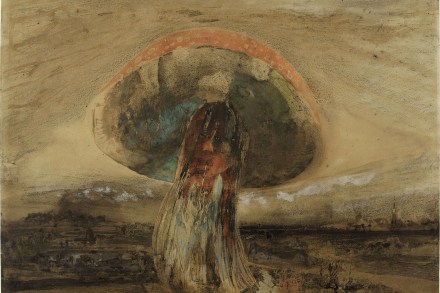
You feel so close to Victor Hugo in this exhibition. It’s as if you are at his elbow while he sighs at his standing desk at the top of his house on Guernsey, where he held France constantly in view as he worked. Here, frustrated by Les Misères (working title), he has thrown down his pen and moved to his art table, sloshing great washes of sepia ink across paper to form lowering clouds. And there, daydreaming, he has cut out a stencil of a castle, and placed it on a cloud of ink. (Hmm, ‘castle on a cloud’ – could make a nice lyric for a song one day…) Here is a person thinking with their pen – or rather, letting their pen think with them There is a wonderful intimacy to his travel sketchbooks, full of minutely well-observed brickwork and staircases.

Paul Wood, Matthew Parris, Ian Buruma, Hermione Eyre and Francis Young

34 min listen

On this week’s Spectator Out Loud: Paul Wood reads his letter from the Vatican (1:17); Matthew Parris warns Conservatives from embracing causes that could lose them as much support as they would gain (7:31); reviewing Richard Overy’s Rain of Ruin: Tokyo, Hiroshima and the Surrender of Japan, Ian Buruma argues that the atomic bombs were not only immoral, but ineffective (15:35); Hermione Eyre examines the life and work of the surrealist artist Ithell Colquhoun (23:03); and, Francis Young provides his notes on Shrove Tuesday (29:12). Produced and presented by Patrick Gibbons.

An exhilarating, uneven survey of an outstandingly eccentric British surrealist

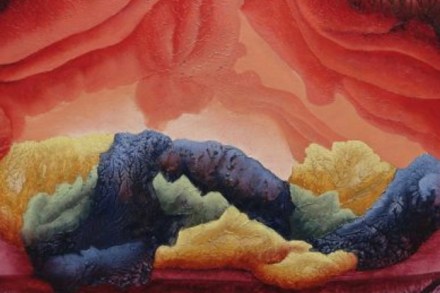
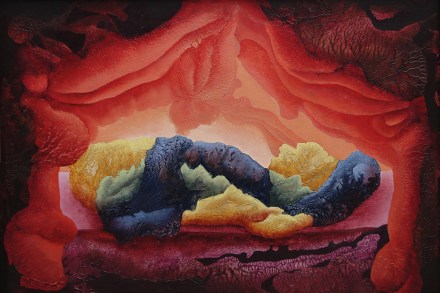
Ithell Colquhoun was always a bit of a mystery surrealist. Her greatest hit is the unsettling, dream-like ‘Scylla’ (1938), a painting of two towering cliffs, which could equally be thighs in the bath. The prow of Odysseus’s Argo peeps through them. The pubic hair is seaweed, and there are shells, but, as far as discernible, no crabs. The point of view of the painting is that of the titular monster Scylla, lying in wait. It’s witty and disturbing; mythic and domestic. A British surrealist high point, frequently anthologised. This aside, her name was relegated to lists.

The rediscovery of the art of Simone de Beauvoir’s sister

An exhibition of the art of Hélène de Beauvoir (1910-2001), sister of the great Simone, opened in a private gallery near Goodge Street last week. It was the first time Hélène’s work had been shown or received any attention in London, and young people in alternative clothing gathered to sip orange wine and listen, rapt, to the 75-year-old biographer and friend of the de Beauvoir sisters, Claudine Monteil, as her recollections helped elucidate Hélène’s abstract paintings. The reclamation of a new ‘lost’ artist was under way. De Beauvoir’s cubist self-portrait is quite good – but ‘Simone in red jacket’ must never be seen It is possible, these days, for gallerists to do good work – self-defining as allies and activists – while making a good fortune.

Stories of the Sussex Downs

This amazing book is itself a little like a flint, a misshapen stone egg of the Sussex Downs. It resists the reader at first, coated in the calcite rind of the author’s slow, scholarly journey, missteps and all. But when you persist, breaking the book’s spine or, as it were, knapping the flinty nodule, you find treasure within. Alexandra Harris quotes the painter Paul Nash writing in 1937: ‘If I broke all the shells of all my wild stones, I should find that precious yolk which is like precious stones, the black core of the flint.’ From Nash, it’s a hop and a skip to Henry Vaughan, the metaphysical poet who ‘understood his heart as a cold flint that must be violently struck if it were to kindle into divine light’.

James Heale, Paul Wood and Hermione Eyre

21 min listen

This week: James Heale takes us through the runners and riders for the conservative nomination for mayor of London (1:00), Paul Wood discusses how Saudi Arabia is trying to buy the world (06:02), and Hermione Eyre reads her arts lead on the woman who pioneered colour photography (12:51).  Produced and presented by Oscar Edmondson.

The woman who pioneered colour photography

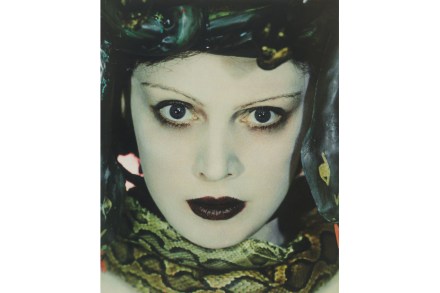
When colour photography first came in at the start of the last century, it met a surprising amount of resistance from distinguished photographers. But Madame Yevonde loved it, owned it, revelled in it. She invested in a new Vivex repeating back camera, exhorting her fellows at the Royal Photographic Society in 1932: ‘Hurrah, we are in for exciting times. Red hair, uniforms, exquisite complexions and coloured fingernails come into their own… If we are going to have colour photographs, for heaven’s sake let’s have a riot of colour.’ But what she went on to create was far better than that. In her classical series ‘Goddesses’ (1935) she controlled colour like a Renaissance master, painting with it, creating atmosphere and character.

Anne Glenconner: ‘I took my courage from Princess Margaret’  

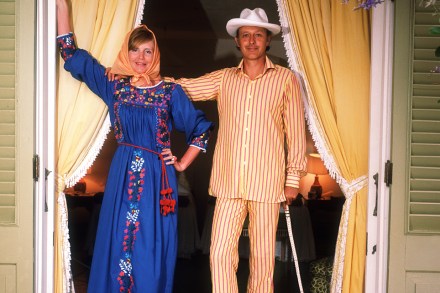
Craig Brown is responsible for the astonishing late flowering of Anne Glenconner. It was his biography Ma’am Darling: 99 Glimpses of Princess Margaret that so enraged her that, in an effort to stick up for her friend, whom she served as a lady-in-waiting for 30 years, Lady Glenconner started writing in her mid-eighties. She hasn’t stopped since. First came an internationally best-selling memoir, Lady in Waiting, then two pacy novels. And now, coinciding with her 90th birthday, as well as (no flies on her) the new season of The Crown, Christmas etc, she publishes this volume of ‘life lessons’ – a catch-all, really, for any other top toff reflections from this most likeable of survivors.

Richard E. Grant’s tribute to his wife leaves us shattered for his loss

Richard E. Grant pulls off a feat here. The title is twee but the content isn’t. With unselfpitying dash the actor-writer recounts caring for his wife, the dialect coach Joan Washington, through lung cancer last year (‘Living grief. Raw. Savage.’). He thoughtfully interleaves the heartbreak with glitzy showbiz recollections which help keep our peckers up, so we ricochet through time, from the Golden Globes to the Royal Marsden, from sedative injections to Star Wars. It’s an unusual structure, but it works – so, to use one of the author’s expressions, ‘Why bloody notsky?’ Grant’s daily diary-keeping is what makes the book.

How to tell your Roman emperors apart

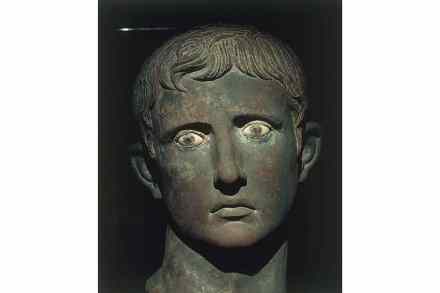
Rising professors do well to be controversial if they wish to be invited to contribute to mainstream media. But the elder professor, lauded, loved and telly-tastic, has the privilege of swerving controversy without losing the limelight. And so Mary Beard gives us this rich disquisition on the Caesars’ visual representation (and misrepresentation), from swapped plinths to forged heads. Handsomely illustrated and brightly ringing with Beard’s enjoyment and scholarship, the book doesn’t inflame debate but brings it down a few degrees. While her publicist might have preferred more engagement with today’s ‘sculpture wars’ (touted on the dust jacket but not mentioned within), Beard provides no ammo for either side, but takes a wry long view.

‘I am not able to answer your question’: an irascible Paolo Sorrentino interviewed

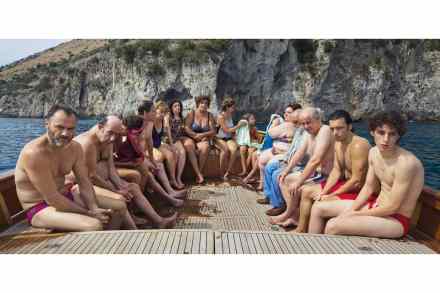
Loving the films of the Italian auteur Paolo Sorrentino, I thought he’d be easy to chat to. But a maestro is a maestro, as I was reminded when I interviewed him in London last week. Masked and communicating through a translator, I semaphored my admiration for his new film The Hand of God, starting with its spectacular opening shot. Like a bird, the camera flies over the sea, then focuses on a vintage car tooling along the promenade, before panning over the city again. But he rejected my praise: ‘It’s not complicated. It’s a normal shot by helicopter.’ He’s right, of course, that his new classic coming-of-age story represents a departure towards simplicity.

Doctor Butcher: crank, genius or son of Frankenstein?

I hated reading this book. Not only was it objectively upsetting, as any book describing monkey vivisection would be (I put my head in my hands when I realised there were photographs), it was also dispiriting, because it showed up my hypocrisy. Like so many, I would gratefully accept perfusion brain-cooling techniques if they helped me survive surgery, yet I do not wish to read about how these techniques were developed on primates. It would be enough for me just to know that their suffering was minimised. This book asks even more of its reader, by focusing on gruelling experiments that lead nowhere.

Nina Hamnett’s art was every bit as riveting as her life

Nina Hamnett is in vogue again. She is the subject of a new pocket biography, no. 7 in Eiderdown Books’s Modern Women Artists series, and her first ever retrospective is now open at Charleston Farmhouse’s gallery space. I confess I didn’t know much about her before this resurrection, but she is now one of my favourite 20th-century artists. In this bucolic gallery space, where cows can be heard bellowing, her portraits are at last hanging together, like a cocktail party finally regrouped. The colours are subtle, beautiful without being decorative; as the co-curator Alicia Foster explains, Hamnett’s use of colour is ‘meaningful, incisive’.

World-class music, heavily symbolic staging: Glyndebourne’s Katya Kabanova reviewed

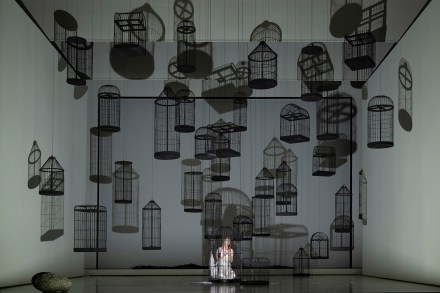
At the first night of Glyndebourne Festival 2021 there was relief and joyful expectation as Gus Christie made his speech of welcome. Never mind the hit to takings from the closed bar and the necessarily half-empty auditorium; never mind the scaled-back orchestra and abridged score. The new production of Katya Kabanova provided the thirsty opera-goer with a long cool drink of world-class music and heavily symbolic staging. Janacek’s exploration of a yearning female psyche has parallels with Anna Karenina and Madame Bovary. It lives or dies by its lead, and the Czech soprano Katerina Knezikova excelled as Katya.

The truth about my father, Philip Guston

Philip Guston’s later work is — and I say this with love — nails-down-a-blackboard weird. The vapid pinks and flat reds lend a nightmare cheerfulness. The menacing American figure wearing Mickey Mouse gloves is rendered in cartoonish style. The clock shows it is time to panic, challenging you to call out the hood for the Ku Klux Klan symbol it appears to be. By the time he started making these paintings, in 1968, Guston was pretty much post-everything: post-realism, post-abstract expressionism, post-criticism (he and his wife Musa sailed to Italy the day after the show’s opening night, and when a review found him in Venice, poste restante, he dropped it in a canal).

Keeping poker-faced is no use – it’s the hands that give the game away

This is not a rip-roaring, gonzo gambling adventure. By page 66 this cautious, thoughtful author has still never played a hand of poker in her life. She has read, re-read, dissected and annotated poker textbooks. She has scribbled notes while trying to keep up with her power-walking mentor, the poker legend Erik Seidel, as he tells her she’ll need to develop the ability to be reckless. This is a swot’s progress, a fish-out-of-water experiment. It’s hard to imagine her taking on, say, Devilfish in Vegas. As she finally joins a charity tournament on page 115, I’ll admit to thinking, this had better go somewhere. And it does. Within 18 months she has turned pro, recruited by Poker Stars after winning an $84,000 trophy and another $60,000 game.

Greg Jenner’s survey of celebrities through the ages has a distinctly Horrible Histories feel

Good writing about celebrity is scant. It has few poets, because it takes depth to go truly shallow (I’d nominate Roland Barthes, Peter Conrad, Kenneth Tynan, Clive James, Marina Hyde, Lynn Barber and the New Yorker’s Lauren Collins). It all runs the risk of becoming instantly dated. As a magazine interviewer myself, I’ve learnt to expect anyone blabbing about their marital bliss and vegan awakening to be divorced and setting up a burger chain by the time the piece comes out. After celebrities die they are stratified; the very good or very bad get biographers. But the mere celebs get Greg Jenner.

Why we’re all in love with Fleabag

Why would you need the scripts for Fleabag? It’s hardly a lost classic. It’s always popping up on BBC iPlayer. So it was with a touch of scepticism that I picked up this volume, subtitled not ‘The Scripts’ but ‘The Scriptures’, in reference to Fleabag’s long, pitiless pursuit of a hot priest in Series 2, and beautifully presented: sombre hardcover without, shocking-pink end-papers within. Clever — there’s already something of the spliced rhythm of the series in the design. But the pink band wrapper made it look too much like a present: was this just a commercial attempt at cramming that scabrous lost soul, transgressive cultural heroine and all round dirtbag into a giftable item? Then I read it. Bliss.

Radio 4’s The Art of Innovation is a series that — for once — deserves the label ‘landmark’

Radio 4, how do I love thee? Rather as one loves the flocked wallpaper that came with the house. It isn’t what one would have chosen — but it is home. Yes, even when plangent piano music indicates a meaningful drama is about to begin. Yes, even when said drama is a woefully wooden effort about Amy ‘a typical modern 18-year-old — who happens to be trans’. Sample quote: ‘You’ve had me for 18 years, now I want me for me!’ Sound effect: peevishly slammed door (mine). New trans dramas are, of course, welcome, but Woman’s Hour drama is often a bit miss and miss.

Serial genius

‘It’s no use at all,’ says Posy Simmonds in mock despair, holding up her hands. ‘I can’t tell my left from my right.’ She is ambidextrous. ‘This hand [her right] writes and draws; and this hand [her left] cuts out, sharpens pencils, throws balls, plays tennis… I can’t drive. I’ve never taken a test. I’m always on the wrong side of the road.’ Looking at these wonderful hands, elegant and almost limp, one would never suppose they had created, over the past 50 years, such a large volume of intensely enjoyable and astute drawings.