Henrietta Bredin

The Wagner effect

From our UK edition

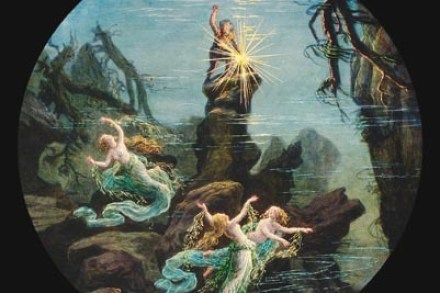
Henrietta Bredin has put together a series of events to celebrate the Royal Opera House’s Ring cycle It is with considerable trepidation that I venture to write about Richard Wagner in these pages, considering that in doing so I am following a trail well blazed by Bernard Levin — a passionate and lushly articulate devotee — and that no fewer than three highly eminent Wagner scholars are current contributors: Michael Tanner, Patrick Carnegy and Robin Holloway. However, I shall take my courage in both hands as I am in the final throes of a project I was asked to take on by the Royal Opera House just over a year ago, devising a festival of events to celebrate its performances of the Ring cycle this October. It has been something of a dream brief.
The man who sheds light on the music

From our UK edition

David Belasco was a pioneer in the field of stage lighting, passionate about creating realistic effects, the most famous of which occurred in his one-act play Madame Butterfly, during which the action slowed to an almost total halt for a 14-minute, lovingly rendered dawn sequence. Puccini saw the play in London in 1900 and rushed backstage afterwards to find Belasco and make an immediate bid for the rights so as to turn it into an opera. Being a man much impressed by technical innovation, Puccini was especially struck by the dawn lighting and went on to incorporate the episode in his opera, as the culmination of Butterfly’s night-long vigil, waiting for the return of the faithless Pinkerton.

The shorter, the better

From our UK edition

A belated response to Mary Wakefield’s rather alarming diatribe of May 3 (unfairly aided and abetted by the genius lyrics of Randy Newman) against short people. There are not only great numbers of wonderful, charming and hugely talented short people around – Kylie Minogue, Simon Rattle, Mikhail Baryshnikov, Dawn French – and sadly not around – Mozart, Nelson, Charlotte Brontë (really really tiny) - but a great many excellent short things. How about short stories, cuts, bread, speeches (yes please), skirts (admittedly best with long legs) and (devoutly to be wished if you’re a politician) memories? Less good are short tempers, change and sight but you can’t have everything.

Repetitive strain injury

From our UK edition

What is it like for an actor, after the stimulating exploratory process of rehearsal, followed by the high-voltage excitement of opening night, to go on performing the same piece over and over again, night after night? A long run of a show makes it a banker for its producers and is therefore in many ways highly desirable. Indeed a big musical has to run for some months before it even begins to recoup its production costs. It is not, however, an easy ride for the actors concerned. There is a range of different challenges to face, from becoming jaded and disenchanted by endless repetition, to being physically and mentally exhausted by the emotional challenges a piece may present.

A natural approach to Chekhov

From our UK edition

Joanna Lumley bears a distinct resemblance to the delectable Mrs Algernon Stitch in Evelyn Waugh’s Scoop, who, while still in bed of a morning, supervises the painting of a mural, fills in the crossword, offers useful advice on matters of state, attends to pressing correspondence, corrects a child’s construing of Horace and deals with a friend’s emotional and financial problems, before bowling merrily into the London traffic in ‘the latest model of mass-produced baby car, painted an invariable brilliant black’. Her modern-day equivalent tends not to run her life from bed but is capable of juggling quite as many and as varied tasks simultaneously, from filming and producing to writing and working unshowily for key charitable causes.

Poetry and music

From our UK edition

The great lyric poets of the English language wrote — and, I hope, are still writing — words which have their own melodic quality, cadences which lure composers to add music to them. Shakespeare, Herrick, Blake, Tennyson, Burns, Yeats have been set to music by numerous composers, creating a lasting heritage of English song. A smaller but intriguing category is poetry that is not turned into song but is spoken to music. Grand master of this compositional genre is Jim Parker. ‘I was an orchestral oboe player,’ he says, ‘but I was always wanting to get away from that and do something a bit more creative so I joined the Barrow Poets, as an oboist and possibly to do some arranging. It developed from there when I started composing music specially for them.

A two-way deal

From our UK edition

The phrase ‘English song’ is often met with suspicion, bringing with it a whiff of the morris dance, the come, follow follow and the hey nonny no — and the work of Roger Quilter, composing in the first half of the 20th century, is no exception to this reaction. However, for those with ears to hear and prejudices to shed, there are rare treasures to be  found when a new recording of his complete songs for solo voice and piano is released at the end of February, sung  by baritone Mark Stone, accompanied by the composer and conductor Stephen Barlow. ‘Quilter and I go back a long way,’ says Stone. ‘Three of his Shakespeare songs were some of the first things I ever learnt.

Christmas cheer

From our UK edition

Puccini’s Bohemians really knew how to have a good time at Christmas. Huddled in a freezing cold Parisian garret, Rodolfo is reduced to burning his own play for warmth and has just consigned the final act to the flames when Schaunard bursts in and flings on to the table a shower of coins he has earned from giving music lessons to an eccentric Englishman. Along with Marcello and Colline they manage to get out of paying the quarter’s rent they owe and head off to the Café Momus to celebrate Christmas Eve with a blow-out dinner. Act Two of the opera is a sort of self-contained festive explosion, with conspicuous consumption (rather than the tubercular variety, which makes itself less joyously apparent later on) at its heart.

Flying high with music and words

From our UK edition

The titles of Jonathan Dove’s musical works — Flight, Tobias and the Angel, Palace in the Sky, The Little Green Swallow, Man on the Moon — might lead one to consider his winged surname a highly appropriate one. However, while the composer undoubtedly possesses a soaring imagination, it is allied to a refreshingly pragmatic, earthbound streak, and he is also the author of the more prosaically titled Pig, Greed and An Old Way to Pay New Debts. ‘I don’t work to an inner manifesto but I suppose that, in my operatic writing, I am always exploring something about where the boundaries of opera are, opera and theatre. I’m trying to reclaim the art form for a broader audience.’ He is currently reclaiming on all sides.

‘There are no barriers’

From our UK edition

There are many who might consider it an absolute crime that someone who would look so entirely delectable in a dirndl is instead about to hit the stage of the London Palladium draped from head to toe in a habit and wimple. Lesley Garrett, however, is so thrilled that she can barely contain herself. Other small girls growing up — as millions of us did — with the film of The Sound of Music spooling like an ever-present backing track to our lives might have felt a particular affinity with the rebellious Maria, the confused teenage Liesl or even the obnoxiously winsome Gretl. Not Lesley. Was she surprised to be asked to take on the role of the Mother Abbess? ‘I wasn’t asked — I volunteered.

Trusting to instinct

From our UK edition

This year is Opera Holland Park’s tenth anniversary season, and to my great shame I have never attended a performance, despite having had the best intentions of doing so for roughly the past ten years. If I don’t turn up this summer, I get the feeling I’ll be in serious trouble with the two men who were sitting on the other side of the lunch table from me a few days ago, Michael Volpe and James Clutton. At least I will be if I survive the fusillade of their rattle-attack enthusiasm without slumping into my salad, lethally punctured by a hail of conversational bullets.

Australian odyssey

From our UK edition

I must admit that the first arts event in which I participated on arriving in Australia was entirely by chance. Sitting in the sun on the restaurant terrace of the Museum of Contemporary Art in Sydney, looking at the ferries bustling in and out of Circular Quay, I picked up a small printed notice that had been placed on my table. It told me that, as part of the current city-wide contemporary art show, the chair in which I would normally have been sitting had been swapped with one from a café in Hanoi. As I pondered on this and gazed across the water, the arm of a crane swung into view and dropped an enormous rock on to a red car that had been parked at the bottom of the steps leading up to the Opera House. That turned out to be a part of the same show.

Words fused with music

From our UK edition

Why would anyone want to write an opera libretto? The words are generally held to be at the service of the music, relegated therefore to second place, so what would make any self-respecting writer choose to offer up their skills to the peremptory demands of a composer? The reason is probably quite simply because it's something else, another way of stringing words together that can take them into an entirely different dimension. Any writer with curiosity will want to experiment with their chosen form, to try more than one way of exercising their craft. And music can take words to places that they cannot reach alone. Langston Hughes knew what the two could do together: Cheap little rhymesA cheap little tuneAre sometimes as dangerous As a sliver of the moon.