Harry Mount

Harry Mount is a barrister, editor of The Oldie and author of How England Made the English (Penguin) and Et Tu, Brute? The Best Latin Lines Ever (Bloomsbury).

After Putin: how nervous should we be?

From our UK edition

37 min listen

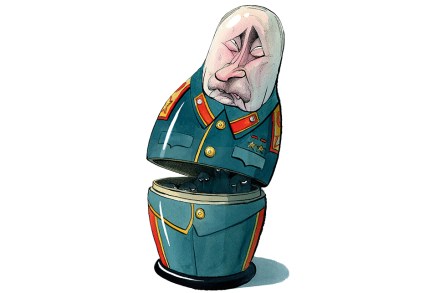
This week: In the magazine we look at the Wagner Group’s failed coup and its implications for Putin’s reign. The Spectator’s Russia correspondent Owen Matthews examines why the Kremlin permits the existence of private armies such as Prigozhin’s Wagner Group, and joins the podcast alongside Jim Townsend, former deputy secretary of defence for European and NATO policy under the Obama administration. (01:15) Also this week: The Spectator’s special projects editor Ben Lazarus writes this week about the claims made in the recent Mirror Group phone hacking trial, and the man orchestrating many of the accusations, Graham Johnson.

The lewdness and lyricism of ancient Roman graffiti

From our UK edition

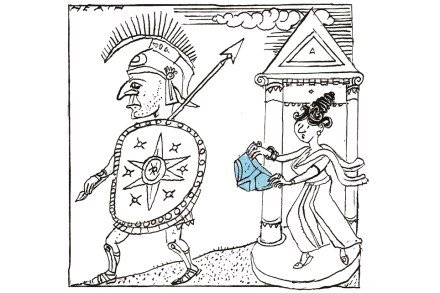
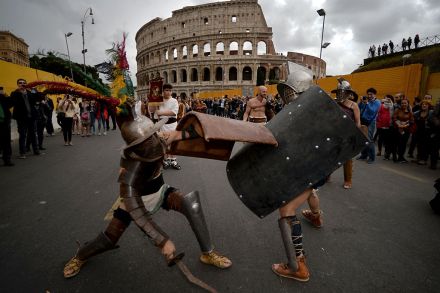
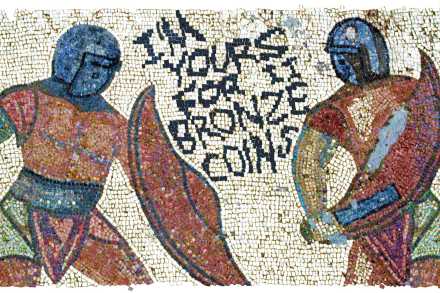
Throw him to the lions! That’s what I thought when I saw the video of a grinning moron desecrating the walls of the Colosseum with the words ‘Ivan + Hayley 23’. He must have been referring to his girlfriend, standing by his side – and the year. It wasn’t just the fact that he’d defaced the greatest of all Roman buildings. It was that he’d written something so depressingly banal. He could at least have written the year in Roman numerals – MMXXIII. And he could have borrowed some themes from the Romans – the rudest graffiti artists ever. ‘Ivan’ could at least have borrowed some themes from the Romans – the rudest graffiti artists ever We like to think of the Romans as highfalutin, high-minded gods. But they swore like us. They were obsessed with sex, like us.

Lady Caroline Lamb and the frantic bed-hopping between the great houses of England

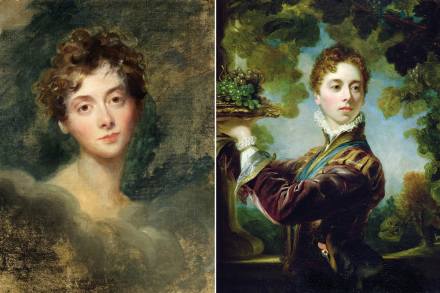
“Mad, bad and dangerous to know.” That’s the line Lady Caroline Lamb (1785-1828) is known for — her brilliant, pithy verdict on her lover Lord Byron. Her other great claim to fame — her marriage to Viscount Melbourne, twice prime minister — was marginal from a historical point of view: she died, aged only forty-two, her health shattered by drink and laudanum, before Melbourne became PM; before he became Lord Melbourne, in fact — he succeeded to the title after her death. But, still, as Lady Antonia Fraser reveals in her gripping biography, Lady Caroline Lamb: A Free Spirit, she was a remarkable woman, possessed of exceptional charm, as was Byron.

Caroline

Curtis Sittenfeld is the great American observer

If a Martian landed on Earth and wanted a quick summary of the state of modern American life, I would point him toward the works of Curtis Sittenfeld. Sittenfeld (born 1975 in Ohio) is a novelist. Like all the great ones, her perceptions are more accurate about real life than most nonfiction writers’ could claim. In Prep (2005), she skewered American class in the story of a Massachusetts boarding school; Sittenfeld herself went to private school at Groton. In Rodham (2020), a novel about Hillary Clinton, she nailed today’s politics. And, in her best book to date, American Wife (2008), a thinly disguised novel about George and Laura Bush, she filleted the American approach to inherited money, and the swaggering confidence it produces.

sittenfeld

Humza Yousaf and Anas Sarwar’s debt to private schools

From our UK edition

Humza Yousaf, the favourite to succeed Nicola Sturgeon as Scottish First Minister, has been ticking all the right boxes in his campaign so far. Last week, he declared: ‘As your SNP First Minister, and as someone from a minority background myself, I will stand up and champion equal rights for all.’ I don’t imagine he’ll be championing the rights of Scottish public-school boys, though. But that is exactly what Yousaf is.  Yes, the 37-year-old Cabinet Secretary for Health and Social Care is the first non-white, first Muslim cabinet minister in the Scottish government. But he’s also an old boy of Hutchesons’ Grammar School, Glasgow, one of the oldest public schools in Scotland, founded in 1641 by brothers George and Thomas Hutcheson.

Was the Queen Mother ever really funny?

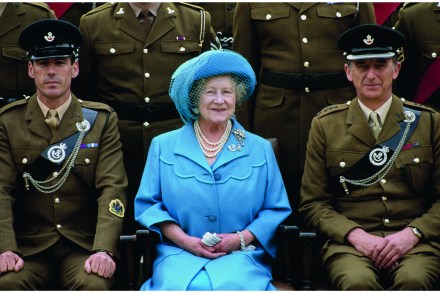
Was the Queen Mother ever really funny? She was clearly extremely good company: an attentive listener, full of enthusiasm and affection, right up until her death, aged 101, in 2002. She was also the ideal queen for an unconfident George VI, undermined by his stutter and caught unawares by his accession to the throne, thanks to the abdication of his appallingly selfish brother, Edward VIII. The only time I ever saw the Queen Mother — when she was eighty, at her Clarence House home — I was only eight, but I remember her clearly. A tiny figure, she beamed away, spreading goodwill among strangers when so many people that age have lost mobility, let alone the ability to cheer up other people. Grumpy George V had thought much the same of her charm nearly sixty years earlier.

queen mother

What kind of king will Charles III be?

In 1988, Prince Charles asked the late Peregrine Worsthorne, then editor of the Sunday Telegraph, what he should do in public life. Perry told Charles he should restrict himself to public duties and never ever air his private thoughts. The prince buried his head in his hands, moaning, “But then I’m just a cipher.” And that, indeed, is what he has just become, as King Charles III. At the end of September, his cipher — the symbol of his reign — was unveiled. The elegant combination of a C, an R (for Rex) and the Roman numeral III come together to symbolize King Charles III. In time, the cipher will appear on government buildings, state documents and new postboxes. Perry Worsthorne was right all those years ago.

charles

Fellowship of the Lamb: how we’re saving Tolkien’s pub

From our UK edition

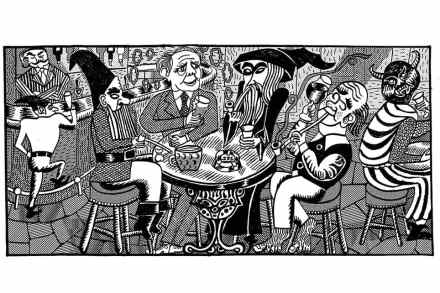
I’ve just bought Tolkien’s pub in Oxford. Well, to be more precise, I and more than 300 fellow drinkers have bought the Lamb and Flag, the 400-year-old Oxford pub where the Inklings group of writers – including J.R.R. Tolkien and C.S. Lewis – drank. Like so many pubs across the country, the Lamb and Flag closed, in January last year, thanks to the pandemic trading slump. Across the road, the Eagle and Child pub also closed, in 2020, because of Covid. Tolkien and Lewis drank there, too – they called it ‘the Bird and Baby’. It remains shut. What rare survival stories these two pubs are – or were. The Eagle and Child, owned by St John’s College, opened in 1650.

How to get through a school reunion

From our UK edition

T here’s no need for a mirror at school reunions. Just look all around you to see the cruel effects of anno domini on your old contemporaries – and don’t fool yourself that you alone have miraculously dodged the hair-thinning, waist-expanding horrors of middle age. Is that really the semi-divine girl who scored a modelling contract in her first term in the sixth form and was in a Nivea advert in Elle? Can that be the Brad Pitt of the Remove – the one who had sex before first lesson every morning? Where has the plumpness in her dewy lips fled to? How far back along his scalp have the golden ropes of hair retreated? I’m certainly not one to speak.

A royal affair

The cover blurb, from “Lady Anne Glenconner” on this huge book proclaims: “Brilliant. Tina Brown has inside knowledge and writes so well.” The credit for the author of the 2019 bestseller, Lady in Waiting: My Extraordinary Life in the Shadow of the Crown should in fact be “Lady Glenconner”. You might not think it matters much these days that, over and over again, Tina Brown gets the titles wrong in this book. But this is supposedly the ultimate insider’s look at the royal family over the last forty years or so. And titles are at the heart of the Firm — think of the agony of Prince Harry and Prince Andrew at no longer being able to use their HRH titles and having to give up their honorary military roles.

royal brown

Why I feel sorry for the super-rich

From our UK edition

Be honest. Aren’t you a teeny-weeny bit jealous of the super-rich? Are you a little annoyed by the new Sunday Times Rich List – which showed the top ten richest people in the country now have £182 billion between them, more than three times what they had in 2010? Don’t your hackles rise on seeing the masters of the universe pad around Davos in their identikit blue suits and tieless white shirts? Well, stop worrying and thank God you aren’t a billionaire. The Super-Rich World Problems are endless. Bucketloads of money should inoculate the rich against anxiety. In fact, money only heightens the worries, particularly about their two principal bugbears: staff and taxes.

Who is David Sherborne, libel lawyer to the stars?

From our UK edition

If you’re a celeb with a burning grievance, the hottest place in town is an unassuming, Georgian terraced house in Gray’s Inn, Holborn. Five Raymond Buildings is the number one libel set in the country. And its most prominent barrister is David Sherborne, aka ‘Orange Sherbet’ – the permatanned schmoozer with the wind-tugged, auburn tresses. Sherborne is currently representing Coleen Rooney, wife of ex-England footballer Wayne Rooney, in the ‘Wagatha Christie’ case. She’s being sued for defamation by Rebekah Vardy, wife of Leicester striker Jamie Vardy. Mrs Vardy disputes Mrs Rooney’s allegation that Vardy leaked stories about her to the Sun.

From the brainiacs to the bluffers: a guide to public school stereotypes

From our UK edition

A Wykehamist, an Old Etonian and an Old Harrovian are in a bar. A woman walks in. The Old Etonian says: ‘Fetch her a chair!’ The Wykehamist gets it. The Old Harrovian sits in it. It’s the oldest public-school joke in the world — and it still has the ring of truth. (Though you might add these days: ‘And then the Old Etonian becomes prime minister.’) But what about the other public schools? Here are the classic characteristics of our most famous schoolboys — and schoolgirls. Charterhouse Artistic, literary, louche, political and on the make… the received wisdom about Old Carthusians was set in stone in the Alms for Oblivion sequence by Simon Raven (1927-2001), who was at the school in the 1940s.

Fall and decline

In December 1921, a twenty-two-year-old Ernest Hemingway, then the European correspondent for the Toronto Star, came across the oddest group of immigrants in history — the White Russians who had fled the Bolshevik Revolution. “Paris is full of Russians,” Hemingway told his readers. “They are drifting along in Paris in a childish sort of hopefulness that things will somehow be all right, which is quite charming when you first encounter it and rather maddening after a few months. No one knows just how they live, except by selling off jewels and gold ornaments and family heirlooms that they brought with them to France.” Hemingway neatly summarized the meat of this gripping latest book by Helen Rappaport, the author of The Romanov Sisters and Caught in the Revolution.

russian

The problem with rewilding

From our UK edition

The government has gone wild. Under new plans, just announced by Environment Secretary George Eustice, farmers and landowners in England could be paid to turn large areas of land into nature reserves and restore floodplains. In place of the old EU subsidies, farmers will be rewarded by the government for how much they care for the environment. It sounds like a wonderful idea — a return to a glorious, prelapsarian wilderness. But it’s a little more complicated than that. Eustice referred warmly to the poster boy of rewilding, the Knepp estate in West Sussex. I’ve been to Knepp and it is indeed glorious. Nightingales have returned, accompanied by clouds of Purple Emperor butterflies. There are even White Storks nesting in the trees.

How the National Trust’s new leader can restore trust

From our UK edition

The National Trust has, thank God, appointed a new chairman. What can he do to restore trust in an organisation that has so catastrophically dumbed down and become so woefully political in recent years? Rene Olivieri is an American-born former publishing executive. He has been interim chairman of the National Lottery Heritage Fund, the RSPCA and the Wildlife Trusts and is a board member of the government’s Culture Recovery Fund. His statement on being appointed had a few subtle, encouraging signs that he might stop the dumbing-down, politicising rot. Olivieri said:  'As a charity and national institution with a 126-year history, it’s uniquely placed to recognise the debt to the generations that have gone before and its responsibility to those which follow.

Don’t turn Notre Dame into a ‘politically correct Disneyland’

From our UK edition

Sacré bleu! Plans are afoot to turn Notre Dame cathedral, once it’s restored, into what some have called a ‘politically correct Disneyland’. The plans, yet to be rubber-stamped, will turn the cathedral into an ‘experimental showroom’, with confessional boxes, altars and classical sculptures replaced with modern art murals. New sound and light effects will be introduced to create ‘emotional spaces’. Themed chapels on a ‘discovery trail’, with an emphasis on Africa and Asia, will pop up. And Bible quotations will be projected onto chapel walls in various languages, including Mandarin. The last chapel on the new trail will have an environmental emphasis.

Will the National Trust now end its war on ‘Restore Trust’?

From our UK edition

Yesterday, at the Trust’s AGM, Restore Trust – the body which wants to stop the dumbing-down and politicisation of the Trust – didn’t win. But it has made an enormous impact for a body which was only set up last summer and now has 20,000 members and a £60,000 war chest. Restore Trust put forward three resolutions. It won one of them: a proposal to disclose in full the pay of the National Trust's senior staff. It lost the other two: one regretting the loss of expert curators; the other deploring the recent treatment of volunteers. The scale of the loss, though, was small – by 54,708 votes to 57,164 on curators; by 56,267 to 59,015 on volunteers. In both cases, the Trust only won because they used their 20,000 or so discretionary votes.

Why is the National Trust waging war against its members?

From our UK edition

The National Trust culture war has just stepped up a gear. Ahead of the Trust’s AGM on 30 October, the Trust has launched an extraordinary attack. Its target appears to be Restore Trust, a new body trying to rein in the National Trust’s political obsessions. 'Our founders set out to protect and promote places of historic interest and natural beauty for the benefit of the nation. That means we are for everyone. Whether you’re black or white, straight or gay, right- or left-wing,' the National Trust has said. This implies that Restore Trust (of which I am a member) is against individuals from different backgrounds. Nothing could be further from the truth.

New world order: can Britain, America and Australia contain China?

From our UK edition

43 min listen

In this week’s episode: can the new Aukus alliance contain China? In his cover piece this week, James Forsyth writes that the new Aukus pact has fixed the contours of the next 30 years of British foreign policy. Britain, he says, is no longer trying to stay neutral in the competition between America and China. On the podcast James is joined by Francis Pike, author of Empires at War: A Short History of Modern Asia Since World War II, who also wrote for the magazine this week, giving the case against Aukus. (00:45)Also this week: what can be done to save the Church of England’s parishes?