Harriet Sergeant

Harriet Sergeant is a journalist and the author of Among the Hoods: My Years With a Teenage Gang.

Reverting to type

From our UK edition

While I was living in Tokyo, a Japanese girl friend of mine fell in love with a British investment banker. After promising marriage, he abandoned her for an English wife from the counties. But my girl friend was no Madame Butterfly. She did not attempt suicide. She felt she had had a lucky escape. A visit to Wiltshire to meet his family had convinced her the English upper classes were mad. Emerging from her room on Sunday evening, she discovered her lover’s father polishing the family shoes. She rang me in shock. Did he suffer from some kind of foot fetish? she asked. I explained that men of that generation who had been to public school and then the army frequently got out the shoe box on a Sunday evening.
The lady from Shanghai

From our UK edition

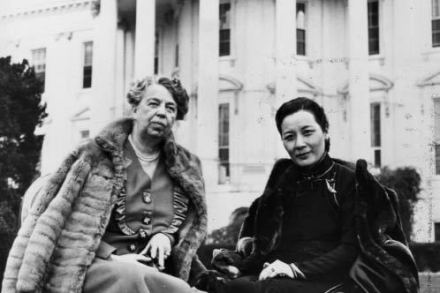
By the middle of the second world war, May-ling Soong was the world’s most powerful woman, at the centre of events in China’s history and its relationship with the USA. By the middle of the second world war, May-ling Soong was the world’s most powerful woman, at the centre of events in China’s history and its relationship with the USA. Hers is an engrossing life which spanned the 20th century and included a cast of extraordinary admirers, from Chinese warlords to Churchill. ‘I think your bark is worse than your bite,’ she cooed at him during the Cairo conference. Born in 1897, she was one of three sisters whose lives and marriages would dominate Chinese politics during the first half of the 20th century. The Last Empress is a misleading title.

Three men and a singer

From our UK edition

Ian Buruma’s latest book, The China Lover, is a fictionalised take on themes previously examined in his impressive body of non-fictional work. His views on Japan, its history, films and underworld as well as the role of the outsider, the relationship between East and West and much more are all unpacked here as we follow the life of the teenage singer and actress, Yoshiko Yamaguchi. She takes us on a tour of Manchuria and Shanghai in the 1930s, Japan during the American Occupation and, finally, Lebanon in the 1970s. These are periods and places that Buruma knows intimately and writes about with confidence. Yamaguchi’s story is told from the perspective of three men who encounter her at different periods of her life.

No mean feat

From our UK edition

Rows of black suits filled the China Airlines flight from Beijing to Paris in September 1984. The People’s Liberation Army had ordered its entire delegation of dancers and musicians to wear the same ill-fitting outfit. Only one 17-year-old dancer had disobeyed the order. For this, his first visit to Europe, Jin Xing had bought a dazzling, white three-piece suit. ‘Only I shone out,’ he declared proudly. It is this desire to shine against the bulwark of the Chinese state that defines Jin Xing’s autobiography, Shanghai Tango. It has been no easy feat. Jin Xing was born a boy and became a colonel in the People’s Liberation Army. A sex change saw her start a new career as an international ballerina, choreographer and, most improbably of all, Beijing bar owner.

Much possessed by death

From our UK edition

On the 25 November, 1970 after a failed coup d’état, the Japanese writer Yukio Mishima stuck a knife into his belly, then had his head cut off with his own sword. Twenty years later I enjoyed a brief flirtation with a member of Mishima’s private militia, the Tate no Kai or Shield Society. Matsumura, like Mishima, proved a series of contradictions. A right-wing nationalist who owned a coffee shop in the centre of Tokyo, he had spent the 1960s cracking left-wing students over the head with a drain- pipe. His best friend, Morita, Mishima’s second-in-command, had beheaded the writer before killing himself. But Matsumura also spoke fluent English, enjoyed arguing with me and baked an excellent cheesecake.

With not much help from Freud

From our UK edition

Shortly after the end of the Cultural Revolution, I found myself in a girls’ dormitory of Beijing university. It was a small drab room of eight wooden bunks. The students wore shapeless Mao jackets over hand-knitted jerseys and their hair in plaits. It was very cold. I had asked about their love life. The girls looked puzzled. The Cultural Revolution had promoted puritanism between the sexes. What preoccupied them was not love but hot water. Each day they received one thermos. That was their lot. ‘So if we wash our hair, we can’t have tea,’ one explained, gazing wistfully at my clean head. It is such girls, modest, virginal if a little grubby, that Mr Muo, the hero of Dai Sijie’s latest novel, is in search of.