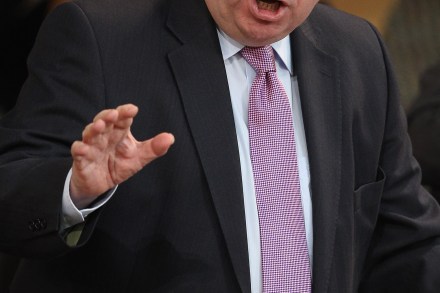
Hamish Macdonell

Poll shows Yes camp are within striking distance of victory

From our UK edition

'It has given us a good, old-fashioned kick up the backside,' said one member of the 'No' camp yesterday. He was being charitable. It could end up being an awful lot worse than that. The ‘it’ in question was the new ICM poll which, suddenly and unexpectedly, has put the Yes campaign right back in the hunt for Scottish independence. At a stroke, all those complacent certainties about the No camp wiping the floor with the Nationalists have been discarded and, this morning at Holyrood, the talk is of little else. 'It is game on,' said one Nationalist with a smile. Just to emphasise how important this new poll for The Scotsman newspapers is, here are the figures: Yes 37 per cent (up from 32 per cent in September) No 44 per cent, down from 49 per cent in September.
Putin’s strange intervention over Scottish independence

From our UK edition

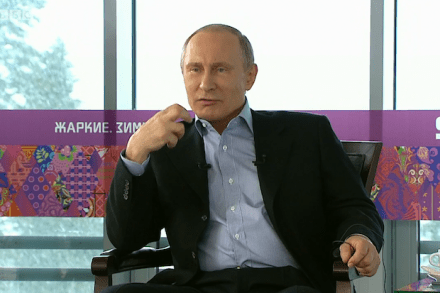
Is it useful to have Vladimir Putin on your side or not? One would have hoped anybody in the UK Government would have considered this question before, apparently, asking for the Russian President’s help in their battle with the Scottish nationalists over independence. Many people saw President Putin’s intervention in the Scottish independence debate on the Andrew Marr Show yesterday morning. Far fewer, however, are aware of the rather murky background to the exchange between Putin and Marr which seems to have preceded it. For the record, this is what the Russian President said in response to a question from Marr about Scottish independence: ‘It is not a matter for Russia, it is a domestic issue for the UK.

Europe will affect the Scots referendum, but not in the way everyone expects

From our UK edition

With William Hague in Glasgow this morning, the Scottish independence debate has swung round to Europe once again. Europe is indeed going to be important as we head towards the referendum, but perhaps not in the way everyone expects. The Foreign Secretary spent this morning warning that Scots would be worse off if they left the UK and then joined Europe as a separate country – without the UK’s rebate. This will rumble on until the September 18 poll, with claim and counter claim from both sides and neither able to prove anything definitively. Hague’s visit, though, has overshadowed one intriguing piece of polling data which could prove to be highly significant later in the year.

Alex Salmond is impaling himself on problems of his own making

From our UK edition

When the independence debate finally started to rumble last year, most people thought it would be the big issues which would dominate as we approached polling day – defence, foreign affairs, welfare, the future of the monarchy and so on. But here we are, just eight months out from the 18 September referendum and there are two very different issues dominating the agenda – childcare and student tuition fees. On both of them, moreover, Alex Salmond has managed to get himself impaled on problems of his own making. First, childcare: when he launched the White Paper on Independence back in November, the First Minister promised a ‘revolution’ in childcare if Scotland became independent.

Osborne sparks the unionists’ fightback

From our UK edition

Edinburgh It became clear last night why George Osborne was put in charge of the Coalition Government’s fightback against Alex Salmond and separatism: he is the only one who has the ability to really score points off the Nats. The Chancellor’s intervention on currency and bank notes – suggesting that an independent Scotland might not be able to keep the pound and that, if it did, it might be banned from producing Scottish bank notes – hit the SNP hard. Osborne’s remarks shook one of those comfortable certainties which the SNP has been peddling for so long – that Scotland would simply keep sterling after independence and everything would progress as normal.

Now Margaret Thatcher is being drawn into the Scottish independence debate

From our UK edition

It may be more than 23 years since she last held office but the late Baroness Thatcher has now been drawn into the battle over Scottish independence – by the Nationalists. In fact, the real surprise is not that Alex Salmond has decided to invoke the legacy of Thatcher in his crusade to break up Britain, but that he has taken so long to do so. Lady Thatcher has long been seen by the SNP as the perfect recruiting tool for Scottish nationalism. They have always liked to portray her as a public sector-slashing, industry-destroying, remote, anti-Scottish Tory. So when papers emerged last week under the 30-year rule showing that Lady Thatcher had tried to cut a swathe through the Scottish budget in 1984, the Nationalists seized on it.

Nobody’s noticed, but the White Paper on Scottish independence has failed to move public opinion

From our UK edition

It is not surprising that the first Scottish opinion poll to be done since Alex Salmond published his White Paper on Independence last week would slip by almost unnoticed. After all, the attention of the Scottish media was somewhere else. It was focused, quite rightly, on events in Glasgow and the aftermath of the terrible helicopter crash there. As a result, the Progressive Scottish Opinion for the Scottish Mail on Sunday appeared and then, somewhat understandably, faded away quite quickly. It was a poll which, on most weekends, would have carried the front page for the paper. However, it was relegated to page 14 by the tragedy in Glasgow. It is, though, worth looking at because the results are most instructive.

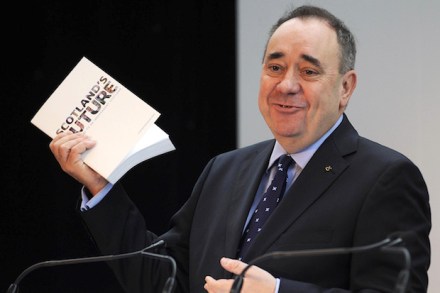
What’s hidden inside the Scottish Independence White Paper?

From our UK edition

Hidden away in the 650-page White Paper on Scottish Independence are a number of very interesting developments, none of which were championed by the SNP beforehand but every one of which has the potential to shape the campaign. Here are just a few of them: 1. A major move on nuclear weapons. The SNP’s position on Trident and nuclear weapons is well known. An independent Scotland would kick Trident out of its current base on the Clyde and become a 'non-nuclear' state with only conventional armed forces. Also, Scotland would be so defiantly anti-nuclear that it would not let ships carrying nuclear weapons enter its water or its ports. Oh really? What about this then?

Salmond goes for the surprise referendum date

From our UK edition

Always the showman, Alex Salmond did the unexpected today when he announced that the referendum on Scottish independence would be held on Thursday September 18 2014. He knew everyone was expecting it to be in October so he chose something different. He knew, we knew: everyone, it seemed, knew, that the events of 2014 have been so carefully planned in the Nationalist calendar that it seemed impossible for the First Minister to choose another date than October. The 700th anniversary celebrations of the Battle of Bannockburn will take place at the end of June 2014. This bout of Nationalist patriotic outpouring will be followed by the Glasgow Commonwealth Games in July and August – which will see even more waving of Saltires.

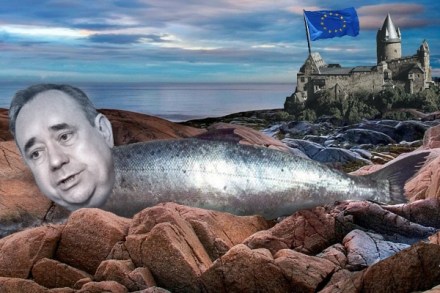
Salmond caught on the rock of Europe

From our UK edition

Europe, so often the rock on which Conservative hopes foundered, is now causing considerable trouble for Alex Salmond. The Scottish First Minister has long campaigned for Scottish separation under the slogan ‘independence in Europe’. Leaving aside his difficulty in justifying the departure from one Union only to become a junior member of another, this has always been a tricky proposal to sell. The main reason for the SNP’s vulnerability has been that no-one has really ever known how Scotland could leave an existing member state and automatically become another one in its own right – not without having to drop all the opt outs and advantages that the UK has squeezed out of Brussels over the decades.

Alex Salmond, Scotland’s longest serving First Minister

From our UK edition

So Alex Salmond has achieved the feat of becoming Scotland’s longest serving First Minister. This is a notable achievement. After all, he has avoided the fate of one of his predecessors – resigning in disgrace – and another: being defeated at the ballot box. Salmond has just served as Scotland’s First Minister for 2001 days, or five and half years, just eclipsing the term served by Jack McConnell between 2001 and 2007. But even he would agree that the field to contest this landmark is not a large one. Scotland has only had four first ministers since 1999. The first, Donald Dewar, lasted just a year before his death in 2000. The second, Henry McLeish, also lasted a year before resigning over an office expenses scandal.

Salmond’s darkest day could be yet to come

From our UK edition

For years Scotland has been waiting to see when his luck would run out – well, now it has. Alex Salmond: gambler, tipster, political animal and First Minister now has another moniker: author of the country’s first scomnishambles. Yesterday marked, without doubt, the First Minister’s worst day in office. First, he lost two MSPs. Left-wingers Jean Urquhart and John Finnie announced they were leaving the SNP because of the party’s conversion to Nato. That decision, taken at SNP conference last weekend, has alienated many left-wingers in the party because they see it – rightly – as part of Salmond’s attempts to take the SNP into the moderate, centre ground of Scottish politics.

Spectator debate: Scotland’s energy policy is just hot air

From our UK edition

Donald Trump and the world's first 'professor of carbon capture' clashed last night in the Spectator's first debate in Edinburgh over the motion :  as they sparred over the contentious motion - Scotland's Energy Policy is Just Hot Air. Andrew Montford posted his argument on Coffee House earlier, and I thought CoffeeHousers may like to know how the rest of the debate went, Trump could not, alas, be there in person but he sent in a video message in which he supported the motion. It was, as you'd expect, a coruscating attack on the SNP administration's pro-wind farm policy. He is a well-known opponent, having been campaigning against a proposed off-shore wind farm which, he claims, will ruin the views from the golf course he has just built on the Aberdeenshire coast.

Alex Salmond booed by crowd in Glasgow

From our UK edition

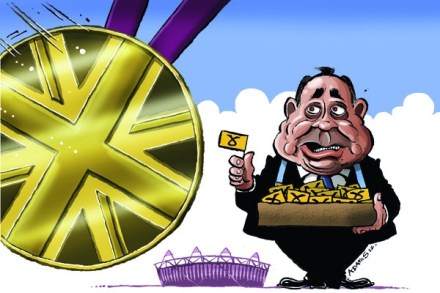
Roman emperors famously used to have a slave to ride behind them in their chariots during victory parades to remind them, by whispering in their ear, that they were only mortal. Alex Salmond must have experienced something of the same down-to-earth experience yesterday evening when he was booed by a crowd in Glasgow that had come to celebrate Britain’s Olympic success. The First Minister can’t have liked it very much. It can’t be a pleasant experience for anybody to get booed by a crowd but for Mr Salmond, it must have been galling. This was a Scottish crowd in Scotland’s biggest city, a country Mr Salmond regards as his fiefdom, where he commands a handsome majority and where he believes – until yesterday that is – that is really very popular.

A solid, unspectacular start

From our UK edition

Tomorrow, the Spectator and six guest speakers (including Kelvin MacKenzie, Sir Malcolm Rifkind and Margo MacDonald) will debate the question, ‘Is it time to let Scotland go?’. You can find more details and information about tickets here. Below, Hamish Macdonell gives his take on the launch of the pro-Union campaign yesterday.   As the pro-Union politicians filed out of Edinburgh’s Napier University yesterday, they passed an Independence Scotland ad-trailer. The lorry with the huge pro-independence poster on the back had been forced to pull over, just outside the campus where the ‘Better Together’ campaign had been launched, it’s progress halted ignominiously by a flat tyre.

Yes campaign launch will cause problems — for the independence movement

From our UK edition

Some of those who queued outside the Cineworld multiplex in Edinburgh for this morning’s Yes for Independence launch found it hard to contain their chortles. There, hanging above the door through which Alex Salmond was due to arrive was a huge poster carrying just two words — The Dictator. And if that ad for Sacha Baron Cohen’s new movie wasn’t enough to send the First Minister into a fury with his PR team, there was more inside.

Labour succeeds in slowing Salmond’s advance

From our UK edition

This was the election which was supposed to establish the SNP as Scotland’s new national party, replacing Labour as the default party of choice for Scottish voters. This was also the election which was expected show that last year’s extraordinary Scottish Parliament result was not a one-off and that the SNP could push on and defeat Labour in its town hall heartlands too. But none of this has happened. Not all the results are in from Scotland’s councils yet but the overall picture is already clear. Labour has recovered from last year’s Scottish Parliament shocker and halted the SNP momentum — at least in its core key urban areas of west and central Scotland.

A pair of tycoons has put Salmond on uncertain ground

From our UK edition

Alex Salmond may feel he got a lot from cosying up to both Rupert Murdoch and Donald Trump but, wow, is he paying the price. The front page of today’s Herald captures the First Minister’s problems perfectly. The entire first half of the front, above the fold, is covered with two pictures, one of Mr Trump and one of Mr Murdoch and the headline: ‘With Friends Like These.’ The strapline underneath states: ‘Salmond feels backlash from relationships with wealthy tycoons.’ The piece itself starts with the following: ‘One hit him with a verbal broadside, the other lavished him with praise. But, for different reasons, Alex Salmond was feeling the heat yesterday over his relationships with two powerful businessmen.

Cameron’s risky move could play into Salmond’s hands

From our UK edition

Not many politicians would conjure up the spectre of Alec Douglas-Home to scare the Prime Minister, but that is exactly what Alex Salmond did today — to some effect. The Scottish First Minister was responding to David Cameron’s ‘jam tomorrow’ offer to the Scottish people. ‘Vote “no” in the independence referendum,’ Mr Cameron effectively told Scots today in his latest attempt to make some progress in the independence debate, ‘And I’ll see that you get major new powers for the Scottish Parliament.’ It was one part bribery, one part political strategy and Mr Salmond was on to it quicker than the average Scot can order a haggis supper.

Salmond lays the ground for his referendum

From our UK edition

So now we have it: the ten words which Alex Salmond hopes will end Scotland’s 300-year-old membership of the United Kingdom. ‘Do you agree that Scotland should be an independent country?’ The First Minister unveiled his consultation paper on an independence referendum today and, to the surprise of many, actually did what David Cameron has been asking of him. He came out with a short, simple, clear question on independence which he wants to put on the ballot paper. The debate will now rage as to whether this question is fair (is it, for example, too positive? Should it perhaps include something about the United Kingdom?), but this does mark a fairly big step on the road towards agreement.