Fraser Nelson

Fraser Nelson

Fraser Nelson is a Times columnist and a former editor of The Spectator.

Exclusive: James Harding to be new BBC Director of News

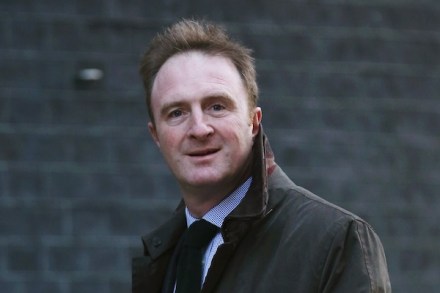
A BBC source tells me that James Harding is the BBC's new Director of News. There is no official confirmation yet, but it makes sense. Just a few months ago, he quit as editor of The Times - with the praise of Fleet St ringing in his ears and a £1.3 million payout in his pocket. The Guardian had reported that he had been approached to be deputy to Tony Hall, the new BBC director-general. (The no2 job has not been filled since Mark Byford quit a couple of years ago.) But DDG, for all its nominal seniority, would not have been as powerful position as Director of News (vacated by Helen Boaden, who was paid £354,000 a year). When Lord Hall arrived, the two main vacancies he had to fill were that of Director of News and Director of Television.

Andrew Lansley, like Andrew Marr, was almost killed by exercise

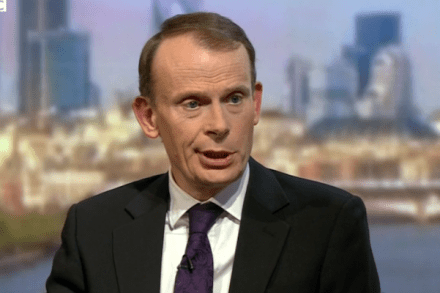
The old joke — 'my only exercise is acting as a pallbearer for friends who exercise' — is no laughing matter for Andrew Marr. He has been interviewed on his own show this morning and revealed what induced his stroke: a session on a rowing machine. "I'd had two minor strokes, it turned out, in that year – which I hadn't noticed – and then I did the terrible thing of believing what I read in the newspapers, because the newspapers were saying what we must all do is take very intensive exercise, in short bursts, and that's the way to health.

Is UKIP posing as the new party of the British working class?

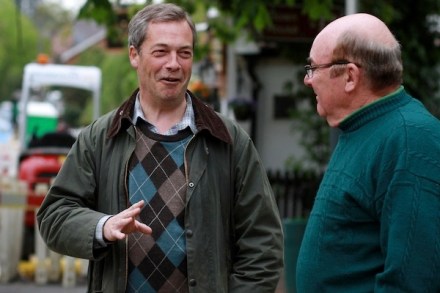
How seriously should we take Nigel Farage? He’s an exceptional politician but when UKIP did so well at Eastleigh I suspected they may have peaked. I went along to test my theory at a UKIP rally in Worcester last week, expecting to find a few hardline Eurosceptics huddled together in a room and I wondered how the audience would compare with that of the old BNP rallies. What I found was quite different: it was mobbed, Farage spoke very well – speaking about housing, unemployment, school places – essentially, UKIP is trying to reposition as a patriotic party of the working class. I write about this in my Telegraph column today. Here are my main points. The Worcester rally’s popularity... My plan was to sneak in half an hour early for the 7pm rally, but by 6.

Situations vacant

I hope CoffeeHousers will forgive me for using the blog to advertise jobs, but we have some vacancies: Production Manager, Special Assistant to the Chairman and Researcher. Applications to editor@spectator.co.uk, saying in the heading which job you are interested in (update: applications for the researcher job are now closed. Everyone should have been sent details; email us if you haven't been). Here are the jobs: 1. Researcher, who knows how to work Excel and has an inexhaustible capacity for digging and hard work in general. This is a research job, not a journalistic job, and may suit someone who'd otherwise be looking for work in a think tank. The two most important skills are accuracy and speed — in that order.

Tony Blair can’t escape blame for trashing the economy

The New Statesman today publishes a splendid centenary edition, to celebrate its 100 years — a collectors’ item. It also carries some vintage blame-dodging by Tony Blair who pretends 13 years of Labour rule was not responsible for the mess we’re still in. Overspending is not to blame for the debt crisis, he says. It’s nonsense on first reading, of course: what else creates a debt crisis, rather than overspending? Bad weather? A bad debt fairy? Blair claims that Labour need to be ‘very robust in knocking down the notion that it “created” the crisis’. Here are his words, some of them flatly untrue: ‘Labour should be very robust in knocking down the notion that it “created” the crisis.

I hate to admit it, but Ed Miliband has a point about welfare and language

In his Mail on Sunday column today, James Forsyth gives a fascinating insight into what both main parties are thinking as we move from welfare wars into local election campaign mode. His piece is, as usual, full of gems - but one in particular caught my eye. Several of those closest to [Ed Miliband] tried to persuade him to use the term ‘benefit cheat’ in a speech soon after he became leader. They believed that Miliband, the son of an academic, needed to speak in the way that voters do. But Miliband refused. He’s determined not to take the tactical approach to the issue beloved by the triangulators of New Labour. Instead, he wants to position himself as a ‘one nation’ politician capable of uniting the whole country.

Matthew Parris is right – and George Osborne should calm down.

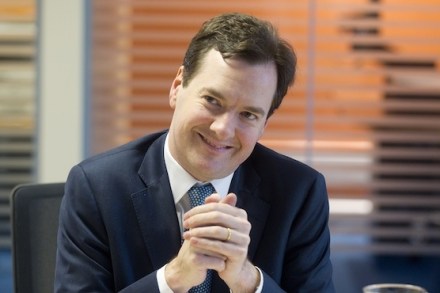
George Osborne has been behaving rather oddly of late. Normally, he’s known as the ‘submarine’ for surfacing only twice a year. Now, it's twice a week. On Tuesday he delivered a speech to supermarket staff, talking tough on welfare and sometimes lapsing into a Dick Van Dyke mockney accent. On Thursday he used the Philpott case to raise questions about the welfare system. Yesterday, David Cameron backed him. It looks like a concerted effort to speak on the wavelength of target voters – but will it work?  In this week’s Spectator, Matthew Parris suggests it may not. He has spoken at length to many of the 40 MPs who hold the most marginal seats.

HBOS and the Evil Banker hypothesis

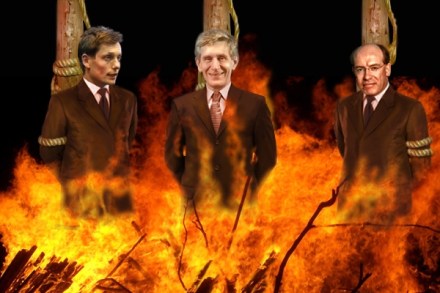
The banking witch trials resume today, and we are offered three new men to burn at the stake: Lord Stevenson, Sir James Crosby and Andy Hornby. The Parliamentary Commission on Banking Standards released its report at midnight (pdf), and it is as personally damning as any I’ve seen. It basically calls for them to be deemed not 'fit and proper' people. They are architects of a recipe for bank failure, taking on far more risk than they admitted, telling the regulator that their policies were cautious when they’d borrowed twice as much as RBS and then, even now, refusing to admit their guilt. It’s not so much a post-mortem examination as an 88-page J’accuse. I look at this in my Telegraph column today*.

Why are the left so angry about today’s welfare reform? Because it’s popular – and right.

It's tough being a supporter of this coalition government. Mishap and omnishambles have come to characterise its first three years in office - but you can almost forgive all of this given the progress being made on education and welfare. Reforming the latter is the toughest mission in politics, and another phase of that reform comes into effect today. But here's the thing: the welfare reform is not causing mass outrage. Of course, Polly Toynbee is furious - but to the bafflement of the chattering class, the masses seem to think the reform is long overdue. Study after study confirms this. There was that  YouGov/Prospect study suggesting that three in four people (and a majority of Labour voters) think that Britain spends too much on welfare.

Trenton Oldfield: why I disrupted the Boat Race, and what it achieved

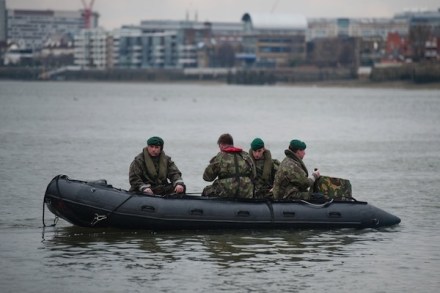
Trenton Oldfield has written in this week's Spectator that he won't be attending today's Boat Race but just in case, we learn today that Royal Marine Commandoes will be patrolling the Thames with thermal imaging equipment to look out for copycat stunt artists. Whatever it cost to imprison Oldfield will be as nothing compared to the cost of discouraging his epigones - real, or imagined. Having made such an impact, what does Oldfield think now? In this week's View from 22 podcast, he has what we can fairly call a sparky debate with Douglas Murray, a contributing editor for the Spectator. It's not for the faint-hearted.

Dying of the cold: a very British disease

A few months ago, a Norwegian students' group made a spoof video sending up Live Aid, and the clichéd Western view of Africa and the stereotypes perpetuated by the aid industry. It has now been viewed two million times, making it one of Europe’s most successful political videos. It starts with an African equivalent of Bob Geldof. “A lot of people aren’t aware of what’s going on there right now. It's kinda just as bad as poverty if you ask me... people don’t ignore starving people, so why should we ignore cold people? Frostbite kills too. Africa: we need to make a difference.” The joke organisation is called Radi-Aid, where Africans share heat with Norway. Here's the video:- http://www.youtube.com/watch?

Budgets, cuts and sacred cows

Today’s newspapers disclose that Cabinet members have received letters telling them to expect 10 per cent cuts to their budget in the next spending round. This will have been a letter designed to be leaked, and to establish a negotiating position. The Times says that the real figure is closer to 8 per cent, as I disclosed in my Daily Telegraph column three weeks ago. It was the 8 per cent figure which set off the chain of events which led to Theresa May’s leadership-style speech. To recap, here’s what happened first time around. The problem came when Osborne asked ministers to make further cuts of 8 per cent in their budgets.

David Miliband bows out of British politics – to a roar of Thunderbirds jokes

David Miliband rather grandly told Sky News last night that the public's "legitimate fascination" with the tension between him and his brother Ed had "obscured the real choice for the country" - that between Labour and the Tories. As if. The truth is that people had just stopped thinking about David Miliband. For all the hopes once pinned on the former Foreign Secretary, he had become an irrelevance. A Puck-like figure who'd pop up on the political stage now and again, to general mirth, then disappear. As Iain Martin says, his departure from Westminster is of almost no significance. Most Blairites bolted at the last election, and those who didn't chose to sulk rather than fight for the future of their party.

Exclusive: the police have offered to HELP Trenton Oldfield protest at the 2013 Boat Race.

Trenton Oldfield, the Australian who was fished out of the Thames last year when disrupting the Oxford-Cambridge Boat Race, is now out of prison and has written a piece for tomorrow's Spectator about his experiences. In it he reveals that the Metropolitan Police have offered to help him protest at the 159th Boat Race taking place this weekend. This is what he has to say: 'Throughout the week, via lawyers, I have received some elegantly crafted emails from Scotland Yard’s Liaison Gateway Team (‘a small unit of officers dedicated to facilitating peaceful protest’). They ask how they can help me organise a protest at the university boat race this year. Their ‘total policing’ sometimes includes pre-emptive arrests.

‘Would you like to replace Ed Balls?’ The question Alistair Darling won’t answer

Ed Balls is a good street fighter, but not a very loveable one. The polls suggest he is perhaps the least popular figure in frontline politics. His manner too abrasive and his political bloodlust too obvious. As James Forsyth says in this week's View from 22 Spectator podcast (below), Balls is — at best — Miliband's 3rd choice for the position of Shadow Chancellor. His first was Alan Johnson and Yvette Cooper (aka Mrs Balls) was asked before it fell to Balls. A triumphant Alistair Darling, fresh from a 2014 Scottish referendum victory, may well be more palatable to the public. It's unlikely that Balls would move over for Darling - although he may not have the choice. We know that Darling loathes Balls (which admittedly, in the Shadow Cabinet, is not saying much).

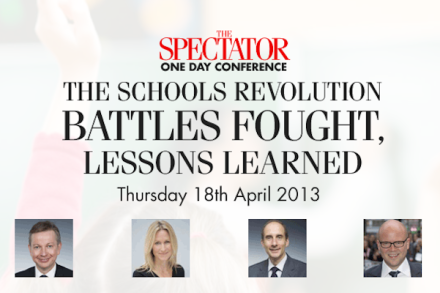
School wars: Michael Gove, Fiona Millar and Andrew Adonis at Spectator conference

Three years ago, Dennis Sewell wrote a Spectator piece about the real enemy awaiting Michael Gove: 'The Blob'. Carla Millar illustrated the point (below). Today in the Mail on Sunday, the Education Secretary extends the metaphor further: 'School reformers in the past often complained about what was called TheBlob – the network of educational gurus in and around our universities who praised each others’ research, sat on committees that drafted politically correct curricula, drew gifted young teachers away from their vocation and instead directed them towards ideologically driven theory. 'Some wonder if past reformers were exaggerating the problem in university education departments.

Why The Spectator won’t sign the Royal Charter

Whatever else is said about David Cameron’s hand-ling of press regulation, there can be no doubt that the deal he struck on Monday demonstrated masterful sleight of hand. Just days earlier, his differences with Ed Miliband and Nick Clegg had seemed irreconcilable and the Prime Minister was heading for defeat in the Commons. But then, overnight, everyone united around a compromise: a state regulator which insisted it was no such thing. It was the political equivalent of Magritte’s ‘Ceci n’est pas une pipe’; Britain’s first piece of legislative surrealism. The Royal Charter’s ornate, 17th-century language is part of the obfuscation. It begins: ‘To all to whom these presents shall come, greeting!

Budget 2013: Six Scary Graphs

Those of a nervous disposition should not click beyond the link. What follows are a few graphs that sum up what's very hard to spin out of: the extent to which our economic situation has worsened, and how bleak the future looks.  The Chancellor started by saying he'd cut the deficit by a third, not a quarter. That's one way of putting it. Another way is to say that debt is up 38 per cent under the coalition so far, and is set to double: George Osborne's targets involve ratios, not absolute levels of debt. Here is how the outlook on his debt/gdp ratio has changed since his first budget:         And that's the optimistic view. Citi doesn't think (pdf) the ratio will fall at all.

Budget 2013: Osborne’s empty budget

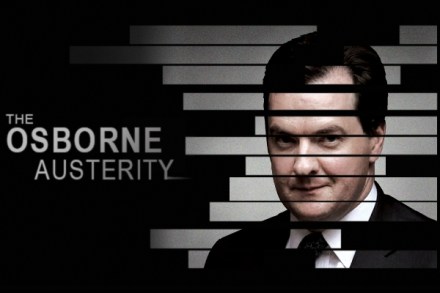
This was, as I suspected, an empty budget. There was the usual whale spray of policies: a penny off beer duty here, petrol tax reduced there. Nowadays, we don’t have to wonder if the Budget will make a blind bit of difference: the Office for Budget Responsibility sees the figures in advance and does the sums. It concludes that the Budget will have 'no impact on level of GDP at the end of the forecast horizon'. To Osborne’s credit, he didn’t try to spin this. The recovery has stalled and he has run out of ideas about how to start it again. It’s difficult to put a gloss on this basic fact. As always, the small steps that Osborne did take were in the right direction. Extending the corporation tax for a year, so it hits 20pc in 2015, is a good idea.

Any questions for Hernando de Soto?

As we wait for the Budget, I’d like to draw CoffeeHousers’ attention to a talk being given to the RSA tomorrow by one of my heroes, Hernando de Soto. Much rot is spoken about how to help the poor and his books, the Mystery of Capital and The Other Path – make some hugely important and fairly basic points. You need to look at capital: the right to own, and (from that) the ability to borrow. If a country has not enforced property rights, then it will never be properly pulled out of poverty because its people have no means to accumulate capital. Wealth creation depends on this microfinance, not handouts. Grant people these basic, and miracles can happen.