Fraser Nelson

Fraser Nelson

Fraser Nelson is a Times columnist and a former editor of The Spectator.

The word is that Labour has lost

I have now spoken to three people in Glasgow with the same news: Labour has lost. It was 42% turnout, a monster turnout – given that 48% voted in the general election. It was the sort of turnout one normally associates with a constituency which fancies giving someone a kicking. Now I’m not calling this for the SNP, but I thought I’d share with CoffeeHousers the message which political journalists are sending to each other right now. Also word that the Tories may beat the LibDems into third place: an unexpected result which would be tremendous news for Cameron.

Have the forgotten voters of Glasgow East triggered a political earthquake?

You don’t mean a thing if your seat’s not a swing – that is the rule which governs Britain’s constituency voting system. Its worst aspect is the emergence of modern day rotten boroughs, where no mainstream party votes. The more I hear from Glasgow, the more likely it looks that the forgotten voters of Glasgow East might – just might – trigger that political earthquake. If it does, it will be for a simple reason: it’s difficult for Labour to turn out your voters if you have never really bothered to find out who they are, or where they live. Difficult to find out at short notice, if your grassroots operation has atrophied.

Tackling poverty | 25 July 2008

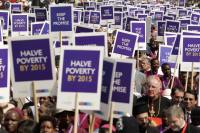
Today’s march on poverty – with church leaders at the front; Gordon Brown giving the sermon – overlooks an important point. Thanks to global capitalism, we are living in a golden age of poverty reduction: never in human history has the West’s wealth been shared more quickly with the developing world, and to such incredible effect. According to the World Bank, the number in extreme poverty has dropped from 40% in 1981 to 21% in 2001. Poverty has fallen most where capitalism has done best. That is why the bulk of the drop in world poverty is done by India and China. “China prices” mean cheap goods for us – but in China it means 400 million fewer people in poverty, according to the World Bank.

How Osborne should manage the budget

Reading George Osborne’s responses to Coffee House has made clearer my own advice to him: save money by decelerating NHS and education budget increases. Max out with rhetoric about “we will outspend Labour” and say “every penny of Brown’s spending will be locked in” etc. It will all be true. But simply increase at very low rates – 0.5% to 1% in real terms. By 2010, with unemployment and repossessions soaring, the public will be in the mood to hear that the government is also tightening its belt. Given that the NHS has so little to show for the doubling of its budget, it will hardly notice if it is on a 1% real growth trajectory rather than a 2% real growth trajectory. But the Treasury will certainly notice - in money left over.

Alan Johnson should save it for Brown

This must be the opposite of "rapid reaction". Some two weeks late, Labour is responding to David Cameron's speech in Glasgow. It is Alan Johnson who is trying to divine some clear, red water: "Before we evoke the Victorian notion of the deserving and undeserving poor we should take a moment to consider how complex these issues really are. Just as the government has a moral duty to tackle poverty and exclusion, so it also has a duty to address obesity. But this is not a licence to hector and lecture people on how they should spend their lives." Consider this for a moment. A Labour government whose leader has just finished telling the nation to eat up its leftovers now decides that it shouldn't boss people around.

The latest from Glasgow East

Conventional wisdom is that Labour will win by a small majority tomorrow in Glasgow East. But isn't a prediction of winning by a few hundred the equivalent of saying "too close to call"? A friend of mine, a former SNP by-election candidate, calls in with a few thoughts: 1. Word is that David Marshall had zero data on his voters, no canvass returns or anything. He took the seat so much for granted that he didn't need to. I can believe this - I have heard worse from Labour rotten boroughs where the party organisation has atrophied.  2. The SNP are apparently very pleased with their campaign - ie, even if they get spanked, they believe their organisation hit the mark. So if the election is a matter of differential turnout, the nats will win. 3.

The West needs to address the Pakistan problem

When I was in Afghanistan two months ago, I was told – with some pride – that no one had been killed by gunfire so far this year. It seems, alas, that the gun battles were delayed rather than cancelled. Today, the MoD has announced that a REME soldier, attached to the Paras, was killed – by a landmine, after coming under fire, taking the death toll to 111. Two other Paras were seriously wounded. My cover story for tomorrow’s magazine is about how the military believe the bombs, and many of the men they are fighting, are coming from the lawless Pakistan border territories. The Taliban operates with impunity in the town of Quetta in the Baluchistan area – and it was pretty much gifted the town by the Pakistani Army in 2002.

Don’t mention the Afghan–Pakistan war

At a recent dinner party in the British embassy in Kabul, one of the guests referred to ‘the Afghan-Pakistan war’. The rest of the table fell silent. This is the truth that dare not speak its name. Even mentioning it in private in the Afghan capital’s green zone is enough to solicit murmurs of disapproval. Few want to accept that the war is widening; that it now involves Pakistan, a country with an unstable government and nuclear weapons. But in fact the military commanders know that they are dealing with far more than just a domestic insurgency. Weapons, men and suicide bombers are flooding in from Pakistan every day. Like it or not, war is being waged on Afghanistan from Pakistan.

Resigning was the best thing David Marshall ever did for Glasgow East

As soon as David Marshall resigned as Glasgow East’s MP, everyone was looking for the “real” story. Unkind souls say that most MPs stay in office through invalidity so their families can receive the mammoth death-in-service payout (a lump sum of four times their pensionable salary, plus whatever their ill-health pension would have been – details here). Given there are (scandalously) zero requirements made of an MP – you can jet off to Barbados for four years after being elected if you want – it is possible for the infirm to be elected from their hospital beds. So an MP who stands down due to ill health (like Marshall) is, in effect, denying their family this huge lump sum. So should we not salute Marshall for his honest in not indulging in this scam?

The welfare Perestroika

What to make of James Purnell’s reforms? When I heard Neal Lawson from Compass on the radio this morning debating IDS, I thought that Purnell will be delighted: is this the toughest opposition he can get? The Campaign Group of socialist Labour MPs would always oppose him. In a way, it’s precisely what he wants. But what he may not be so please dabout is this statement just released from a group called America Works.

When did the moral crusade turn into a plateful of Brownies?

Gordon Brown must have been at his happiest in Opposition, delivering sermons about how Labour would deliver employment to cure the Tories’ wicked devil-take-the-hindmost approach. In launching the New Deal in Feb98, he had this to say: “Young people are our future. Yet unemployment among the under-25s is twice the national average”. It was true then. But the OECD data flagged up by David Willetts shows it is now a shameful four times the national average. Ten years ago, Brown called the unemployed young people “Major’s children.”  Major, of course, had a recession to contend with – last year, after a decade of growth, youth unemployment rose above the level Brown inherited. So whose children are the NEETS?

Breakfast briefing

Spotted: Alastair Campbell tucking into a full Scottish breakfast in the Crutherland House Hotel in East Kilbride – a mere 20 minutes drive from the Glasgow East constituency. Coincidence?

Four out of five drug addicts on welfare

A devastating report on how the state unwittingly bankrolls drug addiction, timed to come out with tomorrow’s Green Paper, can now be downloaded from the DWP website. I’m not sure if this is intentional or not, but there we go. It looks at addiction to opiates (heroin) or crack cocaine, the so called Problem Drug Users or PDUs. Until now, official figures show that just 400 people on Jobseekers Allowance were PDUs – just 0.05 percent. The new figures show the real figure is a scandalous 8 percent, or 66,000 souls. And that’s just JSA. Widen it to all out-of-work benefits and the number is a staggering 267,000 out of what the Home Office believes to be 332,000 PDUs.

A guide to Glasgow East

That wee film I presented about Glasgow East – just over 3 minutes long - is now up on YouTube (you can watch it after the jump), It’s based on my political column from a couple of weeks ago and was broadcast last Friday and commissioned by Robbie Gibb, editor of the BBC’s Daily Politics. The BBC team assembled a powerful collection of images, which tell their own story (just as well, as the narration is a bit dodgy). Here it is with my wee guide beneath. 1) Grey skies in the intro (0’40) – We shot this scene at the end, a race against the rain. We had to beg to get into a disused flat right at the top, which allowed the panoramic filming – and the chance to share a lift with heroin addicts.

The cross-party consensus on welfare reform echoes the Gingrich–Clinton revolution

The Conservatives are making about as much headway in next week’s Glasgow East by-election as they would on Mars. ‘I told one guy I was from the Conservative party,’ moans one shadow Cabinet member who was campaigning there. ‘He said, “Oh, aye. Where’s that happening then?’’’ Hatred would at least entail some kind of recognition. And yet the emerging Cameroon mission is precisely to help places like this — where the party is, quite literally, beneath contempt. The curse of Glasgow East is worklessness — not just its 6.7 per cent level of unemployment. For every unemployed person, there are seven other people on some other form of welfare dependency.

Going places on welfare

It is a red letter day for welfare reform. James Purnell's Green Paper, leaked today, is a clear, honest and robust approach to the scandal of Britain's 5.1m on benefits. I say in my political column in this week's magazine that it is so close to Chris Grayling's report (mainly because David Freud essentially wrote both parties' policies) that the Tories should accept it and wish Purnell well. This is precisely what Chris Grayling has done today, praising Purnell's bravery and pledging to support him. This is a breakthrough.   Bipartisan agreement is the condition for welfare reform. As I say in the column, this was true in Wisconsin in the 1980s and on the Federal level in the US with the Gingrich-Clinton co-operation.

Brown is not playing by the rules any more

The Scorched Earth policy has begun. The FT has a hugely significant story – that the Treasury is “working privately on plans to reform Gordon Brown’s fiscal rules” which would “initially allow for increased borrowing”. In the vernacular, Brown has realised that if the Tories win the next election the he is now spending with Cameron’s Gold Card – every by-election bribe, every union sellout will be funded by borrowing with the bill sent to D. Cameron Esq. Cameron will have to tax us to pay for what Brown is today spending. The Treasury is claiming that it was always going to “review” its 40% limit after the current economic cycle ends. It will struggle to find a single sentence in any speech that will corroborate that.

Will Labour’s welfare reform proposals cost it Glasgow East?

Has Glasgow East influenced the postponed 2p increase in fuel duty, as David Cameron implied today? I doubt it, for a depressing reason. The place is so poor that most households in that constituency – 59% to be precise – simply don’t have access to a car (let alone own one). For the record, here are the car ownership figures for some of the estates in Glasgow East (from the 2001 census). In Parkhead North, 77.2% have no car. In Easterhouse it’s 71%. In Banlanark, 71%. In Bridgeton, 64%.  I can understand why, in Westminster, they may have a vision of the motorists of Glasgow East punching the air in response to today’s news. But there is another area of government policy that matters more to the electors of Glasgow East.

A bumper pack of Brownies

Just as Mr Brown’s jokes are no laughing matter, you imagine his facts are not supposed to be taken seriously anymore either. His statistics go over the heads of the public and one almost tires of correcting them here. But as Simon Mayo mentioned CoffeeHouse on air on Five Live and our fondness for “Brownies” (a word, alas, he didn’t mention) here is a list of today’s top PMQs Brownies. 1. “We now have the second biggest defence budget in the world”. This dodgy figure is cooked up by looking at military spending in nominal terms – rather than adjusting for purchasing power parity (PPP).

Clegg shines at PMQs

I watched PMQs from the vantage point of Simon Mayo’s Radio Five studio today, with John Pienaar. We both scribble furiously during the PMQs – John has to select clips and present a narrative instantly. Now Cable has gone, only Cameron provides the jokes. And he was on especially good form today. John spotted that Cameron used the word “useless” three times. This must have been deliberate. I can easily imagine Andy Coulson in a meeting saying Brown’s main claim to fame is being dull-but-competent. Strip out competent, and you’re not left with much. “The Prime Minister has a nerve to accuse me of inconsistency,” said Cameron. “I said he was useless a year ago, and still think he is now.