Fraser Nelson

Fraser Nelson

Fraser Nelson is a Times columnist and a former editor of The Spectator.

Barclays took the right path

From our UK edition

The angry reaction to Barclays' decision to recapitalise using Middle Eastern money rather than a taxpayer bailout mystifies me. In my News of the World column today, I argue that Barclays may well become 30% Arab but its 100% correct. It has no duty to accept a UK taxpayer bailout over more expensive Arab money, as is widely suggested. Its duty, in fact, lies is in the reverse. A taxpayer bailout is supposed to be the last resort, preventing the banking system from collapse. I'm glad that John Varley, Barclays' chief executive, realises that even if some politicians do not. As Guido notes, Vince Cable has disgraced himself in claiming Barclays should have gone with the taxpayer.

Losing the war on drugs

From our UK edition

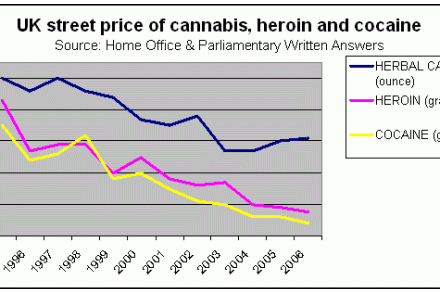
Are UK drugs seizures really going up? The Home Office said exactly this in a press release last week but closer inspection reveals the most extraordinary statistical manipulation, rumbled by my colleague at the Centre for Policy Studies, Kathy Gyngell, who blogs on it here. Here’s the scam. The Home Office boasts about “a record 186,028 drug seizures by police and HMRC… an increase of 15 per cent’”. Clear enough. What purports to be a statistical bulletin makes the case further, showing the steady rise of seizures going back years plus a handy graph showing this triumphant, latent surge. But what about the amounts seized? Here is where one smells a rat. There is no graph, no historical data – in fact, not even a figure for the previous years.

Politics | 1 November 2008

From our UK edition

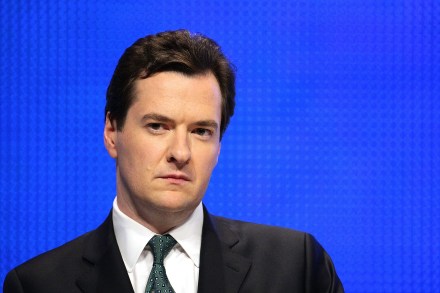
A nanosecond is easily measured in Westminster as the time between a politician’s hearing of a colleague’s impending resignation and wondering ‘What’s in it for me?’ It takes perhaps a full second to construct a theory as to why the unfortunate soul had it coming and probably deserved it. It takes about a minute to draw up a shortlist of potential successors, and half an hour to start some gentle plotting. Sympathy comes last, if at all. So for the few hours when George Osborne’s future was in doubt last week, the corridors and the urinals of Westminster were abuzz with versions of his political obituary.

The Illustrated Brown Bust: negative equity

From our UK edition

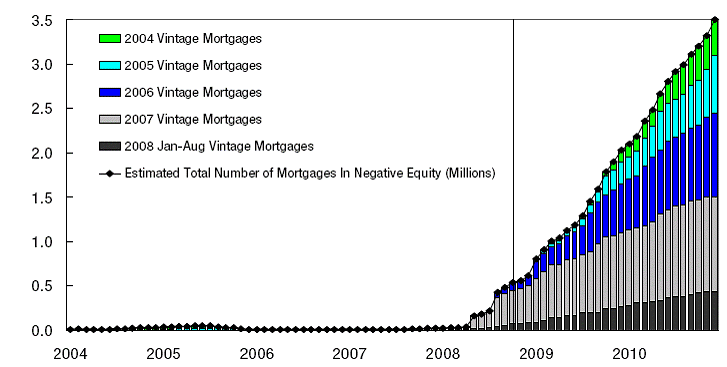
Estimated number of households in negative equity, 2003-10 If you’re a homeowner, turn away now. CoffeeHousers may remember recent reports of 1.2 million houses at risk of negative equity  – well, that may just be the start of a negative equity tsunami. This Citi graph, the latest in our occasional series, shows what would happen if prices do fall 30% as is widely expected. The left-hand scale is million, not per cent. It presumes 0.5m in negative equity now, rising above 3m – or one in four British households. As Michael Saunders from Citi says in his note: “These calculations are uncertain. But the key point is that, with house prices plunging, the numbers of households in negative equity will probably match or exceed the early 1990s peak of 1.8m.

A lack of clarity

From our UK edition

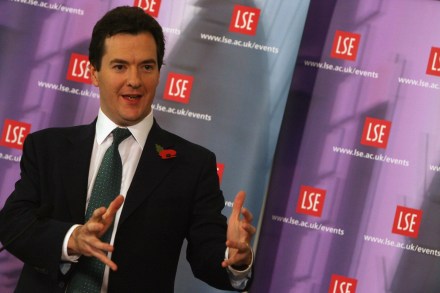
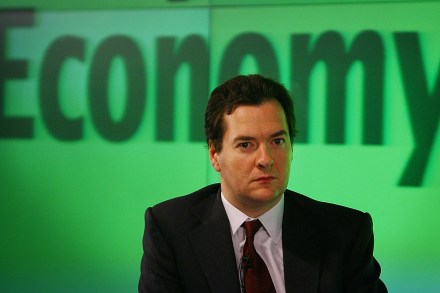
Like Darling’s Mais lecture, Osborne’s speech to the LSE was rather long with no discernable points of action. No matter how much you say the word “responsible” (ten times, in his case), it just doesn’t add up to a policy. First the good news – Osborne uses Japan as an example of Keynesian spending. That’s the right analogy. Next he says he will “help people directly by getting money into their pockets through the tax system” – ie, tax cuts. Great. They can be easily funded by scrapping government waste, or abolishing failing government programmes. But Osborne goes on to complicate the issue and his signoff is this: “There is now a clear choice in British politics.

Osborne needs to recast his policy for the new era

From our UK edition

Now that even Nigel Lawson says tax cuts are not the right way to go, why am I calling for them in my column? Lord Lawson did not issue a fatwa on all tax cuts, but warned against “massive tax cuts.” He is wary of so-called Keynesian fiscal activism – borrowing massively, to cut taxes. As am I. You can argue it’s better than Keynsian spending, but both still do more harm than good. I am arguing that the new era of deficits (I don’t expect we’ll see a balanced British budget for five years) need not lead the Tories to abandon tax cuts. They need a new argument for a new era. One could separate the eras into Before Crash (BC) and After the Downturn (AD). Osborne needs to realise the difference, and recast his policy.

Darling reads the last rites over the fiscal rules

From our UK edition

Alistair Darling has not set out a new fiscal framework in his much-delayed Mais lecture - but he has read the last rites over the so-called the financial rules. “To apply the fiscal rules in a rigid manner today would be perverse,” he says. Not to say impossible: the rules set a 40% limit on net debt and it was 43.4% last month. Instead there is assurance that “people should be in no doubt that Government will take the decisions necessary, to ensure sustainability in the medium term." George Osborne – back in action, and with a major speech planned on Friday – has released other Brown quotes which pledge his rules were always and forever.

PMQs verdict: Clegg gets the message right

From our UK edition

Finally, the right line from Prime Minister’s Questions – and it’s one that Gordon Brown will fear the most. “What people need now is more money in their pockets. He could deliver big tax cuts for people who desperately need help”. It was from Nick Clegg. You can argue – as I do –  that the Liberal Democrats’ proposed tax cut is paltry. But the rhetoric and positioning is precisely right. It’s a binary distinction: Brown trusts the state, and wants to spend his way out of a recession. Clegg is saying he trusts the British public, and wants to stimulate the economy by letting them keep more of their own money.

The debt contagion

From our UK edition

I was joking when I said a few weeks ago that Gordon Brown spoke about the recession as if it were the SARS virus. But at his press conference this morning, and just now at the press conference with Sarkozy, he has used a new phrase: "stop the contagion". Contagion? If it is, it was incubated in 11 Downing Street as he pumped the economy full of debt, in the hope that he'd never be found out and rates would not rise. The contagion kept touting dangerously underpriced debt until the average British household had borrowed 172 per cent of its income - twice as much as even the Italian household. The contagion from No11 also used debt-concealment mechanisms to disguise £110billion of PFI debt and £600 billion of public sector pension liabilities and even international aid.

Sloganeering | 28 October 2008

From our UK edition

Danny Finkelstein argues that I am not "precise" when I say that the Tories have been equating tax cuts to instability - and, as ever, he's right.  This is, happily, a historical argument as the Cameron project has evolved substantially since the first weeks when this "stability before tax cuts" slogan was implied. One does not hear it now, nor does one hear "sharing the proceeds of growth". But to plot the right course for future, the mistakes of the past need to be identified. I believe "stability before tax cuts" to be one of those mistakes, and here's why.   Political slogans are designed have two meanings: what they precisely mean, and what they practically convey. The latter is the more important.

A dynamic new approach for the Tories?

From our UK edition

The debate about taxes was successfully closed down by Gordon Brown when he persuaded the Tories to equate tax cuts with instability. Actually, even Brown didn’t go this far – this “instability” point was Oliver Letwin’s. Even now, when the disastrous effects of Brown’s economic policy are painfully clear, it’s still hard to get a debate going about an alternative approach. So it was with much excitement that I picked up Art Laffer’s latest book in New York last week – the sort of title you just don’t see in Britain. “The End of Prosperity: How Higher Taxes Will Doom the Economy -- If We Let it Happen”.

Brother, can you spare £130 billion?

From our UK edition

It’s funny to hear politicians solemnly talk about “debt-financing”, as if the cash comes down on a moonbeam from the lending gods. In truth, some poor souls have to buy the gilts the Treasury are flogging – and with what? Governments may well find it as hard as the rest of us to find creditors in this global downturn. Especially seeing as the Treasury is flogging a tanking pound, now tainted with the risk of Britain losing its AAA rating (unlikely, but so was the nationalisation of the banks). Consider the sheer scale of cash Brown wants from the City. In 2007/08 net gilt issuance was £29bn – bad enough, but that’s likely to more than treble to £100bn this year. So who will buy?

Sterling plummets on the back of Brown’s debt-fuelled economy

From our UK edition

The sterling crash has now begun in earnest. The pound has today (today!) fallen 9% against the Yen and is off 4% against the dollar to a lowly $1.56 with forecasts of $1.40 or lower next year. Against any other currency you may mention, it’s now plunging. The proximate cause is news that the UK economy is shrinking far faster than expected, and there's talk about a 0.75-point interest rate cut - sooner rather than later. But on a wider prospective, this is the markets commenting more articulately than the Tories on Gordon Brown’s “scorched earth” economic policy. It is becoming clearer that Britain is perhaps in the worst position of any developed economy in this crisis.

Woolas gagged – for now

From our UK edition

Phil Woolas has only been immigration minister a few weeks, and is already controversial enough a figure to be pulled from Question Time. A humiliation for him? I suspect his job is going completely to plan. His Times interview in which he called for the population to be capped at 70m looked part of a co-ordinated campaign, slated as it was ahead of his Politics Show and Question Time appearances. He is, it seems, being groomed to become less libidinous version of David Blunkett - a blunt speaker who occasionally ventures over the top. His job will be to say crazy stuff now and again, cause a stir, and in general give the impression that the government is tough on immigration. Blunkett would use words like “swamped” and then let the press go wild.

The true defenders of liberty

From our UK edition

In Uganda there is a law against annoying the president, and last night I met an incredible person who has been jailed 12 times for breaking that law. Andrew Mwenda, founder of The Independent newspaper, was giving the keynote address at The Bastiat Prize and asking why the West was so timid in defending free markets and the open society which people like him put their lives on the line to support. A crash isn’t a crisis of capitalism, he said, it’s a characteristic of capitalism – when banks err they are punished. Why do so few in the West make this point? I asked him later if he worries that next time he’s arrested it will be worse than just a night behind bars. I’ll never forget his response: “Yes, maybe.

Leaving the drama behind

From our UK edition

How bad are the Deripaska allegations for Osborne? At the very least, climbing on board that yacht raises questions over his judgement. But, as with so many Westminster scandals, all hangs on what more is to come. Labour will gun for him as hard as they can, knowing how important he is to Tory strategy. If nothing more emerges than what's in today's Times, he's okay. But if it turns out that he was part of some operation to solicit an illegal donation, he's finished. For my part, I can't believe he would be so stupid as to do this, or to take the view that what happens in Corfu stays in Corfu. Yet I hear reports of blind panic in CCHQ, and I have spoken to two MPs who wanted to discuss whether Hague or Clarke would be the better replacement. People are expecting fireworks.

Making Northern Rock disappear

From our UK edition

He’s done it. I blogged a while ago about how Gordon Brown lost his battle to have Northern Rock struck off the books, causing trouble for his oft-repeated Brownie that he has reduced debt from 43% to 37% of GDP. In August, the ONS showed National Debt was 43.3% - and had actually been at those levels for a year. So what was Brown to do? Last week, I reported a rumour that he’d ordered up a new debt series to exclude NR. I said something daft at the time, like “he couldn’t – could he?” Well, he did – and in fact he had by the time I blogged. There is now a new measure entitled “National Debt excluding Northern Rock,” code HF6W.

Is Cameron’s VAT plan legal?

From our UK edition

Much as though I applaud David Cameron’s plan to give struggling small companies a VAT holiday, a rather large obstacle occurs to me. Wouldn’t this be illegal under European Union law? The Sixth EU VAT Directive mandates all states to apply VAT the same way as long as the main rate is a minimum of 15% and the discounted rate at least 5%. Room for manoeuvre was tightened to almost zero two years ago in the EU Recast Sixth Directive. You don’t mess with this, as the Blair government found out when it lost its fight to grant companies the right to reclaim VAT spent on fuel. So how will Cameron play this? Perhaps it won’t be an issue for some reason – and if there are any CoffeeHousers who know why, I’d be grateful for clarification.

Politics | 18 October 2008

From our UK edition

Few would dispute that, in the last fortnight, Gordon Brown has shown why he has been a fixture for so long at the very apex of British politics. His economic model has imploded and his debt pyramid collapsed. The taxpayer is up to his neck to the tune of half a trillion pounds to clear up the mess left by the abject failure of the bank regulatory system Brown personally designed. He has taken Britain into recession, with property prices collapsing and unemployment soaring. And yet still the Prime Minister stands politically triumphant, comparing himself to Picasso and Churchill (among other giants) while soaking up the applause of Nobel laureates for his handling of the crisis. Lazarus only did it once. Gordon Brown has set new standards.

Where’s the contrast?

From our UK edition

I’ve read and re-read Cameron’s speech on the economy, hoping that I had somehow missed the radical message to answer Gordon Brown. I have given up. Britain is facing a tsunami of unemployment, two years of recession if we’re lucky and what do the Tories have to say? They’ll set up a new quango, and try to tinker with council tax. We had new phrases: instead of “irresponsible capitalism” we’re told there will be “responsible free enterprise”. His dreadful “social responsibility” phrase is making a comeback in the form of “economic responsibility” and remains just as vacuous as a concept. Much of the detail appears worryingly wrong-headed.