Fraser Nelson

Fraser Nelson

Fraser Nelson is a Times columnist and a former editor of The Spectator.

Harman’s cunning plan could hit her own side

From our UK edition

Harriet Harman, now 3-1 favourite to be the next Labour leader, has a cunning plan to shaft the Tories. For some time now, she has been badgering Brown to outlaw MPs having second jobs. As I disclose in my News of the World column today, the PM is now warming to it because he thinks Cameron would not support it, thus allowing him to draw another of his beloved dividing lines. It would also exploit Cameron's own sensitivities about the number of his shadow cabinet with second jobs. And, of course, underline her class war credentials to Labour's selectorate. There is, however, only one problem. By the time it would be made law, Labour will most likely be months away from opposition.

A recession that the green brigade can enjoy?

From our UK edition

The environmental lobby should be the happiest people in Britain right now. The more people laid off, and the poorer people become, the greener this country will get. All that nasty consumption, and economic growth: kaboom!  No more. Those Indians and East Asians who looked dangerously like they were about to upgrade from mud huts for houses, and to start to polluting by consuming - well, they'll be doing that a lot more slowly now. And the great unwashed British masses, who looked like they needed to be taxed out of the sky and off the roads - well, the recession will also take care of them. And the UK economy contracting by between 2% and 5% this year will do wonders for reducing our CO2 emmissions. See, the recession changes everything: the present, the past and the future.

Recessions compared

From our UK edition

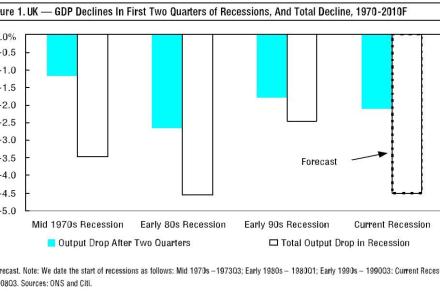
I’ve noticed that Gordon Brown has stopped bragging about how this recession is not as bad as 1990s. And with good reason. It’s far worse – and not just because unemployment and repossessions are rising more quickly. It’s summed up in a graph – and CoffeeHousers who are into this sort of thing may find it useful. It’s from CitiGroup, which warns that even the below picture for the current downturn is optimistic. Citi is now forecasting a 3.3% contraction of the economy this year – last month it was forecasting a 2.5% drop. It says in the note “Apologies for the frequent updates, but the economy is in freefall”. So is Britain well placed to handle the downturn?, I hand over to Michael Saunders from Citi when discussing the 3.

Politics | 24 January 2009

From our UK edition

Perhaps George Osborne regularly serves meatloaf at the powerbroking soirées he hosts at his west London house. But when this detail about the food served at his lunch with David Cameron and Kenneth Clarke was briefed to the press it did seem a bit odd. Perhaps the shadow chancellor suspected Kenneth Clarke would want something more substantial than guinea fowl and polenta. Perhaps Mr Osborne and his fellow strategists were keenly aware that this meal would inevitably take its place in Tory history: the moment when the two young modernisers sealed the deal with the old bruiser. The choice of meatloaf was apparently meant to send out an unambiguous message — that the prodigal Ken had returned, and that beef was back on the Tory front bench.

A transcript of half-truths, exaggerations and Brownies

From our UK edition

Many of you expect Gordon Brown to lie so much that it’s not worth reading a rebuttal of his half-truths, exaggerations and Brownies. Me, I’m addicted. And fascinated. He’s a very clever guy, whose excuses and fake narratives are carefully constructed. He’s also deeply unoriginal, so whatever new excuses he cooks up we can expect to hear repeated for the foreseeable future. How can explain away sterling’s plunge? The absence of any sign of economic recovery – and implicit suggestion that his stimulus has been an abject failure? And how can he explain his ten years as Chancellor? On the radio this morning Evan Davis started his interview with Gordon Brown by a warning that he wouldn’t take his waffling avoidance techniques.

Responding to LabourList

From our UK edition

Although it hasn't been going long, LabourList is already brightening up the blogosphere. They seem up for a genuine scrap, as opposed to the hysteria and name calling that the left often succumb to. It has challenged me to explain Alan Duncan's claim that Obama is in a better position to launch a debt-fuelled stimulus than Britain - suggesting I would be as rude to the Tories' new Shadow Leader of the House as I would be to Mr Brown. I'm not going to be. Duncan was right: America as a country owes about a quarter of what Britain does. And why do I say so? Here's the maths. 1) Labour List quotes the IMF to the effect that US net debt is 50.7% of GDP and Britain only 38.5% of GDP. Why, you might wonder, does LabourList use an annual IMF report for UK debt?

‘I read about my promotion in the Sun’

From our UK edition

When I met Chris Grayling last week, he was about the only member of the shadow cabinet who looked relaxed rather than as though he was nervously awaiting news of the reshuffle. His work on welfare reform had been hailed widely enough for him to feel secure. ‘I’d like to stay in this department. I’m enjoying this job,’ said the then shadow work and pensions secretary. ‘Of course, the job you do is always at the whim of the party leader. Should David Cameron phone up tomorrow and say, “Right, you’re doing something else” — then fine.’ A few days later, Mr Cameron did precisely this. So it is a slightly stunned Mr Grayling whom I meet again just after he has been promoted to shadow home secretary.

Britain to go the route of RBS?

From our UK edition

Britain is now as likely to go bust as RBS - this is the official verdict of the markets. At the bottom of this post is Bloomberg's Graph of the Day, which shows how Britain's dodgiest bank and Europe's dodgiest government now have the same "credit default swap" rating - the yardstick the markets use to guage whether something's about to go bust. No wonder, you may say, given that RBS is state-owned. But my point is that this has major implications for our ability to borrow - and borrowing is what both Cameron and Brown will be relying on to pay the bills. Spain lost its AAA rating yesterday, and the markets think Britain may be next. This would increase the cost of borrowing, our taxes, our mortgages - the works.

The markets tremble

From our UK edition

How's this for a frank assessment of the UK economy? "I would urge you to sell any sterling you might have. It’s finished. I hate to say it, but I would not put any money in the UK”. It's by Jim Rogers, who co-founded the Quantum Fund with George Soros. The markets agree with him - the pound is, again, off between 2% and 3% against major currencies (for the latest, click here). The market is beginning to get a handle on the sheer extent of the damage of Brown's policies - and, crucially, his inept banking regulation. UK banks (in particular, RBS) lent aggressively to everyone from dodgy Russians to leveraged buy-outs. Given that bank debts amount to 350% of GDP, the potential for calamity is clear.

The view from the front bench

From our UK edition

Ken Clarke walked back into the chamber to cheers as if he’d just won a by-election, itself an indication of how little we’ve seen from the man who took an MP's salary for the last 11 years but has seldom been seen around the House. It was his first time, ever, on an opposition front bench and he looked around at the view. Together with Cameron, he flanked Osborne. Clarke hasn’t worked out yet that his job is to make facial expressions of support when Osborne speaks, and to feign disdain at Darling. It’ll take a while to relearn the techniques of active politics. Osborne was on good form. How much of our money is Darling spending? We need to know. “They didn’t have a clue what they were buying, and didn’t bother to find out,” he said.

What does May’s promotion mean for the welfare reform agenda?

From our UK edition

For me, this reshuffle is blemished by the puzzling decision to make Theresa May shadow work and pensions secretary. Welfare reform is, by some margin, the toughest task in politics. If Cameron was genuinely planning to go through with it, he’d realise it would be his single most important departmental appointment. You’re talking about liberating millions of people from welfare dependency. You need someone with the knowledge and energy to engage in hand-to-hand combat with the system – as Milburn did on health and Adonis on city academies. It requires the most energetic, most aggressive and determined member of his team. That’s why Chris Grayling was such a good hire. He immersed himself in it, met the people, read the studies, did the grunt work himself.

Who’s got Brown?

From our UK edition

There’s a scene from Superman: The Movie which sums up the problem with the banking bailout. As the eponymous hero catches Lois Lane falling from a skyscraper, he says ‘Easy miss, I’ve got you’. She replies ‘You got me? Who’s got you?’ So it is with the Gordon Brown and the banks. The bailout plan is intended to insure them against the sorts of losses that will spook their creditors. Don’t forget, the banks have to borrow every penny they lend us. If no one will lend to them, the taxpayer will be forced to. Don’t worry, Brown will say to the banks, I’ve got you. But who has got him? The taxpayer is broke, too. Brown is raiding money from future generations, by doubling the national debt.

Ken Clarke is Shadow Business Secretary

From our UK edition

So it's official - Ken Clarke is back in a reshuffle to be announced tomorrow, replacing Alan Duncan as Shadow Business Secretary. Clarke promised to behave over a lunch with Cameron and Osborne yesterday. He apparently told them he does not accept the party line on Lisbon or the EPP, but will shut up about it and not try to change the party line. No moves in the top jobs (i.e. Hague and Gove staying put, as are Fox and Grayling), yet I hear there may be extensive reshuffling in the lower ranks. My initial take: 1. Cameron is taking a large gamble. Clarke has said precisely what he thought pretty much since 1994, and hasn't held back from sounding off over Europe when he felt like it.

Gangs of New Labour

From our UK edition

The game is up for Brown. Cameron's lead has doubled to 13 points, and that's even before he's got back in his stride.  It's fairly obvious what's going to happen next: Brown will cling on, fight, lose then quit. Perhaps he'll lose by a little, perhaps by a lot, but he's toast. Then Labour's fighting really begins. For my News of the World column I look at the jostling that's already taking place inside Labour. It has a long and proud history of tearing itself apart after losing power - and already you can see MPs getting into groups. Harriet Harman is playing the class war card, and I suspect that Brown didn't know or authorise that daft class-based idea of hers. It was designed to big her up on Labour's left, Polly Toynbee declaring it Labour's biggest idea for 11 years.

Politics | 17 January 2009

From our UK edition

David Cameron has long been keen for his shadow Cabinet to exude greater empathy with recession-struck Britain — and he has inadvertently succeeded in one important regard. Most are now fearful of losing their jobs. The coming reshuffle is being spoken of like a vicious redundancy plan that could claim any scalp at random. Frontbenchers anxiously read and decode newspaper stories — particularly for the latest word on Ken Clarke’s potential return and what that might mean. The suspense is agonising. Reshuffle speculation is normally a media game. This time, few shadow ministers have been able to wish each other happy new year without then discussing for whom, precisely, it will be most happy.

A song for the crunch

From our UK edition

It's bloody depressing being a columnist right now. The meltdown is easily the most important topic, but how many variants of this can you produce before readers give up? Or think they have read it all before?  I was going to give you the latest economic horror story of our L-shaped downturn but instead I'll give it a rest and you this song by Noel Coward. As Ayn Rand's Atlas Shrugged is a book for our times, so this is its song; it has been playing non-stop in my head these last few days. It pretty much sums everything up. Can CoffeeHousers think of an extra verse for the credit crunch?

Is Brown’s stimulus going to miss its domestic target?

From our UK edition

Will Gordon Brown's stimulus serve only to suck in more immigrants? The Prime Minister should ask himself this as he visits the London Olympic 2012 site - it's a classic example of the problem. Sure, there have been plenty of jobs created by the construction. But which English borough registered the biggest increase in National Insurance numbers to foreign nationals last year? Newham - where the site is based. A full 21,510 of them (Fig6, pdf) - and this is in a constituency where there are 32,800 working-aged people on benefits. As I argued in the News of the World last October, most of these have been claiming for five years or more. My point: you cannot understand the UK labour market without taking in immigration.

Improve Heathrow before expanding it

From our UK edition

If the Tories really didn’t want a third runway at Heathrow they should have called for one. That would have stopped Gordon Brown. He is only going ahead because he thinks it will draw a dividing line between the supposedly pro-business Labour and naïve tree-hugging Tories. And I confess that I started out being in favour of it, so fatuous were the environmental arguments against it. Farting cows produce more greenhouse gas than aircraft (or cars), as does rice production – and do we see Greenpeace activists campaigning outside Aberdeen Angus steakhouses or Chinese restaurants’? But the debacle over Terminal Five brought home to me a more important point. Britain needs and deserves a flagship airport, yet Heathrow is a national disgrace.

Brown fends off Cameron’s attacks – for now

From our UK edition

Another good day for Gordon Brown – not because anyone watching PMQs from the gallery would have been inspired (not even Lord Mandelson) but because he has so much to be guilty about and brushed a lot of it off. The highlight of this PMQs was about how the two party leaders use the recession as weapon, both testing the strength of their positions. Cameron started by asking if Brown was wrong to predict an end to boom and bust. As Brown is programmed never to admit error, this question will always leave him looking evasive. He responded, rather oddly, by listing countries he claims are not copying the Tory policy. “No one except him is proposing to cut public spending at this time.” A lie, of course, the Tories propose to increase it.

The truth about interest rates

From our UK edition

Now that Brown has copied the Tory proposal to underwrite bank loans, what's the real picture on interest rates? Since the UK debt crisis started, the Bank of England base rates have become woefully detached from the rates charged to real people. This is powerfully summarised by three graphs from Citi, which I reprint here.. Over last year, BoE base rates fell by three points. Only half of this fall was “passed on” by fixed-rate and variable mortgages, while the cost of borrowing money actually rose for overdrafts, credit cards and personal loans. As the graph shows: The most misery will be felt by those who have unsecured personal loans – ie, the poorest.