Fraser Nelson

Fraser Nelson

Fraser Nelson is a Times columnist and a former editor of The Spectator.

An important voice on African development

From our UK edition

Ever noticed how the debate on African development is colonised by white men? I've just finished a book on the subject by Dambisa Moyo, an African woman, and it's a brilliant indictment of the aid industry which, she agues, does more harm than good in her native continent. Moyo is Zambian born, bred and educated and has worked for the World Bank and then as an economist for Goldman Sachs. Her book, Dead Aid, argues that the $billions the West has ploughed into Africa have simply led to a new sort of corruption; have served in a disincentive to economic development; and are more geared to make politicians and pop stars feel good about themselves than actually help Africa transform itself as South East Asia has. Almost as striking as the book is the reaction to it.

Tracking taxpayers’ cash

From our UK edition

A long, long time ago, when it was still quite unlikely that the Conservatives would form the next government, George Osborne made a promise that, at the time, I thought he'd come to regret. He said a Tory administration would publish online every item of government expenditure over £25,000 - an idea from the Taxpayers' Alliance. Even they, I suspect, couldn't quite believe Osborne had taken such a low threshold rather than, say, £50k. Is this really doable? Well, a CoffeeHouser recently got in touch about this fantastic site from Missouri, where Missourians can track what their tax dollars are being spent on. This kind of accountability will have a transformitive effect on public spending.

When the state spends money, the money has to come from somewhere

From our UK edition

The Wall St Journal is a joy to read because it's a business newspaper which is also proudly free market (and explicit about its philosophy). In contrast, the FT leader column seems to think it is being all clever and counter-intuitive by bashing capitalism now and again, and applauding the more naive schemes of the government. So it's only in the WSJ that you have little reminders about what a stimulus is for, when it works and when it doesn't. And crucially why it's not the case (as Obama seemed to suggest in a speech on Thursday) that any government spending is good. As its editorial says today “A dollar doled out in jobless benefits may well be spent by the worker who receives it. That $1 of spending will count as economic activity and add to GDP.

Politics | 7 February 2009

From our UK edition

It takes more than an inch of snow to stop the wheels of Scottish democracy. The devolved parliament was hard at work on Monday morning, eight of its members engaged on a most sombre business: a motion formally denouncing a rogue political columnist.

Mirages in the desert of Darling’s misery

From our UK edition

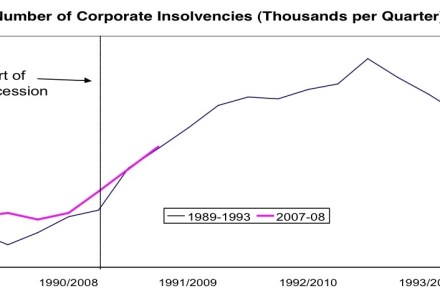
Today's Andy Davey cartoon in The Sun (click at the bottom of this link to see it) deserves to go on Darling's fridge. Because two more pieces of data have just come out which can be confused for good news. One is that personal insolvencies are at a lower level than 2006 and, next, that manufacturing prices rose 1.5% in January. Both are freakish mirages, in the desert of Darling's misery. The personal insolvencies in 2006 were pumped up artificially when new laws made it easier to declare yourself bust. The far more important indicator is company insolvencies, and they are especially worrying. They're up 55% to the highest level since 1994 - but, crucially, this is just the beginning.

The tragedy of welfare ghettoes

From our UK edition

So, Tom Harris and I had our duel on Radio Scotland this morning. His line of attack was straightforward: that when I said “scummy estates” – a charge for which I’m being denounced in the Scottish Parliament - I could only be referring to the people who lived in those estates. I thought back to the Easterhouse estate I visited a few months back in the Glasgow East by-election (see it for yourself – 2’20 into the YouTube video). There were dead rats in the landing, evidence of drug abuse, children playing around broken vodka bottles in the park, a pub boarded up like a Balkan arms stash to save it from attack, hallways which smell of stale urine. If Tom lived in such a place, I wonder how he'd describe it to his friends?

We shouldn’t ignore the poverty in our own country

From our UK edition

I am in the process of being formally denounced by the Scottish Parliament for remarks I made on CoffeeHouse last week - that Castlehouse and Easterhouse were "beautiful names, but scummy estates". An MSP named Charlie Gordon has found time in his busy schedule to table a motion against what he read on the blog. So far, it has 11 signatures.

Preparing for a schools revolution

From our UK edition

I'm at a seminar with David Cameron and Michael Gove on education reform, a favourite subject of ours here in Coffee House. Cameron’s pledge was unequivocal: “A great education reform bill will be a very big part of the first months of a Conservative government”. There are about two dozen people here to discuss what that will mean, a few Swedes, and many good points. Cameron stayed for about half an hour, yet even in that time some fascinating views were expressed. Two main themes: what Cameron is planning, and why it may not work.  Here are some of the points I've jotted down: 1. Gove says that in countries that do well, teaching is a high prestige job. In Singapore, only the top 30pc of graduates qualify as teachers he says.

The d-word heard round the world

From our UK edition

So how significant was Gordon Brown's claim in PMQs that the world is in a "depression?" Those accustomed to his word-mangling wrote it off as another verbal slip. But as Dizzy points out, the world's press were less sanguine. As a result No10 has spent much of the day trying to explain that we have a Prime Minister who mangles his words. And perhaps his slip was Freudian because it fits a trend. The other day, Stephen Timms, the Financial Secretary to the Treasury, told the Commons:  "Today, we are in a recession—the first to hit the UK since the early 1990s and face some of the harshest economic conditions for decades, and perhaps for a century." Worst in a century, Mr Timms, worse than the 1930s?  Even the worst-case scenario, a 5.

How Adam Smith predicted Gordon Brown

From our UK edition

So why was Wen Jiabao, the Chinese Prime Minister, carrying Adam Smith's Theory of Moral Sentiments in his bag when he came to see Gordon Brown? My hunch is that his aides found it contained a perfect description of the man he was about to meet. I reprint Smith's almost Nostradamus-style description here. This is Brown in a nutshell: The "man of system" is apt to be very wise in his own conceit; and is often so enamoured with the supposed beauty of his own ideal plan of government, that he cannot suffer the smallest deviation from any part of it. He goes on to establish it completely and in all its parts, without any regard either to the great interests, or to the strong prejudices which may oppose it.

The pitfalls of a minority government

From our UK edition

If anyone wants a taste of what Westminster would be like with a minority government, have a look at the fiasco in Holyrood. Alex Salmond's nationalists failed to pass their budget last week, so he threatened to resign and have an election (which is automatic, if no other party can form a majority). The Greens were bribing him, asking for £22 million for some home insulation scheme, then upping it to £33 million. As always with the PR system, the tail wags the dog. Salmond refused to play ball, the prospect of an election loomed, and a massive outbreak of political self-indulgence at a time when the devolved government has better things to do. A deal is now reportedly imminent - but the whole thing is shambles.

Cameron may throw like a girl but his education policy is transformative

From our UK edition

Oh the weather outside may be frightful, but David Cameron went ahead with his education speech today - a subject on which he doesn't say enough, in my view, because there is so much to say. The policy he had to launch was a Carol Vorderman-led maths review, but there were plenty of other aspects to his speech. Extracts below, with my take after:-   DC: We envisage academy status – with all the freedoms it brings to generate success freedoms which have been used brilliantly here will become the norm for state schools. These big structural changes are crucial if we’re to have the sort of revolutionary change I think is necessary to make our schools the best in the world.  FN: Cameron does not exaggerate when he says “revolutionary”.

Brown lays the ground for recession rage

From our UK edition

The prospect of a “British Jobs for British Workers” controversy will have haunted Gordon Brown long before he came up with the soundbite. He will have known, way before Fleet St did, that immigrants had taken (or created) 81 percent of British jobs. He'll have known - as he paid for the bills - that at least 5m Brits have been on various out-of-work benefits since 1997 despite his claim to have tackled unemployment. While morally deplorable, this situation was politically manageable as long as there were enough jobs for those who want them. But in a recession, when Brits start to compete with the 6.2m immigrants for these jobs, then it hits the fan. There is a basic political formula that works world over: mass unemployment + mass immigration = political explosion.

Scotland demonstrates the necessity of schools reform

From our UK edition

When Reform Scotland was set up, I feared for their prospects. Although Scotland was birthplace of the Enlightenment, its new parliament has failing strikingly to produce any new ideas. It has instead proved a reactionary force, priding itself in banning things before England does and using powers to reject reform introduced by Blair in England. So what chance do new ideas have? But Reform Scotland has today  produced a proposal that has set debate aflame: why not give a £10,000 schools voucher to parents from poor backgrounds? It's the subject of a BBC Radio Scotland phone in, which shows the paucity of the arguments on the other side. One is that private schools are just for the rich, who want their kids to mix with other posh kids.

How Brown’s stimulus will destroy jobs

From our UK edition

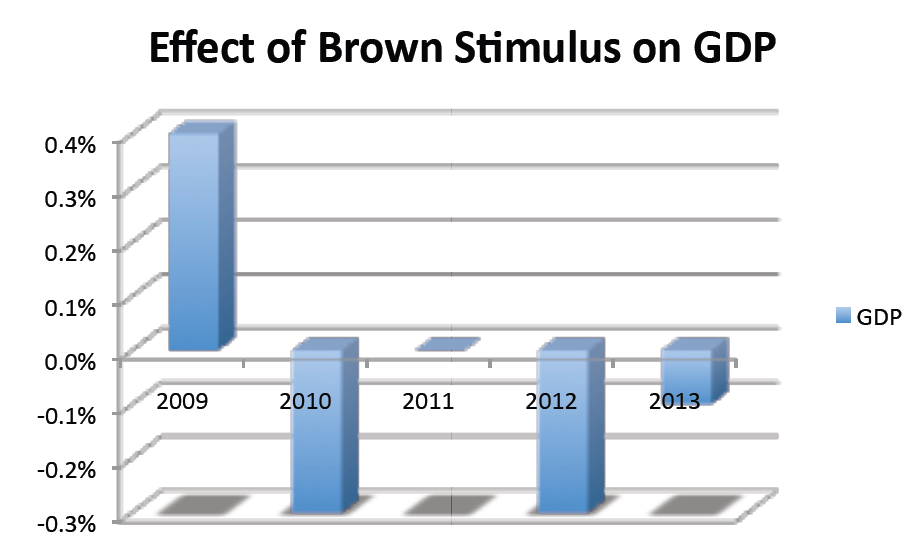
So what will the Brown stimulus actually do? Suspiciously, we’ve never been told. In America, Obama has shown the public what they’ll get for their money – how his stimulus would boost employment and the economy. Seeing as no one in Britain has done this exercise, we at The Spectator commissioned Oxford Economics, perhaps the best economic modelers in the country, to have a look. It ran the Brown stimulus, which we define as the various measures taken in the 2008 Pre-Budget Report, through their computers – and the resultant graphs are fascinating. Here's the first:   So, in year one, there’s an effect – but we pay for it everafter. This year, the stimulus package is expected to stem the fall in GDP by 0.

Obama all set to snub Brown?

From our UK edition

When someone says they "hope" to come to your party, it's normally a polite way of saying "forget it". And when Brown spoke to Obama on Friday, the president said he "hopes" to come to the G20 summit in London. (White House readout here). It wasn't a slipup. I called the Foreign Office who confirmed: it is yet undecided as to whether the G20 will be a finance ministers summit or a head of government one. The invites go out next week, and they may find out the week after. Maybe later. To treble check, I contacted the US Embassy in London - is the president coming to the G20? "As yet his attendance is unconfirmed" was the official reply.

The disgrace of the Lords is a parable for the end of New Labour

From our UK edition

Fraser Nelson says that the ‘cash for amendments’ scandal dramatises the accelerating decay of the Brown regime — economic, political, constitutional. A saga that began in 1997 with grand promises of reform is entering its last bleak phase Even at the ripe old age of 79, Lord Taylor of Blackburn knows how to strike a bargain. ‘Some companies that I work with will pay me £100,000 a year,’ he told the undercover reporter posing as a lobbyist. ‘That’s cheap for what I do for them.’ What he claimed to do for them was help mould the law of the land for a fee — all, he later insisted, following the rules. And thus the final curse descended on Gordon Brown.

Brown’s wrong-headed faith in inflation targeting

From our UK edition

"Why did nobody notice it?" asked the Queen a few months ago, at the LSE. The simplest answer is that inflation targeting was a disaster. People wrongly thought that if you controlled the prices, all else would follow. This was wrong, hopelessly wrong, calamitously wrong. Everyone gushed about what a great idea Bank of England independence was. In fact, monetary policy management in the last ten years was a disaster. Inflation targetting was a false god. And the fact that no one says so now is a sign of just how far we are from understanding what happened in the last ten years. As Friedman taught the world, controlling the supply of money is the key to stability. But the error was to think that inflation was a proxy for money supply.

The neglected war

From our UK edition

Anyone with vaguest interest in the war we’re fighting in Helmand should tune in next Sunday to Ross Kemp’s Return to Afghanistan. I went to a preview on Friday, and was most impressed. We’re told more about the war in Gaza than the one in Afghanistan, and what we do hear from Helmand is normally a staggered narrative of casualties. Kemp’s documentary has something different: it offers a vivid and utterly compelling journey into the lives of the soldiers fighting a fanatical enemy in an environment where the heat can be as deadly as bullets. And Sky has spent the time and money to tell the soldiers’ story. The power of the documentary lies in its fly-on-the-wall style: different things jump out at you, without the need for commentary.

Boris, getting the job done

From our UK edition

Channel Four has just released a striking exchange between Sir Ian Blair and Boris over the de Menezes case, released from Freedom of Information. Boris had gone on the radio to say that one could argue that the police had been "trigger happy" in Stockwell tube that Saturday morning. Sir Ian wrote to him saying this was "outrageous" and made out like Boris was making a general slur on the Met. BoJo had none of it saying it was "hard to think of any other description of a catastrophe in which a completely innocent man ends up with seven bullets in his head... If this man was thought to be a potential suicide bomber, why the hell was he allowed on two buses, and then down the Tube?