Fraser Nelson

Fraser Nelson

Fraser Nelson is a Times columnist and a former editor of The Spectator.

Here’s why so many people in this country are on welfare

From our UK edition

Why is it Left wing to allow millions to live on benefits, and let children get each other pregnant? Tom Harris asks this question in an excellent article in the Mail on Sunday today. He’s right to get angry about a situation that means one in five UK children are brought up in workless households, the highest in the EU. But the reason is not because our women are lazier than the French and Italians. In my News of the World column today I ask: why do so many choose welfare dependency as a lifestyle? Well, it is because we pay them to. To understand why Britain has such welfare dependency, look at the incentives. The horrible truth is that a girl leaving a British school with poor qualifications has a choice of career: work or pregnancy.

Politics | 7 March 2009

From our UK edition

If there is anything that can bring Gordon Brown a shred of comfort, it is that almost no one in the Labour party is now speculating about his future. There is no shortage of plotting in the bars, tearooms, corridors and urinals of the House of Commons. But what happens to the Prime Minister himself is a subject of negligible interest. He is universally expected to lose the next election and then be gone. Labour MPs are focused on a far more sombre matter: the coming battle not just for the party’s soul, but its very survival. This is the key to understanding a run of political stories that might otherwise be baffling. Why is Lord Mandelson so brazenly insistent on privatising the Post Office but nationalising banks?

Osborne’s growth agenda

From our UK edition

Whether the Conservatives like it or not, their agenda in government will be the "more for less" agenda. That is, having to cut public spending and find ways to improve services at the same time. This is far from impossible: after all, Labour has proven in the last 12 years that you can virtually double the money and have worse services. To achieve the reverse, all you need is public service reform—to do what Blair talked about in his final years in the job. George Osbrone has put the reform agenda at the centre of his speech on the economy today. He says:- "We need a new model of growth. We need to change from an economy built on debt to an economy powered by savings and real returns on effort.

Why Brown was so desperate to release those dodgy knife crime numbers

From our UK edition

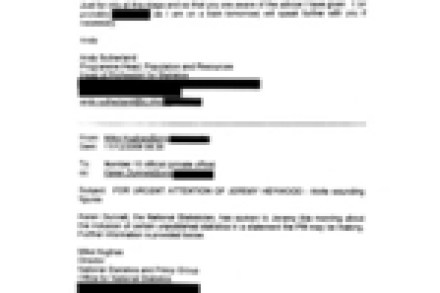
For those who love email trails, the Public Administration Select Committee has served up a feast - the emails flying around when Brown released premature knife crime figures last December. You can read the full trail here, Email Trail PDF . From my reading, it seems that the decision to use unready statistics came straight from Gordon Brown himself.  The only No10 official named in the email trail is Dr Matt Cavanagh, who is the very opposite of a Campbell-style No10 praetorian spinner.

The Bank can’t print a way out

From our UK edition

Today's latest move from the Bank of England is straight from the Dale Winton school of economics: the team (ie, the Monetary Policy Committee) has been given £75 billion to spend in just three months. How will they manage? Time starts... now! Although plenty predicted today's announcement that Quantitative Easing will now be started few predicted the scale - £150 billion "maximum". The MPC's decision to spend half of it in 90 days makes the whole exercise into some kind of fiscal Supermarket Sweep. "It is likely that the majority of the overall purchases by value over the next three months will be of gilts" says the Bank of England - handy, that, seeing as Brown has so much debt to issue. They are now out of ammo on the monetary side, having halved base rates to 0.

House prices have a lot further to fall

From our UK edition

If you own property, look away now because what follows is ugly reading. Those green shoots Margaret Beckett thought she saw in the property market were illusory, and the 2.0 percent upswing in house prices that Halifax recorded for January has been more than offset with a 2.3 percent fall last month. So far they are down 20 percent from their peak, and it won’t get any better. Sure, mortgage rates are falling – but banks are wisely demanding huge deposits now. So the actual cost of getting into the market - ie, he deposit required as a share of average income - is the highest since data began 35 years ago.

PMQs: an instalment of the Labour leadership battle

From our UK edition

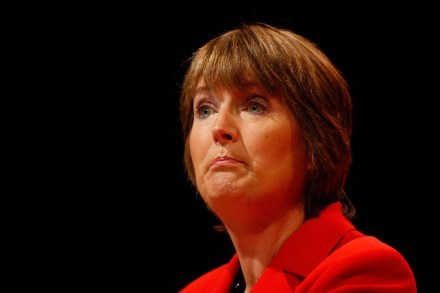
Given that Harriet Harman is the bookies favourite to be Labour leader, it was actually worth tuning in to PMQs today. The Labour leadership contest is well underway, and these few moments at the dispatch box will be crucial for the Flower of the Aristocracy* to set out her stall, with David Miliband sat next to her and looking resentfully on. Hague went on the working capital scheme not working – but with Hague you know there’s a gag waiting. Out it came on the fourth question. She should step up to the plate, he said. When Chamberlain stumbled, Churchill came forward. The Commons mentally held the comparison for a moment, and Miliband made no attempt to conceal his relish. When Eden crossed the Atlantic, Hague continued, Supermac made his move.

Brown gets his Oval Office moment

From our UK edition

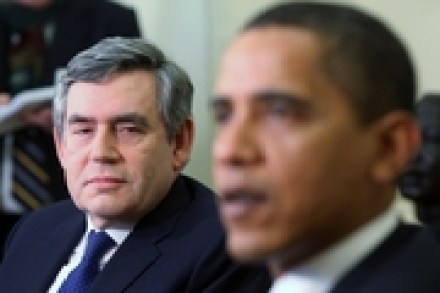
Well, after all that, it's over. Brown looked like a groupie that had just been invited on stage as he sat in the Oval Office beaming from ear to ear beside the Messiah. It was a very different outcome to that he imagined: there was no podium to speak at, no formal press conference, no toothpaste sharing, none of the formalities that have been extended to Tony Blair. Brown was on the same losers chair that the soon-to-be-ex-Japanese PM was on last month. Photographers were invited in, then a handful of journalists took questions from behind the sofa. Brown then grew perhaps a little to excited, referring to the President as "Barack". Strange move, given what sticklers for titles they are in Washington. The informality that was not reciprocated, Obama referred to "Prime Minister Brown".

Brown visit unravels

From our UK edition

Oh dear. Gordon Brown has landed in Washington to discover that there is to be no joint press conference with Barack Obama, none of the treatment that Bush, Clinton and Bush routinely gave visiting British Prime Ministers. Just a 30-minute chat and a couple of questions probably sitting on some chairs. To the frustration of No10, it seems that the Obama White House has its own protocol. When doomed leaders come to visit, such as Taro Aso of Japan and Gordon Brown of Britain, all they will get is a quick photocall. So what does this mean?

The Spectator Inquiry: Questions for the man who saw the crash coming

From our UK edition

After Lord Lawson (whom I interviewed last week – answers to your questions will be posted soon) the next ‘expert witness’ for The Spectator’s wiki-inquiry into the recession is William White. His name is spoken with reverential tones by those who know of him, because he was for years warning about precisely this kind of blow-up.   When he was chief economist at the Bank of International Settlements from 1995 to 2008, it was his job to advise the world’s central banks. He was warning for years about the precise nature of this bubble, and wrote various papers – arguing, for example, that inflation targeting was dangerous because it rendered policymakers blind to the asset bubble which he felt was about to explode.

Debtspotting

From our UK edition

There is a great deal of wisdom in Trainspotting (the book, much more so than the film) not least in its points about the dangers of leverage. When Renton comes to London he is deeply suspicious at the supposed wealth of those he meets. "Ah've known schemie-junkies in Edinburgh wi a healthier asset-tae-debt ratio then some two-waged, heavily-mortgaged couples doon here," he observes. "It'll hit the fan one day. There are a sack load ay repossession orders in the post." And so it was to prove. There are now 1.2m people in negative equity, about 10 per cent of all mortgage holders according to modest estimates by Michael Saunders of CitiGroup. If house prices fall another 10% then, staggeringly, a quarter of all mortgage holders will be in negative equity.

Brown’s on the world stage, but his audience may not listen

From our UK edition

Brace yourselves. For the next few weeks, we will be witnessing Gordon Brown's attempt to have us believe he is saving the world again, brokering a new global deal for the recession. As Chancellor, he loved to promote global plans. Two are worth mentioning.  One was to persuade the IMF to sell its gold as he had done, when the price was about $275 an ounce (it's now around $950). The other was for governments to adopt one of the the debt concealment tactics invented by investment banks, securitisation, and use it for African aid. His plan: participating nations would jointly take out a multi-billion dollar debt pile, and saddle their successors with repayments for the next 30 years. But they'd spend the cash instantly, taking credit for it.

They wish we all could be Californian: the new Tory plan

From our UK edition

Once every fortnight or so, David Cameron’s chief strategist lands at San Francisco airport and returns to his own version of Paradise. Steve Hilton has spent just six months living in this self-imposed exile — but his friends joke that, inside his head, he has always been in California. Look at it this way: this is the place on Earth which fuses everything the Cameroons most like in life, where hard-headed businessmen drink fruit smoothies and walk around in recycled trainers. It is where a dynamic economy meets the family-friendly workplace. And it is here, to an extent that is greatly underestimated, that the Conservative government-in-waiting is looking to find a new blueprint for Britain.

Politics | 28 February 2009

From our UK edition

The name Michael Ashcroft is spat out like a curse whenever it is uttered on the Labour benches. David Cameron may be an annoyingly effective enemy, George Osborne a tricksy strategist — but there is something about Lord Ashcroft that has earned him a special place in Labour demonology. This is why last week’s decision by the Electoral Commission to investigate donations made by one of His Lordship’s companies is being quietly celebrated as a breakthrough that could finally torpedo the engine room of David Cameron’s electoral operation. A substantial bounty is at stake. Some £4.

A bonfire of taxpayers’ cash

From our UK edition

And what, exactly, is the point of this mind-blowingly large bank insurance scheme? I haven't blogged on this so far as it just leaves you numb: as Charles Moore says in his Notebook in this week's magazine, you just stop reacting. Another £300bn? A £10bn loss from Lloyds/HBOS - and that's our problem now? Or is it? Whatever, Mr Brown. The taxpayer has endured so much pain that the new blows don't register. Our nervous system is already in ruins. Billion is the new million. Trillion seems a made-up word, although it's popping up with greater frequency. The next in line is quadrillion, which sounds like some kind of a 1980s boy band. But what is unnerving  me is the absence of any scrutiny, or strategy.

King’s blame game

From our UK edition

Mervyn King was doling out blame at the Treasury Select Committee today - while insisting there was nothing, at all, anywhere that the Bank of England could have done differently. He dumped on Brown, saying that Britain entered the recession "with a pubic deficit that was too high" so leaving less room for a meaningful splurge. I add in parenthesis that of the idea of borrowing in a boom would have appalled Keynes: this is why Brown's claims to be following Keynes now ring hollow. King also blamed the regulators, the banks - everyone, except the Old Lady of Threadneedle Street..

Our condolences

From our UK edition

The tragic news of Ivan Cameron's death broke this morning, and all of us at The Spectator offer our deepest, heartfelt condolences to David and Samantha. It is impossible to imagine what they have come through so far, and what they are feeling now. It one of those moments where there is nothing more to say, apart from to offer our sympathy and prayers.

Spectator Inquiry: questions for Lord Lawson | 24 February 2009

From our UK edition

Thanks for your suggestions on what to ask Lord Lawson, who will be the first ‘expert witness’ on our wiki-inquiry into the recession. The premise behind this whole exercise is that we can, with the internet, harness your collective wisdom – and take this inquiry in directions it couldn’t go on its own (or if powered solely by journalists). Here is a long list of questions for him, which we’ll hone down later. All other thoughts gratefully received. 1. If you were Chancellor the day before Northern Rock went bust, how would you have handled the situation? Granted, you wouldn’t have started from here. But did the banks have to be nationalised, as they were? 2.

Spectator Inquiry: questions for Lord Lawson

From our UK edition

It is a great pleasure to say that Lord Lawson of Blaby will be our first 'expert witness' for The Spectator's wiki-inquiry into the recession. As a former Chancellor and editor of the magazine, it's a tremendous way to start and we'd like your thoughts on what to ask him. Our inquiry is not intended as witch hunt, more to identify what went wrong and how to fix it. He is of a generation of Tory radicals who saved the economy the first time around - and I, for one, am keen to find out what he thinks went wrong. Did he think inflation targeting was too narrow a remit for the MPC? Does he think the banks should have been regulated more? Did he see any warning signs, or was he caught by surprise as so many others were? And does he think state spending needs to be cut?

Jade Goody’s dying wish indicts our failing education system

From our UK edition

Jade Goody got married today, and I can well imagine what CoffeeHousers think of the hullabaloo. In her defence, I’d say that she’s done more to promote awareness of cervical cancer than the last ten years of government initiatives put together – screening is up 20%. And the cash she's getting? Sure – but this is my main point. She’ll put it in a fund to educate her sons. “I know I'm ignorant, but I'm going to make sure my boys are not,” she says. She means, of course, send them private – and the fact that no one questions her logic is a powerful comment on the country we live in. The Finns or Dutch would find it incomprehensible that a mother’s dying wish is for her children to avoid the state education system.