Fraser Nelson

Fraser Nelson

Fraser Nelson is a Times columnist and a former editor of The Spectator.

Cameron’s licence fee cut – and how he’ll pay for it

From our UK edition

All hail, Jeremy Hunt, the axe man. Cameron’s first tax cut will be a licence fee cut* – and Hunt is planning to axe some stations to pay for it.  Hunt is thinking of axing 1Extra, apparently, with BBC3 and BBC4 already under threat. Also under Hunt’s axe would be the National Lottery’s runnng costs. The Sunday Times apparently has the details tomorrow, but I give Hunt this warning: if he even tiptoes in the direction of Cbebbies then he will have a revolution on his hands. Parents depend on it now, utterly. Personally, I’d pay £100 a year just for it – just for its kid-sedating powers. But it makes you think: digital television does allow a subscription model and the BBC could well spin off many of these channels.

In answer to your questions

From our UK edition

So, what is The Spectator coming to? Dishing out trophies to Harman and all these Labour types? Has the editor's chair made me crawl up to people like Harman and Darling? Am I angling for a political seat? The comments to my earlier blog post raise some excellent points - about politics, polemic and The Spectator itself. I thought they deserved a response in a post rather than a comment. The Spectator's tradition of honouring talent on all sides of the political divide in its annual awards is a long one:  La Harman was our 24th Parliamentarian of the Year. While Harman was speaking, Boris and I were holding her trophy and looking at the names that hers would be engaved next to.

Why Harman won

From our UK edition

Harriet Harman as the Spectator/Threadneedle parliamentarian of the year? When the judging panel started our deliberations, we had no idea we’d end up giving the top laurels to Harperson and Mandelson. Well, Mandelson as politician of the year was a no-brainer: you don’t need an explanation. He just is. He took over a government single-handedly. But Harman? I bow to no one (except Rod Liddle) in my hostility to her equalities agenda. But her critics must admit that a) she actually has an agenda, unlike so many of her colleagues b) she advances her agenda powerfully, as she did every day with her displays of political pyrotechnics when she stood in for Gordon Brown and c) she has moulded her agenda into legislation in the form of the Equalities Bill.

How the Tories can still win in Europe

From our UK edition

A week after David Cameron ruled out a referendum on the Lisbon Treaty, hardly a squeak of protest has been heard from Eurosceptics in his party. It’s not because they have accepted defeat, says Fraser Nelson, but because they are deadly serious about victory Anyone who believed last week’s talk of the death of Tory Euroscepticism should have booked a table at Bellamy’s restaurant in Mayfair on Monday. There, the No Turning Back group of Tories had gathered to discuss tactics, and how to continue the fight after the ratification of the Lisbon Treaty. They had also come to discuss what to make of David Cameron’s new European agenda. Was it sincere, or a decoy? Should they press for a referendum?

The pressure’s on Osborne

From our UK edition

The Times tempted fate today with its splash boasting about the confidence and the strong pound. Fitch Ratings has today said that Britain’s AAA debt rating is more at risk than that of any other major nation because it needs “the largest budget adjustment” - ie, the most cuts - because Britain has the largest fiscal mess, and by some margin. (Sterling is off today on the news). But then Fitch says, more or less, that it’s banking on George Osborne’s first budget to sort the mess out. “Our stable rating outlook reflected our expectation that the U.K. government will articulate a stronger fiscal consolidation program next year.” The Conservatives should be proud of that verdict, but also anxious.

Rank desperation

From our UK edition

Gordon Brown’s suggestion for a Tobin tax would, if implemented, crucify the City of London. We are the largest foreign exchange centre in the world and that Brown is seriously suggesting hitting this industry is a sure sign he does not expect to be in government after the election. It is the proposal that a British prime Minister should be dying in a ditch to kill off given that the City generates about a tenth of Britain’s economic wealth. The kind of proposal that might be aired by a Frenchman, purely to outrage Britain. It is, of course, a trick: Brown knows it won’t be agreed because it requires the approval of every major currency-trading country – and that will never be secured.

Labour and the KGB

From our UK edition

How close were Labour and the Soviets during the cold war? At the time, many newspapers were on the hunt for links - but allegations were hard to prove. Today, the Spectator tells the story from the horse's mouth - Anatoly Chernyaev, the Kremlin's link man with Labour in the 70s and 80s. Unbeknown to his visitors - Michael Foot (who welcomed Brezhnev as 'comrade') and even Charles Clarke (who comes out of this quite well) Chernyaev was keeping a diary. It shows how various Labour visitors begged for help - after all, Labour and the Soviets had a common enemy: the Conservatives. They said so in terms. Edward Short, as Harold Wilson's deputy, said: "if you, the Communist party of the Soviet Union, want a Labour government in Britain then help us". It goes on like this.

There is only one question that frightens Brussels

From our UK edition

So David Cameron will let it rest there after all.  And in fairness to him, he can do nothing else. Thanks to the Blair/Brown stitch up, Britain has no options left. It never did. Cameron knows that and today’s speech was just a longwinded way of saying it. He is right not to promise what he calls a “made-up referendum”, that would accomplish nothing other then vent rage. But nor should he kid us all that he is going to renegotiate some powers back from Brussels. That would need the unanimous approval of all other member states, and it would never be granted. If Britain were to repatriate powers, then who would ask next? Where would it stop? The post-Lisbon EU is more powerful, bullying (as we saw with Ireland and Czechs) and it will refuse any request Cameron makes.

Miliband, Sting, Marr and breakfast

From our UK edition

I'm midway through the Andrew Marr show - did the papers and am going back on in a bit to nod appreciatively at Sting - and the main topic is Miliband as EU Foreign Secretary. That Banana boy is being spoken of is not a compliment. The person they want in that job will be a cipher who will obey the orders of the ministers and visit cities that only Robin Cook* would have heard of. But it wil keep him out of the running to challenge Ed Balls for the Labour party leadership. Sting is banging on about how "we need the winter" and it is somehow under threat from global warming. The pity is that this nonsense can stop a guy buying his album. But it does sound quite good  - we heard him rehearsing. Anyway, I wonder if I will be next to Harman?

Learning to let go of the police

From our UK edition

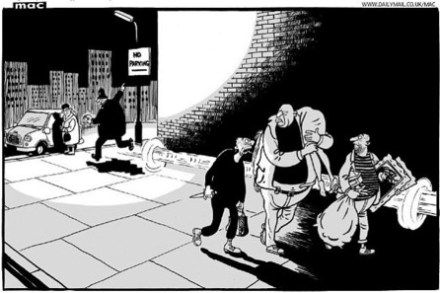
Today's Mac cartoon in the Daily Mail is, for me, a cut out and keep. It epitomises everything that has gone wrong with policing in Britain - a copper running past thieves to nick an old lady who has wrongly parked. And it touches on a wider theme: this is why regard for the police has fallen in the last dozen years. Their priorities seem to have switched from those of the public to those of the bureaucratic elite. This impression is, of course, deeply damaging and will be tough for the Tories to reverse. The plan for directly elected police chiefs, and Nick Herbert's seminal work on the subject, did seem to make sense to me. But not much has been said about it since. The Tories are, of course, in two minds about it.

Debating Aids

From our UK edition

Is it legitimate to discuss the strength of the link between HIV and Aids? It’s one of these hugely emotive subjects, with a fairly strong and vociferous lobby saying that any open discussion is deplorable and tantamount to Aids denialism. Whenever any debate hits this level, I get deeply suspicious. Which is why the below clip – from a documentary which The Spectator Events division is screening next week, called House of Numbers – aroused my interest. The film picked up awards at various American film festivals, but has since been denounced as backing Aids denialism. Yet the footage shows Luc Montagnier – who won a Nobel prize last year for his work on Aids – saying that many HIV infections can be shrugged off by a healthy immune system.

EXCLUSIVE: What was said in Question Time

From our UK edition

First question on the Second World War. Is it fair BNP hijacked Churchill? Straw says in the war Britain defeated a party based on race like the BNP. The BNP defines itself by race - that distinguishes it from every other party. All other parties have a moral compass. Nazism didn't and neither does the BNP. We only won the First and Second World War because we were joined by millions of black and Asian people. Applause. Griffin then counters by saying Churchill would have been in BNP. He described Churchill as Islamaphobic by today's standards. "The government is giving up on British freedom," said Griffin. An audience member says the BNP are an absolute disgrace. For just one minute think of the benefits black people people have brought to the UK. "You are trying to poison politics.

Word from inside Question Time: Griffin “humiliated”

From our UK edition

The first results from Question Time are landing. An audience member has just told me that Griffin  was "humiliated by the whole panel". All of them "did well", I am told. And  Jack straw accused him of being the Dr Strangelove of UK politics: a fantasing conspiracy theorist.

Griffin has achieved exactly what he hoped to

From our UK edition

As far as the BNP is concerned, Nick Griffin has already won this Question Time debate. It’s not about whether he does badly or well – he simply wins from the publicity. He’s been on Channel Four news, got an interview in today’s Times, all will be splashed all across the tabloids tomorrow – and that’s before we consider the Question Time slot itself. Then, he will win because, as we emphasise in the leader of this week’s magazine, millions watch Question Time. For every 50 people who think he disgraced himself, there may be only one person who thinks he might have a point. But, for Griffin, that will be enough. To compound the issue, the panel are pitching themselves at the different audiences.

Welcome to London

From our UK edition

Visitors to London are now given an extra special welcome when they arrive at our stations, thanks to the Metropolitan Police’s latest advert (pictured). It is advising commuters that, if they hide a gun for someone else, they will go to prison too. That’s told ‘em.   But when I walked past, I did wonder what effect this has on our capital’s image. Sure, the homicide rate is now statistically worse in Lambeth, where there have been 12 homicides so far this year, than it is in the Bronx's notorious 52nd precinct, where there have been 6. And gun crime continues to rise sharply in the capital.

Current Tory health plans are backward-looking and reactionary

From our UK edition

I have long been depressed about Tory health policy, or lack thereof. The News of the World today does a head-to-head about whether Andy Burnham or Andrew Lansley would be better to run the NHS – and I give my verdict.  The answer, I say, is neither of them. The patient should become the consumer, as is the case in the healthcare system of every developed country. But this would require taking on the NHS establishment, which no party is committed to doing. Or, rather, Alan Milburn was committed to – and had actually started to enact. But that reform agenda came under attack from the Brownites and Andrew Lansley. The Tory health policy, as it stands, defies understanding.

The horror story of the BNP’s success is not over

From our UK edition

Up to now, MEPs can use Westminster’s facilities; but, yesterday, Nick Brown tabled a deplorable motion in the House of Commons - to ban Nick Griffin from parliament. Just in case there were any doubt, Andrew Dismore spelled it out, saying Brown's motion would "mean that the newly elected British National Party members would not be allowed to get into this place. Most Members are of the view that that should be the case." I bet they are. But why? Whose fault is it that Griffin was elected in the first place? As I argued in the News of the World a while ago: if I had my way, I'd base Griffin in Westminster so MPs would see his smug face walking past them every day.

Introducing Mark Bathgate

From our UK edition

I was at the Editorial Intelligence Comment awards this morning, where the Cultural Commentator of the Year, Johann Hari of The Independent, said that all commentators are only as good as their sources – the people who have the honesty and energy to bash you when you’re wrong, and give you tips so that you might one day get something right. It’s an excellent point. And today, I’d like to introduce CoffeeHousers to one of my most dependable informers: Mark Bathgate, a banking analyst who has agreed to write a few posts for us on economics (which I can’t do as much now that I’ve moved back of the shop).

The politics of growth

From our UK edition

One strange side-effect of the car crash that was the Liberal Democrat conference is that no one dares say the word “cuts” anymore. Since Nick Clegg promised “savage cuts” – alarming his base in the process – we’re back to the normal euphemism of “efficiencies”. This, like so much in life, will have Gordon Brown hopping mad. He didn’t want to say “cuts” in the first place, and the whole farrago will prove (in his head) that he should stop taking advice from people outside his coterie.   The next stage in the debate is to focus on growth. As James revealed in his political column for the current edition of the magazine, the Tory plan to do this is an aggressive cut in corporation tax.

Brown’s double hit

From our UK edition

What is the true price of Gordon Brown’s economic incompetence and inept bank regulation? The soaring national debt is one. And if you own a mortgage, you’ll find that you’re paying another. The gulf between the Bank of England base rate and the average mortgage rate is now at a huge high – as banks rip off their customers, trying to fill the hole in their balance sheets. This is an under-discussed topic. The “action we have taken” (a phrase Brown uses to try to lay claim to the Bank of England’s base rate reduction) would have a far greater effect on the economy if the UK banking system was not (still) so badly broken. The below graph, from Citi, shows spreads (ie, gap between base rate and retail rate) on key UK mortgages from 1995.