Fraser Nelson

Fraser Nelson

Fraser Nelson is a Times columnist and a former editor of The Spectator.

Gordon Brown’s one and only legacy

From our UK edition

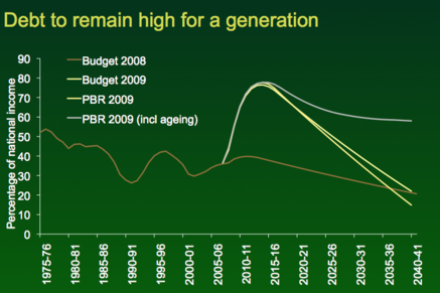
I will sign off tonight with this sickening graph from the earlier IFS presentation – showing the extent to which Gordon Brown’s economic incompetence has transformed the public finances for a generation. Servicing this debt will absorb money that would otherwise be spent creating jobs, lifting people out of poverty, advancing education, promoting prosperity. The leading article in the magazine this week finishes with these words, which came to mind when I saw the above graph: “It will be no surprise if UK public debt has been downgraded by the election; if so, a gilt buyers’ strike will become more than a theoretical possibility. The new government will face a Sisyphian financial task, so formidable as to make almost every other issue of the day look trivial.

Those hidden cuts in full

From our UK edition

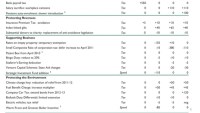
The truth about the Pre-Budget Report was revealed today by the Institute for Fiscal Studies: the new National Insurance tax will hit everyone on £14k or over, not £20k - and there are implied 19 per cent cuts of some £40 billion in the “non-protected” areas. The event was sold out, because it now has the reputation as the only place you learn the truth about Budgets passed by this government. Yet again, Gemma Tetlow from the IFS has unearthed the cuts which the Chancellor felt he had to conceal from the public (and – unwittingly, I hope - lied about this morning on the radio).

The end of spending

From our UK edition

So Alistair Darling today repeated the same trick he used in April’s Budget – referring only to rising “current spending”, so as to hide the full extent of Labour’s spending cuts. Current spending is only one component of total spending, and when you add in some of the other components – as we have done in the table below – the cuts become clearer. The table shows that next year is the last year of any real rise in spending. From 2011, spending either falls or flattens out. But the cuts will be even deeper than the table reveals.  This “total spending” figure is all we could work out from the appendices in today’s Pre-Budget Report – but, alas, it doesn’t account for debt repayments or unemployment benefits.

Don’t worry about the tax on jobs

From our UK edition

I’m not that worked up about the National Insurance increase. Sure, a tax on jobs is the best way to choke a recovery – but this is only due to come in April 2011 by which time Darling will be collecting the royalties on his memoirs. It only matters if the Tories support it, which (I hope) they won’t. It is a wee gesture, to help calm the bond markets. The only fiscally significant mive in this budget is the £550m they intend to raise from inheritance tax. The giveaways are all planned from April next year – ie, they are little exercises in forcing the Tory hand. Extension of free school meals (£140m) the benefits uprating (£700m) - all things Brown would like a Tory government to do. And he may succeed.

In a world of their own

From our UK edition

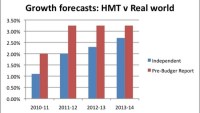
As I suspected, Darling has cooked the figures by laughably unrealistic growth forecasts. He is predicting a sustained economic sprint that will mysteriously come to Britain the April after next. Table B1 of the PBR shows that he expects 3.25% growth every year for a whole four years: from April 2011 to April 2015. How does this square with what the real world thinks? I blogged earlier what HM Treasury’s independent forecasts have to say. Robert Chote from the IFS has just been on TV saying the good news is that the structural deficit isn’t as big as it used to be. Little wonder, when you can concoct growth forecasts like this.  Here is a graph, laying it out. The subtext to this Budget is “securing the recovery”. It should be “once upon a time..

Your guide to the PBR Brownies<br />

From our UK edition

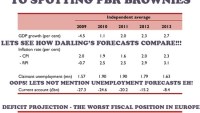
How can you tell if you’re being lied to on budget day? Normally its easy: Gordon Brown’s lips move. But, today, there's a handy guide. You can compare Darling’s fiction with the independent average calculated by HM Treasury.

Darling carves up the spending pie

From our UK edition

It’s the eve of the Pre-Budget Report, and the lunacy has already begun. Tomorrow's FT says that Darling will copy the Tories’ plans to protect the NHS budget – and throw police and schools in to the protected status as well. This is introduced as "the biggest squeeze in pubic spending for a generation," with the headline figure of 14 percent cuts. How to make sense of that? My guide: 1. Any sentence that starts “A Labour government would...” can be ignored. Darling can promise to fund free beer for everyone after 2011 – he won't be in office. These are decoys for the media: the wilder his claims, the worse he expects to lose. 2.

Brown waits to strike

From our UK edition

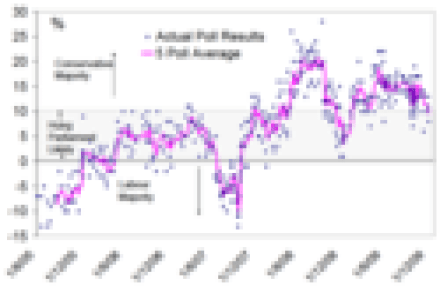
Things are shaping up nicely for Gordon Brown ahead of the Pre-Budget Report next week. The Tories were 17 points ahead on ICM in October – now it’s 11. Cameron would have a narrow majority on this basis but, given the margin of error, we’re back into hung parliament territory. And this has a self-reinforcing effect on the Tories. A shrinking opinion poll means they tend to get paralysed, avoid arguments, play it safe, wait for Labour to screw up again. As I say in my News of the World column today, the voters who are looking for leadership then don’t really see it. This, of course, softens the Tory vote further. So the stage is set for Labour to get away with murder next week.

The truth about global warming

From our UK edition

Anyone interested in climate change should buy The Spectator today. We don’t normally make such naked plugs here on Coffee House, but our global warming special has a line-up of the variety and quality which I guarantee you will find in no other British magazine or newspaper. As the FT's Samuel Brittan says: we dare to debate. You’ve seen the piece about why the Maldives aren’t sinking, from a world-leading sea levels expert who has made six field trips to the islands. We also have the Freakonomics guys showing how geo-engineering has such potential, even though the environmentalists don’t seem interested. We unearth a never-seen-before CIA file from 1974 which shows how all the scientists were convinced about global ...

Global warming: the truth

From our UK edition

Last month, 1,000 emails leaked from the University of East Anglia’s Climatic Research Unit. The institution is more important than it sounds: for decades, it has been at the centre of the global warming debate, keeping in touch with the close-knit group of scientists who guard the various projections about global warming. Or, as the emails showed, the lack thereof. ‘The fact is that we can’t account for the lack of warming at the moment and it is a travesty that we can’t,’ said one scientist. Another said: ‘We can have a proper result — but only by including a load of garbage.’ As the world leaders gather in Copenhagen to negotiate a successor to the Kyoto treaty it is unlikely the subject of these emails will be raised.

What happens when you try to debate climate change…

From our UK edition

Sky News invited me around for what I expected would be a civil debate on climate change at 2:30pm today - but for people like Bob Ward, there’s no such thing. He is policy director at the Grantham Research Institute on Climate Change at the LSE. The debate proceeded along the bizarre path that these types so frequently tread. I was asked about what the climategate emails mean: I said it shows people putting spin first and science second. And raised the prospect of data manipulation. Hope replied by saying, “it's remarkable about how the so-called sceptics have been using this as a propaganda tool to promote political end...

Who cares about the playing fields of Eton?

From our UK edition

The Eton question came up on Question Time – is Labour right to use class in the run-up to the election? I have a piece in The Guardian tomorrow on this theme. The answer should be that which Andrew Lansley read out on Question Time:  that this shows Labour is living in the past, what matters is where you’re going to not where you came from. He’s right. But I do wish the Tories would believe it. The Eton taunt is still taken far too seriously by the Cameroons: it hurts them. It’s a piece of verbal kryptonite. They go to great lengths to defend themselves from such an attack: the 50p tax, for example, is embraced by the Conservatives just so Brown can’t say “Cameron’s looking out for rich folk, just like him.

Countdown to Copenhagen

From our UK edition

How seriously are we to take Lord Stern on the economics of climate change? At the LSE yesterday, he rather hysterically claimed that the Copenhagen summit will be "the most important international gathering since the Second World War". Crucially, he added that the cost of dealing with the problem may reach 5 percent of GDP. Even so, "it would still be a good deal," he said. Really? Losing world economic growth condemns millions in the Third World to poverty: the globalisation of the last 15 years has been the greatest anti-poverty tool ever invented. So we should not be blasé about sacrificing growth, as if all it means is smaller cars for the rich. Poverty kills, and so will forfeited economic growth. Stern would argue that climate change also kills.

The odds on independence

From our UK edition

Whenever a London bookmaker made odds on Scottish politics, my former colleagues at The Scotsman used to make easy money*. The world of Holyrood, where yours truly served a one year tour of duty, has its own political weather system that it’s hard to understand from a distance – so likelihoods are given very high odds. But today Ladbrokes gives odds that I think are pretty fair: 20-1 on independence before 2015. The SNP’s rout in Glasgow North West a fortnight ago is part of a wider reluctance to separate from England. The financial crisis, and the way that RBS somehow became the new Darien Scheme, has spooked everyone.

The Iraq inquiry we should be having

From our UK edition

Do we still have the will to win in Afghanistan? If so, the question the Iraq inquiry should be asking is not “how did we get into this war” - we have had a number of separate inquiries into that already – but “why were the military defeated on the ground in Basra?”. If the Chilcot Inquiry were to focus on that, it might actually serve a purpose: not just in unearthing new information (which it has signally failed to do so far) but drawing lessons that just might help the troops in Afghanistan. I make this point in my News of the World column today. I am in a tiny minority of people who a) supported the war in Iraq, and b) still admits it. People like me feel every bit as angry as the anti-war people about what happened next.

Turning Japanese

From our UK edition

Is the British economy turning Japanese? Since asking the question last year on Coffee House, the evidence has been piling up – and it makes for a cover story in this week's magazine (which I have written with Mark Bathgate). The similarities are as follows: 1. Japan’s bust followed years of debt-fuelled growth which vain politicians saw as prosperity. 2. When the bust came, Japan’s government kept on spending. They did so in the name of Keynsian stimulus, thinking this would in itself kick start a recovery. All it achieved was to sink Japan deeper into debt. 3. Crucially, Japan didn’t do full disclosure on the collapsed banks. To fix the banks was, they figured, painful root canal surgery that this recession-struck country could do without. 4.

Prepare for a Japanese-style lost decade

From our UK edition

Zombie banks and high unemployment look set to curse our economy as they did Japan’s, say Fraser Nelson and Mark Bathgate. A Conservative government could avoid disaster, but only if it is prepared to face the painful reality To say a country is turning Japanese has a very special meaning to economists. It means entering recession and never properly escaping it. It means entering a world of zombie banks that are being kept alive by taxpayers’ money. It means year after year of huge government deficits: profligacy masked as Keynesian medicine. It means year after year of false dawns, high unemployment and lapses back into recession. It is an acute form of economic purgatory — and one which Britain might well be facing.

Congratulations, Michael Heath

From our UK edition

Last night, Michael Heath, The Spectator’s brilliant cartoon editor, won a lifetime achievement award at the Cartoon Art Trust Awards – and what a lifetime. His first illustrations for The Spectator appeared in the mid-1950s, and have long since become a mainstay of the magazine. To mark this special talent, we've pasted a selection of his cartoons, from across the decades, below. So congratulations, Michael. And here's to the next 55 years.

Britain’s AWOL ally

From our UK edition

Cameron just made a very good point in his speech – namely, that Brown claimed just days ago that Obama would make an Afghanistan announcement in the “next few days”. Now, we have no idea when the announcement will come. But this isn't Gordon Brown’s fault – it’s Obama’s. The way Washington is treating Britain is deplorable and the subject of an excellent cover piece tomorrow by Con Coghlin (cover image above). As Con says in his piece: 'The Afghan issue has made clear the astonishing disregard with which Mr Obama treats Britain . As he decides how many more troops to send to Afghanistan – a decision which will fundamentally affect the scope of the mission – Britain is reduced to taking a guess.