Fraser Nelson

Fraser Nelson

Fraser Nelson is a Times columnist and a former editor of The Spectator.

International development’s statist underpinning

From our UK edition

Why increase aid to Afghanistan by 40pc when troops are dying from a lack of body armour and helicopters? The pledge to not just protect but vastly increase the aid budget is one which, polls show, leaves the public puzzled.  I was on the Politics Show with Jon Sopel, who was putting to Andrew Mitchell some very sharp questions about all of this. Why build schools in Afghanistan, but cancel them in Britain? Worse, in fact, DFID has a habit of building schools but not finding teachers for them - its ideology states that teaching should be a job for central government, just like it is in Britain. The Afghan government is corrupt and pays a pittance for teachers, who can usually earn more as translators for other foreigners, etc.

Making work pay | 16 July 2010

From our UK edition

What is the purpose of the welfare state? To protect British people from unemployment, or to protect them from jobs like fruit-picking and working in Pret A Manger? I listened to Farming Today* earlier, in which they interviewed the Eastern Europeans that we import en masse to do jobs that Brits used to do. Having done the job myself in my younger days (I come from a part of the world where the October break is called the 'tattie holidays' so kids can dig potatoes), I can attest that it's bloody hard work for a paltry reward. But it pays no less than the minimum wage. Without immigration, we'd be forced to find a proper solution to this problem: that welfare has priced a lot of British people out of this particular market.

Vince, useless degrees would have been a better target

From our UK edition

Vince Cable faced next to no questioning on his hugely controversial plans for a graduate tax on Today this morning. Instead he was allowed to make an annoucement, was thanked as "Doctor Cable" by a reverential Jim Naughtie, and left to trundle back up Mount Sinai where the BBC seems to think he lives. There are plenty hard questions to ask. The main one is what I regard as a national scandal: young people being missold useless degrees that benefit neither students nor society. They get fed this line, about how graduates earn more, and are led to believe that the letters MA after your name mean an extra £7k or more, for life.

Balls clutches at straws

From our UK edition

Many CoffeeHousers will have heard Ed Balls' preposterous performance on the Today programme this morning. We have transcribed it below, to put it on the record. Three things jump out at me. The way that Balls is the last purveyor of Brownies, still talking about new jobs when all of the new jobs can be accounted for by immigration. Next, the way he airbrushes his record to strip out all the disasters. It was the Balls-Brown economic model which rigged the Bank of England so it would keep rates artificially low, flooding the economy with dangerously underpriced debt and putting not just the government but the whole economy on a debt binge, as John Humphrys rightly points out.

Will the coalition defeat the roadblocks to reform?

From our UK edition

The biggest reform to the NHS since its inception since 1948. A move away from bureaucracy towards a proper internal market. GPs commissioning. A revolution, taking on the vested interests. Yes, there was so much to savour in the NHS Plan of 2000 - enough, Alan Milburn would later joke, that he kept re-announcing its policies for the next three years and getting headlines. Well, the Tories can play at that game too. Now, it has been reannounced by Andrew Lansley and called the coalition NHS White Paper. This is, in my book, a compliment to Lansley. In opposition, he sided with the unions and attacked Labour from the left on the "stop the cuts" platform. Now, he is picking up some of the discarded Blair reform agenda – centrally, GP commissioning.

Cameron’s refreshing honesty on schools

From our UK edition

David Cameron has today told the News of the World that he is "terrified" about the prospect of sending his children to an inner-London state school. This is quite some statement, given how many tens of thousands of parents are in the same predicament. Isn't it the classic politician's error? To betray how his aloofness from voters by showing how he fears what ordinary parents have to put up with? That's what Tony Blair thought – so he'd pretend to be happy with state schools while sending his kids to the ultra-selective Oratory School. That is hypocrisy. What David Cameron has said represents honesty. After all, why shouldn't he be terrified? As I say in my News of the World column today, the record is appalling.

Why we shouldn’t worry about overpopulation

From our UK edition

Perhaps the most sinister side of the environmentalist movement is the idea of an “optimal population,” where human life is seen as a menace. The Optimal Population Trust has today said that there are 45 million too many people living in Britain – which, for a country of 60 million, is quite some statement. The peculiar thing is that this “problem” may well have a solution in the form of the human race failing to reproduce. The hands of the world population clock are slowing. The natural population replacement level, 2.1 kids per woman, is achieved by no European country (pdf here). England stands at a respectable 1.75, Scotland at 1.6 and Italy at a dismal 1.2.

Gove puts democracy ahead of bureaucracy

From our UK edition

Michael Gove's welcome freeze on Building Schools for the Future will invite tomorrow's press to claim only that this means 715 various building projects are not being carried out. In fact, what it means is that the fund will be open for the Swedish-style new schools. The budget will be transferred from bureaucratic priorities to those of communities, as expressed by those who wish there to be a new school. One of the great tragedies of the politicians' stranglehold over education is that they just love huge, shiny buildings to point at, complete with new whiteboards and all the latest gadgets. The Swedish experiment has shown the parents care not one jot about how grand the building is: their value is placed on the importance of teaching.

Cameron’s realignment of our party politics

From our UK edition

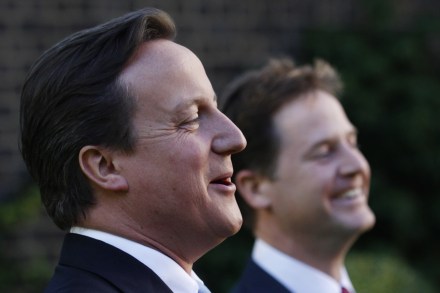
When the coalition was first formed, I expected it to collapse in months. But, then, I was expecting the type of coalition that I’d seen in the Scottish Parliament when Labour and the Lib Dems kept their distance (and their mistrust). But what has emerged is a far tighter coalition – and one that may even end up in a merger. Cameron has been very generous to the Lib Dems, in both Cabinet places and policies. But since then, he has just grown more generous. In the News of the World today, I wonder if he’s playing for keeps.   It was great to welcome Nick Clegg to The Spectator’s summer party last week, and the other Lib Dems who turned up to raise a glass to the return of fiscal sanity.

In praise of Spotify

From our UK edition

Last night, I met a man who changed my life. Not that he knew it. Shakil Khan from Spotify is part of the team that has delivered what is – to me – the most lifestyle-changing innovation since Sky Plus. For the uninitiated, it has a seemingly limitless database of music all for £10 a month, and it basically means I listen to music again. I had, stupidly, spent days digitally archiving my CD collection but it was so much hassle to play it that I’d given up. Wire up Spotify – from an iPhone or laptop – and you can instantly play a whole load of stuff that you thought you could never afford, or find.

What happened to the Tory manifesto?

From our UK edition

During the love-in at the start of the coalition, no one really asked which Tory pledges bit the dust. It becomes relevant now: the Tory pledge to reduce immigration to the "tens of thousands," for example, was in their manifesto but not in the coalition agreement. Although verbally restated later, it is still seen as being a flexible pledge due to its absence in that document. There is no record of what was dropped, so we at CoffeeHouse have provided one below. I won't say it's a rip-roaring read. But for those who think manifestos mean something, it's good to have on the record. UPDATE: I agree with Mycroft, below, that the first headline on this post – '190 Tory sacrifices' – was misleading. Writers never do their own headlines, but that's no excuse.

Cameron meant what he said on Afghanistan

From our UK edition

Although David Cameron said later that he didn’t mean it, there was no mistaking the sincerity when he told Adam Boulton that “We cannot be there for another five years having effectively been there for nine years already”. In my News of the World column  today, I say that it’s pretty clear his Afghan strategy is to secure the earliest dignified exit. But I also say that this does not necessarily bode ill for defence more widely. I gather that George Osborne, fresh from the success of his Budget last week, is working on a plan that will freeze defence budget in cash terms (an 11% real terms cut over five years) thereby saving the military from the 25% average cut for non-ring fenced departments.

The G8 doesn’t mark a change in strategy towards Afghanistan

From our UK edition

Has the G8 agreed a five-year deadline for getting out of Afghanistan? This is the Politics Home headline, and that of other publications. Either there are some Chinese whispers going on - or some British spin. None of the foreign media appear to have discerned a new strategy - but for Brits it chimes with what Cameron was saying yesterday that he wanted to be out after five years. In fact, the full text of the G8 agreement reads as follows... The Kabul Conference in July will be an important opportunity for the Government of Afghanistan to present its detailed plans and show tangible progress in implementing the commitments made in the January 2010 London Conference Communiqué, including measures to...

The oracle speaks

From our UK edition

Robert Chote’s Institute of Fiscal Studies is widely seen as the source of all wisdom on economic matters. So what did its director make of the Budget? Fraser Nelson asks him A British Budget is never over until Robert Chote has spoken. It’s unclear just when this was inserted into Britain’s unwritten constitution, but his status was obvious from the audience gathered to hear his verdict on Wednesday. Policymakers, economics editors, broadcasters — all had come to note down, and take as gospel, what this friendly, slightly gangly 42-year-old had to say. ‘It’s amazing how one man came to wield so much power,’ muses a Treasury source. Just what to do about it has been on the Tories’ minds for some time.

Swedish lessons | 25 June 2010

From our UK edition

I’m in Stockholm today to celebrate the summer solstice. It’s a magical part of the year, best illustrated by the newspaper column (below) giving times for sunrise and sunset in various parts of Sweden. In Kiruna there’s just a dash – the sun doesn’t rise or set in this part of the year. (The same is true in winter, the poor things). Normally, the Swedes disguise their pagan festivals with a Christian veneer (like Santa Lucia) but today’s all-out dance-round-the-fertility-pole without apology. It’s like a cross between the Waltons, Woodstock and the Wicker Man.

Cable begs for protection

From our UK edition

Vince Cable is announcing to Metro that "We do not want to make such deep cuts to transport, energy, science research and universities." Really? According to whom? The science budget, which has shot from £1.3bn to an indefensible £3.7bn, is a prime example of a cost that should not be borne by the taxpayer. Scientists are best left to get on with this themselves, and companies are more than capable of funding research. On energy, again, there are many expensive vanity projects just begging for the axe. Given that Cable is in charge of the universities brief - the most important part of his otherwise non-job - you can expect him to want to protect it from cuts. But to lobby openly like this is not something that Theresa May or Liam Fox would do.

The true meaning of Osborne’s Budget

From our UK edition

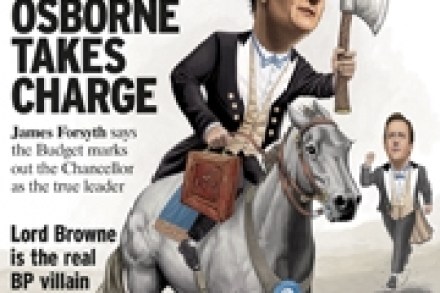
To understand the budget properly, read James Forsyth's cover story in The Spectator today. Sure, it was about reducing the deficit - but within it lie several political strategies which explain how George Osborne hopes to win a majority Conservative government. James says that those around Cameron will not entertain this notion - they "have been persuading themselves that coalition government is the best possible result". But Osborne, he says, finds it deeply unsatisfactory and has a twin mission: fix the economy, and win outright next time. "He has been observing recently that Gordon Brown spent 13 years successfully creating Labour voters — mainly through state dependency — and that the Tories need to reverse this process if they are to win.

The road to recovery | 23 June 2010

From our UK edition

This is a slow-burning budget. Not because Osborne has concealed, like Gordon Brown did, but because the reverse is true. The budget is, as Osborne says, a third of the size but with three times the amount of information. It has layers: some policies and language are there just to assuage the LibDems. Some are pure Tory. James has a brilliant cover piece in tomorrow’s magazine which spells out the political, rather than economic, forces at work in this budget. Osborne, that great player of three-dimensional chess, sees in this budget plans to restore a Tory majority government. The Red Book itself is, for wonks like myself, a joy to read: straight figures, with nothing concealed.

Osborne’s massive opportunity

From our UK edition

I’m quite optimistic about George Osborne’s budget – in the same sense that one might have been optimistic when Churchill took over from Chamberlain. Not because the situation is good, or because you think the road ahead will be easy or enjoyable, but because the road no longer leads to disaster. Not that Osborne is a Churchill – even though he will have his own fair share of blood, sweat toil and tears for us on Tuesday. I’m pretty confident he’ll head in the right direction, and at the right speed. I discuss this in my News of the World column today, but will say a little more here: 1. This Budget will probably mark the point when the UK started to recover. For two months now, the economic data has been favourable.

Scotland deserves better

From our UK edition

I knew it was time for me to leave the Scottish Parliament press corps when I was in Deacon Brodie's Tavern one night and pulled into a game of "name the top ten sexiest MSPs". On my first day there, September 2000, the journalist next to me was in trouble for headbutting a politician in the pub the night before. It's an unusual place with antics that make Westminster look like a nunnery: I remember one set of political awards where a Labour MSP drunkenly set fire to the curtains and was imprisoned. I feel sorry for the poor members of the general public who come into contact with these MSPs - primarily through the Petitions Committee. It's chaired by Frank McAveety, who forgot to turn his microphone off when leering after a member of the public.