Fraser Nelson

Fraser Nelson

Fraser Nelson is a Times columnist and a former editor of The Spectator.

At last, Grayling takes on the Ancien Regime

To disguise the radical nature of reform, one need only make it boring. And here Chris Grayling has succeeded spectacularly. Today he has announced further details on the ‘Work Programme’ and the ‘Benefit Migration’, which sound like the type of well-intentioned but doomed reforms that ministers tried over the Labour years. The welfare state has incubated the very ‘giant evils’ it was designed to eradicate. There are, scandalously, 2.6 million on incapacity benefit right now – a category which ensures they don’t count in unemployment figures. Brown didn’t care much, but Grayling is taking this head-on.

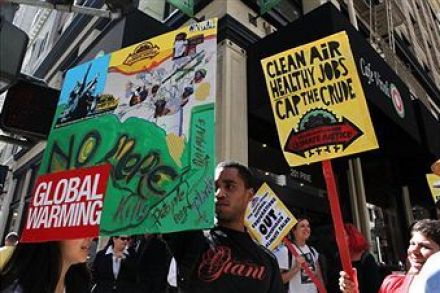
When it comes to global warming, rational debate is what we need

We had a sell-out debate on global warming at The Spectator on Tuesday and, as I found out this morning, the debate is still going on. The teams were led by Nigel Lawson and Sir David King, and I was in the audience. I tweeted my praise of Simon Singh’s argument as he made it: it was a brilliant variation on the theme of "don’t think – trust the experts". He seems to have discovered the tweet this morning, and responded with a volley of five questions for me. Then David Aaronovitch weighed in, followed by Simon Mayo. At 8.35am! I had the choice between replying, or carrying on with my gourmet porridge. I chose the latter, and promised to blog my response later on to Simon Mayo and the Breakfast Crew. So here goes.

How much are we still paying for Brown?

The story today of a pregnant woman being downgraded so Gordon Brown and his six aides could travel business class from Abu Dhabi to London may ring a bell with CoffeeHousers. We revealed last August that Brown has a taste for freebies, and that he was offering himself for $100,000 at speaking and award-giving engagements. For an extra $20,000 he would throw in his wife, Sarah. The Mail on Sunday reports that one of the pregnant woman's co-passengers was "livid, asking why it was necessary for all of [Brown's team] to be travelling business — and if it was being paid for by the taxpayer." He raises an interesting point. Tony Blair notoriously claimed a "pension" of £64k, and an £84k contribution for the costs of running his office.

The joy of diversion

“We should have more history on the programme,” said Evan Davis at the end of yesterday’s episode of R4’s Today. “I learned a lot from that.” He had just been interviewing Peter Jones (listen here) about a piece in this week’s Spectator about the two Libyas — a split which may emerge as a result of the fly zone. Tripoli and Benghazi were originally part of two different worlds: Roman and Greek. For these coastal towns, north-south sea routes were more important than east-west road routes (which 500 miles of desert made pretty much impossible). Just as the Kurds managed independence in the north of Iraq after the 1992 No Fly Zone, so the ancient Cyrenaica may re-emerge now. Peter explains all this beautifully in this week’s magazine.

Scouring the Budget small print

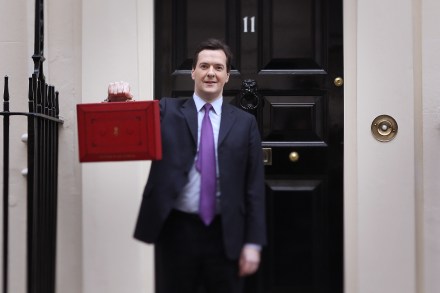
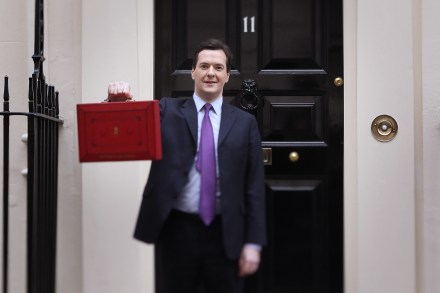
This morning's newspapers have a feast of analysis on the Budget. I've covered 15 of them, and what journalists normally do is spend the day trawling the small print of the Budget document hunting for stories. But this time, the stories seem to have migrated to the Office for Budget Responsibility's accompanying report, packed with new analyses and metrics — even disaster scenarios — which those with an interest in UK economics will find useful. The OBR document is now released with the Red Book, and speaks with the authority of government economists who (unlike the rest of us) have had weeks to chew over Osborne's claims. The OBR must now be considered part of the Budget's small print.

Osborne gets his man

So Martin Sorrell is set to move WPP back to Britain. This was always part of Osborne's Budget plan, as I revealed in my News of the World column and also mentioned on Coffee House. As I said in the newspaper: "The Chancellor has been on bended knee, pursuing Sorrell with energy that would make Berlusconi blush. 'What do we need to do?' he asks. Sorrell’s answer is to cut the tax on overseas profits. So Osborne will, hoping to lure back companies who generate most of their cash abroad." Today, Sorrell will announce that he'll come back from Ireland if the Budget is made law. Of course it will be made law, governments collapse if they can't have their budget passed. So he'll redomicile, as will (perhaps) other multinationals.

Osborne’s new, softer cuts

George Osborne has today done some massive juggling. It wasn't a Budget for jobs after all, but a Budget to help people cope with the soaring cost of living. North Sea oil companies and banks were stung for various income, fuel and corporation tax cuts. The Chancellor spotted — immediately — that cost of living was the No.1 issue and turned on a sixpence. His skills as a politician were again demonstrated. But let's not fool ourselves. Fiscally, today's is not a big Budget. What movement there has been is to make the cuts programme even milder than it already was. The "total cuts" figure is, oddly, not printed in the Budget. Perhaps because it's so embarrassingly small. After the Autumn Statement, it was 5 per cent over four years. Now it's back to 3.

The levers that Osborne might pull

Cutting taxes for the low-paid is the most useful thing Osborne can do in what will, I suspect, be a distinctly unmemorable budget. The Mail and The Sun both have competing figures — £205 and £320 — for the annual rebate. Given that the average Brit is paying £310 more due to Osborne's VAT rise in January, one might forgive taxpayers for not punching the air. And anyone on more than £25k a year is still face a higher tax burden than they did three months ago. But the beauty of Budget day (as Osborne knows) is that you have can just present one side of the ledger. You can show the 'give', not mention the 'take' and end up with front pages similar to those which Pete mentioned earlier.

Nuclear hysteria

The above Japanese video - explaining the nuclear accident to children — makes a lot more sense than many of the hysterical reports we have been reading in the last few days. The figures are not out yet, but it's likely that tens of thousands were killed by the tsunami. Yet the newspapers were all focused on the nuclear meltdown — which injured 15 people. The irony is that, when a tsunami strikes, the local nuclear power station is pretty much the safest place to be. This is the argument advanced in the leading article for the current issue of The Spectator (subscribers, click here; non-subscribers please join us for £1 a week).

Inflationary troubles ahead of Osborne’s Budget

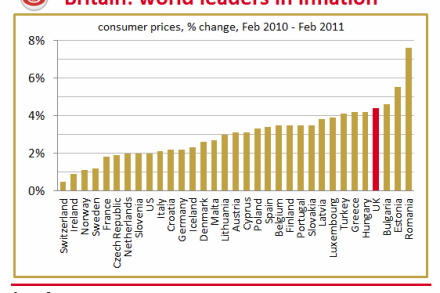
Unwelcome news for George Osborne: he will tomorrow present his Budget against a backdrop of the highest inflation for 20 years. The RPI index — what the nation called “inflation” until Brown changed the definition — is 5.5 per cent. It hasn't been this bad since the aftermath of the ERM crisis, an unhappy comparison for the Tories. The CPI index is up to 4.4 per. And those who deploy the usual arguments about global food prices are spiking might wonder: why is Britain now even worse off than Greece?     Even the Zimbabwean media is laughing at us (their inflation is now considerably lower than ours). It's shocking, but not surprising.

Sarkozy’s game

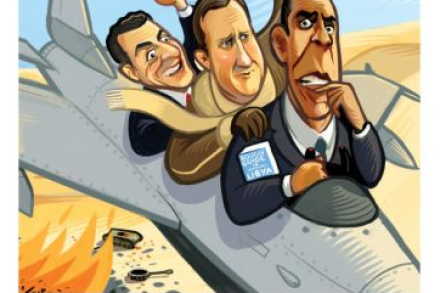
I'm hearing more reports about the rather peculiar behaviour of Nicholas Sarkozy, and how he is playing the Libya campaign thus far. Obama wants to hand over leadership of this mission quick. He was never really into it, but the US Navy was overwhelmingly the best placed to do the first phase of the mission (ie, fire Tomahawks into 20 Libyan targets). The Tomahawk team constituted 11 US ships and submarines, plus one British submarine. Anything other than American leadership would have been a joke. Phase Two is to take out Gaddafi's surface-to-air missiles as soon as he dares to move them. Obama wants to hand over the baton to NATO, with its bases in southern Italy and other Mediterranean nations. But Sarko objects. He likes the idea of US, UK and France as a triumvirate.

George Osborne’s Budget magic trick

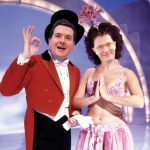
Spare a thought for George Osborne and Danny Alexander. They had their own budgetary magic show planned for Wednesday, and were yet again planning to be the Paul Daniels and Debbie McGhee of British politics. Now, it looks like they’re going to be competing with exploding Libyan MiGs for the national attention. This Budget was, as James says in his cover story this week, the government’s great hope for getting itself back on track. Grabbing the newspaper headlines, resetting the narrative etc. Now, the budget will be overshadowed by war. These Tomahawks don’t come cheap and Osborne has pitifully few cards to play.

Cameron’s achievement

Just last month, David Cameron declared that you “can’t drop democracy from 40,000 feet.” He’s right. It’s more like 400 feet: this is the cruising altitude of the 112 Tomahawk missiles fired from British and American submarines earlier this evening, low enough to dodge Gaddafi’s radars and take out some 20 targets. Given that Obama and Cameron have both ruled out ground forces this will be, as Kosovo was, a bombing-only campaign. And launched on the eighth anniversary of the Iraq war. The US Navy, which was always itching to proceed with the no-fly zone, is now leading the operation; hence its briefing, on CNN, above. There is one British submarine and 11 other US warships in the region.

The threat to a British liberty

It’s a funny old world. I have now been contacted by two journalists informing me that Bedfordshire Police are investigating The Spectator. Why? Because of the Melanie Philips blog where she referred to the “moral depravity” of “the Arabs” who killed the Fogel family in Israel. CoffeeHousers can judge for themselves if they agree or disagree with her language and views – but should this be illegal?  The Guardian has written this story up, claiming The Spectator is being investigated by the Press Complaints Commission. This is untrue. The PCC tell me that a complaint has been lodged, but that’s as far as it has gone. They investigate only if they believe there is a serious prospect that their code has been breached, and it hasn't.

In this week’s Spectator | 18 March 2011

The latest issue of the Spectator is out. Here, for the benefit of CoffeeHousers, is a selection of five pieces from it. 1) How did David Cameron mutate into a hawk? The last few weeks have been like a political version of a Manimal* transformation sequence. Daniel McCarthy, editor of The American Conservative, looks at this in the current edition of the magazine – he’s sceptical about the operation underway (as were most CoffeeHousers when  I last blogged on it) and argues that “Cameron’s interventionism would substitute the discredited example for a hopeful one”. 2) Blair always viewed foreign affairs as a welcome relief from the home front.

Clegg’s coup

Libya is not the only scene of conflict today. Nick Clegg has just won a powerful victory over the Conservatives, appointing a Bill of Rights commission which is certain to leave the ECHR intact. When you see the names Philippe Sands, Helena Kennedy and Lord Lester on the list — even alongside Tories — you know that this review is over before it has begun. Clegg is a firm believer in Europe, and has played his hand very well — outmanoeuvering the Conservatives who thought that a British Bill of Rights should supplant edicts from Strasbourg. Upshot: there may still be a Bill of Rights, containing various declarations inserted by the Tories on the panel. But what the BoR says will matter not one jot.

The grade inflation scam

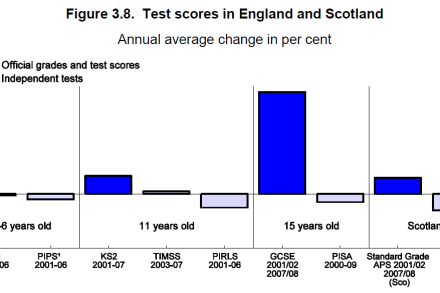
Today’s OECD Economic Survey of the UK (download the complete pdf here ) contains some devastating passages about our education system. As it's 148 pages in size, we thought CoffeeHousers might appreciate some highlights. Here's your starter for ten: “Despite sharply rising school spending per pupil during the last ten years, improvements in schooling outcomes have been limited in the United Kingdom.” This is rather a staggering indictment of Tony Blair's "education, education, education" policy. But what about the ever improving exam results that we hear about each summer?

More woe for the FCO

The Japanese tsunami is exposing the shortcomings of the Foreign Office. Embarrassingly, a team of British rescuers has been thwarted because the British embassay in Tokyo failed to process the right paperwork - so they are now flying back home. The words of Willie McMartin, head of the Grangemouth-based outfit, speak best for themselves: 'The team has had excellent help from the Japanese embassy in London and the authorities in Tokyo but it broke down when they couldn't get the relevant paperwork from the British embassy in Tokyo. This was the 32nd world disaster we have been to and we've only had problems twice before with host governments in China and Afghanistan.

Clegg defines his liberalism

I do feel for Nick Clegg. He’s taken an oppositionalist party into government, and they hate it. He is politically and psychologically prepared for what goes with power; grassroots LibDems less so. And this brings problems. Yesterday, he was complaining that his party is “too male and too pale”; but his main problem is that there are too few of any. At the peak of Cleggmania, the Lib Dem had 30 per cent of the the vote. Now it’s 10 per cent in the polls. If things continue at this rate, he won’t need a ‘ring of steel’ for his next conference: a phone box will suffice. So, what can he do? His speech tries to define a new word: ‘liberal’. He has this to say: 'For the left, an obsession with the state.

Cameron’s principled stand over Libya

Slowly, David Cameron seems to be mutating into a hawk over Libya. I've been increasingly impressed with the way he has made the case for a no-fly zone - knowing that it is an unpopular cause outside of the Arab world. Since the evacuation chaos, which he apologised for, he has pretty much led calls for some form of military intervention to stop Gaddafi bombing his own people back into submission. He was laughed at to start with; accused of making it up on the hoof. But now the 22-nation Arab League backs this position, as does Sarko. It may have been messy at first – but that’s how these things go. From the offset, Cameron was articulating a basic principle: we need to help the Libyan rebels, not sit and watch them get butchered.