Frank Lawton

The sad death of Poets’ Corner

From our UK edition

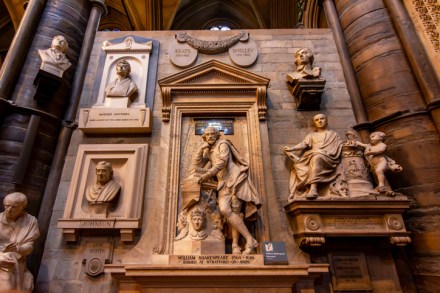
If there is such a thing as a home for Britain’s national story, it might be found in Westminster Abbey. Enter, and you are immediately inducted into the long history of these islands. Monarchs, statesmen, scientists, generals, poets: here, under one roof, are memorialised the people whose works have formed the mind and body of England and in whose language England learnt to dream. These days, however, we dream less. The problem is not that our contemporary culture is incapable of producing figures of significance. It is that we can no longer recognise it when we do. As a result, the gates of the Abbey have been closed to the dead. The gates of the Abbey have been closed to the dead Last month, J. H.

What is it about Bob Dylan that sends writers mad?

From our UK edition

Ron Rosenbaum is a man of galactic learning. Theology, neuroscience, American history, psychology, Shakespeare, cosmology, ‘all of Dickens’, nuclear weapons, quantum theory, iron ore – nothing escapes his hungry eye. Except, perhaps, Bob Dylan. Which is unfortunate, given that he’s written a book about him. What is it about Dylan that sends writers mad? Christopher Ricks’s usual mellifluousness succumbs to a pun-overdose; Clinton Heylin’s blindingly completist biographies are as impenetrable as their subject; Sean Wilentz lurches from the unlikely to the banal. With Things Have Changed, Ron Rosenbaum, the de facto ‘Dylan correspondent’ for the Village Voice in the early 1970s, proves that even ‘being there’ confers no immunity.

Clouded memories: Ballerina, by Patrick Modiano, reviewed

From our UK edition

There are, broadly speaking, two types of artist: the explorer and the miner. The explorer keeps moving on, staking out new aesthetic or thematic terrain, while the miner keeps returning, digging deeper into the same earth each time. Patrick Modiano, the French Nobel prizewinner for literature in 2014, is an artist firmly of the second camp. Ballerina may be Modiano’s 32nd novel, but it feels more like the latest haunting chapter of the one long book that makes up his career. Blending noir, elegy, Paris and an obsession with memory, Modiano writes like Proust conducting a police line-up.

Catherine Nixey’s Heresy is a joy to read

What people tend to forget about Jesus Christ is that he killed children. As a five-year-old, Jesus was toddling through a village when a small boy ran past, knocking his shoulder. Taking it like any five-year-old would, Jesus shouted after him "you shall not go further on your way," at which point the boy fell down dead. Later, when the boy’s parents admonished Joseph and Mary for failing to raise their son properly, Jesus blinded them. Something to bear in mind next time you ask yourself: "What would Jesus do?" If this story is unfamiliar, that is because it doesn’t appear in any of the Bible’s traditional Gospels.

Heresy

Why Joni Mitchell sounded different from the start

From our UK edition

What makes Joni Mitchell’s music special? The lyrics alone put her on 20th-century music’s Mount Rushmore, alongside her cultural mirror Bob Dylan and her brief lover Leonard Cohen. But for me it’s her phrasing, her tunings and her sense of time. Decades on, her music remains endlessly surprising. Think a line is going in a certain direction? Think again, as Mitchell bends it away; or shifts key; or arcs her voice into its celestial sphere, only to suddenly plummet, like a plane in turbulence. And yet the swerves feel somehow right, inevitable.

The many Jesus-like figures of the ancient world

From our UK edition

What people tend to forget about Jesus Christ is that he killed children. As a five-year-old, Jesus was toddling through a village when a small boy ran past, knocking his shoulder. Taking it like any five-year-old would, Jesus shouted after him ‘you shall not go further on your way’, at which point the boy fell down dead. Later, when the boy’s parents admonished Joseph and Mary for failing to raise their son properly, Jesus blinded them. Something to bear in mind next time you ask yourself: ‘What would Jesus do?’ Jesus smites teachers, sells a ‘twin’ into slavery, and has someone crucified in his stead If this story is unfamiliar, that is because it doesn’t appear in any of the Bible’s traditional Gospels.

Religion provides the rhythm

From our UK edition

Music is an art of time: songs play to a rhythm, giving shape to the seconds as they pass, charging the present with a pulse we can feel. But as music takes us forward through time it also takes us back – to the moment of its composition or recording; to a particularly resonant time in our own past; and yet further, summoning the echoes of older music contained within a song. In new books by David Remnick and Michel Faber we get two different approaches to writing about something ephemeral yet emotionally adhesive. One of them made time fly, and one of them made time slow until the only beat I could hear was the sound of my own head against the desk.

The bittersweet comedy of ageing: Ladies’ Lunch and Other Stories, by Lore Segal, reviewed

From our UK edition

Every family has its folklore. Apparently, as a five-year-old, I was on the floor playing when I looked up at my grandmother and told her matter-of-factly that she ‘was not the kind of granny I had been expecting’. I’m not quite sure what my foetal presumptions had been, but she is far from the hackneyed image society reserves for older women: no blankets or twee knitting for Norma. Sharp, glamorous, her face alive with mischief, she is a lady who lunches, a nonagenarian who shared stories, gossip and advice amid a riot of laughter. She would be familiar with much of the gentle drama in this collection of Lore Segal’s stories, which revolves around five women in their nineties dining on a monthly basis together.

Funny peculiar

From our UK edition

My ex-dentist resembled a potato wearing a Patek Phillipe. In those precious moments between the golf course and the cruise ship he would take the time to remind patients what good value our treatments were. Under the spotlights we could do little but stare, gurn and dribble, which he took, I presume, as a sign of our overwhelming gratitude. I thought that was bad enough, but it’s nothing compared to J.P. Wintergreen, the dentist villain of Nina Stibbe’s ‘dentally particular’ comedy Reasons to be Cheerful. Set in Leicester in 1980, the novel is the third in Stibbe’s Sue Townsend influenced series of (stand-alone) books tracing the life of narrator Lizzie Vogel and her dysfunctional family.

The art of art restoration    

From our UK edition

When I first saw ‘The Triumph of Death’ (1562-63), by Pieter Bruegel the Elder, the painting throbbed: this land was sick, smothered in smoke; the fires on the horizon had been burning for ever, turning earth into dirt, air into haze. All was dull, lethargic, ill. When I saw the painting again some years later, the smoke had cleared. Patches of green pushed up from the canvas; the peasantry’s clothes were suddenly bright; the sun appeared to exist. In its new clarity, some of the painting’s jaded horror had been replaced by a sort of comedy. The work had been restored, but something had been lost.

Magic and medicine: The Barefoot Doctor, by Can Xue, reviewed

From our UK edition

It must be exhausting to live as a barefoot doctor in a Chinese village if Can Xue’s latest novel is anything to go by. Not because of your work as curer-in-chief, but because all your patients are either nauseatingly happy or prone to near-constant weeping. Barefoot doctors emerged in the 1930s, but really hit their stride under Mao, when they spread throughout rural China. They were folk healers with basic medical training who provided healthcare in places where urban trained medics wouldn’t settle. Now one of China’s most feted novelists, Xue is better known for her avant-garde dreamscapes than her acupuncture, but she was a barefoot doctor in her youth.

Piloting a Boeing Dreamliner can be less than dreamy

From our UK edition

Mark Vanhoenacker dreams of my nightmares. Ever since he was a young boy, he fantasised about piloting airplanes. Ever since I was a young boy, well, let’s just say I’ve preferred to take the train. Of course I know that, statistically, flying is safe; but that knowledge doesn’t stop the unnerving sense that at some point the laws of physics will reimpose themselves and we’ll be punished for our former miracles. And let’s be honest, if God had wanted us to fly, would he really have invented airline food? Vanhoenacker has no such worries – which is handy, since he’s fulfilled his dream and now pilots Boeing 787 Dreamliners round the world (a life he detailed in his surprise 2015 bestseller Skyfaring).

Thoroughly modern Marie: Matrix, by Lauren Groff, reviewed

From our UK edition

It is 1158. A 17-year-old girl, born of both rape and royal blood, is cast out of the French court and condemned to spend her days in a threadbare abbey in England. She will go on to become abbess and one of the dominant forces in the land, transforming her abbey from a shack into an institution grown fat on holy power. The girl is Marie de France, loosely based on the 12th-century poet, about whom very little is known. Into history’s silence steps the American novelist Lauren Groff, who imagines a character who seems remarkably familiar. For Marie is a strong, feminist lesbian, who doesn’t fit into her era’s gender roles, considers much religious teaching to be laughable and who worries about global warming.

The end of capitalism has been just around the corner for centuries

From our UK edition

These days the world seems to end with staggering regularity. From the financial crisis to Brexit to Trump to a climate apocalypse to coronavirus: new eras are born faster than old ones can die. And yet, despite it all, the proletariat still haven’t bothered to rise up and overthrow capitalism. Worse still, many of them voted for an old Etonian with the middle name ‘de Pfeffel’. When will the oppressed masses learn? Perhaps, just perhaps, such questions aren’t helpful. For the left-wing political scientist Francesco Boldizzoni, rather than banging on about class consciousness, it’s time that a new consciousness dawned on a class of intellectuals who have confidently predicted capitalism’s downfall for two centuries, only to see it adapt and thrive.

Ben Lerner’s much hyped latest novel reads like an audit of contemporary grievances

From our UK edition

Things keep recurring in the novels of Ben Lerner — snatches of conversation, lines of poetry, Lerner himself. But in The Topeka School, while things keep returning, something has also been lost. Lerner’s third novel reunites us with Adam Gordon, the protagonist — and Lerner surrogate — of his much acclaimed debut, Leaving the Atocha Station. Adam is a senior at Topeka High School in the late 1990s, an aspiring poet and champion debater (as was Lerner), whose parents are psychologists at the Foundation, ‘a world-famous psychiatric institute and hospital’ which treats just about everyone in the book.

Seek, and ye shall find

From our UK edition

The bearded figure clad in white robes and wandering barefoot through the streets of Jerusalem is not, in fact, the messiah. But neither is he a very naughty boy.  Rather, he is a middle-aged man from Texas in need of a shower who, like the German across the street claiming to be Saint Paul, is caught in the grip of Jerusalem Syndrome — first clinically described in 1937. The afflicted are visitors so struck by their encounter with the city they become convinced they are ‘prophets, messiahs or redeemers. They can no longer distinguish between reality and fevered imagination.