Frank Johnson

A puzzle still unsolved

From our UK edition

Sara Moore would explain a rise to power as astonishing as any in history. A down-and-out house-painter and plebeian agitator becomes master at 43 of a country whose most influential classes expected its rulers to be of some social standing, and not to look absurd. The Marx, Lenin and Stalin, all in one, of his revolution; writing the manifesto, building the party; overthrowing the state after a lost war; then murdering his party rivals; becoming the subject of a ‘leadership cult,’ and then war leader; there differing only from Stalin in that he lost. Take away any one part of the whole —defeat in 1918, inflation, the army and bourgeoisie owing no allegiance to the new republic, slump — and it probably would not have been possible.
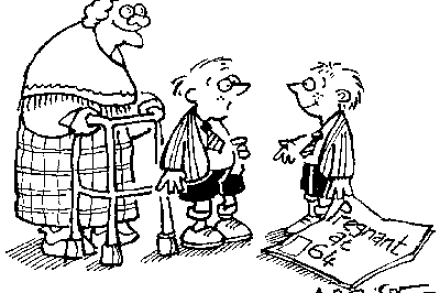
How did an immigrant to England get into the Home Secretary’s office?

From our UK edition

How did an immigrant to England get into the Home Secretary’s office? News that various Nigerian cleaners, working on Home Office premises dealing with immigration, were themselves illegal immigrants was amusing enough. But people are always wandering around Home Office premises whom staff cannot be expected immediately to identify, no matter how hard staff might try. First Nigerian cleaner: ‘Excuse me, sir. Do you work here?’ John Reid: ‘Aye.’ ‘For how long?’ ‘About a week. Just gettin’ t’noo the place.’ Second Nigerian cleaner: ‘What language is he speaking?’ First Nigerian: ‘English, but with a foreign accent. He obviously wasn’t born here. Do you have any means of identification, sir?

Waiting for Gordo, by Margaret Beckett

From our UK edition

‘You don’t have to be an intellectual to enjoy Beckett.’ A theatre critic, in this centenary year, wrote on Sunday, ‘You don’t have to be an intellectual to enjoy Beckett.’ Many theatregoers must also have thought that, for maximum enjoyment, it helps to be a pseudo-intellectual. Doubtless plenty of the people at present lauding Beckett are saying what they truly think. But common observation of the way of the world tells us that plenty are not. They are only saying what they think they should say. There have, so far this year, and so far as one can tell, been no dissenting voices about Beckett. That is implausible, suggestive of a climate of fear. This is also a Mozart anniversary year.

A rather unBritish achievement

From our UK edition

Listing page content here Who would have thought that the British, of all unexotic peoples, would turn out to be good at ballet; both at dancing and choreographing it? One minute they could do next to nothing of either. The next the world knew about Britain and ballet was that this damp, dour island off the Continent had a company as famous as any in the world. The newly formed Vic-Wells Ballet gave its first full evening’s programme in the — for ballet — unglamorous Old Vic in 1931. By 1949, as Sadler’s Wells, it was thought glamorous enough to appear in the world’s most star-struck opera house; with Fonteyn and the Sleeping Beauty opening its first season at the New York Metropolitan.

Hugo Chavez: a man with the perfect name to be a Cameroon MP

From our UK edition

Two weeks ago I mentioned here the Venezuelan President, Hugo Chavez; I think he is the international Left’s best hope at present: anti-American without being bin Laden. He causes trouble for the United States, but in the old-fashioned Cold War way for a Latin American: delivering two-hour speeches about gringo imperialism to various mobs, attributing Latin American poverty to American corporations, being lauded by the former Mrs Jagger, and being written up by the evergreen Richard Gott in the Guardian, who did the same for Che Guevara so many years ago. All Camden could rally to such a leader. Soon he will receive the greatest honour which the British Left can at present bestow — dinner here with London’s Chavez: Mr Livingstone.

Be as bad as you like, but be sure to call an inquiry

From our UK edition

By the weekend, the Conservatives had achieved the feat of making their own funding become just as much ‘the issue’ as Labour’s. The papers were full of sharp-looking loans which the Tories, as much as Labour, had received from the capitalist class. The Prime Minister and his allies had succeeded in making any scandal appear bipartisan. So much so that Mr Blair felt safe enough to set up an ‘independent inquiry’ not into how he and Lord Levy had financed New Labour, but into how all parties were financed. His friends were able to put it about that it was time to ‘move on’ and to have a ‘serious debate’. It was a brilliant stratagem. It also told us much about the times in which we live.

The wobbly Anglo-French tandem

From our UK edition

In the spring of 1916, the young French officer Charles de Gaulle was captured at Verdun. The French demanded from the British a diversionary offensive to prevent the entire French army from collapsing. Most British troops were not yet trained for such an effort. Nonetheless, they opened an offensive on the Somme. There, the young British officer, Harold Macmillan, was almost fatally wounded. Twenty-seven years later, the Anglo-Americans intrigued against that same de Gaulle in North Africa, and he intrigued back against the same. Churchill sent that same Macmillan from London to help resolve the dispute. De Gaulle survived as Free French leader, partly as a result of Macmillan’s diplomatic skills.

View from the engine room

From our UK edition

Most readers probably remember the name Guy Liddell, if at all, as the Fifth Man. Or possibly the Fourth, since we remember the first three, Burgess, Maclean and Philby, but cannot remember the next one, since the name kept on changing between Straight, Hollis and others. Liddell’s death in 1958 was largely un- noticed. He only became better known in the 1980s. David Mure, who in Cairo during the war had organised deception operations across the Middle East (on our side, I emphasise) announced that Liddell deliberately arranged a series of British intelligence failures. To the Cambridge historian John Costello, in his biography of Blunt, Master of Deception, Liddell’s long friendship with Blunt seemed to be much of the proof that Liddell had been a Soviet spy.

It is as well that Mr Blair did not in the end go to Blackpool for his holiday

From our UK edition

Nr Pézenas, Departement de L’Hérault Random thoughts from mid-August abroad; not that they should be all that random. Now that BBC News 24, Sky and CNN can be viewed in the deepest Midi, where we are, and several British newspapers print ‘same day’ editions in Marseilles, which are on sale at 8.30 a.m. in our nearest village, most of us should be as in touch with events as we would be in London. But somehow, in deepest August, in Mediterranean lands, we cannot be. The sun and the wine make us think we are out of touch, that they know more in London. ‘Just ringing to find out what’s happening about [say] Ken Clarke reneging on the euro after all his years as a Brussels agent,’ we tell some London answering machine.

Why Mr Duncan refuses to drop his knickers

From our UK edition

Mr Alan Duncan, the Conservative transport spokesman, announcing in the Daily Telegraph his candidacy for the party leadership, was quoted as likening the Tories’ situation to Marks & Spencer’s: ‘...a fantastic brand in good times, but if you have a lousy CEO and lousy knickers you don’t do well, and like M&S we need both a good brand and better knickers’. The vivid analogy aroused a certain disapproval among the party’s primmer spirits. Whereupon Mr Duncan used it again a few days later.

A landslide in the Midi

From our UK edition

Dept d’Hérault Our TGV, slipping through La France Profonde from Lille to Montpelier three days before the referendum, would now end its journey earlier, at N.

Religion is never easy, and sometimes it’s hard to be a truly faithful Wagnerite

From our UK edition

Two weeks ago, quite a few of us in London were at a religious occasion. On the face of it, this was unsurprising since it was just before Christmas. But few competing religious occasions would have had this one’s air of reverence. It was the first night of the first part of what will become a new production of Wagner’s Ring at Covent Garden. Many of us arrived early just so that we could stand around and experience the mass expectation. Over the throng in the bars there was a sense that we were about to be admitted to something sacred. The seats had sold out within hours of going on sale months before. The sense of occasion was all around us. What would the production be like? What would be its ‘concept’?

The Stauffenberg plot to kill Hitler failed — and a good thing too

From our UK edition

If only the assassination attempted 60 years ago last Tuesday had succeeded, we have heard all this week. But what was the conspirators’ idea of success? In particular, what did the awesome man whose sonorous name we have heard this week really believe? Colonel Claus Graf Schenk von Stauffenberg was of his time and his class, we are told. What then was his attitude to, say, Slavs and Jews? But first, to recount what happened 60 years ago last Tuesday. It is untrue that Stauffenberg and the other leading conspirators resolved to kill Hitler only once they knew that Germany was going to lose the war. They had long been anti-Hitler. By 1944, Stauffenberg, aged 37, was chief of staff to Colonel-General Fromm, head of the reserve army.

There was nothing slow about Ronald Reagan. He spotted me for an Englishman right away

From our UK edition

Ronald Reagan fascinated me from the moment he became governor of California in 1966. He was a right-winger who had won office. In those days right-wingers never won anything. Every office-holder or potential office-holder in every democracy — Labour, Tory, Democrat, Republican — seemed to be a liberal or a centrist. All the authorities said that that was the only way democracies could be governed. I had only just become interested in politics, and was bored by the subject already. If no one could do anything differently from anyone else, when would I witness any of the great clashes that I had just started reading about in books? Then came Reagan.

Now we know: discrimination against exhibitionists is politically incorrect

From our UK edition

Writing from the Commons for the Daily Telegraph this week, though alluding to him, I went to tortuous lengths not to name the MP whom a Sunday newspaper had exposed as the subject of the latest 'gay sex scandal'. Why should I have mentioned him in the first place? Because only the day after the Mail on Sunday had made him famous, he strolled into a committee's proceedings as if nothing untoward had happened to him. In my line of work, it was therefore impossible not to mention him. He did not say a word, but his presence distracted all of us. We were at the standing committee on the inter-governmental conference on the European Union's proposed constitution.

IDS fell for the same reason as Ceausescu: his security apparatus turned against him

From our UK edition

For a party which all agree is unlikely to win a general election in the foreseeable future, the Conservatives arouse disproportionate interest. For weeks, an unprecedentedly open dispute between Mr Blair and Mr Brown has racked what has long looked like becoming the natural party of government. But hardly anyone is really interested. Nearly everyone assumes that an unprecedentedly open dispute between Mr Blair and Mr Brown always racks the natural party of government. But the Conservatives? Now there is an interesting situation, everyone seems to agree. Not just what is going to happen but will having a ‘big beast’ of a leader make all the difference, and so on? People still seem to be interested in what happened. What brought about the fall of the little beast?

In their own way the Tories are perfectly normal. Consider Mr Norris

From our UK edition

In-between returning from being one of the Daily Telegraph’s representatives at the Bournemouth Labour conference, and setting off to be one at the Blackpool Conservative conference, the flu struck me. The doctor said that, among other things, I would have to avoid crowds for the next few days. I thought: that means I can at least go to the Conservative conference. But apparently not. Even that modest gathering was not safe for me, nor from me. I had to follow the conference on television. Thus the mind went back to the first time I had ever done so. The realisation dawned that it was a Blackpool Conservative conference, and that this year was its 40th anniversary. It was, I suppose, the most famous Conservative conference in the party’s history.

Who is the 16th least influential person in Britain?

From our UK edition

The Daily Mirror this week put us all in its debt by publishing a list of the 100 least influential people in Britain. Many of us are tired of those lists of the 100 richest, or most influential, or most powerful. So many of them are people of whom we have never heard. Those responsible for what we see on television are especially hard to remember, but fascinate the compilers of the lists. ‘Liz Rating: poached from ITV’s Channel Smut to be honcho of BBC heavy entertainment. Inventor of capital television. Thanks to her, televised capital punishment is now mass viewing all over the world. Thought of as the next Dawn Airey.’ The 100 richest in the country, or the 100 most powerful in the City, are even harder to recognise or recall.