Douglas Murray

Douglas Murray

Douglas Murray is associate editor of The Spectator and author of The War on the West: How to Prevail in the Age of Unreason, among other books.

Justice in war is messy

From our UK edition

At the end of last month, a judge in Belfast issued a verdict that was both right and wrong. The case related to a man known to the public only as ‘Soldier F’. He was one of the members of the Parachute Regiment involved in the events of the day in January 1972 that became known as Bloody Sunday. That day 13 members of the public were shot dead during a civil rights march in Londonderry that turned violent. The precise details are probably more heavily documented than those of any other day in history thanks to the Saville Inquiry, which became the longest and costliest legal inquiry in British history. Indeed, it made the trial of Warren Hastings look like a snap verdict.

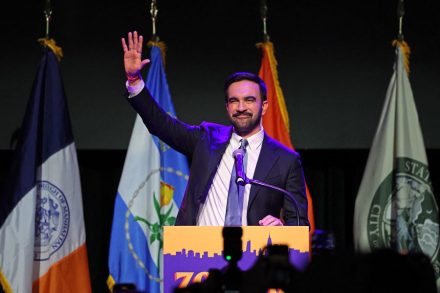
New York is not the city that Mamdani pretends it is

There is an unhappy history of left-wing Britons getting involved in US elections. Back in 2004, the Guardian organised a letter-writing campaign, urging voters in the swing state of Ohio not to re-elect George W. Bush. The good people of Ohio didn’t take kindly to a bunch of Islingtonians telling them how to vote, and although the Guardian’s campaign probably can’t be given all the credit, the voters of Ohio duly went to the polls and swung firmly behind Bush. One wishes that Sadiq Khan’s intervention in this week’s New York mayoral election might have had a similar result. Interviewed shortly before Zohran Mamdani was elected, the mayor of London praised the Democratic Socialist candidate for mayor of New York as ‘fun’ and ‘authentic’.

Don’t fear the bogeyman

From our UK edition

Britain is beset by a bogeyman. A giant, mystical beast that the public are forever being threatened with. Remember last year when a young Welsh choirboy stabbed three young girls to death at a Taylor Swift-themed dance party in Southport? Long before we were allowed to know the name of the culprit – Axel Rudakubana – we were warned about a much greater menace: a rallying by the ‘far right’. After impromptu protests and some rioting broke out in various cities, we were promised on an hourly basis that the ‘far right’ was mobilising. Soon there were crowds of Muslim men organising to counter any such threat.

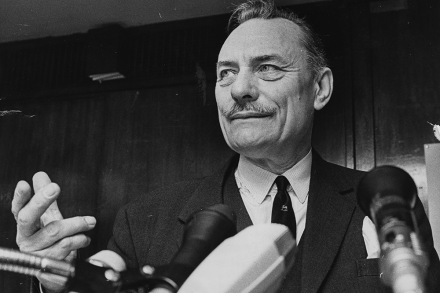
Imagine what Enoch Powell might have said

From our UK edition

The great John O’Sullivan has a story about Enoch Powell which he keeps promising to put into print. Since he still hasn’t done so, I will risk repeating it here. It occurred during a conversation some years after the Rivers of Blood speech. A group of conservatives were talking, and Powell was among them. At some point one of those present referred to the 1968 speech and asked Powell: ‘Why did you do it?’ Powell’s reply started something like this: ‘When the lark sings in the morning they do not say – “Oh lark why dost thou sing?” When the nightingale gives forth her song…’ and so on. After Powell had gone through an array of the bird kingdom metaphors, he came to his clincher: ‘And so it was with me that day in Birmingham.

The pathology of politics

From our UK edition

Researchers from Imperial College London this week released an analysis of the health of voters in the UK. In a publication associated with British Medical Journal, the experts claimed to have found that people who vote for Reform are disproportionately sick. I am sure that the researchers in question could not possibly have enjoyed coming to their conclusions. But they reported that the conditions Reform voters are most likely to suffer from include obesity, chronic obstructive pulmonary disease and epilepsy. The scientists did not go so far as to claim that voting Reform makes you epileptic. As every smart-aleck first-year at Imperial could tell you, correlation does not imply causation.

The increasing fear felt by Britain’s Jews

From our UK edition

If you walked down the Strand in London on Tuesday this week you would have been greeted by hundreds of people outside King’s College London. The gathering was organised by students from KCL, the London School of Economics and University College London. They chanted ‘Intifada, intifada’ and ‘Long live the intifada’. They had chosen the day well – Tuesday was the second anniversary of the 7 October massacre, in which some 1,200 Israelis were killed and hundreds more taken hostage. Tuesday’s hate-fest was not, of course, an unusual event. The first demonstrations in support of the 7 October massacre of Jews took place in west London on the day of the massacre itself. And the protests have not stopped since. In fact, they have only swelled in number.

The mainstreaming of leftist violence

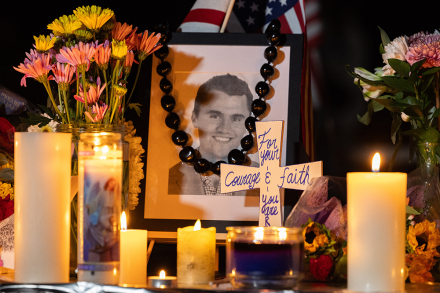
In the wake of Charlie Kirk’s assassination, Democratic lawmakers and commentators found themselves in a quandary. On the one hand, most of them loathed Kirk. On the other, many felt that they should try to hold the line condemning the shooting through the throat of a young husband and father at an American university. These so-called ‘anti-fascists’ started behaving like nothing so much as the fascists they were searching for The New York Times’s Ezra Klein was among those who dipped his toe into the water, writing a piece within the day titled “Charlie Kirk was practicing politics the right way.

violence

The Murray Test for TV drama

From our UK edition

It is almost a century since Ronald Knox wrote his ‘Ten Commandments’ for detective fiction. Most of them still hold true. For example, his edict that twin brothers and other lookalikes must not be introduced to the story unless the reader has been prepared for them. Also the forbidding of more than one secret passageway or room in any story and the insistence that the sidekick, Dr Watson-like figure should never keep a thought to himself, while having thoughts slightly below the anticipated intelligence of the average reader. My favourite rule is number five. ‘No Chinaman must figure in the story.’ In reality this is an extension of rule one, which holds that the criminal must be someone who has appeared early in the story.

First they came for the Jews…

From our UK edition

It was moving to watch Keir Starmer announce this week, from a corridor in Downing Street, that his government has decided to recognise a state of Palestine. Starmer took this bold action at the same time as his French, Canadian and Australian counterparts. But as with Emmanuel Macron, Mark Carney and someone called Anthony Albanese, he seemed to be labouring under a number of misunderstandings. The first was that it makes any difference. Starmer and his counterparts overseas appear to be under the misapprehension that the creation of states still lies in their hands. I had thought that the present generation of leftists looked down on imperialist western powers making their colonialist interventions in foreign regions.

The political resurrection of Christianity

From our UK edition

There is a passage in Milan Kundera’s novelisitic essay ‘Testaments Betrayed’ where he writes about the nature of history. Man walks in a fog, Kundera observes. He stumbles along a path and creates the path as he walks it. When he looks back, he can see the path, he may see the man, but he cannot see the fog. Everything looks inevitable after it has happened. So we have the ‘sleepwalkers’ explanation of how Europe stumbled into the first world war. We have the ‘inevitability’ of the slide into the second world war. It is perhaps the greatest of all idiotic modern presumptions that so many people imagine while looking back that they would have known better or acted differently. Which brings me to the present.

Beware the restless, shifty liars

From our UK edition

I have only been to Alexandria once, some years ago, when Hosni Mubarak was still in power, but it struck me as a sad city. Of course the library was not the library. The lighthouse was not the lighthouse. The city was not the city. I looked around for the remnants of the Greeks who had made it their own, but there seemed little left of them. Is there a cause we are financing so considerable it is decent to pass the cheque on to the next generations? Alexandria was on my mind again this week while reading a new biography of the city’s most famous modern poet, Constantine Cavafy (1863-1933). He was part of that world which migrated across the Mediterranean.

Can anyone save Britain from self-destruction?

From our UK edition

Tens of thousands of people turned out on the streets last week to protest against mass immigration. The protestors were promptly labelled ‘racist’ by their own government, ‘far-right’ by the New York Times and as having links to ‘neo-Nazis’ by the Guardian. The protests in question happened in cities across Australia, including Sydney – but frankly those sentences could have been written about similar protests in Britain and in almost any western country. Coincidentally, the past weekend also saw the ten-year anniversary of the German chancellor Angela Merkel opening the doors of Europe, saying ‘We can manage’ and allowing Europe to become the home of anyone in the world who wanted to move in.

Why the row about the England flag matters

From our UK edition

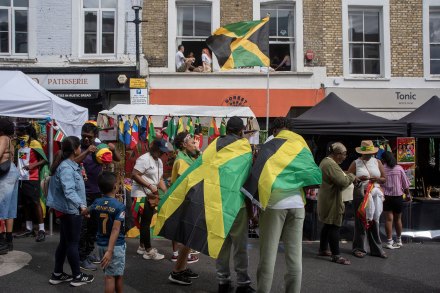
At the end of Sky News’s coverage of last year’s Notting Hill Carnival, its correspondent recited the usual list of arrests, stabbings and so on before concluding her piece to camera by saying: ‘But overall it’s been a really peaceful and enjoyable day.’ This year the honour of summing up the beauty of the event was left to Sky’s arts and entertainment correspondent, Katie Spencer. The reason it is important for two million people to gather in the tight streets of Notting Hill over the August bank holiday, she said, is because of ‘resistance to racism’. ‘This is a place where community comes together,’ she went on, ignoring all the shops in the area that had been boarded up. ‘You don’t walk around constantly looking over your shoulder.

The oppression of Sally Rooney

From our UK edition

Almost a decade ago the Irish academic Liam Kennedy published a tremendous book with the title Unhappy the Land: the Most Oppressed People Ever, the Irish? It is a dissection of one of the most curious pathologies in the world: the desire to have been oppressed; a glorying in being repressed. Kennedy, like a few other brave writers (Ruth Dudley Edwards, Malachi O’Doherty, Kevin Myers) has the courage to point to an under-examined seam in Ireland’s history. Specifically he takes aim at the mawkishness that exists in contemporary Irish affairs. The desire to be the first victim, perhaps the greatest victim, of all victims, anywhere in the world. You see similar strains of aspiring victimhood in other mini-nationalisms.

Clive of India must not fall

From our UK edition

The only MP I have ever really wanted to marry is Thangam Debbonaire. The former Labour MP for Bristol West and I have little in common. But it has sometimes been a desire of mine to marry her and take her surname, so becoming Mr Debbonaire. Marital relations would doubtless be fraught, but on the plus side there would be the thrill of friends being able to say things like ‘Darling, you know the Debbonaires are coming for dinner?’ Which would more than make up for it. Since being booted out by the voters at last year’s general election, Debbonaire has been elevated to the House of Lords, where she still attracts my attention.

My victory over Mohammed Hijab

From our UK edition

One of the occupational hazards of being a journalist is being hounded by litigants. Indeed, one of the reasons why much of the media finds it easier to report fluff than to write about difficult issues is that the latter can be costly in terms of money, as well as time. Three years ago I wrote a column in this magazine about some of the downsides of diversity. At the time there had just been serious disturbances in Leicester between local Hindus and Muslims. One of the people who decided to throw himself into the middle of that trouble and to try to make things worse was an online pugilist known as Mohammed Hijab. Hijab had already been filmed intimidating Jews in Golders Green and whipping up a crowd of masked men outside the Israeli embassy in London.

How to handle the Wagner problem

From our UK edition

There are deep ructions across Europe, as in Britain. All come down to the same thing. The societies in question have decided to take in more people than they could ever absorb or integrate, and have done so at a rate that will ruin these societies financially as well as socially. It’s a little late for the occasional minister to talk about the fabric of the country being under ‘strain’, or the need for greater ‘social cohesion’. These things have been shot for years. What is interesting is not just what a mountain Wagner is for modern Germany, but how they deal with it The problem is that every counter to this problem has the same Charybdis. Oppose the migration extremism and even now you will be accused of Hitlerian tendencies.

Soul suckers of private equity, Douglas Murray on Epstein & are literary sequels ‘lazy’?

From our UK edition

44 min listen

First up: how private equity is ruining Britain Gus Carter writes in the magazine this week about how foreign private equity (PE) is hollowing out Britain – PE now owns everything from a Pret a Manger to a Dorset village, and even the number of children’s homes owned by PE has doubled in the last five years. This ‘gives capitalism a bad name’, he writes. Perhaps the most symbolic example is in the water industry, with water firms now squeezed for money and saddled with debt. British water firms now have a debt-to-equity ratio of 70%, compared to just 4% in 1991. Britain’s desperation for foreign money has, quite literally, left Britain ‘in the shit’.

MAGA, Epstein and the paedo files

From our UK edition

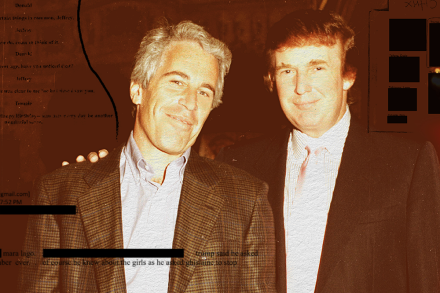
Bill Clinton published another memoir last year, entitled Citizen, and I take it that everyone read the book the minute it came out. For those who somehow didn’t, there’s a striking passage that can be easily found by standing in a bookshop, going to the index and searching under ‘E’ for ‘Epstein’. This leads to a single page reference in which the 42nd president gives a terse and somewhat legalistic account of his relationship with Jeffrey Epstein, explaining that he never went to Epstein’s island, borrowed his plane only to support the work of the Clinton Foundation and cut off contact before Epstein’s first arrest in 2005. In a brusque summary Clinton or his ghostwriters conclude: ‘I wish I had never met him.

The pointlessness of ‘smashing the gangs’

From our UK edition

‘Smash the gangs’ is the fascinating slogan that Keir Starmer’s government has settled on for tackling illegal migration. What is the government going to do to stop the hundreds – sometimes thousands – of people sailing across the Channel and coming into England each day? ‘We will smash the gangs,’ they say. The slogan is interesting for reasons beyond the tough-guy rhetoric. For it suggests, of course, that it is people-smuggling gangs that are the main problem. Perhaps our government sees them as being like press gangs back in the day, roaming around northern France, waylaying passing migrants and forcing them on to rubber dinghies to begin a new life in Britain.