David Blackburn

From carpet-bombing to love-bombing

From our UK edition

Labour’s relationship with the Lib Dems gets more like Dallas’s JR and Sue Ellen with each passing day. Contemptuous and contemptible one day to lisping breathless compliments the next.  Gordon Brown snarled at Nick Clegg during last week’s debate. Clegg would, Brown argued, leap gaily into bed with the Tories on Friday morning - a departure from the previous ‘we must form a progressive coalition’ line pushed by Andrew Adonis. This morning brings another volte face: Brown and several cabinet ministers urge ‘progressives’ to vote tactically. Writing in the Guardian, Gordon Brown pitches for Lib Dems to vote Labour in 100 Tory/Labour marginals.
The Tories will trust in the Irish

From our UK edition

The Telegraph reports that a Conservative minority government would rely on an ‘informal understanding’ with Unionist MPs and that David Cameron is preparing the ground for co-operation.  It’s a courageous plan, in the Sir Humphrey sense.  Many journalists argue that Cameron has a duty to preserve the Union. Certainly he does, but his overtures to the Ulster Unionists have been self-defeating. There is an assumption that the Unionist parties are conservative. Besides conserving the Union, they are not. Back in February, I reported that the Tory alliance with Reg Empey was serving only to eviscerate the UUP, as its socialist and social democratic factions revolted against Tory alignment.

Labour’s campaign implodes

From our UK edition

Labour’s campaign has been dysfunctional. ‘Bigot-gate’, the concealed cuts, the absence of a spending review, open challenges to the leadership, infighting and a manifesto that read like the terms of surrender, it has been beset by gaffes and self-immolation. Last night, Gordon Brown personified the desperation at Labour’s core. He was negative – dour predictions accompanying an ashen expression. He defibrillated the old cuts versus investment line – a lurid grope for his core vote and one that is incredible in the current circumstances. We expected all of that; what we did not expect was that Brown no longer agrees with Nick.

Should Cameron attack Brown or Clegg?

From our UK edition

Obviously, yesterday's disaster has written-off tonight's debate for Brown. But ‘Bigot-gate’ is obscuring the European bailout crisis. Allister Heath and Iain Martin surmise that the euro crisis gives David Cameron a further advantage, if he can exploit it. Iain writes: ‘Mr. Cameron has just been dealt a potential ace by the markets. It will be interesting to see if he realizes this and works out a way of playing it in a manner that voters understand. The worsening crisis in the euro zone has attracted very little attention in the general election, thus far. After all, the U.K. isn’t a member.

“That was a disaster…”

From our UK edition

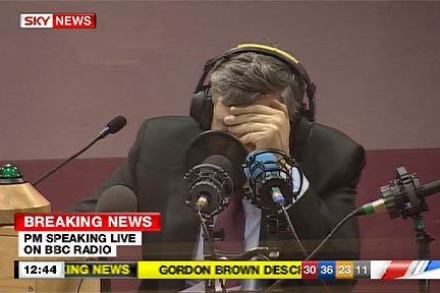
… Well that ain’t the half of it. Brown has just made the most garbled apology imaginable on the Jeremy Vine show: “I apologise if I said anything like that.”  Well, unfortunately, Brown had, and Vine duly played the tape. Brown had to apologise again:  “I apologise if I’ve said anything remotely hurtful…there were comments about immigration...which I didn’t get the chance to reply to...that were annoying…you've got to remember, it's a case of me being helpful to the broadcasters who have recorded and played my private conversation.” He might be cowering, but verbally Brown simply comes across as arrogant and unrepentant. Small wonder that politicians are loathed.

A deeply emotive issue

From our UK edition

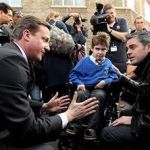
Jonathan Bartley, the man who ambushed Cameron yesterday, has written a piece for the Guardian. In it, the education establishment’s counter-productive monopoly is exposed. Bartley writes: ‘Either we are for inclusion or we aren't. To include children with special needs in mainstream schools takes commitment and a lot of work. Indeed, it requires "bias" – which has actually been lacking in the education system, despite all the talk of inclusion from Labour. There are few parents of children with special educational needs who would not want their children to attend their local school with brothers and sisters and friends, provided that the school is properly resourced, equipped and able to successfully include their children.

The high tide of Liberalism?

From our UK edition

Cleggmania may be in remission. A Populus poll for the Times puts the Tories up 4 at 36 percent, the Lib Dems down 3 at 28 percent and Labour down one at 27 percent. Com Res has Labour and the Lib Dems tied on 29 percent with the Tories up 1 to 33 percent, whilst You Gov has the Tories on 33 percent, Labour on 29 percent and Clegg’s party on 28 percent. A hung parliament remains the probable outcome next Thursday. Anything other than a decisive Tory victory will sustain the Liberal surge, as Clegg would hold the balance of power or a Lib-Lab coalition would seek to inaugurate electoral reform.

The battle for the middle ground

From our UK edition

The New Statesman has interviewed Douglas Alexander, who appeals, as Andrew Adonis has, to Liberal Democrat voters to back Labour to inaugurate what he terms a ‘New Dawn for Labour and progressive politics.’ Progressive is a vague term, but the best definition for it is reform to encourage social mobility. In this morning’s Times, former Fabian Stephen Pollard argued that only the Tories can guarantee this. For the time, Pollard says, he will vote Conservative and all because of Michael Gove’s schools reform.   ‘Mr Gove has promised that within four years of a Tory government, all parents will have the option of sending their child to an independent school offering to educate the child free.

The government, not Chris Grayling, is misleading the public over violent crime

From our UK edition

The New Statesman’s George Eaton admonishes Chris Grayling repeating his ‘false claim that violent crime has risen dramatically under Labour.’ Eaton cites the British Crime Survey’s findings that violent crime has fallen by 41 percent since 1997. True, the BCS asserts that violent crime has fallen since 1997. Changes in recording practice in 2002-03 mean that comparing current statistics with those compiled a decade ago is inherently inaccurate – a point conceded by UK Statistics Agency head Sir Michael Scholar with regard to Grayling's police statistics, but not the BCS'. The independent House of Commons Library gave a more accurate assessment, finding that violent crime rose from 618,417 to 887,942 last year, or 44 percent.

Has Nick Clegg ruled out a pact with the Tories?

From our UK edition

No, in short, he hasn’t. Clegg was deemed to have compromised his party’s intricate anti-politics strategy by ruling out a ‘progressive’ coalition with Labour led by Gordon Brown, a stance that suggested Clegg sought the affections of David Cameron. Clegg has since clarified his position: "I think, if Labour do come third in terms of the number of votes cast, then people would find it inexplicable that Gordon Brown himself could carry on as prime minister. As for who I'd work with, I've been very clear – much clearer than David Cameron and Gordon Brown – that I will work with anyone. I will work with a man from the moon, I don't care, with anyone who can deliver the greater fairness that I think people want.

The Tories in a PR pickle

From our UK edition

Clegg won’t join without proportional representation; Cameron says he won’t countenance such a ‘con’. Indeed, it runs deeper than that. Iain Martin has canvassed Tories from across the party and found that Cameron will get short shrift if he tries to reform the voting system at all. There is another consideration. This election has the potential to blow traditional party structure out of the water. Labour’s right will be marginalised by the unions’ grip over the party and Liberal Democrats like David Laws and Clegg (up to a point) have more in common with the One Nation Tories than they do with out and out left wingers like Kennedy and Cable.

The Tories’ latest campaign image

From our UK edition

Arresting, to the point and right. But tactically it leaves the Tories open to claims about 'scare tactics', of which the Tories accuse Labour. UPDATE: This one is more effective because it avoids the other one's tactical shortcomings.

Seeking an audience with the Pope

From our UK edition

Rod Liddle’s right, Steven Mulvain should not be sacked for his limp attempt at humour. You know, Benedict branded condoms and the like. (Maybe endorsing the age of consent with a brand called ‘XVIs’ might have worked better. I don’t know.) However, there is a possibility that Mulvain’s email was part of an FO ‘brainstorm’. This raises questions about the section of the FO concerned and the hypocrisy often engendered by political correctness. James Macintyre is ‘reliably’ informed by a senior Whitehall figure that: ‘This was not written as a joke. It was meant to be a serious brainstorming by various people designed for a meeting. I know it is hard to believe but it is serious.

Latest projections confirm deepening Labour decline, will it be terminal?

From our UK edition

Well no surprise there – the Politics Home poll projection suggests that the Tory recovery, started by Cameron on Thursday night, comes at the expense of Labour but remains indecisive: ‘In the new projection, which incorporates all polls published up to and including Sunday 25th April, The Conservatives would be thirty six short of a majority, with 289 seats - 11 more than they were projected to win last week. Labour are projected to win 234 seats and the Lib Dems 94. Labour’s projected total has fallen by nine, while the Lib Dem total has fallen by four. The Tories are projected to gain a 35.1 per cent share of the vote, Labour 27.0 and the Lib Dems 28.4.’ No party has significant forward momentum.

Labour’s Catch 22

From our UK edition

The sole current political certainty is that Nick Clegg will not prop-up Gordon Brown. Clegg holds Brown personally responsible for 13 years of failure and not even political marriages can be built on enmity.  Labour’s choice is clear: remove Brown to accommodate Clegg. The Sunday Times reports plots are afoot to kill Gordon ‘with dignity’. But euthanasia is messy. Two options are being discussed. First, Brown would be given a year to make a final indelible mark on Britain before shipping himself off to Westminster’s version of Dignitas. I think we can all see the problem with that cunning scheme, and Nick Clegg certainly will.

A culture of intimidation and a conspiracy to silence

From our UK edition

On the afternoon of 4 June 2009, John Hutton, then Secretary of State for Defence, told the House of Commons: ‘Every one of our servicemen and women has the right to know that we are doing everything possible to ensure that every pound of investment in our equipment programme goes towards the front line and is not wasted in inefficient or weak processes of acquisition. That is why I asked Bernard Gray in December last year to conduct a detailed examination of progress in implementing the MOD’s acquisition change programme, as I hope right hon. and hon. Members will recall. I have to be satisfied that the current programme of change is sufficient to meet the challenges of the new combat environment that we now face. To date, I am not.

Clegg sets Cameron a trap over the EU

From our UK edition

I’d expected the papers to be full of Nick Clegg’s offer of an ‘In/Out’ EU referendum, should the EU draw up a treaty that would further alter the British constitution. He made the pledge on radio yesterday; he insisted that he would campaign to remain in the EU, but the people should decide. The papers are silent as yet, but I expect Clegg to have another crack this evening. For all his wide-eyed innocence, Clegg’s a cunning knave. Scenting dissent if not panic among conservatives, Clegg offers eurosceptics 30 pieces of silver. His promise is utterly disingenuous: Clegg’s record on the Lisbon Treaty proves he cannot be trusted, and the manifesto is silent on the issue.

The worst ever?

From our UK edition

Danny Finkelstein nominates Lord Pearson’s appearance on The Campaign Show as the worst interview ever given by a party leader in an election campaign. I second that.

Cable catches a broadside

From our UK edition

What is the difference between 'an alternative’ and 'an addition’? It is on this question that the Liberal Democrat manifesto turns. If there is a difference, then there is a substantial black hole in their deficit reduction plans. There is a difference. The manifesto presents a £3.4bn public sector payroll measure as an addition to existing government measures, when in fact the small-print discloses that it’s an alternative. Caught double counting, at best the Lib Dems would cut £36.6bn of the £40bn or so pledged. Under further scrutiny from Andrew Neil and Stephanie Flanders, Cable could not define where a further £10bn of cuts was coming from. £20bn of the remaining £26.