Damian Thompson

Damian Thompson

Damian Thompson is an associate editor of The Spectator

Obama’s intervention in Iraq proves that religion really is the new politics

From our UK edition

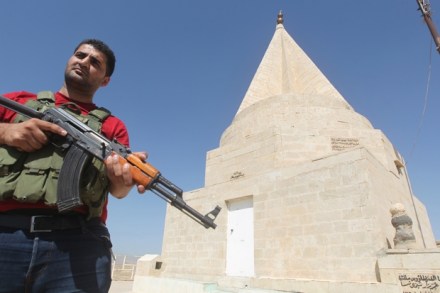
Today we are witnessing the extraordinary – and long overdue – spectacle of an American president intervening in Iraq to protect religious minorities from ISIS death squads motivated by their own extreme religious beliefs. The minorities are Christians, whose looming extinction the West has ignored for years, and the Yazidis, members of an ancient faith rooted in Zoroastrianism that very people had heard of until the past fortnight. The butchery in Iraq and Syria – and that is exactly the right word, since ISIS have literally cut children in half – bears out my argument that 'religion is the new politics'. Here is the Spectator cover story on that subject published on June 28: Aren’t Buddhist monks adorable?

At last! An Archbishop of Canterbury recognises that Islamists slaughter Christians

From our UK edition

The Archbishop of Canterbury, Justin Welby, has just issued a statement about the slaughter of Christians in Iraq that is both brave and perfectly judged. What an outstanding representative of English Christianity he is turning out to be – in sorry contrast to his predecessor. Here is the section of Archbishop Welby’s statement that illustrates his keen judgment. It makes clear that he does not think that Christian lives are worth more than those of Yazidis or Muslims. (The ordained Anglican priest Chris Bryant MP accused me of believing this when I asked him on Twitter today why, in common with many liberal Christians, he had remained silent on the plight of his co-religionists.) The horrific events in Iraq rightly call our attention and sorrow yet again.

Jean-Marie Charles-Roux, a good and holy priest

From our UK edition

I am so sorry to hear of the death of Fr Jean-Marie Charles-Roux in Rome at the age of 99. I won't attempt an obituary, but my memories of him from the late 1980s are still vivid. He was a slender, aristocratic figure who wore a frayed but superbly cut soutane; his long hair was combed backwards in the style of the first Doctor Who, William Hartnell. For many years he was based at the Rosminian church of St Etheldreda's, Ely Place, where he celebrated only the Tridentine Rite. 'When the New Mass came in I tried it in English, French, Italian, even in Latin – but it was like a children's game,' he told me.

Why is China tearing down church crosses? Because it’s terrified of religion

From our UK edition

Since the beginning of this year, China has been engaged in a cruel and bizarre campaign against Christians in the south-eastern province of Zhejiang. Its main target is Wenzhou, a city known as ‘China’s Jerusalem’ because a million of its eight million residents are Christian. Wenzhou’s 2,000 churches display hundreds of crosses that illuminate the skyline (a pattern familiar to any visitor to South Korea, where even the smallest towns sprout neon crosses). Now China wants those crosses taken down, and fast. According to AP, at the end of July ‘200 congregants rushed to the Longgang Huai En Church in Wenzhou to protect their building – but to no avail.

Now that Richard Dawkins is attacking Muslims and feminists, the atheist Left suddenly discover he’s a bigot

From our UK edition

‘Richard Dawkins, what on earth happened to you?’ asks Eleanor Robertson in the Guardian today. Ms Robertson is a ‘feminist and writer living in Sydney’. She follows to the letter the Guardian’s revised style guide for writing about Prof Dawkins: wring your hands until your fingers are raw, while muttering ‘Oh, what a noble mind is here o’erthrown’. For some time now Dawkins has been saying rude things about Muslims and feminists. This makes him a bigot in the eyes of the Left — and especially the Guardian, which is extraordinarily and mysteriously protective of Islam. As Robertson puts it: ‘Sure, he wrote some pop science books back in the day, but why do we keep having him on TV and in the newspapers?

In Iraq, ancient Christianity lies in ruins. But who cares?

From our UK edition

The Mar Behnam monastery outside Mosul, seized by ISIS just over a week ago, bears an inscription in the Turkic language of the Mongols who invaded Iraq in the 13th century. It asks for ‘the peace of Mar [Saint] Behnam to come down and rest on the Khan, his elders and his wives’. Why should Mongols revere Behnam, a convert to Christianity who was martyred by the region’s Zoroastrian ruler in the fourth century? The answer is that the Church of East to which Behnam converted had been the world’s greatest Christian Church. Its missionaries were firmly established in China by the seventh century. It was independent of both Rome and Byzantium, teaching that Christ’s human and divine natures were separate — a doctrine known as Nestorianism.

Why is The Daily Dot, smooth and sassy website of ‘the internet community’, publishing racist nonsense?

From our UK edition

The Daily Dot, founded less than two years ago, is best read while sipping the flattest of flat white coffees. I love it, even though it's not pitched at me: most of its 11 million monthly unique visitors are 'millennials'. No UK site integrates tech news into the broader culture so expertly. This is what you can find on the Daily Dot home page right now: 'A guide to Silicon Valley's top political donors'; 'How the paleo diet developed into a cult of nonsense'; 'Anonymous goes to war with Israel'; 'Jennifer Aniston and Adam Sandler freaked out by giant reporter'. Those headlines were brewed by some of the world's best digital baristas.

Flight MH17: the unctuous Bishop James Jones shows off on ‘Thought for the Day’

From our UK edition

Perhaps it’s my imagination, but every time the Rt Rev James Jones, former Bishop of Liverpool, pops up on Thought for the Day I hear an undertone of disappointed ambition. The same goes for Lord Harries, ex-Bishop of Oxford and, like Jones, once spoken of as a future Archbishop of Canterbury. It’s as if they’re saying: look how much poetry and gravitas I can pack into three minutes!

As Christians are massacred in Iraq, laid-back Obama maintains his shameful silence

From our UK edition

Christians in Mosul have been offered three choices by ISIS: 1. Convert to Islam. 2. Pay the ‘jizya’ tax that renders them dhimmis – i.e., second-class citizens granted limited protection if they hand over half an ounce of pure gold. 3. Death by the sword. They had until noon today to make up their minds. Bit of a no-brainer, really. Mosul's Christians – Catholics and Orthodox who until this month had celebrated Mass in the city every Sunday for 1,600 years – are fleeing for safety. Perhaps, by the time you read this, Barack Obama – a weekly worshipper at a crazy rabble-rousing church while he was running for office in Chicago – will have said something about this tragedy.

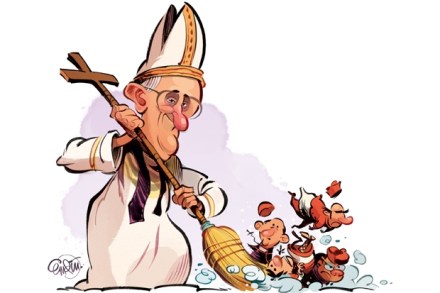
The Pope and ‘paedophile cardinals’: another clue that Francis is at war with the Vatican

From our UK edition

Today’s front-page splash in The Catholic Herald reads: ‘Vatican in a spin as Pope Francis grants an explosive new interview’. That interview, with La Repubblica, quoted Francis as saying that his advisors had told him that two per cent of clergy were paedophiles – including ‘bishops and cardinals’. The Independent ran with the headline: ‘Pope Francis: “One in 50” Catholic priests, bishops and cardinals is a paedophile’. What fascinates me is the reaction of the Vatican Press Office, which has gone into full L/Cpl Jones ‘Don’t Panic!’ mode.

Is Handel’s Messiah anti-Semitic?

From our UK edition

The Hallelujah Chorus crops up in the most unexpected places, says Michael Marissen in his new book about Handel’s Messiah. For example, it’s used in a TV ad ‘depicting frantic bears’ ecstatic relief in chancing upon Charmin toilet paper in the woods’. That’s an amusing detail: it lingers in the mind. But, as you can work out from the title, Tainted Glory in Handel’s Messiah isn’t intended to be a fun read. Marissen, an American specialist in baroque music, has been taking a long, hard look at the oratorio’s libretto, adapted from the Old and New Testaments by Charles Jennens, a gentleman scholar.

Women bishops: the game’s up for Anglo-Catholics

From our UK edition

From the moment the General Synod voted for women priests in 1992, it was inevitable that it would also vote for women bishops. Conservative evangelicals and Anglo-Catholics engineered a delay of 21 years, but I doubt they’ll be shocked by today’s decision. Some traditionalists have even been arguing that, although they were still opposed to the measure on principle, another ‘no’ vote would be a disaster for the Church of England. That strikes me as hopelessly muddled thinking, but remember that these are the people who brought you the Alice-in-Wonderland notion of ‘flying bishops’. How will Pope Francis react?

Lord Carey undermines his successor, again

From our UK edition

The former Archbishop of Canterbury, Lord Carey, has changed his mind about ‘assisted dying’ and intends to vote for Lord Falconer’s Bill, which will be debated in Parliament next week. His article in today’s Daily Mail is a tremendous coup for the Dignity in Dying lobby. When Carey was in office, no one paid much attention to his views. He lumbered from one gaffe to another; we religious correspondents were too amused by his self-importance to notice that he tended to get his way – for example, over women priests in 1992. Since retirement, his stature has grown. He has become more right-wing.

Chris Patten keeps failing upwards – now he’s advising the Pope. Poor Pope.

From our UK edition

There is a wearying inevitability to the announcement that Pope Francis’s reforms of the Vatican media will be overseen by Lord Patten of Barnes. Of course it was going to be him. It always is. The man defies the laws of political gravity. As Margaret Thatcher’s environment secretary he was responsible for the poll tax. He walked away from the disaster unscathed, explaining that it was nothing to do with him, guv, it was Thatch. As Tory chairman he presided over Major’s 1992 victory but lost his own seat. He was made governor of Hong Kong, where he stood up to China.

Religion is the new politics — but Britain’s secular politicians just don’t get it

From our UK edition

[audioplayer src="http://traffic.libsyn.com/spectator/TheViewFrom22_26_June_2014_v4.mp3" title="Damian Thompson vs. Cristina Odone on the role religion plays in politics" startat=44] Listen [/audioplayer]Aren’t Buddhist monks adorable?  They meditate for days without needing to go to the toilet. They talk to each other in ‘grasshopper’ haikus. Their pot bellies are full of wholesome vegetarian fare. Your package tour to Southeast Asia isn’t complete without a sprinkling of them begging politely in the markets. Hollywood stars hire them for beachfront weddings because they’re so cute. Apart from the ones who are terrorists.

I think I’ve found the new Alfred Brendel

From our UK edition

Can you tell how intelligent a musician is by listening to him play? Last year I discovered a recording of Schumann’s Piano Sonata No. 3 in F minor, a sprawling and spidery work that can fall apart even under the nimblest fingers. Not this time. Francesco Piemontesi, a young Swiss–Italian pianist, totally nails it. Believe me, it takes some nailing. In the opening Allegro brillante and the final Prestissimo possibile, Schumann stretches lyrical melodies across madcap scales and arpeggios that dart in every direction. The rhythms are insistently dotted: Schumann at his most obsessive-compulsive. There are lots of crunching gear changes and scampering pianissimo passages that turn to mush if the pianist seeks safety in the sustaining pedal.

I could be dead soon. What should I listen to?

From our UK edition

If I live as long as my father, I’ll be checking out on 9 December 2017. Since every man in my family drops dead of a heart attack at a ridiculously young age, it’s not inconceivable. I mean, obviously the chances of me dying on precisely that day are tiny, but it’s my ballpark figure. This faces me with big questions. Given that I’m probably croaking soon anyway, should I try smack? (I mean, try it properly: the only time I was handed a heroin pipe, by a professor, I was far too scared to inhale.) Do I need to worry about my miserably empty pension pot? Is there a God? And if there is, should I stop being so monstrously selfish? Big questions, as I say, but I still shunt them to the back of my mind.

In the mood for Parsifal, my Passiontide fare

From our UK edition

This week, I have been mostly listening to Parsifal. Not the St Matthew Passion, which is my usual Passiontide fare. And, boy, it’s been quite an experience. You have to be in the mood for the Bach, but for the Wagner you really have to be in the mood. Parsifal is nearly five hours long. I’m reluctant to say that not a lot happens, because it’s a story of overpowering philosophical transformation. But, alas, no two commentators agree on the nature of that transformation and, unlike the Ring Cycle,  it doesn’t offer many plot twists by way of distraction. The knights who guard the Holy Grail, the chalice of the Last Supper, have lost their second most precious possession, the lance that pierced Christ’s side.

Menuhin is the world’s toughest violin competition. Why is it packed with Asians, and no Brits?

From our UK edition

‘The truth is,’ says Gordon Back, lowering his voice, ‘that if the violin finalists from the BBC Young Musician of the Year were to enter the Menuhin Competition, they wouldn’t make it to the first round.’ Not through the first round, note, but to the first round: they wouldn’t be good enough to compete. Back is artistic director of the Menuhin, held every two years in a different country. In effect, it’s a search for the next Yehudi Menuhin, who recorded the Elgar concerto with the composer at the age of 15. Some critics think Menuhin never quite fulfilled that astonishing early promise — but I wouldn’t dare suggest that to Gordon Back.

Are hymns dying? 

From our UK edition

I love a good hymn, so long as I’m not expected to sing it. Lusty declarations of faith sound ridiculous coming out of my mouth and embarrass the hell out of me, so I pretend that I’ve forgotten to pick up a hymnbook on my way in. If someone shoots me an accusatory glance, then I move my lips like John Redwood singing the Welsh national anthem. (Talking of whom, has it dawned on the jolly self-important Dr Redwood, former Fellow of All Souls, director of Rothschild’s, cabinet minister, etc., that one day he’ll be remembered only for that delicious video clip?) The earliest Christian hymns were chanted — but when we talk about a ‘hymn’ in everyday speech we mean a harmonised sacred song in which every verse uses the same melody.